July 29, 2026 6:22 pm
CRIT Nation, Parker, AZ
July 29, 2026 6:22 pm
CRIT Nation, Parker, AZ

Click the links below to download a form

Direct Deposit Authorization Form

General Welfare Application_09242024

General Welfare Application Minors_09242024

PLEASE READ CAREFULLY


Dear Tribal Member:

Tribal Council has approved a 2024 General Welfare Assistance payment of $2,000.00 for each CRIT Tribal Member. CRIT Tribal members, both minors and adults, who are enrolled with CRIT as of November 1, 2024 are eligible to receive assistance. Tribal Members MUST submit an application to receive a General Assistance Payment for 2024.

Click the links below to download a form

Direct Deposit Authorization Form

General Welfare Application_09242024

General Welfare Application Minors_09242024

This 2024 General Welfare Assistance payment replaces the annual Tribal Distribution Payment.  The benefits to the membership are that the General Welfare Assistance payment is NOT income subject to federal taxes and should not impact eligibility for benefits such as SSI and food stamps.  You will not be issued a 1099 for this payment.  Please review the General Welfare Plan for more information.

Tribal Members will receive their General Welfare Assistance payment by mail or by direct deposit into a bank account after submitting their application.  Parents or legal guardians may request direct deposit for their eligible minor tribal member children into an account owned by the parent or the child.  YOU DO NOT HAVE TO SUBMIT A NEW DIRECT DEPOSIT FORM WITH YOUR APPLICATION IF YOU INTEND TO RECEIVE YOUR GENERAL WELFARE ASSISTANCE PAYMENT IN SAME BANK ACCOUNT AS YOU RECEIVED YOUR 2023 GENERAL WELFARE ASSISTANCE PAYMENT.

The General Welfare Assistance payment will be mailed or direct deposited as follows:

Application and Forms Due Date                   Payment Issued

Must be received by Accounting:

October 18, 2024                                            November 21, 2024

November 22, 2024                                        December 19, 2024

December 20, 2024                                         January 16, 2025

After December 20, 2024                              Payments issued monthly on a rolling basis

and before December 31, 2025

If you want to receive your General Welfare Assistance payment by direct deposit, you must submit the attached Direct Deposit Authorization Form along with a voided check to CRIT Accounting.  If you do not have a direct deposit authorization form on file from last year, or do not submit one for 2024 with your application, your payment will be mailed to the address on your application.  The mailing address you provide on the application will be used to update your address with both enrollment and accounting.   You may have already  received written notification  along with  an application and a self-addressed stamped envelope for your use to return the forms or the forms can be dropped off in person at Tribal Administration.  Additionally, the application and forms can be emailed to GWA@crit-nsn.gov.

Please note that the checks for eligible minor tribal members will be issued in the name of the child and not the parents. Parents or guardians must submit proof of their right to receive the distribution on behalf of their child by submitting an application with a copy of the birth certificate listing the parent(s), and if applicable, a court order establishing legal custody and placement before checks will be mailed or the payment directly deposited.

Checks will not be issued to the parent(s) if they do not have the care and custody of their children.  Guardians and custodians of minors who are not the child’s legal parent shall be required to provide a court order indicating their status.  Payments for children in the physical care and custody of CRIT Social Services or other state or tribal agencies shall be held in an account established by CRIT Accounting.

Tribal Members must apply for the 2024 General Welfare Assistance Payments no later than December 31, 2025 after which a 2024 payment will not be available.

Please be advised that if you are in default on a debt you owe to the Colorado River Indian Tribes or its enterprises, you may voluntarily agree to apply your General Welfare Assistance to the loan or other outstanding debt in default.  If you have any questions about outstanding debts in default please contact Tracey Quillen at (928) 669-1239.

If you have any questions regarding General Welfare Assistance or you have an agency incorrectly treating this payment as income please contact the Office of the Attorney General at (928) 669-1271.

Click the links below to download a form

Direct Deposit Authorization Form

General Welfare Application_09242024

General Welfare Application Minors_09242024

Follow this link for more information including how to apply.

This position is located with the Bureau of Indian Affairs, Superintendent, Colorado River Agency in Poston, Arizona.

Duties

  • Responsible for supervising Lead Irrigation System Operators and Irrigation System Operators.
  • Receives water orders; takes daily measurements; maintains record of water delivery, reservoir inflow and outflow, and instream flows, calculates requirements for area served.
  • Operates project distribution facilities to regulate and deliver water in accordance with Bureau water project policies and procedures.
  • Responsible for constant surveillance and condition or irrigation related faculties. Recommends needed maintenance and schedules required repairs.
  • Plan work for subordinates, establish priorities and prepares schedules for its completion.


The Colorado River Indian Tribes Tribal Council has made a historic decision to protect the lifeblood of their Reservation. On November 6, 2025, the Council unanimously approved Resolution No. R-375-25, which proclaims the personhood status of the Colorado River under tribal law.

This resolution acknowledges the Colorado River as a living entity whose health and well-being are intrinsically linked to the well-being of the Colorado River Indian Tribes (CRIT) members. The Tribes’ deep-rooted connection to the river spans centuries, providing cultural identity, spiritual strength, food systems, and economic stability that continue to shape their community life today.

The resolution emphasizes the central role the river has played in defining the identity of the CRIT. It highlights that CRIT’s ancestors have preserved and protected these lands since before the establishment of the Colorado River Indian Reservation in 1865.

The Council underscores the crucial role the river plays in sustaining traditional practices, wildlife, and agriculture, including the federal irrigation systems authorized as early as 1867. Today, the Colorado River Indian Irrigation Project stands as a cornerstone of the tribal economy.

The resolution underscores significant legal milestones that acknowledged CRIT’s water rights. In the landmark 1964 and 2006 Arizona v. California U.S. Supreme Court decisions, the Tribes secured 719,248 acre-feet of water annually, ensuring their access to the river for generations to come.

By granting personhood to the River, the Tribal Council reaffirmed its sovereign duty to honor and protect it. This status mandates that the River’s well-being must be a priority in governance and decision-making moving forward.

As part of the resolution, the Attorney General and their staff will develop legal safeguards and propose updates to the CRIT Water Code and other relevant regulations. These updates may include the potential designation of the river as a protected cultural landscape.

Council members recognized that protecting the river is not merely a legal obligation but a continuation of cultural beliefs passed down through generations.

Through this declaration, CRIT demonstrates its unwavering commitment to stewardship. The resolution concludes with a resolute message: the Colorado River is, and will always remain, a vital entity deserving of respect, care, and protection for all future generations.

Article Written by CRIT Media Reporter Ariana Romero

News Update November 12, 2025

Negotiations over the future of the Colorado River have reached a standstill after all seven basin states failed to meet a key federal deadline. Reports from 12News and 8NewsNow confirm that the states were unable to agree on a new water-sharing plan, leaving the situation unresolved as the river continues to decline.

High Country News explains that the biggest disagreements involve how much each state should give up in the future. The upper Basin states want fewer mandatory reductions, while the Lower Basin states, including Arizona, say they have already taken the deepest cuts and cannot continue to absorb the majority of the impacts.

With no agreement in place, Arizona Governor Katie Hobbs has asked the Trump administration to intervene. She stated that Arizona has made significant sacrifices and cannot carry the weight of the reductions while other states refuse to commit to measurable cuts. If the states cannot reach a plan soon, the federal government may create one for them.

For the Colorado River Indian Tribes, the outcome of these negotiations has major importance. CRIT holds valuable senior water rights and relies on a stable and fair management plan to ensure long-term security for the community and the region.

For more information, you can read the news articles with the links below.

8NewsNow
https://www.8newsnow.com/news/local-news/colorado-river-negotiations-fail-to-meet-federal-deadline-for-7-state-agreement/

High Country News
https://www.hcn.org/articles/why-colorado-river-negotiations-are-so-difficult/


ABC 15 News
https://www.abc15.com/weather/impact-earth/why-gov-katie-hobbs-wants-trump-administration-to-broker-colorado-river-deal


12 News
/wednesday-is-deadline-for-7-state-including-arizona-to-negotiate-the-colorado-river

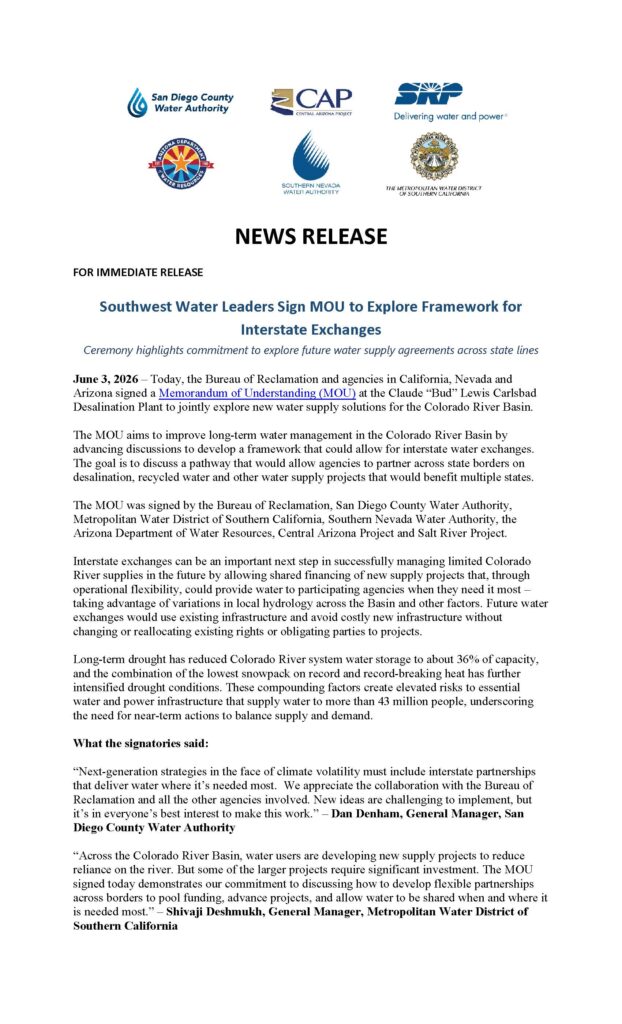
In early May , there were press reports regarding the Lower Basin states of Arizona, California, and Nevada releasing a proposal on how to manage shortages on the Colorado River system through the end of 2028.  The proposal identifies how current and future shortages on the Colorado River system will be apportioned among the three states.  It establishes goals for the conservation of water and proposes studies to reoperate the reservoirs on the Colorado River to allow for water deliveries at lower elevations.

The Lower Basin Proposal also established a Tribal Pool in Lake Mead setting aside water to specifically address future shortages for those Tribes that receive their water through the Central Arizona Project (CAP) and may be shorted as CAP allocations are diminished.  We want to be clear with you that this Tribal Pool does not pertain to CRIT because our water comes directly from the Colorado River and NOT delivered through the CAP.  Our water rights are the senior Tribal rights in the Colorado River Basin and senior to the CAP.

Tribal Council has taken no formal position on this proposal, and we were not involved in its drafting or negotiation.  We do appreciate, however, that this proposal does not seek to set aside the priority system in allocating shortages, which some in the Lower Basin states have pushed for in the past.  Retaining the priority system for allocation of shortages has been the biggest concern of Tribal Council throughout the Post 2026 Process and we want to acknowledge the Basin States holding firm on this position.  We are concerned, however, about the significant federal investment it will take to implement this proposal and want to be assured that portions of these federal funds will be expended on all Tribal Nations in the Basin.

Tribal Council has been in contact with leadership from Arizona and will continue to monitor how this, and other proposals for the management of the Colorado River, will be viewed by Reclamation.  Tribal Council is also in continuing contact with Reclamation and will hold a government-to-government consultation with Senior Reclamation leaders on June 1st.  We will continue to update membership as these matters develop.

The Bureau of Indian Affairs (BIA) has proposed increasing Operation and Maintenance (O&M) rates for the delivery of water from $85 to $93 per acre. Over the past three years, CRIT and local farmers have experienced water delivery cost increases of more than 20%, while services have remained the same or declined due to the federal government’s cuts in staffing and the poor condition of Colorado River Indian Irrigation Project.

Madam Chairwoman Flores and the CRIT Tribal Council opposes this proposed rate increase and remains committed to strengthening Tribal sovereignty. That includes advocating for fair, transparent, and reliable O&M water delivery rates for our farmers, to preserve the economic health and wellbeing of the Tribes. We have listened to the concerns raised by the CRIT community and our farmers, and will continue working to protect our land, our water, and our future.

Get Involved: Farmers and community members who would like more information or who want to provide input on the proposed rate increase are encouraged to participate by sending a comment letter. Written comments may be submitted to: comments@bia.gov. Use the
subject line: Rate Adjustments for Indian Projects.

Contact: Leslie Underwood, Program Specialist, BIA Division of Water and Power
Office of Trust Services

Comment deadline: May 22, 2026

Learn more:

Letter from CRIT to BIA Opposing the Proposed 2027 O&M Rate Increase:  CRIT Letter

Information from BIA re: the Proposed 2027 O&M Rate Increase: https://www.federalregister.gov/documents/2026/03/23/2026-05577/rate-adjustments-for-indian-irrigation-projects