Several outlets reported on the release of the Draft Environmental Impact Statement (EIS) by the U.S. Bureau of Reclamation, which outlines how the Colorado River could be managed after current rules expire in 2026.
The draft lays out five possible management alternatives for operating Lake Powell and Lake Mead, including options where the federal government steps in if Basin states cannot agree. Federal officials acknowledge that a temporary or stopgap deal may be necessary if negotiations remain stalled. These decisions will directly affect how water is released downstream.
As a senior water rights holder, CRIT’s rights and sovereignty must be protected in any final plan. The draft process is a critical opportunity for tribal input.
Coverage from Nevada and Utah outlets explains that while states continue negotiations, deep disagreements remain over how water cuts should be shared. Federal officials are signaling they are prepared to act if consensus is not reached.Some articles describe this moment as a turning point, where long-standing assumptions about water use are being challenged and previously “untouchable” practices are now on the table.
If states fail to agree, federal decisions could reshape river operations. Tribal nations must be included to ensure historic rights are not overlooked.
California-focused reporting explains how the draft federal plan could require additional water cuts, even during wet years. Officials emphasize that recent storms do not erase long-term shortages caused by overuse and climate change.
California’s use affects overall Basin stability. How cuts are distributed influences downstream reliability for Lower Basin users.
Multiple sources covered Arizona’s continued focus on groundwater protection, including new Active Management Areas and enforcement actions tied to large agricultural water users. These efforts are framed as necessary as Colorado River supplies remain uncertain.
As surface water becomes less reliable, pressure shifts to groundwater. Strong regulation helps prevent over-pumping that could undermine regional water security and tribal resources.
Nonprofit and policy reporting highlights a key admission from federal officials: a full, long-term Colorado River agreement may not be ready by 2026, making interim solutions likely. (more…)
Bureau of Reclamation – The Bureau of Reclamation released its long-awaited Draft Environmental Impact Statement outlining potential strategies for managing Lake Powell and Lake Mead after 2026, when current operating guidelines expire. The draft presents multiple alternatives, including scenarios where the federal government steps in if Basin states fail to reach agreement. No preferred alternative has been selected yet, keeping negotiations open.This document will directly shape how Colorado River water is managed in the future. Tribal water rights, sovereignty, and protections for the river itself must be recognized in any final decision.
Lake Powell Chronicle – This piece outlines which players are involved in current negotiations and what each is seeking, including states, tribes, and federal agencies.Who is “at the table” determines whose rights and values are reflected in the final outcome. Tribal voices remain essential.
Tucson Sentinel – Despite recent storms and heavy rainfall in Phoenix, much of Arizona remains in long-term drought. Experts caution that short-term rain does not replenish groundwater or stabilize Colorado River supplies. Reinforces that reliance on weather alone will not protect tribal water rights or the river.
Arizona Water News – Arizona Department of Water Resources hydrologists are conducting field investigations across multiple basins to better understand groundwater use and conditions. Increased groundwater scrutiny reflects growing pressure as Colorado River supplies tighten, which can affect regional water demand and policy.
KLAS CBS 8 – Forces aligning against healthy snowpack for Colorado River states
Experts warn that warming temperatures, dry spells, and climate trends are working against the development of a healthy snowpack, threatening future river flows. Snowpack is the river’s primary source. Poor conditions upstream affect all downstream users.
Colorado Public Radio / The Hill – House fails to override Trump veto of Colorado water project
Lawmakers failed to override a presidential veto blocking a major Colorado water infrastructure project, leaving future water deliveries uncertain.Delays in infrastructure add pressure to existing Colorado River supplies. (more…)
KGUN 9 Tucson – Group urges Sahuarita to review Hudbay groundwater agreement
Community advocates are calling for closer review of groundwater agreements tied to mining operations, citing long-term water security concerns.
Cave Creek/Carefree Independent – Water at the forefront of Tuesday meetings
Local leaders are increasingly focused on water planning as development and supply concerns grow.
Santa Rosa Press Democrat – California’s largest reservoir rises 36 feet as rains boost water supply statewide. Storms have boosted reservoir levels in California, but officials caution that snowpack remains below what is needed for long-term security.
GV Wire – Winter storms wipe out drought in California, for now
California officials stress that recent rains offer short-term relief but do not end the drought.
CBS News – Colorado’s snowpack woes continue into 2026
Colorado snowpack remains well below average, heightening concern for river flows later this year.
Salt Lake Tribune – The Great Salt Lake enters 2026 uncomfortably close to record lows.
Low water levels highlight the broader regional water crisis tied to climate change and overuse.
Engineering News-Record – At Lake Powell, engineering is outpacing Colorado River policy.
Engineers are adapting dam operations to keep the system functioning, even as policymakers lag behind on long-term solutions.
KJZZ – Arizona water chiefs report movement in Colorado River talks, potential Lake Powell protections
Arizona water leaders say there is some movement in long-stalled Colorado River negotiations, including discussions around protecting critical elevations at Lake Powell. While no agreement has been reached, officials describe cautious progress as pressure mounts ahead of post-2026 management decisions.
Mohave Valley Daily News – Arizona bill would add $1 million to Colorado River legal fund
Arizona lawmakers are considering adding $1 million to the state’s legal fund to prepare for potential litigation if Colorado River negotiations fail. The proposal reflects how seriously states are preparing for court battles over water rights.
Nevada Current – Tribes stake their claim on the Colorado River, and help conserve it
This article highlights how tribes across the Basin are asserting their legal rights while also leading conservation efforts. It emphasizes tribes as both senior water rights holders and active stewards of the river.
Circle of Blue – Tribal Water Rights Settlement in Arizona Reintroduced in Congress
A long-standing tribal water rights settlement in Arizona has been reintroduced in Congress, aiming to resolve unresolved claims and provide certainty for tribes and non-tribal users alike.
KLAS CBS 8 Las Vegas – Water shortage in 2026: Pressure builds on Colorado River, Lake Mead
Officials warn that 2026 could bring increased pressure on Lake Mead and the Colorado River if snowpack and runoff do not improve. Water managers stress that short-term storms do not erase long-term shortages.
SFGate – America’s largest reservoir remains in peril
Despite recent storms, Lake Mead remains far below healthy levels. Experts caution against assuming drought is over, noting long-term structural shortages.
Newsweek – Where Lake Mead water levels stand amid heavy California rain
Lake Mead has seen limited gains, but experts stress that precipitation alone cannot resolve decades of overuse.
KUNC – Colorado ends 2025 with extremely low snowpack (more…)
As 2025 came to a close and 2026 began, water issues across Arizona and the Colorado River Basin remained front and center. New reporting highlighted continued uncertainty around Colorado River negotiations, growing concern over snowpack levels, and major developments in local groundwater and community water planning.
Local Groundwater and Community Water Planning
In western Arizona, the Parker Pioneer reports that an Active Management Area is being proposed for the Ranegras Plain. The proposal reflects growing concern over groundwater depletion and signals a shift toward stronger oversight in areas increasingly relied upon as Colorado River supplies tighten.
Meanwhile, years of uncertainty came to an end for residents of Rio Verde Foothills. Multiple Arizona outlets report that permanent water infrastructure is now coming online, including new pipelines and water filling stations. The long-awaited solution brings relief to residents, local businesses, and even animal sanctuaries, while also serving as a cautionary example of what can happen when development moves forward without secure water planning.
Snowpack and Weather Conditions Raise Red Flags
Snowpack remained a major concern across the Basin. Reports from KJZZ, KTAR News, CBS News, AP News, and several California outlets show that while recent storms boosted snowpack in parts of California, overall levels remain below average for this point in the season.
Officials with the Central Arizona Project acknowledged concern about snowpack levels, though they noted it is still early in the water year. Upstream, conditions appear more troubling. Colorado news outlets report historically low snowpack in some regions, while Utah coverage shows Lake Powell has dropped significantly over the past year, underscoring the fragile state of the system.
Late December also brought renewed uncertainty around water infrastructure projects. Coverage from KJZZ, Colorado outlets, and national public media reports on a presidential veto of a major Colorado water pipeline project. The decision disrupted financing for a project already underway and prompted calls from lawmakers to reconsider or override the veto. (more…)
By Ariana Romero
Reporter, CRIT Media
As 2025 comes to a close, new reporting shows Colorado River negotiations narrowing toward what many leaders describe as a final window for agreement, while local water solutions and long-term risks continue to take shape across the Southwest.
ABC15 Arizona reports that Colorado River states may only have one last realistic chance to reach a deal before federal intervention becomes unavoidable. With existing guidelines set to expire and reservoir conditions still fragile, officials warn that failure to compromise soon could lead to decisions being imposed rather than negotiated.
CBS 5 Arizona’s Family highlights what is at stake specifically for Arizona as talks drag on. The report notes that unresolved negotiations could affect everything from water deliveries to long-term planning for cities, tribes, agriculture, and industry, reinforcing why Arizona leaders are under pressure to help move talks forward.
Several opinion pieces stress the need for compromise in the Upper Basin. Phys.org and the Imperial Valley Press argue that without meaningful concessions, negotiations risk collapse, deepening divisions among states and prolonging uncertainty across the Basin.
At the local level, attention turned to Rio Verde Foothills, a community that famously ran out of water. The Arizona Republic, CBS 5, and AZ Big Media report that a permanent water solution has now been secured, ending years of uncertainty. However, the Arizona Republic notes that questions remain about the long-term cost of that solution, underscoring the financial realities of securing water in unregulated areas.
Water policy and development pressures remain closely linked. The Daily Independent reports that Valley water officials are urging legislators to invest more heavily in water resources, while opinion pieces from Nevada question whether the continued expansion of data centers is compatible with long-term water sustainability.
Conditions on the river itself remain mixed. Newsweek reports on how Lake Mead’s water levels changed throughout 2025, showing modest gains at times but continued overall vulnerability. Meanwhile, CBS News warns that Colorado is facing its worst snowpack on record for this point in the season, a troubling signal for future Colorado River flows, though experts say late-season storms could still offer some relief.
Despite tensions, collaboration remains a recurring theme. An opinion from the University of Colorado Boulder notes that Colorado River discussions continue to bring together unlikely partners through forums like the Colorado River Water Users Association, even as disagreements persist. Another Colorado Sun opinion stresses that public access to rivers and responsible stewardship must remain part of broader water policy discussions.
Together, these reports show a Basin approaching a crossroads. With negotiations nearing a critical moment, local water fixes highlighting real costs, and climate signals raising alarm, decisions made in the months ahead will play a major role in shaping the future of the Colorado River.
Sources
The Colorado River Indian Tribes’ new Head Start School is moving closer to opening, with the sewer system expected to be ready for final inspection during the week of September 21, 2026. Once final approvals are received, the project team will be able to move toward opening the new school.
The delay has been tied primarily to operation and capacity issues at the Joint Venture Sewer treatment facility. Because of those issues, the project team had to redesign the school’s sewer system so it would meet Joint Venture Sewer requirements before the facility could become operational.
That redesign required additional engineering work for a holding tank and lift station system. The system will temporarily store wastewater and then release it into the Joint Venture Sewer system in a controlled, timed discharge during non-peak hours. A contractor also had to be brought on to complete the additional installation and related work.

The project team has continued working closely with Joint Venture Sewer, CRIT Utilities, CRIT Building & Safety, the engineering team, and contractors to finish the required work and secure final approval.
When it opens, the new facility will include 10 classrooms, a large multi-purpose room with capacity for 500 people, a playground, a bus barn, and room for future expansion.
CRIT received a $13.8 million federal grant to help fund the project. CRIT is contributing another $7.2 million, bringing the total investment to nearly $20.8 million.
CRIT Chairwoman Amelia Flores said, “This represents a vital investment in our children. The benefits of this facility will be felt for generations as we seek to provide our children with the best possible head start as they prepare for school, life, and the opportunities that await. We want to thank everyone for their patience during this time. This is a momentous step forward in the right direction for the entire community, and we thank everyone who helped get us this far.”
Following a series of historic ceremonies on Friday, September 4, 2026, the University of Arizona has permanently integrated the four native languages of the Colorado River Indian Tribes (CRIT) into its campus landscape. Organized by the university’s Office of Native American Advancement & Tribal Engagement (NAATE) in partnership with individual academic colleges, the Native Languages Campus Sign Initiative unveiled a progression of permanent building signs throughout the day to celebrate the Mohave, Chemehuevi, Hopi, and Navajo languages.
Members of the CRIT Tribal Council attended the sign ceremonies, including Treasurer Anisa Patch, Secretary Josephine Tahbo, Councilmember Vanessa Welch, and Councilmember Raeanne Patch.
The continuous initiative aims to elevate the visibility, recognition, and enduring presence of Indigenous communities within academic spaces. Levi Esquerra, Special Advisor for NAATE, explained that the permanent structural markers grew out of a linguistics department tradition where temporary language signs were posted for just one day each February to observe International Mother Language Day. “They used to put up tarps of native languages throughout campus at six o’clock in the morning, take them down by six, and they wanted permanent signage,” Esquerra said. “We started an initiative of reaching out to tribes and having them add language to our buildings… What makes CRIT so unique is, you know, CRIT is made up of four distinct tribes. And so we felt it was only correct to honor each of those tribes that make up the CRIT nation.”
The day-long celebration began at 9:00 AM at the Emil W. Haury Anthropology Building, home to the School of Anthropology. The Chemehuevi language inscription “Puha” was added to the building’s sign, translating to the “Power of learning about the people.” School of Anthropology Director Rob Schon noted that the naming honors and renews structural ties established in 1954 when Emil Haury preserved Chemehuevi baskets for the Arizona State Museum. Reflecting on the word chosen for the sign, Schon remarked, “Phua is a sacred term… As interpreted here, Puha means power of learning about the people. There is no greater calling for an anthropologist to aspire to.” CRIT Chairwoman Amelia Flores highlighted the deep perseverance required to bring the project to fruition, stating, “When I first heard of the university asking the tribes in Arizona to name buildings, I approached him and I said, ‘Why not CRIT? Why not CRIT?’ … It’s taken this long. So thank you, my dear friend, for making this happen… Most tribes have only one, but CRIT, you have four.”
At 10:30 AM, the procession moved to the Environment and Natural Resources 2 (ENR2) Building to honor the CRIT Navajo language with the phrase “Nihimá Nahasdzáán baa’áhwíílyą́,” meaning “We are protecting Mother Earth.” During the ceremony, CRIT Navajo representative Harlietta Mitchell shared her family’s history of post-World War II relocation to the western Arizona desert, emphasizing that true ecological resilience requires a marriage of academic science and ancestral wisdom. “I hope this building will be more than a place where people study environmental science,” Mitchell said. “May it be a place where indigenous knowledge and scientific knowledge meet with respect.” Chairwoman Flores added, “This signage marks a permanent and visible commitment to honoring the first people of the land. When you see the words… they are a powerful, powerful declaration that indigenous knowledge and culture belongs in academia.” Navajo artist Nicole Pete also presented the history of the official CRIT Tribal Seal, which was designed by her grandfather, John Scott Sr., in 1966.

The afternoon continued at 1:00 PM at the Forbes Building, the home of the College of Agriculture, Life, and Environmental Sciences (CALES) and the Cooperative Extension. Honoring the CRIT Hopi language, the building’s new sign reads “Tutskwat, Sinmuy, pu’ Natwanit Kyaptsilalwa,” which translates to “Honoring the land, the people and the Harvest.” Professor Sheilah Nicholas detailed the deep, remote history inherent in the chosen Hopi vocabulary. “Means land, but the nuances of the Hopi perspective of land inherent in the word changes,” Nicholas explained. “…encompasses the understanding of land as place and a specific place where groups of people coalesced and became a distinct people…” (more…)
Written by CRIT Media Reporter Ariana Romero
“This river is everything to so many people. And yet so many of us treat it as if it’s nothing.”
Those words from ultradistance runner and water advocate Mina Guli carry added weight as the Colorado River faces more than two decades of drought, declining reservoir levels, and growing uncertainty over how the river will be managed in the years ahead.
For the Colorado River Indian Tribes, the future of the river is not a distant issue. CRIT lives along its banks, holds senior Colorado River water rights, and continues to play an active role in conversations surrounding conservation, management, and the river’s future.
Those conditions gave added significance to Guli’s 2,000-mile “Keep the River Running” journey as it reached the Colorado River Indian Reservation.
Guli is running approximately 2,000 miles in 100 days along the Colorado River as part of her “Keep the River Running” campaign. Her journey follows the river through communities that depend on it, with a focus on raising awareness, listening to local voices, and encouraging cooperation around the river’s future.
Her CRIT visit began on the California side of the Reservation, where Councilman Tommy Drennan, Councilwoman Raeanne Patch, and Councilwoman Tracey Quillen greeted and welcomed her before the run.
From there, members of the Mohave Runners, Adrian Pulido, Nolan Taliman, Irving Sharp, Elan Drennan-Webb, Joseph “Joe” Deleon, Aniah “AB” Booth, Mickey Anderson Jr., Joshua Mike, Oslette Johnson, and Chance Fisher joined Guli and ran alongside her through scorching desert heat. Together, they crossed the Colorado River from the California side into Arizona and continued through the community to the Tribal Council Chambers on Mohave Road.
The Mohave Runners brought a strong local presence to the event. Their participation reflected more than physical endurance. They were running beside a river that has sustained their community for generations, showing strength and determination while taking part in a larger effort focused on the future of the Colorado.
Guli said running alongside local people gave her a deeper understanding of the communities tied to the river.
“These are people who have spent their lives here and have so much to share and so much knowledge,” she said.
After the run, Guli, Tribal Council, and community members gathered inside the Tribal Council Chambers. Vice Chairman Dwight Lomayesva, Secretary Josephine Tahbo, Treasurer Anisa Patch, Councilwomen Tracey Quillen, Vanessa Welch, and Raeanne Patch, and Councilman Tommy Drennan were among those in attendance.
The Tribal Council welcomed Guli, presented her with a gift, and thanked her for bringing attention to the Colorado River and the people whose lives are connected to it.
During the gathering and her interview with CRIT Media, one message continued to surface: the importance of working together.
Guli spoke about the many challenges facing the river, including fragmentation among governments, communities, industries, and organizations. She said long-term solutions will require people to look beyond individual interests and focus on a shared future.
“Together doesn’t mean that the river is yours or mine,” Guli said. “It means that it’s ours.”
She also described what she called the “power of together,” saying the future of the river will depend on people being willing to listen to one another, include different perspectives, and work across boundaries.
For Guli, that includes Tribal communities whose relationship with the river goes back generations.
She said being at CRIT gave her the opportunity to listen directly to people who have lived with and understood the Colorado River “since time immemorial.” She also pointed to CRIT’s work involving legal personhood as an example of thinking about the river as more than simply a resource.
“The way to hear them is to be here,” she said. (more…)
(PARKER, Ariz.) The Colorado River Indian Tribes (CRIT) remains vigilant and recognizes the efforts brought forward in the release of the Record of Decision (ROD) for operations of Lake Powell and Lake Mead (2027–2036). The Bureau of Reclamation (BOR) is not imposing illegal water cuts on CRIT that it initially proposed in the draft EIS issued earlier this year.
CRIT recognizes the current water crisis impacts the millions of people who depend on the River including wildlife and natural habitats. CRIT’s own membership residing in the various towns, cities, states will be impacted by water shortages. Indeed, the Tribes’ deep-rooted connection to the River spans since time immemorial.
The ROD cites to formally include Tribal nations including CRIT in the Basin-wide consultation structure. CRIT has been seeking this for years and hopes the BOR keeps to their promise.
On behalf of the CRIT Tribal Council, Chairwoman Amelia Flores states, “The efforts of CRIT have made a difference. The numerous meetings and discussions between CRIT’s Tribal Council and the Bureau of Reclamation have clearly had an impact. In the ROD, the Bureau of Reclamation acknowledged they would follow the decree established in AZ v. California. This is of critical importance to CRIT, which holds the most senior Tribal rights in the Lower Basin.”
Tribal Council Member Tommy Drennan states, “We turn another page in this water crisis. We go forward to defend the river, our allocation, and the voice of our CRIT nation. It is progress, knowing that the US recognizes the need to work towards further solutions until the river recovers. It is progress to know there are no illegal reductions facing our allocation today. We will continue to do what we must to keep the river alive.”
Councilmember Raeanne Patch states, “Given the critical status of the river, tribal consultation is mandatory in every discussion and decision regarding the Colorado River.”
Councilmember Anisa Patch states, “As the river’s natural ability to replenish itself falls further behind, CRIT continues defending our water allocation and traditional lifelines, navigating colonial processes. We fight to preserve our livelihoods, the livelihoods of all living things who depend on this river to the changed landscapes ahead.”
Councilmember Tracey Quillen states, “I am proud of the work CRIT has done to bring us to this point, but our work is not finished. We remain vigilant in protecting our water and will continue working together to ensure that our rights are respected and protected for generations to come.”
The ROD preserves the legal status of CRIT’s water rights. It also clarified Reclamation will not rely on misdealing assumptions about CRIT’s water use in the FEIS (Final Environmental Impact Statement) regarding CRIT’s inability to entirely use its water resources.
However, the ROD also introduces a series of two-year operating frameworks under which additional reductions in water supply for central Arizona could be adopted if reservoir conditions worsen. As a result, CRIT will continue to proactively engage with Reclamation and other stakeholders throughout these successive two-year processes to fully protect CRIT’s water rights.
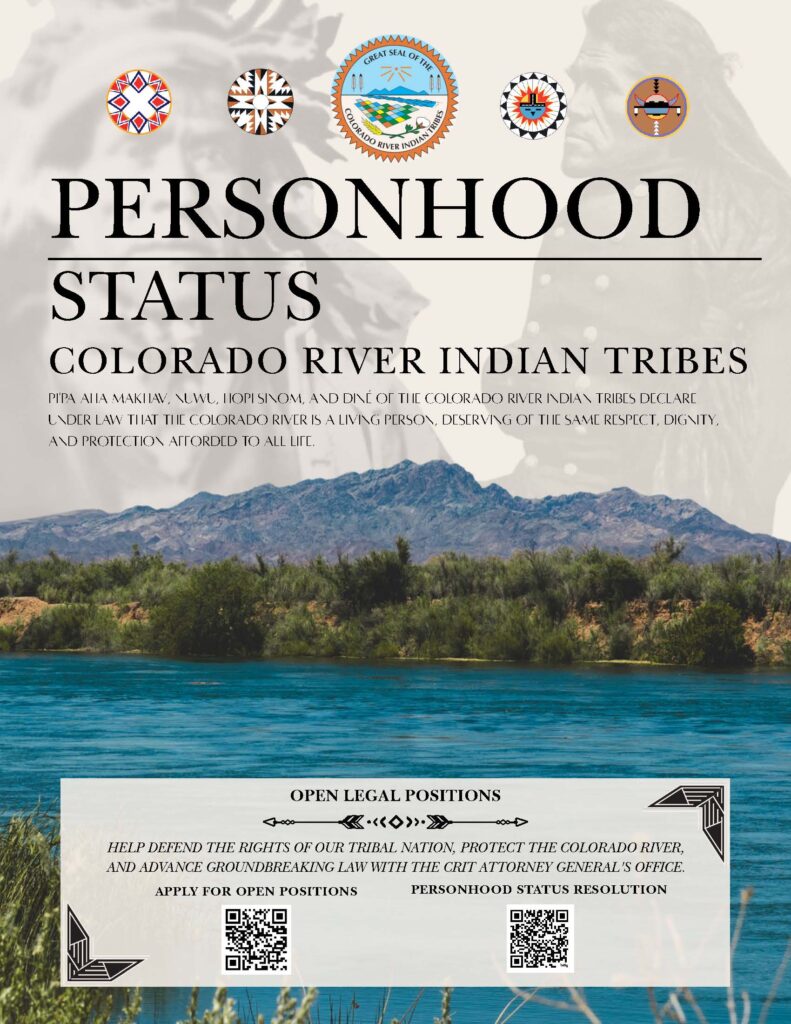
In November, the CRIT Tribal Council voted unanimously to proclaim Personhood Status for the Colorado River, acknowledging the Colorado River as a living entity whose health and well-being are intrinsically linked to the well-being of the Colorado River Indian Tribes (CRIT) members.
While the Tribal Council will stay engaged regarding CRIT’s water allocation, It will also continue to actively address the limitations in water delivery infrastructure which must be addressed by the federal government.
Flores added, “As this water crisis persists, CRIT continues conservation measures to preserve the life of the Colorado River.”
TUCSON, Ariz. — The University of Arizona will host a special series of sign unveiling ceremonies on Friday, September 4, 2026, honoring the four languages of the Colorado River Indian Tribes (CRIT): Mohave, Chemehuevi, Hopi, & Navajo. These ceremonies represent an important milestone in an ongoing campus-wide initiative to elevate the visibility, recognition, and continued presence of Indigenous languages and cultural heritage within the campus community.
The events are organized by the University of Arizona’s Office of Native American Advancement & Tribal Engagement (NAATE) in collaboration with individual academic colleges. Students, faculty, staff, tribal community members, and the general public are invited to attend the progression of ceremonies throughout the day.
The schedule for the Friday ceremonies includes:
The celebration of Indigenous culture continues into the weekend with the Native American Heritage Game on Saturday, September 5, 2026. The Arizona Wildcats will face Northern Arizona at Casino Del Sol Stadium, with kick-off scheduled for 6:30 PM MST. Pre-game festivities at Bear Down Field will begin at 3:15 PM with the Bear Down Bash, featuring 18-minute cultural performances from each tribe. A traditional gift presentation will follow during the Wildcat Walk at 4:15 PM, leading up to an on-field tribal recognition ceremony during the second quarter of the football game.
For more operational schedules or to register for the unveiling events, please visit the official University of Arizona Event Page.