Lake Powell remained one of the biggest concerns. The Colorado Sun reported that low water levels are creating new pressure at Glen Canyon Dam, where federal officials are working to protect dam infrastructure as the reservoir drops. The report focused on cavitation, a problem caused when fast-moving water creates vapor bubbles that can damage dam equipment and concrete surfaces.
The issue shows how falling reservoir levels affect more than water storage. Lake Powell also supports hydropower generation, downstream releases, and dam operations. When the reservoir drops too low, federal managers have fewer options to move water through the system safely and efficiently.
Arizona water users are also watching federal planning closely. The Arizona Daily Star reported that a Colorado River water savings plan could reduce the effect of future cuts on Arizona users. The plan is part of ongoing Lower Basin negotiations as Arizona, California, and Nevada look for ways to conserve water and avoid deeper mandatory reductions.
Those negotiations remain unsettled. Fox 13 Salt Lake City reported that Colorado River governors said they are not at a stalemate, even as the deadline for new river rules gets closer. The current operating guidelines are set to expire after 2026, and the seven Basin states still need agreement on how future shortages will be shared.
For Arizona, Central Arizona Project water remains a major concern. The CAP canal moves Colorado River water to central and southern Arizona, including cities, farms, and tribal users. If future cuts fall heavily on CAP water, impacts would vary depending on each user’s legal priority, water portfolio, and access to stored supplies.
AMWUA reported on the importance of municipal access to stored water credits. Cities have stored water underground for years to prepare for shortages, but access to those credits becomes more important as Colorado River supplies become less reliable. Stored credits can help cities manage short-term gaps, but they are not a permanent replacement for long-term river reductions.
The idea of moving new water into Arizona also received attention. Some proposals have looked at whether abandoned energy pipelines could be used to bring water west. These ideas reflect the search for new supplies, but large importation projects often involve high costs, legal questions, energy demands, and environmental review. (more…)
Recent developments across the Colorado River Basin show how changes in water supply are beginning to affect recreation, agriculture, and future water planning. While the seven Basin states remain divided over how to manage the river, communities are already dealing with the effects of lower flows and looking at new ways to protect their water.
Colorado River negotiators recently made a rare public appearance together, but there was little indication that the states are closer to an agreement. Representatives from the Upper and Lower basins continue to disagree over how future water reductions should be shared and whether the next plan should offer long-term certainty or act as a temporary bridge.
Nevada negotiator John Entsminger said the latest Lower Basin proposal could provide a workable plan for the next few years and help keep the states out of court while discussions continue. Colorado negotiator Becky Mitchell questioned whether returning to negotiations every two years would build stability or simply create another series of temporary fixes.
The negotiators also discussed mediation as a possible next step. One idea would involve choosing three mediators: one selected by the Upper Basin, another by the Lower Basin, and a third selected by the first two. The ongoing disagreement is also making it difficult for Mexico, which receives Colorado River water under international agreements, to prepare for future shortages.
While those larger negotiations continue, uncertainty is reaching businesses that depend directly on the river. KNAU reported that Grand Canyon rafting companies are watching lower water levels near Lees Ferry following a historically dry winter and reduced releases from Lake Powell.
Rafting trips are still operating, and visitors may not notice a major difference today. However, business owners and river guides are concerned about what lower and less predictable flows could mean in the future. One company reported that bookings were down about 25% this year, although it was unclear whether water conditions were the main reason.
The concern shows how Colorado River operations support more than drinking water, agriculture, and hydropower. Releases from Glen Canyon Dam also affect rafting companies, guides, tourism, and communities connected to Grand Canyon recreation.
Arizona is also looking at less traditional ways to increase its water supply. Voice of San Diego reported that a private utility proposed using Arizona funding to help treat wastewater from the Tijuana River. The water would be treated and returned to Mexico, while Arizona could seek part of Mexico’s Colorado River allocation in exchange.
The proposal could initially produce more than 14,000 acre-feet of water each year, with the possibility of increasing that amount through future development. However, the project is still being studied and would involve complicated questions involving water quality, cost, environmental review, and agreements between the United States and Mexico.
Colorado, meanwhile, has taken action to reduce the damage left behind when agricultural water is sold and transferred to cities. A new state law will require farmland in the Arkansas River Basin to be revegetated before irrigation water can be moved to another use. (more…)
As Colorado River negotiations remain stalled, water leaders across the West are looking beyond temporary reservoir protections and considering broader changes to how water is managed. Recent reports show growing interest in mediation, permanent groundwater conservation, less water-intensive agriculture, and stronger tribal participation in state water decisions.
Representatives from the seven Colorado River Basin states recently addressed criticism over their failure to reach an agreement for managing the river after the current operating rules expire. KJZZ reported that negotiators remain divided over how future reductions should be shared between the Upper and Lower basins, despite more than a year of talks and worsening conditions across the watershed.
The negotiators acknowledged the frustration surrounding the process but maintained that the disagreements involve difficult legal, economic, and hydrological questions. Some state representatives have suggested bringing in a mediator to help narrow the divide. Mediation could provide another path toward compromise, but it would not remove the central dispute over who should reduce water use and by how much.
While the states continue debating Colorado River operations, groundwater is becoming another area of concern. KJZZ examined whether Arizona could establish a program to voluntarily purchase and permanently retire groundwater rights, similar to a program being developed in Nevada. Nevada’s approach would pay willing water-right holders to stop pumping permanently in areas experiencing declining aquifers, threats to groundwater-dependent ecosystems, or conflicts between existing users. An assessment of more than 6,000 Nevada wells found that nearly 40% showed significant declines over several decades.
A similar program could offer Arizona another tool for addressing groundwater depletion, especially in rural basins where pumping can exceed natural recharge. However, the cost of purchasing water rights would vary by location, and a voluntary program would require stable funding and clear priorities. Buying back rights would not restore an aquifer immediately, but it could prevent additional pumping and reduce long-term pressure.
Agriculture is also being asked to adapt to shrinking supplies. The Colorado Sun reported that researchers and farmers are testing crops that require less water, including black-eyed peas and drought-tolerant grains. Black-eyed peas can reach strong production with considerably less water than some traditional crops and can withstand heat without showing the same level of stress.
The challenge is not only whether farmers can grow less-thirsty crops, but whether there is a reliable market for them. Farmers must consider processing, transportation, buyers, and prices before replacing established crops. Water conservation will be difficult to sustain if producers are asked to take on the financial risk alone. Researchers say successful transitions will require partnerships among farmers, universities, buyers, and public agencies.
New reporting also provides a clearer picture of agriculture on California tribal lands. The Public Policy Institute of California found that about 15,800 acres are irrigated annually on tribal reservations in the state, representing roughly 0.2% of California’s irrigated acreage and agricultural water use. Most irrigated tribal acreage is located within the Colorado River Basin.
The report found that tribal agriculture generally has a more balanced mix of crops than agriculture statewide, with fewer permanent orchards and vineyards and a greater share of annual crops, pasture, and vegetables. Because annual crops can be changed more easily from year to year, tribal agricultural operations may have more flexibility during drought. However, tribal producers still face challenges involving infrastructure, financing, water access, and unquantified rights.
California lawmakers are also considering a measure that would strengthen the role of tribes in water policymaking. Assembly Bill 2218 passed the State Assembly and would require certain state agencies to consult affected tribes when reviewing water rights and policies. The bill would also recognize historical inequities caused by state actions that excluded tribes from access to and control over water.
Supporters say existing tribal consultation policies are not always legally secure and can depend on executive decisions. The proposed law would provide a stronger requirement for agencies to consider tribal water uses, Indigenous knowledge, and ecosystem restoration when making water decisions. (more…)
While much of the latest Basin Brief coverage has been focused on the new interstate water-exchange agreement between Arizona, California, and Nevada, other reports show the growing consequences of the Basin’s worsening drought. Declining reservoirs are affecting wildlife, hydropower, recreation, and local economies, while new industrial development continues to raise questions about how limited water supplies should be used.
The environmental effects of the Colorado River crisis extend far beyond the millions of people who depend on the river for drinking water, agriculture, and power. ABC15 reported that at least 150 threatened species of mammals, reptiles, fish, and plants depend on the Colorado River. As federal officials work toward new rules for dividing the river, conservation experts say the future of the Basin must also account for the ecosystems that rely on healthy river flows.
The river’s decline can change water temperatures, damage habitat, and place additional pressure on native species. These environmental concerns show that decisions about shortages and reservoir operations are not only about how much water reaches cities and farms. They also determine whether the river can continue supporting the plants, animals, and landscapes that make up the Colorado River ecosystem.
The effects of emergency river operations are already being felt in the Upper Basin. WyoFile reported that additional releases from Flaming Gorge Reservoir are causing serious problems for recreation businesses and communities along the Wyoming-Utah border. Federal water managers plan to release about 1 million additional acre-feet from Flaming Gorge between April 2026 and April 2027 to support Lake Powell.
The releases are expected to lower Flaming Gorge by approximately 35 feet, bringing the reservoir to about 59% of capacity. Falling water levels have already damaged boat ramps and marina structures, caused cancellations, and raised concerns about access to drinking water, fishing, and the future of the local recreation economy.
Flaming Gorge serves as an emergency water bank for the broader Colorado River system, but drawing it down to protect Lake Powell shifts some of the consequences of drought upstream. Communities that depend on the reservoir for tourism and local business are being asked to absorb losses so the larger system can continue operating. Water managers have also warned that using Flaming Gorge now reduces its ability to provide the same emergency support during future dry years.
Colorado may also be moving toward a statewide drought emergency declaration as poor snowpack and dry conditions affect agriculture, waterways, and communities. The Upper Basin provides much of the Colorado River’s flow through mountain snowpack, meaning worsening drought in Colorado has consequences throughout the entire river system. When less water reaches the river’s headwaters, less water is available to refill Lake Powell and serve downstream users.
At the same time, growing industrial demand continues to raise concerns in the Lower Basin. Reports about proposed data centers near Lake Mead have led to questions about whether water-intensive development should continue in areas facing long-term shortages. Data centers require large amounts of electricity and, depending on their cooling systems, can also consume significant amounts of water.
Lake Mead remains at approximately 30% of capacity, yet Southern Nevada and other parts of the Southwest continue to attract new technology and industrial projects. The tension between economic development and water security is becoming harder to ignore. Communities must now consider whether new projects can be supported without placing additional pressure on residents, existing businesses, and the Colorado River. (more…)
Water leaders across the Southwest are looking at new ways to manage limited Colorado River supplies as the Basin continues to face drought, low reservoir levels, and uncertainty over future rules. Recent reports show that agencies are no longer only talking about emergency cuts. They are also exploring interstate exchanges, desalination, recycled water, local conservation, rate increases, and new federal leadership as the Colorado River system moves closer to a critical point.
Arizona Water News reported that the Bureau of Reclamation and water agencies from Arizona, California, and Nevada signed a Memorandum of Understanding at the Claude “Bud” Lewis Carlsbad Desalination Plant in California. The agreement is meant to explore a framework for future interstate water exchanges, allowing agencies to discuss partnerships around desalination, recycled water, and other supply projects that could benefit more than one state.
The MOU was signed by the Bureau of Reclamation, San Diego County Water Authority, Metropolitan Water District of Southern California, Southern Nevada Water Authority, Arizona Department of Water Resources, Central Arizona Project, and Salt River Project. According to the release, future exchanges would use existing infrastructure and would not change or reallocate existing water rights. Instead, the goal is to create more flexibility so agencies can share the benefits of new water supplies when and where they are needed most.
That kind of flexibility is becoming more important as long-term drought has reduced Colorado River system storage to about 36% of capacity. Arizona Water News reported that record-low snowpack and record-breaking heat have added more pressure to the river system, increasing risks to the water and power infrastructure that millions of people depend on.
NPR reported that San Diego, once one of the cities most dependent on the Colorado River, now has excess water it may be able to sell or exchange. The city has invested in water recycling, conservation, and the Carlsbad Desalination Plant, which produces about 50 million gallons of drinking water each day. The plant supplies about 7% to 10% of the region’s water.
The idea would not involve physically sending desalinated water to Arizona or Nevada. Instead, San Diego could use more desalinated water locally and leave some of its Colorado River supplies in Lake Mead for others to use. This kind of exchange could help the larger system by keeping more water in the reservoir while allowing participating agencies to benefit from new local supplies.
At the federal level, the Bureau of Reclamation may soon see new leadership. KJZZ reported that water leader Aubrey Bettencourt is likely to be nominated to run Reclamation, the top federal agency involved in Colorado River operations. Scott Cameron currently serves as the acting leader of Reclamation and oversees the agency at a time when decisions about Lake Mead, Lake Powell, and post-2026 river rules are especially important. Cameron has previously visited the CRIT Reservation, and hopefully CRIT will get the opportunity to meet and build a working relationship with the next Reclamation leader.
Local communities are also preparing for a future with less reliable Colorado River supplies. KJZZ reported that Scottsdale approved a 4.5% water rate increase, with part of the funding going toward additional water sources. Scottsdale receives about 70% of its water from the Colorado River, and Arizona is expected to face more reductions in its river allocation. The city is considering several options, including advanced water purification, groundwater from Harquahala Valley, and expanding Bartlett Dam on the Verde River.
Utah Public Radio reported that Lake Powell may be in worse condition than its surface elevation suggests. A new report from Colorado River experts warns that the Basin’s major reservoirs are sliding toward “devastating consequences” if water levels continue to drop. The report said another dry year could push Lake Powell and Lake Mead toward “run-of-the-river” conditions, meaning the reservoirs would lose much of their ability to store water for the future and would mainly pass water downstream.
The Colorado River’s future will depend on whether states, tribes, federal agencies, cities, and water users can agree on rules that reduce demand while protecting the river itself. New supply projects and flexible exchanges may help, but they cannot replace the need for serious conservation, fair long-term management, and meaningful tribal involvement.
What does this mean for CRIT? (more…)
The Colorado River Basin is facing another warning sign, as experts suggest that another dry winter could push the system closer to a serious storage crash. Recent reports indicate that the river’s future is being shaped by shrinking reservoir levels, uncertain runoff, growing demand, city-level water planning, and the need for better information about who depends on the river and how much water is actually available.
Inside Climate News reported that Colorado River experts are warning of “devastating consequences” if the Basin experiences another dry winter. The warning comes after record-low snowpack across parts of the Colorado River Basin and continued low water levels at Lake Powell. According to the report, if the 2027 water year looks similar to one of the driest years since 2000, the system could overuse the river’s natural flow by millions of acre-feet, putting Lake Mead and Lake Powell dangerously close to critical operating levels.
That matters because Lake Mead and Lake Powell are not just large reservoirs. They are the main storage system for the Colorado River. They help move water downstream, support hydropower generation, protect against dry years, and serve cities, farms, tribes, ecosystems, and industries throughout the West. If those reservoirs continue to fall, the river system becomes harder to manage, and federal agencies may have fewer options to protect both water deliveries and infrastructure.
Experts also warned that even a wet winter would not fully solve the problem. A strong snow year could temporarily refill part of the system, but without long-term reductions in water use, the reservoirs could return to today’s low levels within a short period of time. This shows that the Colorado River crisis is not only about one dry year or one bad snowpack. It is about a long-term imbalance between how much water the river produces and how much water the region has planned to use.
As Arizona cities get ready for less Colorado River water, a heads-up is in order. The Arizona Municipal Water Users Association mentioned that while the final call hasn’t been made, the federal government suggests that Arizona, California, and Nevada might need to use a lot less Colorado River water to keep the river’s infrastructure safe from getting worse. AMWUA pointed out that Arizona might be hit first because the Central Arizona Project, which brings Colorado River water to Phoenix and Tucson, gets priority lower than other users.
For Phoenix-area cities, this means we can’t just rely on the Colorado River to always have enough water. AMWUA said cities are already stepping up by investing in long-term water security, conservation, and infrastructure. The takeaway is clear: a river shortage doesn’t automatically mean a tap shortage, but to avoid that, we need to plan, invest, and get everyone involved.
Other Arizona communities are also figuring out what less water might mean for them. San Tan Sun News reported that Chandler is looking at how reduced water supplies could affect them. This kind of local planning is becoming more crucial as cities across Arizona get ready for a future where Colorado River deliveries might be smaller, cost more, or less dependable. Water cuts that used to seem far off are now being talked about in city budgets, plans for buildings, and conservation efforts.
Water managers and reporters are also starting to question some of the standard figures we hear about the Colorado River. KNAU mentioned that the common estimate of nearly 40 million people depending on the Colorado River might not be spot-on. Water policy experts pointed out that it’s tough to pin down the exact number because people use the term “Colorado River water” in different ways. Some only count the main river, while others include tributaries, groundwater, service areas, and growing communities in Mexico.
This uncertainty is important because how many people there are can affect who has the power, how much money gets allocated, and how everyone understands the situation. If decision-makers don’t have clear numbers on how many people use the river, how much water they’re using, and how much farmland depends on it, it becomes harder to make fair and accurate choices. KNAU also noted that tribal water rights add another layer of uncertainty because some tribal rights in the Basin aren’t recognized or measured.
Water quality is also a key part of Arizona’s water discussion. Arizona’s Family reported that Gov. Katie Hobbs signed a water quality bill as nitrates keep being a problem in the waterways. While this is separate from planning for the Colorado River shortage, it shows that Arizona’s water issues aren’t just about having enough water. Communities need to also take care of water quality, treatment, infrastructure, and public health as the pressure on water systems gets higher.
Weather is another thing to keep an eye on as Arizona gets ready for summer heat and the monsoon season. Triple-digit temperatures make us use more water, especially for homes, gardens, and outside activities. While summer storms can give us a little break, they don’t replace the need for winter snowpack in the Rocky Mountains, which is what feeds most of the Colorado River system. Short bursts of rain might help local conditions, but they can’t fully fill Lake Mead and Lake Powell or fix the long-term shortage problems. (more…)
The Bureau of Reclamation told all 30 Tribal Nations in the Colorado River Basin on May 8th that they will no longer seek to allocate across-the-board shortages to all water users as previously proposed but instead will follow current law and respect senior tribal rights. This is a major victory for CRIT, Tribal rights advocates, and holders of senior water rights. As stated by CRIT Chairwoman Amelia Flores “We are pleased that Reclamation has finally decided to drop its illegal proposal to disregard CRIT’s senior water rights and allocate shortages without regard to priority.” Chair Flores continued, “Tribal Council has never backed down on the issue of protecting our Tribal rights. Throughout this process, Reclamation, and many others, have proposed for setting aside the priority system and for all water users to share equally in shortages. We know this is wrong and we were prepared to defend our senior water rights all the way to the Supreme Court. Fortunately, Reclamation has understood the seriousness of our position and dropped its proposal.”
Tribal Council has opposed these so called “pro-rata” shortages since they were first proposed by Reclamation over two years ago to manage reductions in Colorado River water due to overuse and climate change. Over this time, Tribal Council has been in support to stop the implementation of pro-rata shortages through an intensive and coordinated advocacy effort with the Trump Administration. This included many trips to Washington, DC, meetings with state-wide elected officials, and direct government-to-government consultation with senior Trump Administration officials.
While these efforts paid off in the statements made by Reclamation last week, the process regarding how the dams on the Colorado River will be operated is still ongoing. The CRIT Tribal Council understands that while the Reclamation’s reversal is a critical milestone, the fight to protect and preserve CRIT’s rights remain. As stated by Councilman Tommy Drennan “we will never rest in protecting and preserving our rights, not just for today but for future generations. “
CRIT’s water rights date back to the creation of the reservation, March 3, 1865 and are the most senior tribal water rights in the Lower Colorado River basin. We expect Reclamation to issue a final environmental document sometime in June.
During the mid-1800s, as the American Southwest was rapidly changing, Charles Debrille Poston emerged as one of the key figures helping shape the future of Arizona. A strong promoter of the region and its opportunities, Poston would later earn the nickname “Father of Arizona” for his efforts to establish Arizona as its own territory.
Poston was born on April 20, 1825, in Kentucky. Like many Americans of his time, he moved west in search of opportunity as new lands opened following the Gadsden Purchase of 1853. He soon became involved in mining ventures and settlement efforts in southern Arizona, particularly around the community of Tubac. His work promoting the region helped bring national attention to Arizona’s potential during a time when the area was still largely considered a frontier.
When the Arizona Territory was officially created in 1863, Poston was appointed Superintendent of Indian Affairs for the territory, a position that required him to travel throughout Arizona and meet with tribal leaders across the region. His duties frequently brought him to the lower Colorado River, an important transportation corridor that connected Arizona with California and Nevada.
During these travels, Poston visited areas along the river near present-day Parker, where Native communities had lived for generations. The Colorado River served as a lifeline for tribes of the region, supporting agriculture, trade, and daily life long before American settlers arrived. By the early 1860s, however, the arrival of miners, settlers, and military expeditions was beginning to reshape the Southwest and create new challenges for Native communities.
Among the tribal leaders working to navigate these changes was Mohave leader Chief Irataba, known for his diplomacy and efforts to work with federal officials while protecting his people and their homeland. Territorial leaders like Poston met with tribal representatives as the United States government considered how to organize the region and respond to increasing pressure on tribal lands. (more…)
In early May , there were press reports regarding the Lower Basin states of Arizona, California, and Nevada releasing a proposal on how to manage shortages on the Colorado River system through the end of 2028. The proposal identifies how current and future shortages on the Colorado River system will be apportioned among the three states. It establishes goals for the conservation of water and proposes studies to reoperate the reservoirs on the Colorado River to allow for water deliveries at lower elevations.
The Lower Basin Proposal also established a Tribal Pool in Lake Mead setting aside water to specifically address future shortages for those Tribes that receive their water through the Central Arizona Project (CAP) and may be shorted as CAP allocations are diminished. We want to be clear with you that this Tribal Pool does not pertain to CRIT because our water comes directly from the Colorado River and NOT delivered through the CAP. Our water rights are the senior Tribal rights in the Colorado River Basin and senior to the CAP.
Tribal Council has taken no formal position on this proposal, and we were not involved in its drafting or negotiation. We do appreciate, however, that this proposal does not seek to set aside the priority system in allocating shortages, which some in the Lower Basin states have pushed for in the past. Retaining the priority system for allocation of shortages has been the biggest concern of Tribal Council throughout the Post 2026 Process and we want to acknowledge the Basin States holding firm on this position. We are concerned, however, about the significant federal investment it will take to implement this proposal and want to be assured that portions of these federal funds will be expended on all Tribal Nations in the Basin.
Tribal Council has been in contact with leadership from Arizona and will continue to monitor how this, and other proposals for the management of the Colorado River, will be viewed by Reclamation. Tribal Council is also in continuing contact with Reclamation and will hold a government-to-government consultation with Senior Reclamation leaders on June 1st. We will continue to update membership as these matters develop.
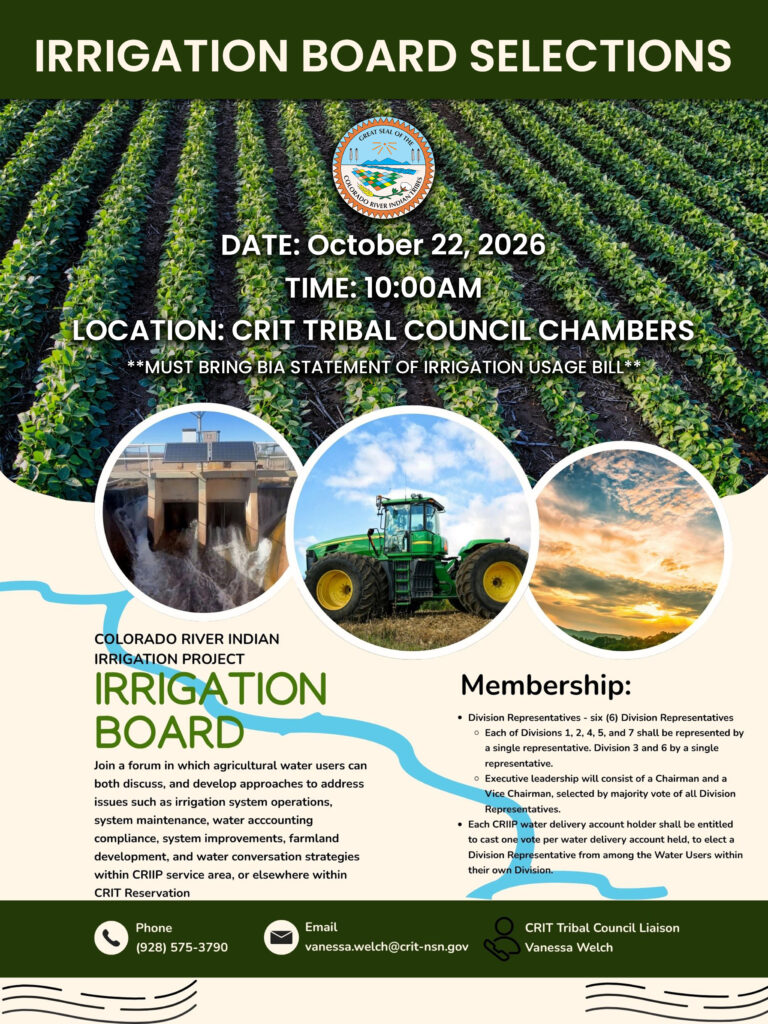
The Bureau of Indian Affairs (BIA) has proposed increasing Operation and Maintenance (O&M) rates for the delivery of water from $85 to $93 per acre. Over the past three years, CRIT and local farmers have experienced water delivery cost increases of more than 20%, while services have remained the same or declined due to the federal government’s cuts in staffing and the poor condition of Colorado River Indian Irrigation Project.
Madam Chairwoman Flores and the CRIT Tribal Council opposes this proposed rate increase and remains committed to strengthening Tribal sovereignty. That includes advocating for fair, transparent, and reliable O&M water delivery rates for our farmers, to preserve the economic health and wellbeing of the Tribes. We have listened to the concerns raised by the CRIT community and our farmers, and will continue working to protect our land, our water, and our future.
Get Involved: Farmers and community members who would like more information or who want to provide input on the proposed rate increase are encouraged to participate by sending a comment letter. Written comments may be submitted to: comments@bia.gov. Use the
subject line: Rate Adjustments for Indian Projects.
Contact: Leslie Underwood, Program Specialist, BIA Division of Water and Power
Office of Trust Services
Comment deadline: May 22, 2026
Learn more:
Letter from CRIT to BIA Opposing the Proposed 2027 O&M Rate Increase: CRIT Letter
Information from BIA re: the Proposed 2027 O&M Rate Increase: https://www.federalregister.gov/documents/2026/03/23/2026-05577/rate-adjustments-for-indian-irrigation-projects