September 10, 2026 10:06 am
CRIT Nation, Parker, AZ
September 10, 2026 10:06 am
CRIT Nation, Parker, AZ

On a Proposed Ordinance to Amend
the Government Code
to Add an Article 6. Standard of Conduct and Ethics


Dates:
Thursday, November 14, 2024 at 5:30 P.M.
Saturday, November 16, 2024 at 1:00 P.M.
Monday, November 18, 2024 at 9:00 A.M.

Location:  Colorado River Indian Tribes Tribal Council Chambers

The proposed Ordinance will amend the Government Code by adding an Article 6. Standard of Conduct and Ethics, which will govern the actions and activities of Tribal Council members to ensure they are carried out in the highest ethical standards, and to set forth consequences for violating these standards.

Written comments from the public will be accepted at the address below up until 5:00 p.m., Wednesday, November 20, 2024. Any comments submitted will be made a part of the legislative record and will be considered for incorporation into the final Code.

Submit comments to:  Colorado River Indian Tribes
Office of the Attorney General
26600 Mohave Road Parker, Arizona  85344

The proposed Code can be viewed online and printed just follow this link C_Standards of Conduct Ethics _08062024 Edits


Copies will also available at the Tribal Administrative Bldg. and the CRIT Library, located at 26600 Mohave Road, Parker, Arizona.

Per BIA Electric, Mochem Housing in the Valley will not lose power


Según BIA Electric, Mochem Housing en el valle no se quedará sin electricidad.

Click the links below to download a form

Direct Deposit Authorization Form

General Welfare Application_09242024

General Welfare Application Minors_09242024

PLEASE READ CAREFULLY


Dear Tribal Member:

Tribal Council has approved a 2024 General Welfare Assistance payment of $2,000.00 for each CRIT Tribal Member. CRIT Tribal members, both minors and adults, who are enrolled with CRIT as of November 1, 2024 are eligible to receive assistance. Tribal Members MUST submit an application to receive a General Assistance Payment for 2024.

Click the links below to download a form

Direct Deposit Authorization Form

General Welfare Application_09242024

General Welfare Application Minors_09242024

This 2024 General Welfare Assistance payment replaces the annual Tribal Distribution Payment.  The benefits to the membership are that the General Welfare Assistance payment is NOT income subject to federal taxes and should not impact eligibility for benefits such as SSI and food stamps.  You will not be issued a 1099 for this payment.  Please review the General Welfare Plan for more information.

Tribal Members will receive their General Welfare Assistance payment by mail or by direct deposit into a bank account after submitting their application.  Parents or legal guardians may request direct deposit for their eligible minor tribal member children into an account owned by the parent or the child.  YOU DO NOT HAVE TO SUBMIT A NEW DIRECT DEPOSIT FORM WITH YOUR APPLICATION IF YOU INTEND TO RECEIVE YOUR GENERAL WELFARE ASSISTANCE PAYMENT IN SAME BANK ACCOUNT AS YOU RECEIVED YOUR 2023 GENERAL WELFARE ASSISTANCE PAYMENT.

The General Welfare Assistance payment will be mailed or direct deposited as follows:

Application and Forms Due Date                   Payment Issued

Must be received by Accounting:

October 18, 2024                                            November 21, 2024

November 22, 2024                                        December 19, 2024

December 20, 2024                                         January 16, 2025

After December 20, 2024                              Payments issued monthly on a rolling basis

and before December 31, 2025

If you want to receive your General Welfare Assistance payment by direct deposit, you must submit the attached Direct Deposit Authorization Form along with a voided check to CRIT Accounting.  If you do not have a direct deposit authorization form on file from last year, or do not submit one for 2024 with your application, your payment will be mailed to the address on your application.  The mailing address you provide on the application will be used to update your address with both enrollment and accounting.   You may have already  received written notification  along with  an application and a self-addressed stamped envelope for your use to return the forms or the forms can be dropped off in person at Tribal Administration.  Additionally, the application and forms can be emailed to GWA@crit-nsn.gov.

Please note that the checks for eligible minor tribal members will be issued in the name of the child and not the parents. Parents or guardians must submit proof of their right to receive the distribution on behalf of their child by submitting an application with a copy of the birth certificate listing the parent(s), and if applicable, a court order establishing legal custody and placement before checks will be mailed or the payment directly deposited.

Checks will not be issued to the parent(s) if they do not have the care and custody of their children.  Guardians and custodians of minors who are not the child’s legal parent shall be required to provide a court order indicating their status.  Payments for children in the physical care and custody of CRIT Social Services or other state or tribal agencies shall be held in an account established by CRIT Accounting.

Tribal Members must apply for the 2024 General Welfare Assistance Payments no later than December 31, 2025 after which a 2024 payment will not be available.

Please be advised that if you are in default on a debt you owe to the Colorado River Indian Tribes or its enterprises, you may voluntarily agree to apply your General Welfare Assistance to the loan or other outstanding debt in default.  If you have any questions about outstanding debts in default please contact Tracey Quillen at (928) 669-1239.

If you have any questions regarding General Welfare Assistance or you have an agency incorrectly treating this payment as income please contact the Office of the Attorney General at (928) 669-1271.

Click the links below to download a form

Direct Deposit Authorization Form

General Welfare Application_09242024

General Welfare Application Minors_09242024

The Colorado River Indian Tribes Tribal Council has made a historic decision to protect the lifeblood of their Reservation. On November 6, 2025, the Council unanimously approved Resolution No. R-375-25, which proclaims the personhood status of the Colorado River under tribal law.

This resolution acknowledges the Colorado River as a living entity whose health and well-being are intrinsically linked to the well-being of the Colorado River Indian Tribes (CRIT) members. The Tribes’ deep-rooted connection to the river spans centuries, providing cultural identity, spiritual strength, food systems, and economic stability that continue to shape their community life today.

The resolution emphasizes the central role the river has played in defining the identity of the CRIT. It highlights that CRIT’s ancestors have preserved and protected these lands since before the establishment of the Colorado River Indian Reservation in 1865.

The Council underscores the crucial role the river plays in sustaining traditional practices, wildlife, and agriculture, including the federal irrigation systems authorized as early as 1867. Today, the Colorado River Indian Irrigation Project stands as a cornerstone of the tribal economy.

The resolution underscores significant legal milestones that acknowledged CRIT’s water rights. In the landmark 1964 and 2006 Arizona v. California U.S. Supreme Court decisions, the Tribes secured 719,248 acre-feet of water annually, ensuring their access to the river for generations to come.

By granting personhood to the River, the Tribal Council reaffirmed its sovereign duty to honor and protect it. This status mandates that the River’s well-being must be a priority in governance and decision-making moving forward.

As part of the resolution, the Attorney General and their staff will develop legal safeguards and propose updates to the CRIT Water Code and other relevant regulations. These updates may include the potential designation of the river as a protected cultural landscape.

Council members recognized that protecting the river is not merely a legal obligation but a continuation of cultural beliefs passed down through generations.

Through this declaration, CRIT demonstrates its unwavering commitment to stewardship. The resolution concludes with a resolute message: the Colorado River is, and will always remain, a vital entity deserving of respect, care, and protection for all future generations.

Article Written by CRIT Media Reporter Ariana Romero

News Update November 12, 2025

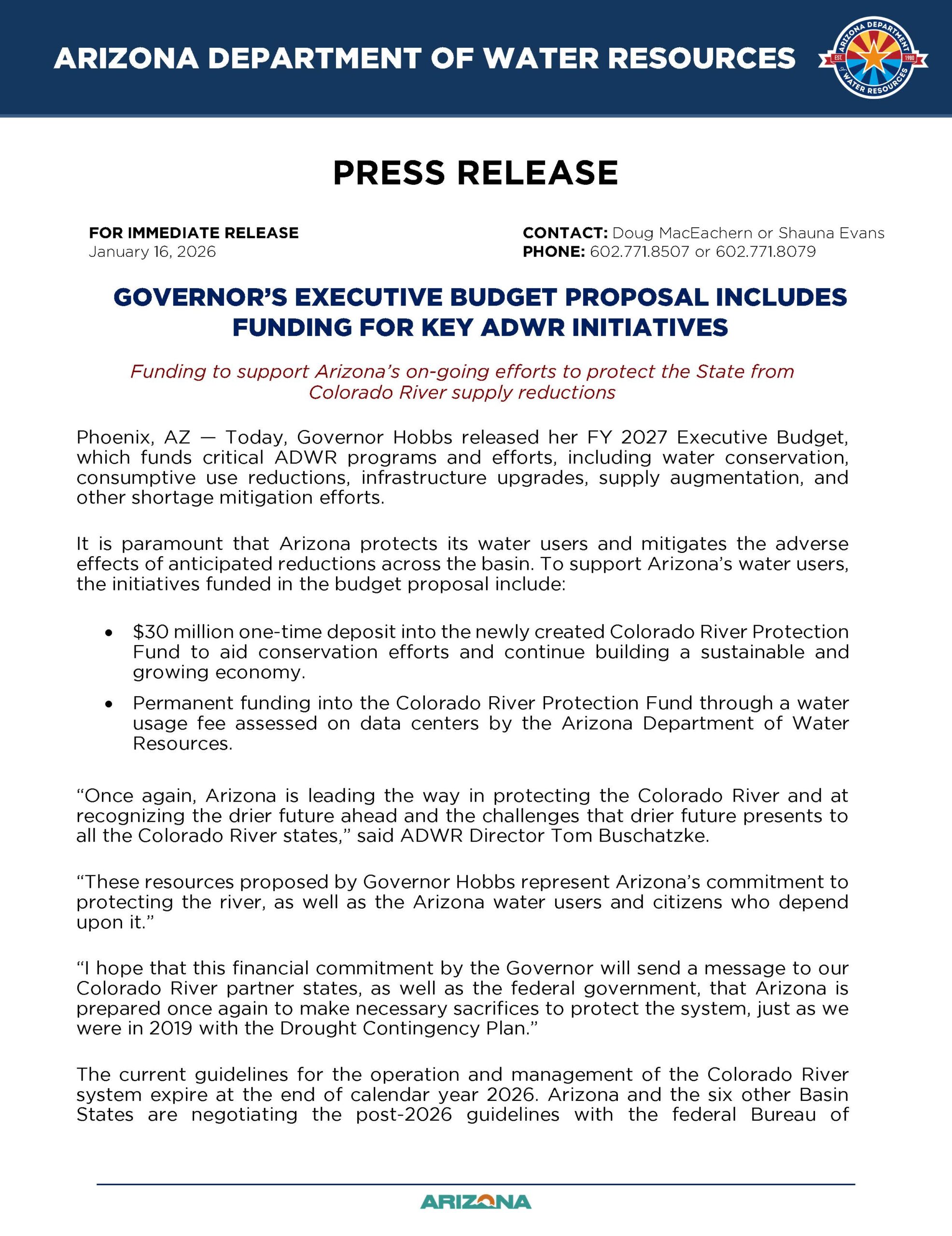
Negotiations over the future of the Colorado River have reached a standstill after all seven basin states failed to meet a key federal deadline. Reports from 12News and 8NewsNow confirm that the states were unable to agree on a new water-sharing plan, leaving the situation unresolved as the river continues to decline.

High Country News explains that the biggest disagreements involve how much each state should give up in the future. The upper Basin states want fewer mandatory reductions, while the Lower Basin states, including Arizona, say they have already taken the deepest cuts and cannot continue to absorb the majority of the impacts.

With no agreement in place, Arizona Governor Katie Hobbs has asked the Trump administration to intervene. She stated that Arizona has made significant sacrifices and cannot carry the weight of the reductions while other states refuse to commit to measurable cuts. If the states cannot reach a plan soon, the federal government may create one for them.

For the Colorado River Indian Tribes, the outcome of these negotiations has major importance. CRIT holds valuable senior water rights and relies on a stable and fair management plan to ensure long-term security for the community and the region.

For more information, you can read the news articles with the links below.

8NewsNow
https://www.8newsnow.com/news/local-news/colorado-river-negotiations-fail-to-meet-federal-deadline-for-7-state-agreement/

High Country News
https://www.hcn.org/articles/why-colorado-river-negotiations-are-so-difficult/


ABC 15 News
https://www.abc15.com/weather/impact-earth/why-gov-katie-hobbs-wants-trump-administration-to-broker-colorado-river-deal


12 News
/wednesday-is-deadline-for-7-state-including-arizona-to-negotiate-the-colorado-river

Andrea Travnicek, Assistant Secretary of the Interior for Water and Science, recently toured the Colorado River Indian Reservation with Chairwoman Amelia Flores, ‘Amat Kuhwely Farms Manager Joshua Moore, Deputy Attorney General Travis Nez, Lead Water Attorney John Bezdek, Water Resources Director Dillon Esquerra, and Fish & Game Wildlife Manager Alexander Kalinowski. The goal of the visit was for Travnicek to understand in real time about the Tribe’s water, agricultural capabilities, and infrastructure inefficiencies.

Travnicek was accompanied by members of her staff and representatives from the Bureau of Reclamation, an agency within her oversight portfolio. During the visit, Tribal representatives took her to several locations across the reservation to provide a firsthand look at CRIT enterprises, agricultural operations, and the deteriorating irrigation infrastructure affecting the vast farmland throughout the valley.

The tour began at Aha Quin Resort, a Tribally owned and operated recreational destination located on CRIT lands along the California side of the Colorado River.

Travnicek then visited a portion of the valley’s irrigation system, a critical stop because it is where excess water flows through the canals before draining back into the Colorado River. The deteriorating infrastructure limits CRIT’s ability to retain and reuse that water within the irrigation system. Once the water returns to the river, it becomes available to downstream junior users, some of whom have derived substantial economic benefit from water over which CRIT holds a far more senior legal claim, with an earliest priority date of March 3, 1865. The location has long been used to demonstrate the serious condition of the aging irrigation system. By visiting the site, Travnicek was able to observe the problems firsthand and hear Dillon Esquerra and Joshua Moore. explain how the failing infrastructure affects the Tribe’s ability to conserve and efficiently use its water.

The tour continued at ‘Amat Kuhwely Farms, where Travnicek met with Farm Manager Joshua Moore and local farmers John Nelson and tribal member Ciesto Leivas, Jr.. The farmers discussed the challenges of maintaining agricultural operations while relying on aging and unreliable infrastructure throughout the valley. They also discussed the Bureau of Indian Affairs (BIA) inoperable ability to maintain its own infrastructure and how often (if not daily) these farmers need to do the work of the BIA in order to maintain their crops and yield successful results.

Travnicek listened to their concerns and expressed her willingness to elevate these issues with BIA leaders in DC. She relayed how frustrating it must be for them, and for CRIT overall to not see any updates. (more…)

The CRIT Department of Health and Social Services hosted its Health Fair on Wednesday, June 24, at Irataba Hall. The event brought together departments and programs from across the community to share helpful resources and important health information.

There was food, games, raffles, and free shaved ice provided by Uncle Phil’s Awesome Snow Shaved Ice. Guests also left with bags filled with informational flyers, recipes, and useful household items. It was great to see so many departments working together to support and connect with the community.

Last week was filled with proud moments, happy tears, and celebrations as students across the community marked important milestones in their educational journeys.

The celebrations began Thursday, May 21, with the Parker Alternative Graduation ceremony that morning. Later that evening, families gathered again as students from Wallace Jr. High and Le Pera Elementary School took part in their promotion ceremonies, marking their next step forward.

The excitement continued Friday, May 22, with Parker High School’s Graduation celebration. Before the ceremony, graduates took part in a parade through town, where family, friends, and community members lined the route to cheer them on as they passed by. It was a special moment of recognition, not only for the graduates, but for everyone who supported them along the way.

The week ended Saturday, May 23, with the Head Start Promotion, a celebration filled with excitement, smiles, and a few tears from both parents and students. Although Head Start was the final event of the week, for many students, it represents where their educational journey first began.

Each ceremony served as a reminder of growth, hard work, and the importance of community support. From the youngest students taking their first big step forward to high school graduates preparing for new opportunities, each milestone is worth celebrating.

Congratulations to all the students who walked across the stage, down the aisle, or through the crowd of cheering loved ones. May you continue to shine, reach your goals, and move forward with confidence.

As Eleanor Roosevelt once said, “The future belongs to those who believe in the beauty of their dreams.”

Written by CRIT Media Reporter Ariana Romero

TUCSON, Ariz. — The University of Arizona will host a special series of sign unveiling ceremonies on Friday, September 4, 2026, honoring the four languages of the Colorado River Indian Tribes (CRIT): Mohave, Chemehuevi, Hopi, & Navajo. These ceremonies represent an important milestone in an ongoing campus-wide initiative to elevate the visibility, recognition, and continued presence of Indigenous languages and cultural heritage within the campus community.

The events are organized by the University of Arizona’s Office of Native American Advancement & Tribal Engagement (NAATE) in collaboration with individual academic colleges. Students, faculty, staff, tribal community members, and the general public are invited to attend the progression of ceremonies throughout the day.

The schedule for the Friday ceremonies includes:

  • 9:00 AM – Emil W. Haury Anthropology Building (1009 E South Campus Dr): Honoring the CRIT Chemehuevi language. The ceremony features a welcome and land acknowledgment from Levi Esquerra (Special Advisor, NAATE), a prayer by Eloy DeLeon, remarks from Clarissa Robles Parra on behalf of the Office of the Provost, and an address by CRIT Chairwoman Amelia Flores. Cultural sharing will feature the Salt Song(s) and Red Foot, followed by refreshments.
  • 10:30 AM – Environment and Natural Resources 2 (ENR2) Building (1064 E Lowell St): Honoring the CRIT Navajo language. Hosted by Liz Petterson, Associate Director, Arizona Institute for Resilience, alongside CRIT Chairwoman Amelia Flores, and a Navajo language representative featuring a traditional blessing and cultural demonstration.
  • 1:00 PM – Forbes Building (1140 E South Campus Dr): Honoring the CRIT Hopi language with remarks from Dr. Edward Martin (Associate Dean, CALES Cooperative Extension), Professor Sheilah Nicholas, and Dean George W. Smith.
  • 2:30 PM – College of Education Building (1430 E 2nd St): Honoring the CRIT Mohave language. The concluding sign unveiling of the day will include introductions by students, remarks from CRIT Chairwoman Amelia Flores, and a final cultural demonstration.

The celebration of Indigenous culture continues into the weekend with the Native American Heritage Game on Saturday, September 5, 2026. The Arizona Wildcats will face Northern Arizona at Casino Del Sol Stadium, with kick-off scheduled for 6:30 PM MST. Pre-game festivities at Bear Down Field will begin at 3:15 PM with the Bear Down Bash, featuring 18-minute cultural performances from each tribe. A traditional gift presentation will follow during the Wildcat Walk at 4:15 PM, leading up to an on-field tribal recognition ceremony during the second quarter of the football game.

For more operational schedules or to register for the unveiling events, please visit the official University of Arizona Event Page.