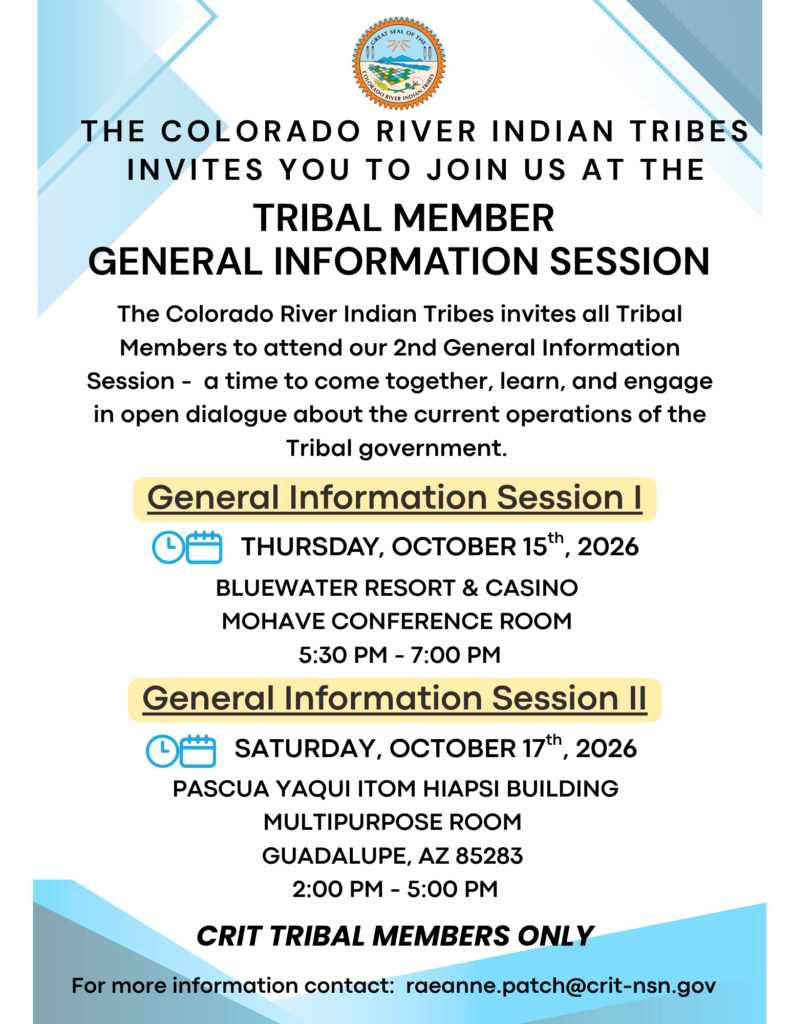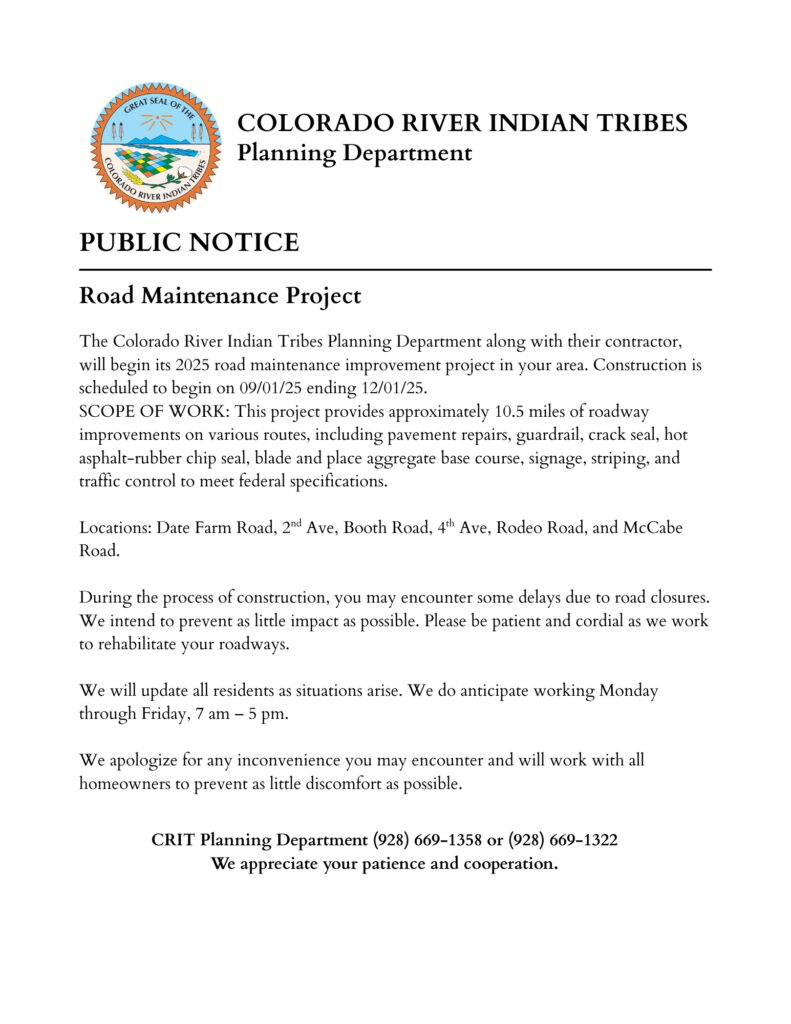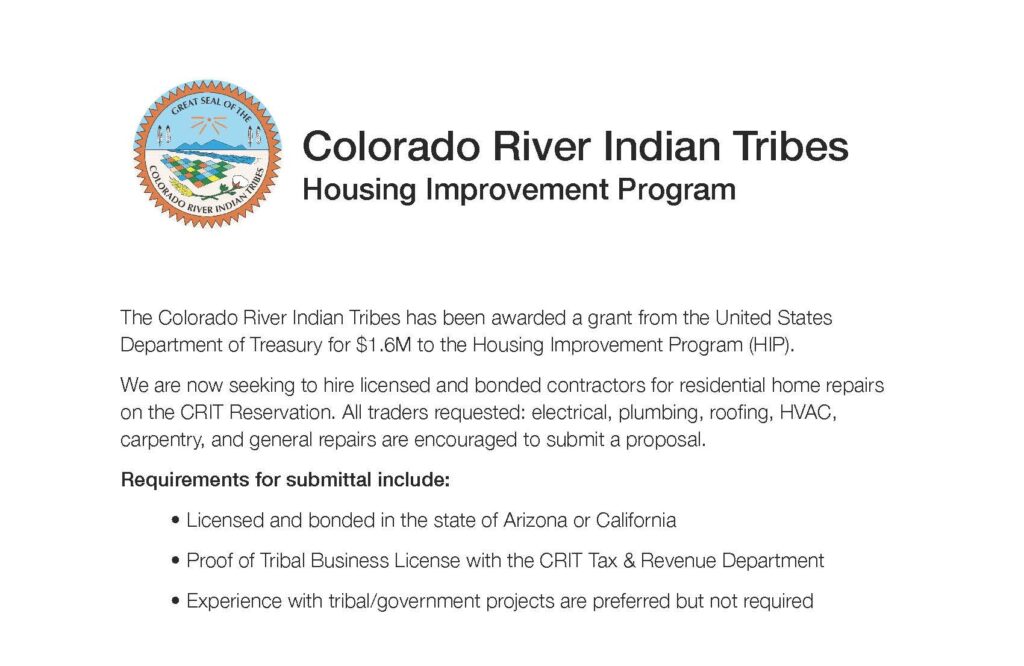
To download more information and an application please follow this link

According to 12News (KPNX), Arizona leaders say the state is approaching a critical moment as Colorado River negotiations continue and water cutbacks remain likely. Officials described the situation as a crossroads, warning that the next few years will require difficult decisions about conservation, water use, and long-term planning.
The looming reductions stem from ongoing negotiations over post-2026 operating rules for the Colorado River, which will determine how water shortages are shared among the seven basin states. Arizona has already taken significant reductions under earlier shortage agreements, and additional cuts could affect cities, agriculture, and water providers across the state.
For CRIT and other Tribal Nations along the river, these discussions are important because future operating guidelines will shape how the Colorado River is managed for decades. Tribal water rights, infrastructure investments, and long-term planning will all be influenced by how states and the federal government resolve these negotiations.
According to the Arizona Republic, scientists say the western United States may not simply be experiencing a drought but a long-term shift toward a drier climate known as “aridification.” Researchers say the region has effectively been in a 32-year drought, but climate patterns suggest the West could remain permanently drier than historical averages.
This shift is affecting the Colorado River Basin, where reservoirs like Lake Mead and Lake Powell remain far below historic levels despite occasional wet years. Scientists say warmer temperatures cause more water to evaporate and reduce snowpack that normally feeds the river.
For CRIT, this concept of aridification is important because it changes how water planning is approached. Instead of preparing for drought cycles followed by recovery, water managers may need to plan for a permanently smaller Colorado River supply.
According to KJZZ, lawmakers introduced around 30 groundwater-related bills during the current Arizona legislative session, but most proposals do not directly focus on conservation. Instead, many of the bills address water development, transportation, or regulatory changes.
Arizona groundwater policy has become a growing concern as communities increasingly turn to underground aquifers to supplement shrinking Colorado River supplies. Some lawmakers and water experts argue stronger conservation policies are needed to protect these aquifers for future generations.
For CRIT and other Tribal communities, groundwater policy is significant because it influences regional water demand and long-term water sustainability across Arizona. As Colorado River supplies tighten, groundwater management decisions could shape how the state balances growth with water availability.
According to KJZZ News, environmental groups are warning of serious long-term impacts to the Colorado River system after negotiators missed another deadline to finalize future water management rules. Advocates say declining reservoir levels, ongoing drought, and delayed agreements could increase pressure on ecosystems, agriculture, and water supplies across the Southwest. The warnings highlight growing urgency for coordinated conservation and policy action. For CRIT, these discussions are important because federal decisions about river operations directly influence how tribal water rights are protected and how long-term water stability is maintained.
Source: KJZZ News — https://www.kjzz.org/politics/2026-02-19/environmental-groups-warn-of-dire-impacts-after-colorado-river-negotiators-miss-another-deadline
According to Nevada Public Radio, Colorado River negotiations continue to face challenges as states balance drought impacts, water demand, and competing priorities. Officials involved in the talks say progress has been uneven and that future agreements may require difficult compromises across the basin. Continued uncertainty highlights the complexity of managing the river under changing climate conditions. For CRIT, ongoing interstate negotiations remain important because federal and regional policy decisions directly affect how tribal water rights are recognized and protected.
Source: Nevada Public Radio — https://knpr.org/show/knprs-state-of-nevada/2026-02-20/nevadas-main-water-negotiator-talks-about-the-bumpy-road-ahead-in-the-colorado-river-discussions
According to Newsweek, recent data shows some improvement in Lake Mead water levels following storms and conservation efforts, offering cautious optimism for the Colorado River system. However, experts note that long-term drought conditions still pose significant challenges and continued conservation will remain essential. Reservoir levels remain a key factor in determining water deliveries across the basin. For CRIT, reservoir conditions remain important because federal operational decisions tied to storage levels directly affect how tribal water allocations are managed and protected.
Source: Newsweek — https://www.newsweek.com/lake-mead-water-levels-get-good-news-11557968
According to Arizona Water News, Arizona and its Lower Basin partners say they remain committed to finding common ground on new Colorado River operating rules despite stalled negotiations among the seven basin states. Officials emphasized continued collaboration with federal agencies and neighboring states to stabilize water supplies beyond 2026 as drought conditions persist. The effort reflects ongoing attempts to balance conservation, water demand, and long-term river sustainability. For CRIT, these negotiations remain important because federal and interstate agreements directly influence how tribal water rights are recognized and protected in future Colorado River management decisions.
Source: Arizona Water News — https://www.azwater.gov/news/articles/2026-02-19
According to the Navajo Times, federal officials are moving forward with developing new Colorado River operating guidelines even as state negotiations remain stalled. The Department of the Interior is continuing its environmental review process to prepare for post-2026 river management, highlighting the federal government’s role when states cannot reach consensus. Tribal consultation remains part of that process. For CRIT, federal involvement is significant because Colorado River policies shaped at the federal level directly affect tribal water rights, long-term planning, and regional water security.
Source: Navajo Times — https://navajotimes.com/reznews/federal-officials-move-forward-on-colorado-river-operating-rules-as-state-negotiations-stall/
According to ABC 15 Arizona, tribal nations along the Colorado River are among those with the most at stake as negotiations over future water allocations continue. Tribal leaders emphasize the importance of protecting established water rights while ensuring sustainable solutions to ongoing drought conditions. The article highlights how tribal participation is increasingly central in discussions about the river’s future. For CRIT, these conversations are especially important because tribal sovereignty and water rights remain critical factors in how Colorado River resources are managed across the basin. (more…)
According to CBS 5 Arizona’s Family, Arizona could face deeper Colorado River water cuts following missed negotiation deadlines, raising concerns about future water supply stability across the state. Officials say ongoing drought and reduced reservoir levels continue to challenge long-term planning efforts. These developments may lead to increased federal involvement in river management decisions. For CRIT, potential cutbacks are important because federal allocation decisions directly influence how tribal water rights are maintained and protected.
Source: CBS 5 Arizona’s Family — https://www.azfamily.com/2026/02/17/arizona-faces-major-colorado-river-water-cuts-deadline-passes/
According to the Colorado Sun, new forecasts suggest Lake Powell could reach critically low levels that threaten hydropower production and water deliveries if drought conditions persist. Reservoir storage plays a central role in determining how water is distributed across the Colorado River Basin. Experts say ongoing climate pressures and declining inflows continue to complicate long-term planning. For CRIT, reservoir conditions remain important because federal operational decisions tied to storage levels directly affect how tribal water allocations are managed and protected.
Source: Colorado Sun — https://coloradosun.com/2026/02/18/lake-powell-forecast-critical-lows-federal-study/
According to AZPM News, Colorado River basin states missed another federal deadline to reach agreement on future water reductions, increasing the likelihood of additional cutbacks across the Southwest. Officials warn that continued drought and declining reservoir levels could force tougher decisions about water allocation in the coming years. The missed deadline highlights growing uncertainty about long-term river management. For CRIT, potential water reductions and federal policy decisions directly influence how tribal water rights are protected and incorporated into basin planning.
Source: AZPM News — https://news.azpm.org/s/102728-arizona-and-western-states-miss-colorado-river-water-deadline-as-cuts-loom/
According to Newsweek, Lake Powell water levels could drop to critical levels sooner than expected, raising concerns about hydropower production and water deliveries across the Colorado River Basin. Experts say continued drought, reduced snowpack, and high demand are contributing to declining reservoir storage. These conditions add urgency to ongoing negotiations about future river operations. For CRIT, reservoir levels are important because federal decisions tied to storage conditions directly affect how tribal water allocations are managed and sustained.
Source: Newsweek — https://www.newsweek.com/lake-powell-water-could-drop-to-critical-levels-sooner-than-expected-11531274
According to Pinal Central, the Gila River Indian Community expressed concern over the lack of agreement among Colorado River basin states, noting the importance of tribal voices in ongoing water negotiations. Tribal leaders emphasized the need for sustainable solutions that recognize existing water rights while addressing long-term drought conditions. The statement highlights growing awareness of tribal participation in basin discussions. For CRIT, tribal engagement in Colorado River negotiations is significant because it reinforces the importance of protecting tribal sovereignty and water rights across the region.
Source: Pinal Central — https://www.pinalcentral.com/sacaton_central/gric-laments-lack-of-deal-over-colorado-river-water/article_cb91f461-07de-4f88-8d70-c3dec3b96c67.html
A recent statement from Colorado River Commissioner JB Hamby says California and other Lower Basin states have been working with federal officials and neighboring states to develop new long-term operating rules for the Colorado River after 2026. He noted that the original 1922 Colorado River Compact was based on water supply estimates that no longer match today’s reality, as river flows have declined over the past 25 years while demand continues to grow.
According to the statement, California, Arizona, and Nevada committed to major conservation efforts in recent years and have already exceeded planned water savings meant to stabilize Lake Mead and Lake Powell. However, disagreements remain between Upper Basin and Lower Basin states about how future reductions should be shared, and negotiators have not yet reached a final agreement.
For CRIT, these ongoing negotiations are important because federal Colorado River policies, interstate agreements, and conservation requirements directly influence how tribal water rights are protected, managed, and incorporated into long-term river planning that affects the entire region.
Source: https://crb.ca.gov/2026/02/statement-from-jb-hamby-colorado-river-commissioner-for-california/
(LAS VEGAS) The Colorado River Indian Tribes (CRIT), the Gila River Indian Community (GRIC) and the Central Arizona Water Conservation District, which manages the Central Arizona Project, have signed an historic proclamation to work together to protect the Colorado River.
The three entities have had differing priorities and goals over the years regarding the River, but those differences do not prevent them from working together to safeguard the Colorado River which is suffering from drought and overuse.
The proclamation was signed during the Colorado River Water Users Association conference where multiple states, local and regional government entities, and the federal government have been trying to reach an accord on river water allocation and use.
CRIT, GRIC, and the CAP hope their proclamation can set an example and demonstrate the need for collaboration and conservation. The resolution states:
The Colorado River Indian Tribes, the Gila River Indian Community, and the Central Arizona Water Conservation District have been collaborative partners on various conservation projects to protect the Colorado River including the Pilot System Conservation Program, the Drought Contingency Plan and innovative water efficiency demonstration projects.
We commit to working on collaborative and creative partnerships that, consistent with our respective principles and values, utilize all the tools that are available to us through the Consolidated Decree in Arizona v. California, the Arizona Water Settlements Act, the 2007 Interim Guidelines, the Drought Contingency Plan, the System Use Agreement, the Colorado River Indian Tribes Water Resiliency Act of 2022, and the Arizona’s Groundwater Management Act, in addition to others.
Together, the Colorado River Indian Tribes, under its laws, including requiring preservation of the River as a living entity, the Gila River Indian Community and the Central Arizona Water Conservation District are committed to protecting the Colorado River and the needs of our respective tribal members while connecting much-needed resources to end users within the Central Arizona Water Conservation District service area.

CRIT Chairwoman Amelia Flores said, “All of us who live in Arizona, native and non-native alike, are connected by water for without water, there is no life. And it is that common thread that binds us, which has us here today, pledging to work together for the greater good of all who live in Arizona.” CRIT recently took the pioneering step to acknowledge personhood status for the Colorado River under Tribal Law. According to Chairwoman Flores, “CRIT will always put the Colorado River first.” (more…)
by Abigail Wilt
Cronkite News
PHOENIX – Natasha Bowman is a Navajo doula and student midwife. Her work centers around revitalizing traditional birthing through practices that have been overshadowed by Western medicine.
In traditional spaces, families are often there, supporting the mother through labor and birth. One of Bowman’s clients was the first woman in her family to have a home birth since her great-great-grandmother. The client was in the company of other women in her family and for the first time — her father.
Before the woman’s home birth, her father wasn’t allowed to be present for the births of his own children. His wife would labor at the hospital while he was at home and then return with their babies.
It was very different while his daughter was in labor. He was invited into the space and able to console her, rubbing her head and speaking to her as she moaned through contractions.
He sat in the living room during the active birth and told Bowman — through tears — that he wished he would have been there for the births of his children. He had no idea what his wife was going through until he saw his daughter go through it.
“Within the community, bringing in the aunts, the grandmas, the sisters, the cousins, bringing them all within that space, working as a community together. It’s beautiful to see everyone come together at a birth with the women around,” Bowman said.
Bowman explained that traditional births can often involve ceremonies, songs, holistic herbs, tinctures and the use of Native language alongside including family members.
Indigenous medicinal practices, alongside cultural and religious ceremonies, were considerably restricted under the 1883 Code of Indian Offenses, allowing authorities to withhold food, impose extra labor or jail people for up to 10 days for seeking or providing medicine or traditional healing.
Until the Congress passed the American Indian Religious Freedom Act in 1978, Native communities were largely forced to seek care within Western health systems.
“We see that we had our traditional birthing practices long ago. It was taken from us when hospitals came into our communities, and then our traditional birth ways were taken from us. They started telling us it was unsafe,” Bowman said.
Last year, the Centers for Medicare & Medicaid Services approved a Section 1115 waiver, allowing Medicaid to cover traditional healing. On Oct. 1, Arizona Health Care Cost Containment System, AHCCCS, Arizona’s Medicaid agency, began reimbursing them, making Arizona one of the first states to do so. The initiative “aims to offer culturally appropriate options for eligible members.”
For tribal communities, this progress has been decades in the making.
“I’m really happy that, after over a decade, or to this point, that the advocates in our state didn’t give up and that we just kept moving it forward because we really understood the value of it,” said Kim Russell, the policy advisor at Sage Memorial Hospital on the Navajo Nation.
Hanley Manygoats is a traditional medicine practitioner (Hatalii) on the Navajo Nation. He grew up around traditional healing before becoming a practitioner himself. Lately, Manygoats went from seeing one person a month to three or four a week.
“It’s all part about healing, spiritual healing. It’s all about this being the one with nature, mother earth, father sky,” Manygoats said. “So we have all these stories that go with our traditional healing, our songs, our prayers. So it all starts with the origin stories.”
For many, he said, it’s the first time in decades they’ve been able to experience these healing ceremonies.
“When I do prayers for the elders, they get emotional because they haven’t heard prayers like this in a long time. The last time they had a prayer done was when their grandparents or their fathers and mothers were around. Now they’re gone,” he said.
Though AHCCCS coverage has allowed more people to seek traditional health care, Manygoats said the coverage is limited. (more…)
The Ahakhav Tribal Preserve is a treasured outdoor space for the Colorado River Indian Tribes community. Located along the beautiful Colorado River in Parker, the Preserve offers a peaceful and educational environment where families can explore nature, relax, and learn about the land we call home.
Newly hired Project Administrator, Marisol Chavira, has been dedicated to the Preserve for more than 20 years. Born and raised in Parker, she’s passionate about caring for the land and helping future generations enjoy it. After serving as the Administrative Assistant for many years, she began acting as the Project Administrator in 2021 and officially stepped into the role in November 2025.
Marisol shared that her favorite part about working at the Preserve is the quiet and comfort it brings. “It’s green, beautiful, and peaceful,” she said. “There’s so much for people to enjoy here.” From walking trails and bird watching to designated playground areas for families, the Preserve is an inviting space for all ages.
A typical day for the Preserve team includes maintaining the park, trimming trees, caring for the natural habitat, and working on grants to continue improving the area. One of Marisol’s favorite spots is Willow Beach, a scenic area where families can enjoy the water, shade, and open spaces.
Fall is her favorite season at the Preserve because the changing leaves bring the area to life with color. She even recalled one memorable morning early in her career when a doe fell into a ditch. Without hesitation, she rushed in to help and ended up drenched but proud of what she did. It’s moments like these that show how much she cares for the wildlife and environment.
The Preserve is also home to important cultural resources. Marisol was surprised to learn just how many of the trees and plants hold cultural value and are monitored and preserved with great respect. Restoration continues to be a major focus. A recent grant supports the revegetation of native trees, including cottonwood, willows, and mesquite, helping to restore the natural habitat and strengthen the ecosystem for future generations. (more…)
The Colorado River Indian Tribes Employment Development and Training Department (ED&T) continues to be a vital resource for tribal members seeking support, skills, and employment. Through partnerships with the Department of Labor, Arizona Tribal Workforce, and the Department of Economic Security, ED&T provides job readiness services, education support, and hands-on work experience to those enrolled in a federally recognized tribe. Their mission focuses on promoting general welfare, encouraging educational progress, protecting tribal interests, and helping community members build stable, independent futures.
The department offers a wide range of services designed to meet people where they are. Community members can receive help studying for a driver’s permit or license, creating resumes and cover letters, preparing job applications, and building job readiness skills. ED&T also assists with obtaining needed documents such as a GED or ID. For those looking to gain work experience, the Adult Work Experience program offers a 90-day on-the-job training period with the goal of permanent employment once training is complete. High school and college students can participate in the Summer Youth Experience Program, which provides hands-on workplace exposure during summer break. When needed, ED&T also provides supportive services such as work clothing, tuition assistance, certifications, testing fees, and education supplies if those items cannot be obtained through another program.
Click the links below to upload needed forms
UPDATED SUPPORTIVE SERVICE FORM 2025

The department is guided by a committed team dedicated to helping the community move forward. Acting Director and Case Worker Kaye Antone works closely with participants to understand their goals, explore their interests, and determine what support they may need. Office Administrator Madolyn Brenner reviews applications, assists staff, and helps maintain a welcoming and organized department. Office Assistant Deaun Johnson and ED&T participant supports daily operations, helps participants with questions, and ensures they receive assistance quickly and respectfully. Together, the team works one-on-one with community members and emphasizes the importance of offering help confidentially and with care, recognizing that every situation is different. (more…)
TUCSON, Ariz. — The University of Arizona will host a special series of sign unveiling ceremonies on Friday, September 4, 2026, honoring the four languages of the Colorado River Indian Tribes (CRIT): Mohave, Chemehuevi, Hopi, & Navajo. These ceremonies represent an important milestone in an ongoing campus-wide initiative to elevate the visibility, recognition, and continued presence of Indigenous languages and cultural heritage within the campus community.
The events are organized by the University of Arizona’s Office of Native American Advancement & Tribal Engagement (NAATE) in collaboration with individual academic colleges. Students, faculty, staff, tribal community members, and the general public are invited to attend the progression of ceremonies throughout the day.
The schedule for the Friday ceremonies includes:
The celebration of Indigenous culture continues into the weekend with the Native American Heritage Game on Saturday, September 5, 2026. The Arizona Wildcats will face Northern Arizona at Casino Del Sol Stadium, with kick-off scheduled for 6:30 PM MST. Pre-game festivities at Bear Down Field will begin at 3:15 PM with the Bear Down Bash, featuring 18-minute cultural performances from each tribe. A traditional gift presentation will follow during the Wildcat Walk at 4:15 PM, leading up to an on-field tribal recognition ceremony during the second quarter of the football game.
For more operational schedules or to register for the unveiling events, please visit the official University of Arizona Event Page.