
According to KJZZ News, environmental groups are warning of serious long-term impacts to the Colorado River system after negotiators missed another deadline to finalize future water management rules. Advocates say declining reservoir levels, ongoing drought, and delayed agreements could increase pressure on ecosystems, agriculture, and water supplies across the Southwest. The warnings highlight growing urgency for coordinated conservation and policy action. For CRIT, these discussions are important because federal decisions about river operations directly influence how tribal water rights are protected and how long-term water stability is maintained.
Source: KJZZ News — https://www.kjzz.org/politics/2026-02-19/environmental-groups-warn-of-dire-impacts-after-colorado-river-negotiators-miss-another-deadline
According to Nevada Public Radio, Colorado River negotiations continue to face challenges as states balance drought impacts, water demand, and competing priorities. Officials involved in the talks say progress has been uneven and that future agreements may require difficult compromises across the basin. Continued uncertainty highlights the complexity of managing the river under changing climate conditions. For CRIT, ongoing interstate negotiations remain important because federal and regional policy decisions directly affect how tribal water rights are recognized and protected.
Source: Nevada Public Radio — https://knpr.org/show/knprs-state-of-nevada/2026-02-20/nevadas-main-water-negotiator-talks-about-the-bumpy-road-ahead-in-the-colorado-river-discussions
According to Newsweek, recent data shows some improvement in Lake Mead water levels following storms and conservation efforts, offering cautious optimism for the Colorado River system. However, experts note that long-term drought conditions still pose significant challenges and continued conservation will remain essential. Reservoir levels remain a key factor in determining water deliveries across the basin. For CRIT, reservoir conditions remain important because federal operational decisions tied to storage levels directly affect how tribal water allocations are managed and protected.
Source: Newsweek — https://www.newsweek.com/lake-mead-water-levels-get-good-news-11557968
According to Arizona Water News, Arizona and its Lower Basin partners say they remain committed to finding common ground on new Colorado River operating rules despite stalled negotiations among the seven basin states. Officials emphasized continued collaboration with federal agencies and neighboring states to stabilize water supplies beyond 2026 as drought conditions persist. The effort reflects ongoing attempts to balance conservation, water demand, and long-term river sustainability. For CRIT, these negotiations remain important because federal and interstate agreements directly influence how tribal water rights are recognized and protected in future Colorado River management decisions.
Source: Arizona Water News — https://www.azwater.gov/news/articles/2026-02-19
According to the Navajo Times, federal officials are moving forward with developing new Colorado River operating guidelines even as state negotiations remain stalled. The Department of the Interior is continuing its environmental review process to prepare for post-2026 river management, highlighting the federal government’s role when states cannot reach consensus. Tribal consultation remains part of that process. For CRIT, federal involvement is significant because Colorado River policies shaped at the federal level directly affect tribal water rights, long-term planning, and regional water security.
Source: Navajo Times — https://navajotimes.com/reznews/federal-officials-move-forward-on-colorado-river-operating-rules-as-state-negotiations-stall/
According to ABC 15 Arizona, tribal nations along the Colorado River are among those with the most at stake as negotiations over future water allocations continue. Tribal leaders emphasize the importance of protecting established water rights while ensuring sustainable solutions to ongoing drought conditions. The article highlights how tribal participation is increasingly central in discussions about the river’s future. For CRIT, these conversations are especially important because tribal sovereignty and water rights remain critical factors in how Colorado River resources are managed across the basin. (more…)
According to CBS 5 Arizona’s Family, Arizona could face deeper Colorado River water cuts following missed negotiation deadlines, raising concerns about future water supply stability across the state. Officials say ongoing drought and reduced reservoir levels continue to challenge long-term planning efforts. These developments may lead to increased federal involvement in river management decisions. For CRIT, potential cutbacks are important because federal allocation decisions directly influence how tribal water rights are maintained and protected.
Source: CBS 5 Arizona’s Family — https://www.azfamily.com/2026/02/17/arizona-faces-major-colorado-river-water-cuts-deadline-passes/
According to the Colorado Sun, new forecasts suggest Lake Powell could reach critically low levels that threaten hydropower production and water deliveries if drought conditions persist. Reservoir storage plays a central role in determining how water is distributed across the Colorado River Basin. Experts say ongoing climate pressures and declining inflows continue to complicate long-term planning. For CRIT, reservoir conditions remain important because federal operational decisions tied to storage levels directly affect how tribal water allocations are managed and protected.
Source: Colorado Sun — https://coloradosun.com/2026/02/18/lake-powell-forecast-critical-lows-federal-study/
According to AZPM News, Colorado River basin states missed another federal deadline to reach agreement on future water reductions, increasing the likelihood of additional cutbacks across the Southwest. Officials warn that continued drought and declining reservoir levels could force tougher decisions about water allocation in the coming years. The missed deadline highlights growing uncertainty about long-term river management. For CRIT, potential water reductions and federal policy decisions directly influence how tribal water rights are protected and incorporated into basin planning.
Source: AZPM News — https://news.azpm.org/s/102728-arizona-and-western-states-miss-colorado-river-water-deadline-as-cuts-loom/
According to Newsweek, Lake Powell water levels could drop to critical levels sooner than expected, raising concerns about hydropower production and water deliveries across the Colorado River Basin. Experts say continued drought, reduced snowpack, and high demand are contributing to declining reservoir storage. These conditions add urgency to ongoing negotiations about future river operations. For CRIT, reservoir levels are important because federal decisions tied to storage conditions directly affect how tribal water allocations are managed and sustained.
Source: Newsweek — https://www.newsweek.com/lake-powell-water-could-drop-to-critical-levels-sooner-than-expected-11531274
According to Pinal Central, the Gila River Indian Community expressed concern over the lack of agreement among Colorado River basin states, noting the importance of tribal voices in ongoing water negotiations. Tribal leaders emphasized the need for sustainable solutions that recognize existing water rights while addressing long-term drought conditions. The statement highlights growing awareness of tribal participation in basin discussions. For CRIT, tribal engagement in Colorado River negotiations is significant because it reinforces the importance of protecting tribal sovereignty and water rights across the region.
Source: Pinal Central — https://www.pinalcentral.com/sacaton_central/gric-laments-lack-of-deal-over-colorado-river-water/article_cb91f461-07de-4f88-8d70-c3dec3b96c67.html
A recent statement from Colorado River Commissioner JB Hamby says California and other Lower Basin states have been working with federal officials and neighboring states to develop new long-term operating rules for the Colorado River after 2026. He noted that the original 1922 Colorado River Compact was based on water supply estimates that no longer match today’s reality, as river flows have declined over the past 25 years while demand continues to grow.
According to the statement, California, Arizona, and Nevada committed to major conservation efforts in recent years and have already exceeded planned water savings meant to stabilize Lake Mead and Lake Powell. However, disagreements remain between Upper Basin and Lower Basin states about how future reductions should be shared, and negotiators have not yet reached a final agreement.
For CRIT, these ongoing negotiations are important because federal Colorado River policies, interstate agreements, and conservation requirements directly influence how tribal water rights are protected, managed, and incorporated into long-term river planning that affects the entire region.
Source: https://crb.ca.gov/2026/02/statement-from-jb-hamby-colorado-river-commissioner-for-california/
February 14, 2026
According to the U.S. Department of the Interior, federal officials are moving forward with new operating guidelines for the Colorado River even though the seven basin states have not yet reached full agreement. The updated rules, expected by October 2026, are meant to provide stability for water deliveries, power generation, and long-term management as drought conditions and declining inflows continue to strain the river system. Interior Secretary Doug Burgum said discussions with states, Tribal Nations, and Mexico are ongoing, but federal action is needed to ensure future reliability of the river.
The Colorado River supplies water to about 40 million people, supports millions of acres of farmland, generates hydropower, and serves 30 Tribal Nations, making it one of the most important water sources in the West. Federal officials are currently accepting public comments on the draft environmental review that will guide future reservoir operations.
For CRIT, these federal guidelines are important because Colorado River management decisions directly affect how tribal water rights are protected, how water is allocated in the Lower Basin, and how long-term planning supports the Tribe’s water security, economy, and future generations.
Source: U.S. Department of the Interior / Bureau of Reclamation press release
The Colorado River has faced historic drought and declining reservoir levels for more than two decades. In 2019, the Department of the Interior, Bureau of Reclamation, and representatives of the seven Colorado River Basin states signed the Drought Contingency Plans (DCP). The plans established coordinated conservation measures to reduce the risk of Lake Mead and Lake Powell falling to critically low levels.
The Colorado River Indian Tribes (CRIT) were among the Colorado River water users that voluntarily agreed to conserve water as part of the DCP. Between 2020 and 2022, the Tribes conserved 150,000 acre-feet of Colorado River water, helping keep additional water in Lake Mead. An acre-foot is enough water to cover one acre of land one foot deep.
CRIT received compensation for the 150,000 acre-feet it conserved. The effort also left approximately 10,000 acre-feet of additional water in Lake Mead. CRIT was not compensated for that portion, which became the Tribes’ Intentionally Created Surplus (ICS).
ICS is conserved water stored in Lake Mead for later use. The Bureau of Reclamation continues to credit the water to CRIT, similar to money held in a savings account. The balance is separate from the Tribes’ regular annual Colorado River allocation, and using it would not reduce CRIT’s allocation in future years.
Two rules govern CRIT’s ICS water. The first involves evaporation. The Bureau of Reclamation accounts for ICS as water stored at the top of the reservoir, making it subject to evaporation losses. Similar to water sitting in an uncovered container, water at the surface is the first to evaporate.
Those losses have reduced CRIT’s original ICS balance from approximately 10,000 acre-feet to 9,009 acre-feet. Water lost through evaporation cannot be recovered, and CRIT does not receive compensation for it. The longer the water remains in Lake Mead, the less CRIT has available to use or receive compensation for.
The second rule limits who may use ICS. It may only be used by the federal government or another entity that also holds ICS. Under the current rules, the Central Arizona Project, commonly known as CAP, and the Gila River Indian Community are the only eligible users for CRIT’s stored water.
CAP has approached Tribal Council about using the water in exchange for compensation. A possible agreement would allow CRIT to receive value from the remaining balance before additional water is lost through evaporation.
CRIT’s ICS is a finite Tribal resource created through conservation. Tribal Council is now considering how to use the remaining 9,009 acre-feet before evaporation further reduces its potential value.
On July 31, the Final Environmental Impact Statement (FEIS) was released for the Post-2026 Operational Guidelines and Strategies for Lake Powell and Lake Mead. The Colorado River Indian Tribes (CRIT) Attorney General’s Office swiftly responded upon its release. There are major highlights to note in both the comment letter and the FEIS.
The release of the FEIS is the next step in the process of Reclamation implementing an operations plan for the upcoming water year beginning on October 1. We expect a Record of Decision (ROD), where Reclamation will identify the overall operational parameters for Lake Powell and Lake Mead for the next 10 years, to be released later this week.
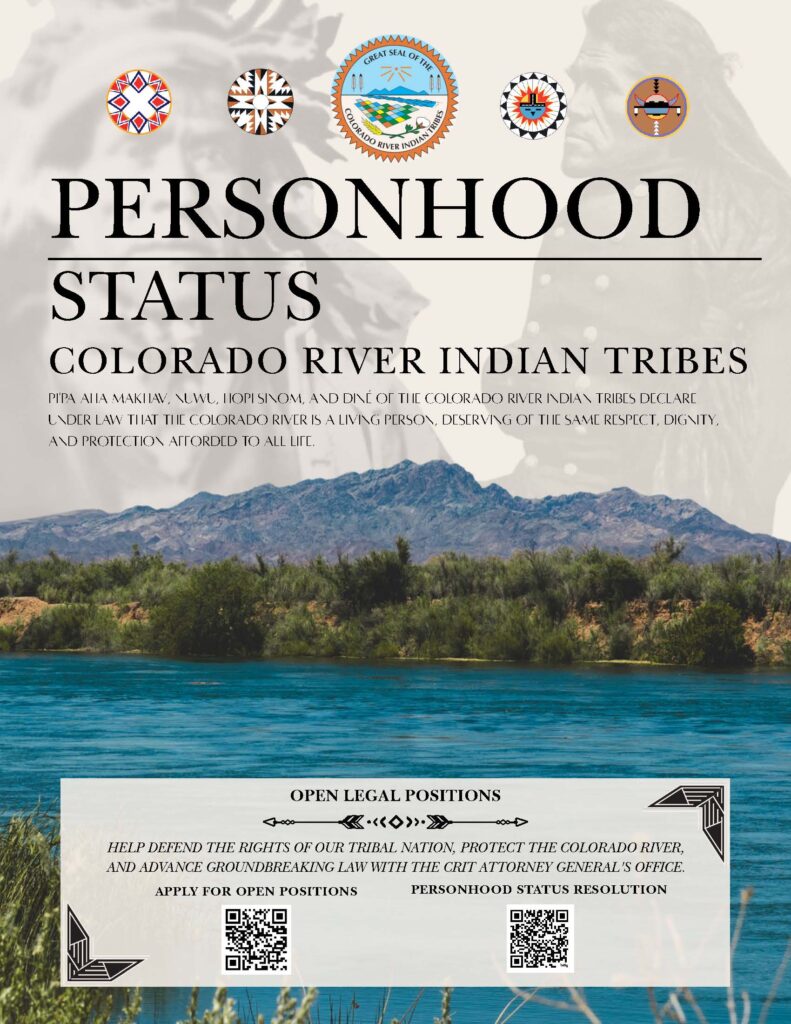
CRIT’s declaration of Personhood Status has made it into the official federal record through the FEIS. For the first time ever, Reclamation has acknowledged that the Colorado River is entitled to protection under CRIT law. While it may appear to be a small acknowledgment within this massive federal document, its significance should not be overlooked because it recognizes CRIT’s sovereign Tribal law and its role in protecting the River for generations to come.
Reclamation removed pro-rata distribution from the Preferred Alternative, as it had previously told Council they would (read about their visit here https://bit.ly/4z4Yl13). The letter acknowledges that the federal government has stated in the Preferred Alternative that it will not impact Tribal water entitlements and that any water transactions must be between willing parties.
While Reclamation removed pro-rata from the Preferred Alternative, it did not remove the language from its initial listing of alternatives. The Attorney General was clear that CRIT will always oppose any approach that could disregard the established priority system by allocating shortages proportionally among water users, including those with senior rights, instead of following the law and protecting senior Tribal rights.
Despite these important developments, Reclamation did not fully address CRIT’s earlier comments, and concerns remain with the Final EIS. It continues to incorrectly group CRIT with Tribes that receive water through the Central Arizona Project (CAP). CRIT’s water rights are directly from the Colorado River and are acknowledged in Arizona v. California as the senior-most Tribal right on the Colorado River, which makes CRIT’s water rights fundamentally different from those of Tribes in Central Arizona. Therefore, treating CRIT as though it is similarly situated to CAP Tribes is fundamentally wrong and risks obscuring the legal priority and unique status of CRIT’s water rights.
Just as importantly, CRIT again raised concerns about the lack of meaningful Tribal participation in the broader Basin States negotiation process. CRIT’s position is that Tribal Nations must have a meaningful role in shaping the decisions, not simply an opportunity to comment after those decisions have already taken form.
Quickly filing the comment letter before Reclamation takes any action, and identifying the items in the FEIS where Reclamation failed to address CRIT’s comments, are important parts of the legal process necessary to preserve CRIT’s rights for the future.
Read the comment letter in its entirety and the FEIS below.
Comment Letter
L_Colorado River Indian Tribes_Comments to BOR on Final EIS on Post-2026 Operation Guidelines for Lake Powell and Mead_08022026
FEIS
https://www.usbr.gov/ColoradoRiverBasin/post2026/final-eis/index.html
Chairwoman Amelia Flores:
“The Colorado River Indian Tribes appreciates the continued engagement by the Bureau of Reclamation as the Post-2026 Colorado River operations process moves forward. In response to CRIT’s request Reclamation recently reached out to us and walked us through the portions of the final Environmental Impact Statement relating to changes made to the document in response to comments CRIT raised during the process, but we were not shown the entire statement.
We are encouraged that Reclamation has acknowledged in the final EIS the recent action taken by Tribal Council acknowledging the Colorado River is alive and entitled to protection under CRIT Tribal law.We are also encouraged the final preferred alternative does not include allocating shortages on a pro rata basis for all water users, but instead any allocation of shortages would occur through the existing priority system or through agreements between willing parties. As long as federal agencies follow the law CRIT’s senior water rights will be protected.
We remain concerned that the BIA’s failure to properly maintain our irrigation systems adversely impacts on our ability to conserve and properly use our Colorado River water allocation.
We are mindful of the significant shortages that will be borne by tribal and other water users elsewhere in Arizona and we remain hopeful that an agreement between the United States, and the seven basin states that respects tribal sovereignty will be reached.
At the same time, we remain concerned that the highly compressed schedule severely limits our ability to conduct a comprehensive review before the document becomes final. The conversation with Reclamation was helpful, but it was not government-to-government consultation. Going forward, as the preferred alternative is being implemented, CRIT expects true consultation that respects our sovereign status and provides adequate time for meaningful review and input.”
Vice Chairman Dwight Lomayesva:
“This consultation was a good start. Our immediate need is to protect CRIT’s allocation and ensure the federal government follows the law. When received, CRIT will evaluate the final EIS and protect the Tribe’s rights, resources, and future on the Colorado River.”