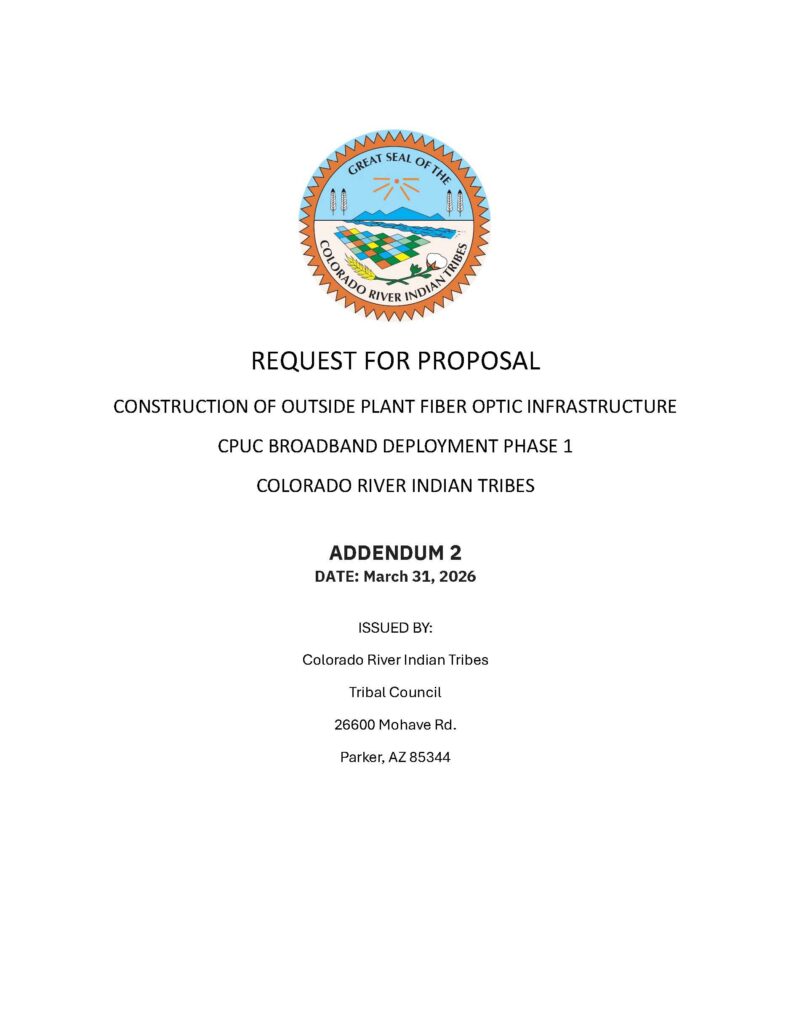
Notice to Contractors: The Colorado River Indian Tribes has issued Addendum 1 for the CPUC Broadband Deployment Phase I Request for Proposals for the construction of outside plant fiber optic infrastructure. This addendum includes answers to questions discussed during the March 17 pre-bid meeting, along with revisions to the construction specifications. Proposers are required to acknowledge receipt of Addendum 1 in the cover letter of their proposal.
Click the link for details
The Colorado River Indian Tribes (CRIT) is requesting proposals from qualified contractors for the renovation of a building located at 1405 S. Joshua Ave. in Parker, Arizona, which will serve as the future CRIT Broadband Operations Facility. The project will convert the existing structure into a secure, fully functional center to support CRIT’s expanding broadband network.
A pre-proposal site visit will take place on March 18, 2026 at 10:00 AM at the project location. Proposals are due by April 7, 2026 at 2:00 PM (Arizona Time).
Follow the link below for details.
REQUEST FOR PROPOSAL-Broadband building (002)
According to KOLD News 13, ongoing debates over how Colorado River water should be allocated could have major consequences for Arizona farmers. Agriculture relies heavily on Colorado River water, particularly through deliveries from the Central Arizona Project.
If deeper cuts are implemented under new federal operating guidelines, many agricultural operations could face significant reductions in available water. Farmers and water managers are closely watching negotiations as federal officials work to finalize new management rules for the river after 2026.
For CRIT, these discussions are important because agriculture remains one of the largest users of Colorado River water. Decisions about water allocations across the basin could influence farming operations, economic stability, and long-term water planning throughout the region.
According to the Los Angeles Times, officials from Arizona, California, and Nevada are urging the federal government to reconsider parts of its draft plan for managing Colorado River water shortages.
Leaders from the Lower Basin states say the proposal could shift too much responsibility for water reductions onto their states, even though they have already implemented conservation measures in recent years. The request highlights ongoing tensions between the Upper Basin and Lower Basin states as the federal government works toward new operating rules.
For CRIT and other Tribal Nations along the river, the outcome of these negotiations will shape how water shortages are shared across the basin and how the Colorado River is managed in the future.
According to KJZZ, a new agreement involving Arizona and Mexico could move forward plans to produce desalinated ocean water that could eventually supplement Colorado River supplies.
The concept would involve building desalination facilities along the Gulf of California and transporting treated water inland. While the project would require major infrastructure and investment, supporters say it could help reduce reliance on the Colorado River during prolonged drought conditions.
For CRIT, proposals like this reflect how states are exploring alternative water sources as pressure on the Colorado River increases and long-term supply challenges continue.
According to KJZZ, Arizona water officials are pushing back against a draft federal proposal that would guide how the Colorado River is managed after 2026. Leaders from Arizona’s water agencies say the proposal could unfairly shift more water reductions onto Lower Basin states like Arizona.
The plan is part of the Bureau of Reclamation’s process to create new operating rules for Lake Mead and Lake Powell as the river continues to face long-term drought and declining flows. Arizona officials argue the draft proposal does not adequately account for previous conservation efforts already made by Lower Basin states.
For CRIT and other Tribal Nations along the Colorado River, these negotiations are critical because the final federal plan will shape how water shortages are shared and how the river system is managed in the decades ahead.
According to the Colorado Sun, water experts are exploring a “conservation pool” concept that could help stabilize water levels in the Colorado River’s major reservoirs. The idea would create a reserve of water stored specifically to protect Lake Mead and Lake Powell from dropping to critically low levels.
Under the proposal, water users across the basin would contribute conserved water that could be held in reserve and used during severe shortages. Supporters say the concept could provide more flexibility in managing the river during drought conditions.
For CRIT and other Colorado River communities, ideas like this illustrate the kinds of creative management strategies being discussed as officials work to protect the long-term reliability of the river system.
Source:
https://coloradosun.com/2026/03/04/conservation-pool-path-forward-colorado-river/
According to the Imperial Valley Press, California water officials are warning that the federal government’s proposed Colorado River management plan could conflict with the Colorado River Compact and other long-standing water agreements.
State officials say parts of the draft plan could undermine legal water rights that have governed the river for more than a century. The warning highlights growing tension among the basin states as they struggle to reach consensus on how to manage declining river supplies.
For CRIT, discussions about the Law of the River, compacts, and federal authority are especially important because Tribal Nations hold legally recognized water rights that must be considered in future river management decisions.
According to KTAR News, decisions being made about the future management of the Colorado River will have major consequences for Arizona’s water supply. State leaders say upcoming federal decisions on post-2026 river operations could determine how much water Arizona receives during future shortages.
The Colorado River supplies water to millions of people across the Southwest and supports agriculture, cities, and power generation. As negotiations among the seven basin states remain unresolved, federal officials may ultimately have to determine how water reductions are shared.
For CRIT and other Tribal Nations along the Colorado River, these decisions are especially important because new operating rules will guide how the river is managed for decades and could influence water deliveries, infrastructure planning, and long-term water security.
According to 9News Denver, the seven Colorado River Basin states have missed key deadlines to reach a new agreement on how to manage the shrinking river. With negotiations stalled, the federal government may ultimately step in and set new operating rules.
The U.S. Department of the Interior has been working with the states to develop guidelines for managing Lake Mead and Lake Powell after 2026, when current shortage agreements expire. Without consensus among the states, federal officials could impose a plan to prevent reservoir levels from dropping to dangerously low levels.
For CRIT, federal involvement in Colorado River operations is significant because Tribal Nations are key stakeholders in the river system. Decisions made during this process could affect water allocations, infrastructure planning, and the long-term stability of the river that supports communities across the basin.
According to 12News (KPNX), Arizona leaders say the state is approaching a critical moment as Colorado River negotiations continue and water cutbacks remain likely. Officials described the situation as a crossroads, warning that the next few years will require difficult decisions about conservation, water use, and long-term planning.
The looming reductions stem from ongoing negotiations over post-2026 operating rules for the Colorado River, which will determine how water shortages are shared among the seven basin states. Arizona has already taken significant reductions under earlier shortage agreements, and additional cuts could affect cities, agriculture, and water providers across the state.
For CRIT and other Tribal Nations along the river, these discussions are important because future operating guidelines will shape how the Colorado River is managed for decades. Tribal water rights, infrastructure investments, and long-term planning will all be influenced by how states and the federal government resolve these negotiations.
According to the Arizona Republic, scientists say the western United States may not simply be experiencing a drought but a long-term shift toward a drier climate known as “aridification.” Researchers say the region has effectively been in a 32-year drought, but climate patterns suggest the West could remain permanently drier than historical averages.
This shift is affecting the Colorado River Basin, where reservoirs like Lake Mead and Lake Powell remain far below historic levels despite occasional wet years. Scientists say warmer temperatures cause more water to evaporate and reduce snowpack that normally feeds the river.
For CRIT, this concept of aridification is important because it changes how water planning is approached. Instead of preparing for drought cycles followed by recovery, water managers may need to plan for a permanently smaller Colorado River supply.
According to KJZZ, lawmakers introduced around 30 groundwater-related bills during the current Arizona legislative session, but most proposals do not directly focus on conservation. Instead, many of the bills address water development, transportation, or regulatory changes.
Arizona groundwater policy has become a growing concern as communities increasingly turn to underground aquifers to supplement shrinking Colorado River supplies. Some lawmakers and water experts argue stronger conservation policies are needed to protect these aquifers for future generations.
For CRIT and other Tribal communities, groundwater policy is significant because it influences regional water demand and long-term water sustainability across Arizona. As Colorado River supplies tighten, groundwater management decisions could shape how the state balances growth with water availability.
According to KJZZ News, environmental groups are warning of serious long-term impacts to the Colorado River system after negotiators missed another deadline to finalize future water management rules. Advocates say declining reservoir levels, ongoing drought, and delayed agreements could increase pressure on ecosystems, agriculture, and water supplies across the Southwest. The warnings highlight growing urgency for coordinated conservation and policy action. For CRIT, these discussions are important because federal decisions about river operations directly influence how tribal water rights are protected and how long-term water stability is maintained.
Source: KJZZ News — https://www.kjzz.org/politics/2026-02-19/environmental-groups-warn-of-dire-impacts-after-colorado-river-negotiators-miss-another-deadline
According to Nevada Public Radio, Colorado River negotiations continue to face challenges as states balance drought impacts, water demand, and competing priorities. Officials involved in the talks say progress has been uneven and that future agreements may require difficult compromises across the basin. Continued uncertainty highlights the complexity of managing the river under changing climate conditions. For CRIT, ongoing interstate negotiations remain important because federal and regional policy decisions directly affect how tribal water rights are recognized and protected.
Source: Nevada Public Radio — https://knpr.org/show/knprs-state-of-nevada/2026-02-20/nevadas-main-water-negotiator-talks-about-the-bumpy-road-ahead-in-the-colorado-river-discussions
According to Newsweek, recent data shows some improvement in Lake Mead water levels following storms and conservation efforts, offering cautious optimism for the Colorado River system. However, experts note that long-term drought conditions still pose significant challenges and continued conservation will remain essential. Reservoir levels remain a key factor in determining water deliveries across the basin. For CRIT, reservoir conditions remain important because federal operational decisions tied to storage levels directly affect how tribal water allocations are managed and protected.
Source: Newsweek — https://www.newsweek.com/lake-mead-water-levels-get-good-news-11557968
According to Arizona Water News, Arizona and its Lower Basin partners say they remain committed to finding common ground on new Colorado River operating rules despite stalled negotiations among the seven basin states. Officials emphasized continued collaboration with federal agencies and neighboring states to stabilize water supplies beyond 2026 as drought conditions persist. The effort reflects ongoing attempts to balance conservation, water demand, and long-term river sustainability. For CRIT, these negotiations remain important because federal and interstate agreements directly influence how tribal water rights are recognized and protected in future Colorado River management decisions.
Source: Arizona Water News — https://www.azwater.gov/news/articles/2026-02-19
According to the Navajo Times, federal officials are moving forward with developing new Colorado River operating guidelines even as state negotiations remain stalled. The Department of the Interior is continuing its environmental review process to prepare for post-2026 river management, highlighting the federal government’s role when states cannot reach consensus. Tribal consultation remains part of that process. For CRIT, federal involvement is significant because Colorado River policies shaped at the federal level directly affect tribal water rights, long-term planning, and regional water security.
Source: Navajo Times — https://navajotimes.com/reznews/federal-officials-move-forward-on-colorado-river-operating-rules-as-state-negotiations-stall/
According to ABC 15 Arizona, tribal nations along the Colorado River are among those with the most at stake as negotiations over future water allocations continue. Tribal leaders emphasize the importance of protecting established water rights while ensuring sustainable solutions to ongoing drought conditions. The article highlights how tribal participation is increasingly central in discussions about the river’s future. For CRIT, these conversations are especially important because tribal sovereignty and water rights remain critical factors in how Colorado River resources are managed across the basin. (more…)
The Colorado River Indian Tribes Employment Development and Training Department (ED&T) continues to be a vital resource for tribal members seeking support, skills, and employment. Through partnerships with the Department of Labor, Arizona Tribal Workforce, and the Department of Economic Security, ED&T provides job readiness services, education support, and hands-on work experience to those enrolled in a federally recognized tribe. Their mission focuses on promoting general welfare, encouraging educational progress, protecting tribal interests, and helping community members build stable, independent futures.
The department offers a wide range of services designed to meet people where they are. Community members can receive help studying for a driver’s permit or license, creating resumes and cover letters, preparing job applications, and building job readiness skills. ED&T also assists with obtaining needed documents such as a GED or ID. For those looking to gain work experience, the Adult Work Experience program offers a 90-day on-the-job training period with the goal of permanent employment once training is complete. High school and college students can participate in the Summer Youth Experience Program, which provides hands-on workplace exposure during summer break. When needed, ED&T also provides supportive services such as work clothing, tuition assistance, certifications, testing fees, and education supplies if those items cannot be obtained through another program.
Click the links below to upload needed forms
UPDATED SUPPORTIVE SERVICE FORM 2025

The department is guided by a committed team dedicated to helping the community move forward. Acting Director and Case Worker Kaye Antone works closely with participants to understand their goals, explore their interests, and determine what support they may need. Office Administrator Madolyn Brenner reviews applications, assists staff, and helps maintain a welcoming and organized department. Office Assistant Deaun Johnson and ED&T participant supports daily operations, helps participants with questions, and ensures they receive assistance quickly and respectfully. Together, the team works one-on-one with community members and emphasizes the importance of offering help confidentially and with care, recognizing that every situation is different. (more…)

(Parker, Ariz.) CRIT’s Tribal Council has voted to acknowledge personhood status for the Colorado River under Tribal Law. The Tribal Council approved the resolution on November 6th.
Click the link below to see the entire resolution.
personhood resolution
The council’s decision came after soliciting substantial input from Tribal Members in person and in writing through numerous outreaches.
Other Tribes have approved similar measures to safeguard natural resources. CRIT would be the first community to do so for the Colorado River. The status comes as overuse and drought are threatening the life of the River which CRIT considers to be a living entity in addition to being a life-giving resource.
Personhood status means the Colorado River has the right to be protected under Tribal Law. The status directs current and future Tribal Councils to account for the needs of the River in decision-making as well as giving CRIT legal means to address the damage climate change is causing to the Colorado River.
The resolution states in part:
“There is no greater expression of sovereignty than protecting, stewarding, and securing for future generations what our Ancestors handed down to us, and that personhood status is a reflection of our values as a people and our spiritual, cultural, and religious connection to the Colorado River from the beginning of time through the end of time;”

CRIT’s Attorney General and staff will be developing provisions for Tribal Council review and possible approval for inclusion in the tribal code, including the Water Code, to reflect the personhood status of the Colorado River as well as all the protections to which the Colorado River will be entitled under tribal law.
CRIT Chairwoman Amelia Flores said, “This resolution authorizes CRIT to take specific and concrete actions for the river and its ecosystem at a time when, more than ever, it is needed. Within Arizona, CRIT will be inevitably asked to help shoulder the burden of maintaining Arizona’s economy and way of life. This must be a two-way street, however. At CRIT we are prepared to engage and be part of the solution for Arizona, but part of the solution is the long-term protection of our river. The river is a part of who we are and who we will always be: The Colorado River Indian Tribes.”
In the quiet valley of the Colorado River Indian Tribes (CRIT), once stood one of the largest Japanese American incarceration camps of World War II, the Poston War Relocation Center. Between 1942 and 1945, nearly 18,000 men, women, and children of Japanese ancestry were forced to live there.
This past weekend, the annual Poston Pilgrimage returned to the CRIT Reservation, drawing in the largest gathering to date. More than 100 visitors met at the CRIT Museum to honor those who have lost their lives while imprisoned at Poston. Starting the weekend off at Blue Water Casino was an introduction of the event with descendants of former incarceratees, Chairwoman Amelia Flores, Debbie Pettigrew, and Karen Harjo. Many of the adults who once lived in the camps have since passed on, leaving their children to share stories of life inside, memories that continue to move and teach new generations.
This year’s pilgrimage carries special meaning with the arrival of the Ireichō, also known as The Book of Names.
The Ireichō is part of the Irei: National Monument for the WWII Japanese American Incarceration, a national project dedicated to honoring more than 125,000 people of the Japanese ancestry who were unjustly imprisoned during the war.
For the first time, every individual’s name has been compiled into one permanent record. The Ireichō follows the Japanese Buddhist tradition of kakochō, “The Book of the Past,” in which the names of those who have passed are written to be remembered and respected.
Unveiled at the Japanese American National Museum, the Ireichō invites visitors to place a red hank (stamp) beneath each name as an act of remembrance. The book has since traveled to historic incarceration sites across the country, allowing families, descendants, and visitors to honor those who lived through that time in history.
The day began with a blessing from Duncan Ryūken Williams, the Ireichō’s co-founder and Soto Zen Buddhist priest.
The Ase S’maav Parker Boys and the River Tribes United Dance Group shared songs and danced for the descendants of Poston’s former residents. The ceremony closed with a memorable moment as children and families were invited to stamp the Book of Names.
Each year, the Poston Pilgrimage brings together descendants, historians, and community members returning to the monument to honor those who lived behind the barbed wire and ensures their stories continue to be told. What makes Poston unique is its shared history between the Japanese American community and the tribal nations whose land was used for the camp. Built on CRIT lands under federal direction, the camp became a symbol of resilience and reflection, a reminder of the injustices endured and strength that followed. (more…)