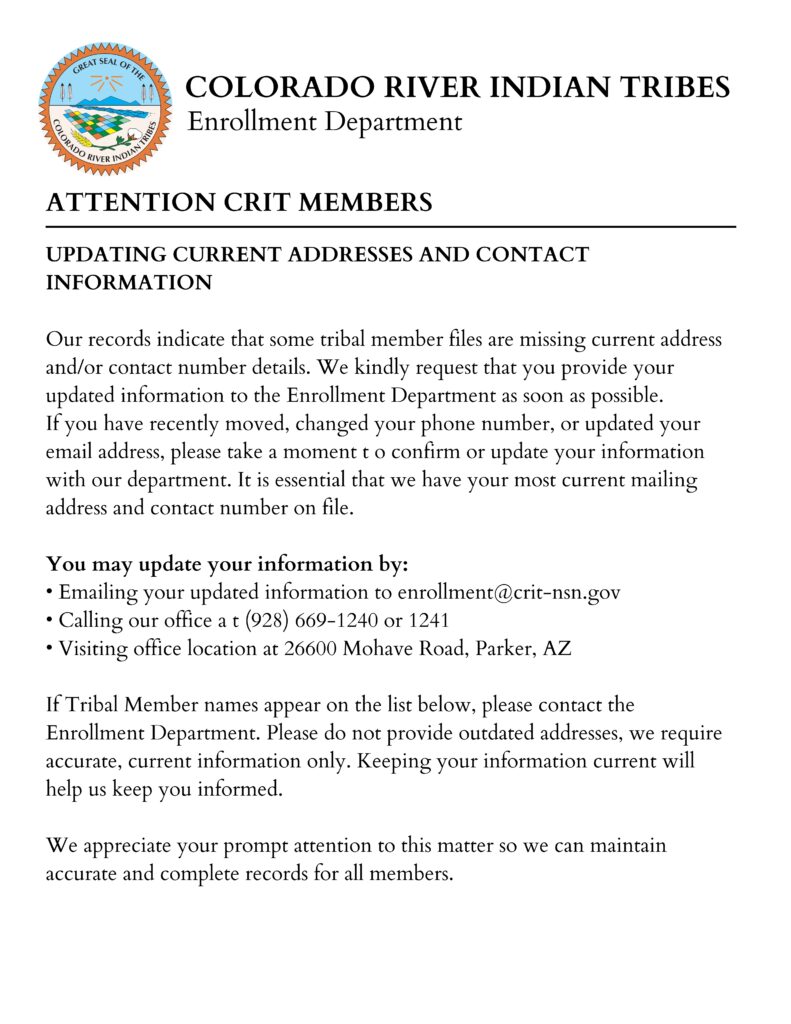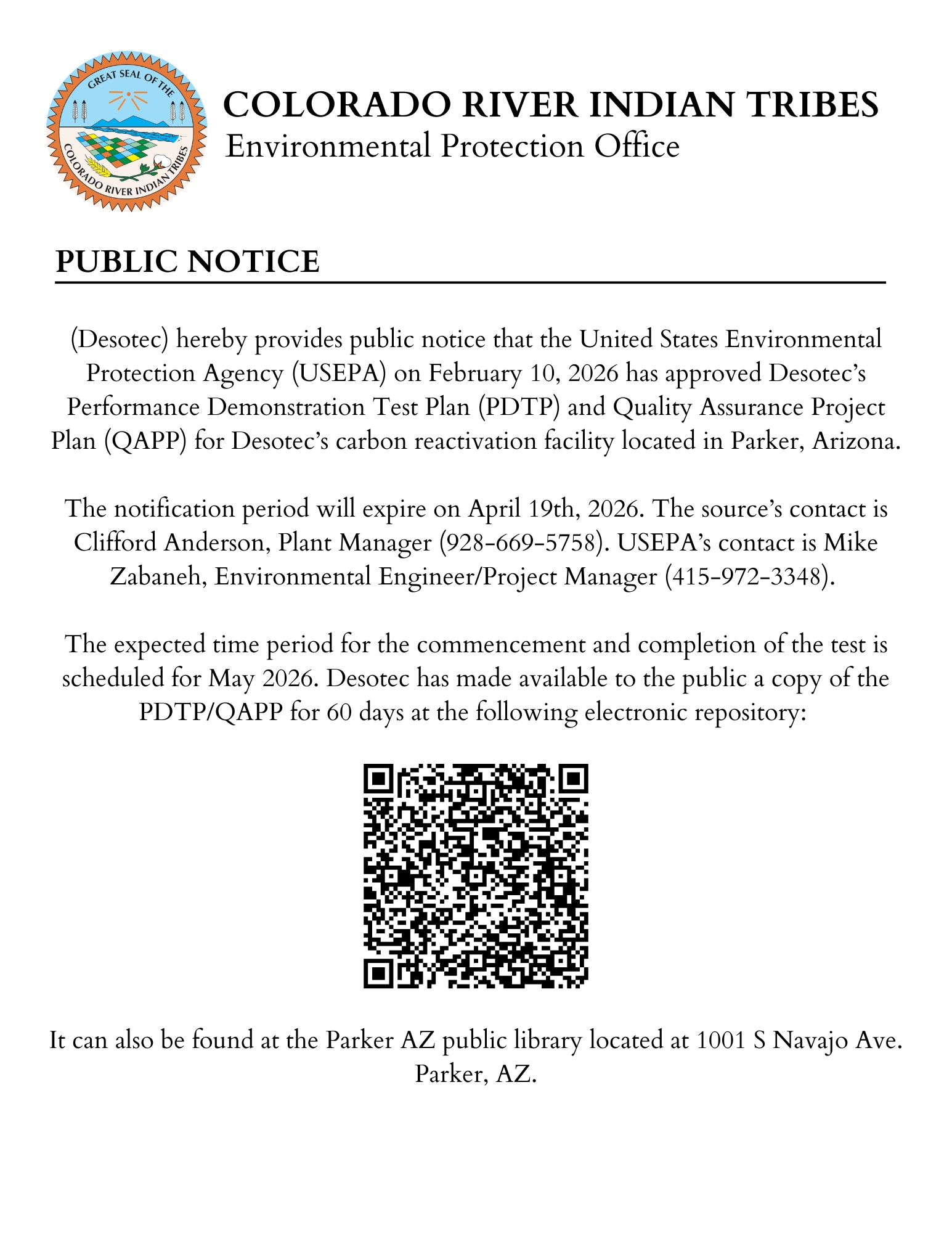
Follow the link below for the propsed amended code
2026 Amended and Restated Gaming Code_Public Hearing
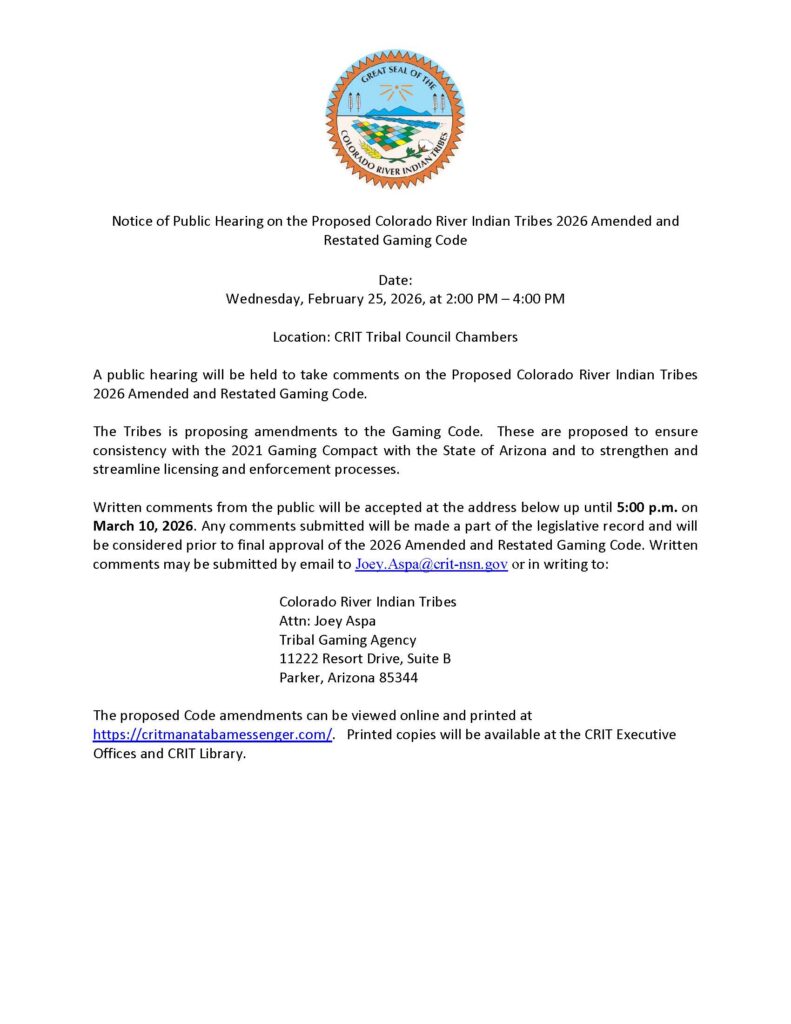
Follow the link below to download an application.
CRIT Tribal Board Vacancies Application 2026

The Colorado River Indian Tribes (CRIT) Water Resources Department is now accepting proposals for Drain Cleaning and Mechanical Vegetation Management services for the Colorado River Irrigation Project (CRIP) near Parker and Poston, Arizona.
This project supports the continued care and functionality of CRIT’s irrigation system, which is vital to agricultural operations and stewardship of the Colorado River. Qualified contractors are encouraged to review the full Request for Proposals and submit by the stated deadline.
For full details, submission guidelines, and requirements, click the link below.
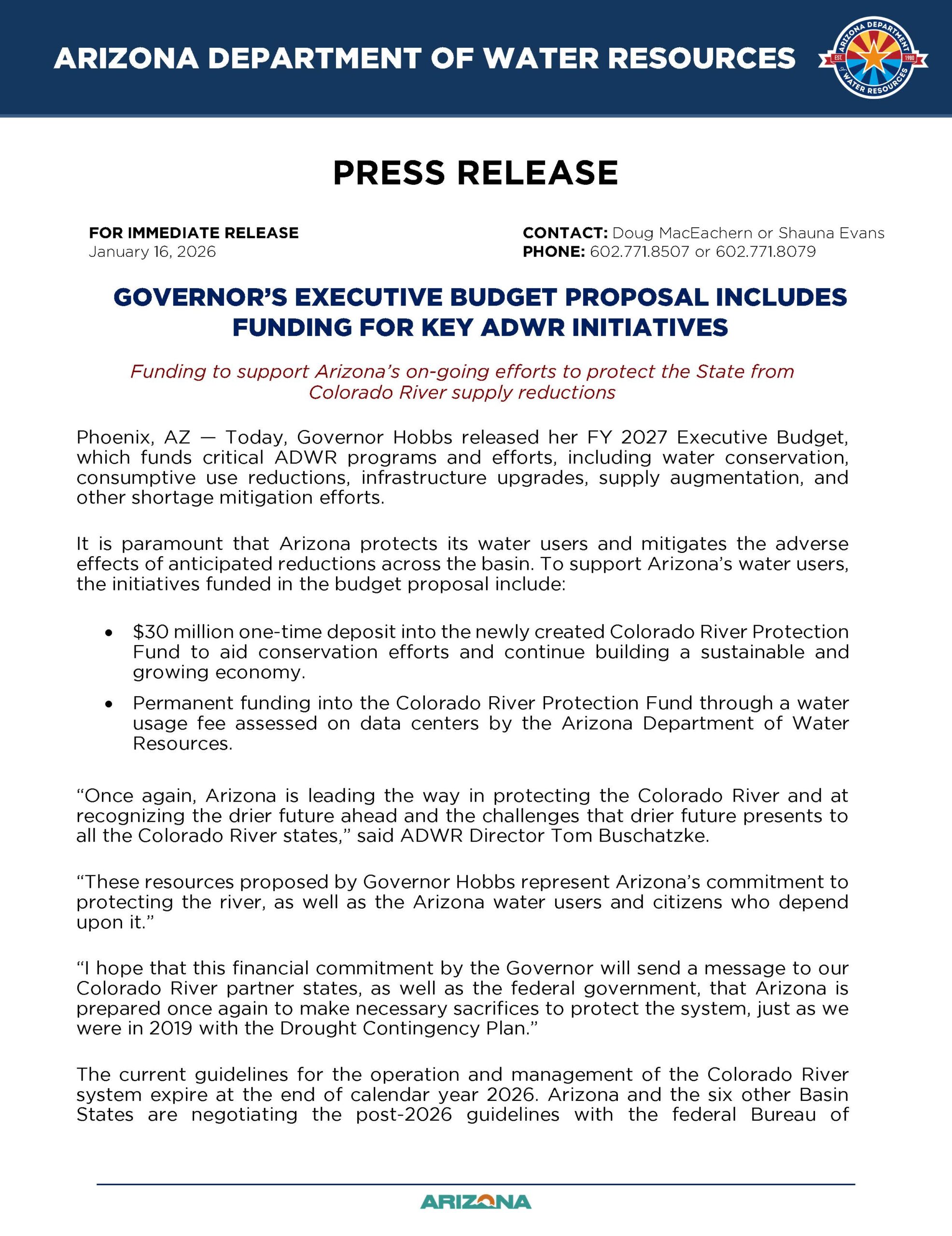
The Colorado River Indian Tribes Tribal Council has made a historic decision to protect the lifeblood of their Reservation. On November 6, 2025, the Council unanimously approved Resolution No. R-375-25, which proclaims the personhood status of the Colorado River under tribal law.
This resolution acknowledges the Colorado River as a living entity whose health and well-being are intrinsically linked to the well-being of the Colorado River Indian Tribes (CRIT) members. The Tribes’ deep-rooted connection to the river spans centuries, providing cultural identity, spiritual strength, food systems, and economic stability that continue to shape their community life today.
The resolution emphasizes the central role the river has played in defining the identity of the CRIT. It highlights that CRIT’s ancestors have preserved and protected these lands since before the establishment of the Colorado River Indian Reservation in 1865.
The Council underscores the crucial role the river plays in sustaining traditional practices, wildlife, and agriculture, including the federal irrigation systems authorized as early as 1867. Today, the Colorado River Indian Irrigation Project stands as a cornerstone of the tribal economy.
The resolution underscores significant legal milestones that acknowledged CRIT’s water rights. In the landmark 1964 and 2006 Arizona v. California U.S. Supreme Court decisions, the Tribes secured 719,248 acre-feet of water annually, ensuring their access to the river for generations to come.
By granting personhood to the River, the Tribal Council reaffirmed its sovereign duty to honor and protect it. This status mandates that the River’s well-being must be a priority in governance and decision-making moving forward.
As part of the resolution, the Attorney General and their staff will develop legal safeguards and propose updates to the CRIT Water Code and other relevant regulations. These updates may include the potential designation of the river as a protected cultural landscape.
Council members recognized that protecting the river is not merely a legal obligation but a continuation of cultural beliefs passed down through generations.
Through this declaration, CRIT demonstrates its unwavering commitment to stewardship. The resolution concludes with a resolute message: the Colorado River is, and will always remain, a vital entity deserving of respect, care, and protection for all future generations.
Article Written by CRIT Media Reporter Ariana Romero
News Update November 12, 2025
Negotiations over the future of the Colorado River have reached a standstill after all seven basin states failed to meet a key federal deadline. Reports from 12News and 8NewsNow confirm that the states were unable to agree on a new water-sharing plan, leaving the situation unresolved as the river continues to decline.
High Country News explains that the biggest disagreements involve how much each state should give up in the future. The upper Basin states want fewer mandatory reductions, while the Lower Basin states, including Arizona, say they have already taken the deepest cuts and cannot continue to absorb the majority of the impacts.
With no agreement in place, Arizona Governor Katie Hobbs has asked the Trump administration to intervene. She stated that Arizona has made significant sacrifices and cannot carry the weight of the reductions while other states refuse to commit to measurable cuts. If the states cannot reach a plan soon, the federal government may create one for them.
For the Colorado River Indian Tribes, the outcome of these negotiations has major importance. CRIT holds valuable senior water rights and relies on a stable and fair management plan to ensure long-term security for the community and the region.
For more information, you can read the news articles with the links below.
High Country News
https://www.hcn.org/articles/why-colorado-river-negotiations-are-so-difficult/
12 News
/wednesday-is-deadline-for-7-state-including-arizona-to-negotiate-the-colorado-river
CRIT Chairwoman Amelia Flores and Councilman Tommy Drennan attended the 45th Annual Colorado Law Conference on Natural Resources in Boulder, Colorado June 5th and 6th.
“It was an honor to attend this important gathering which brought together leaders, legal experts, and diverse stakeholders from across the country to address today’s most pressing issues in natural resource law and policy,” said Chairwoman Flores.
While at the conference CRIT Councilman Drennan and Chairwoman Flores met with Senior Department of Interior and Bureau of Reclamation officials to further the goals of the tribes, including finalizing a $1million grant to identify repairs needed on CRIT’s irrigation project.
CRIT’s 15th Annual Earth Day Celebration May 31 not only featured raffles, music, food, and information booths, it also provided Tribal Members the opportunity to learn about and weigh in on personhood status under Tribal Law for the Colorado River.
The event took place at the Ahakhav Preserve and ran from 8am to 11am.
CRIT Chairwoman Amelia Flores and Councilman Tommy Drennan were on site to provide information and answer questions about the personhood status issue under consideration by the CRIT Tribal Council.
Personhood status would mean that the Colorado River, along with its spiritual and cultural connection to CRIT, has the right to be protected under Tribal Law. It would acknowledge what members already know and believe, that the River is alive, and it is a part of every Tribal Member. It would direct current and future Tribal Councils to account for the needs of the River in decision-making as well as giving CRIT legal means to address the damage climate change is causing to the Colorado River. It would state that anyone doing business with CRIT will be required to address the needs of the Colorado River. (more…)
PARKER, AZ – May 23, 2025 – With a stadium full of proud families, friends, and community members, Parker High School honored the Class of 2025 with an unforgettable commencement ceremony at Joe Bush Stadium.
The evening began with the PHS Band performing “Pomp and Circumstance.” The PHS Choir followed with a stirring performance of the National Anthem.
The program included heartfelt speeches by Senior Class Officer Jacob Bailey, Salutatorian David Daly, and Valedictorian Maria Loudbear. Their words reflected on the challenges, growth, and milestones of the past four years, while also looking ahead with hope and determination. The ceremony also featured moving musical selections from Wicked, arranged by Jay Bocook and performed by the PHS Choir and Band.
(more…)
David Corona started his career with the Colorado River Indian Tribes on December 2, 2004 as an EMT/Firefighter with the CRIT Fire Department.
Demonstrating exceptional commitment, skill and leadership, Mr. Corona was promoted to Captain in February of 2006, a role he still holds today.
Captain Corona has dedicated all his years of service with CRIT to the Fire Department. (more…)
TUCSON, Ariz. — The University of Arizona will host a special series of sign unveiling ceremonies on Friday, September 4, 2026, honoring the four languages of the Colorado River Indian Tribes (CRIT): Mohave, Chemehuevi, Hopi, & Navajo. These ceremonies represent an important milestone in an ongoing campus-wide initiative to elevate the visibility, recognition, and continued presence of Indigenous languages and cultural heritage within the campus community.
The events are organized by the University of Arizona’s Office of Native American Advancement & Tribal Engagement (NAATE) in collaboration with individual academic colleges. Students, faculty, staff, tribal community members, and the general public are invited to attend the progression of ceremonies throughout the day.
The schedule for the Friday ceremonies includes:
The celebration of Indigenous culture continues into the weekend with the Native American Heritage Game on Saturday, September 5, 2026. The Arizona Wildcats will face Northern Arizona at Casino Del Sol Stadium, with kick-off scheduled for 6:30 PM MST. Pre-game festivities at Bear Down Field will begin at 3:15 PM with the Bear Down Bash, featuring 18-minute cultural performances from each tribe. A traditional gift presentation will follow during the Wildcat Walk at 4:15 PM, leading up to an on-field tribal recognition ceremony during the second quarter of the football game.
For more operational schedules or to register for the unveiling events, please visit the official University of Arizona Event Page.