August 14, 2026 4:44 pm
CRIT Nation, Parker, AZ
August 14, 2026 4:44 pm
CRIT Nation, Parker, AZ

Según BIA Electric, Mochem Housing en el valle no se quedará sin electricidad.

Click the links below to download a form

Direct Deposit Authorization Form

General Welfare Application_09242024

General Welfare Application Minors_09242024

PLEASE READ CAREFULLY


Dear Tribal Member:

Tribal Council has approved a 2024 General Welfare Assistance payment of $2,000.00 for each CRIT Tribal Member. CRIT Tribal members, both minors and adults, who are enrolled with CRIT as of November 1, 2024 are eligible to receive assistance. Tribal Members MUST submit an application to receive a General Assistance Payment for 2024.

Click the links below to download a form

Direct Deposit Authorization Form

General Welfare Application_09242024

General Welfare Application Minors_09242024

This 2024 General Welfare Assistance payment replaces the annual Tribal Distribution Payment.  The benefits to the membership are that the General Welfare Assistance payment is NOT income subject to federal taxes and should not impact eligibility for benefits such as SSI and food stamps.  You will not be issued a 1099 for this payment.  Please review the General Welfare Plan for more information.

Tribal Members will receive their General Welfare Assistance payment by mail or by direct deposit into a bank account after submitting their application.  Parents or legal guardians may request direct deposit for their eligible minor tribal member children into an account owned by the parent or the child.  YOU DO NOT HAVE TO SUBMIT A NEW DIRECT DEPOSIT FORM WITH YOUR APPLICATION IF YOU INTEND TO RECEIVE YOUR GENERAL WELFARE ASSISTANCE PAYMENT IN SAME BANK ACCOUNT AS YOU RECEIVED YOUR 2023 GENERAL WELFARE ASSISTANCE PAYMENT.

The General Welfare Assistance payment will be mailed or direct deposited as follows:

Application and Forms Due Date                   Payment Issued

Must be received by Accounting:

October 18, 2024                                            November 21, 2024

November 22, 2024                                        December 19, 2024

December 20, 2024                                         January 16, 2025

After December 20, 2024                              Payments issued monthly on a rolling basis

and before December 31, 2025

If you want to receive your General Welfare Assistance payment by direct deposit, you must submit the attached Direct Deposit Authorization Form along with a voided check to CRIT Accounting.  If you do not have a direct deposit authorization form on file from last year, or do not submit one for 2024 with your application, your payment will be mailed to the address on your application.  The mailing address you provide on the application will be used to update your address with both enrollment and accounting.   You may have already  received written notification  along with  an application and a self-addressed stamped envelope for your use to return the forms or the forms can be dropped off in person at Tribal Administration.  Additionally, the application and forms can be emailed to GWA@crit-nsn.gov.

Please note that the checks for eligible minor tribal members will be issued in the name of the child and not the parents. Parents or guardians must submit proof of their right to receive the distribution on behalf of their child by submitting an application with a copy of the birth certificate listing the parent(s), and if applicable, a court order establishing legal custody and placement before checks will be mailed or the payment directly deposited.

Checks will not be issued to the parent(s) if they do not have the care and custody of their children.  Guardians and custodians of minors who are not the child’s legal parent shall be required to provide a court order indicating their status.  Payments for children in the physical care and custody of CRIT Social Services or other state or tribal agencies shall be held in an account established by CRIT Accounting.

Tribal Members must apply for the 2024 General Welfare Assistance Payments no later than December 31, 2025 after which a 2024 payment will not be available.

Please be advised that if you are in default on a debt you owe to the Colorado River Indian Tribes or its enterprises, you may voluntarily agree to apply your General Welfare Assistance to the loan or other outstanding debt in default.  If you have any questions about outstanding debts in default please contact Tracey Quillen at (928) 669-1239.

If you have any questions regarding General Welfare Assistance or you have an agency incorrectly treating this payment as income please contact the Office of the Attorney General at (928) 669-1271.

Click the links below to download a form

Direct Deposit Authorization Form

General Welfare Application_09242024

General Welfare Application Minors_09242024

Follow this link for more information including how to apply.

This position is located with the Bureau of Indian Affairs, Superintendent, Colorado River Agency in Poston, Arizona.

Duties

  • Responsible for supervising Lead Irrigation System Operators and Irrigation System Operators.
  • Receives water orders; takes daily measurements; maintains record of water delivery, reservoir inflow and outflow, and instream flows, calculates requirements for area served.
  • Operates project distribution facilities to regulate and deliver water in accordance with Bureau water project policies and procedures.
  • Responsible for constant surveillance and condition or irrigation related faculties. Recommends needed maintenance and schedules required repairs.
  • Plan work for subordinates, establish priorities and prepares schedules for its completion.


News Update November 12, 2025

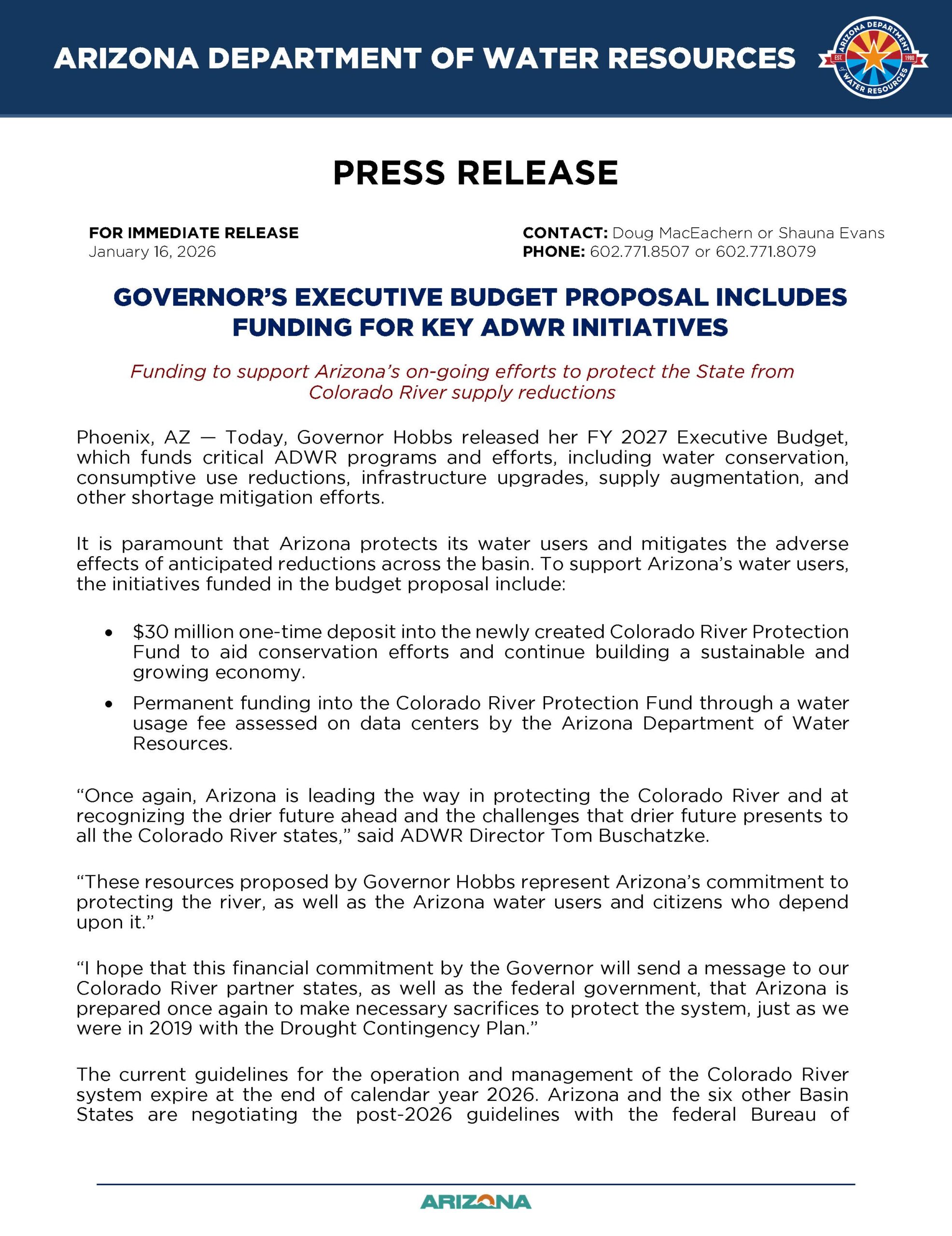
Negotiations over the future of the Colorado River have reached a standstill after all seven basin states failed to meet a key federal deadline. Reports from 12News and 8NewsNow confirm that the states were unable to agree on a new water-sharing plan, leaving the situation unresolved as the river continues to decline.

High Country News explains that the biggest disagreements involve how much each state should give up in the future. The upper Basin states want fewer mandatory reductions, while the Lower Basin states, including Arizona, say they have already taken the deepest cuts and cannot continue to absorb the majority of the impacts.

With no agreement in place, Arizona Governor Katie Hobbs has asked the Trump administration to intervene. She stated that Arizona has made significant sacrifices and cannot carry the weight of the reductions while other states refuse to commit to measurable cuts. If the states cannot reach a plan soon, the federal government may create one for them.

For the Colorado River Indian Tribes, the outcome of these negotiations has major importance. CRIT holds valuable senior water rights and relies on a stable and fair management plan to ensure long-term security for the community and the region.

For more information, you can read the news articles with the links below.

8NewsNow
https://www.8newsnow.com/news/local-news/colorado-river-negotiations-fail-to-meet-federal-deadline-for-7-state-agreement/

High Country News
https://www.hcn.org/articles/why-colorado-river-negotiations-are-so-difficult/


ABC 15 News
https://www.abc15.com/weather/impact-earth/why-gov-katie-hobbs-wants-trump-administration-to-broker-colorado-river-deal


12 News
/wednesday-is-deadline-for-7-state-including-arizona-to-negotiate-the-colorado-river

Chief Irataba stands among the most notable figures in Native American history. Some leaders are remembered for their war strategy and resistance, while others are known for diplomacy and negotiation. Rarely do those qualities come together in one leader. Chief Irataba was one of those rare individuals. Known by the Mohave people as fearless, and described by American settlers as peaceful and fair, Irataba helped shape the future of the Mohave people and the land that would later become the Colorado River Indian Reservation.

Irataba, whose Mohave name was Eecheyara Tav, meaning bright bird,” was born around 1814 along the Colorado River. Historical accounts describe him as a striking and commanding figure. Standing approximately six feet four inches tall, with a heavy jaw and broad shoulders, he was widely recognized for his intelligence, bravery, and leadership. Despite his powerful physical presence, those who encountered him often described his demeanor as calm and gentle. Historian Arthur Woodward referenced early descriptions of the Mohave leader, writing that Irataba was “a man six feet four inches tall, of very powerful frame, but very gentle and kind in demeanor.”

During the early nineteenth century, Mohave communities thrived along the Colorado River. The river provided fertile floodplains for farming and served as an important route for travel and trade among tribes throughout the region. Irataba rose to prominence during this time and became a war leader of the Kwanami, a group whose name has been interpreted as meaning “fearless.” His leadership earned him a reputation as both a warrior and a respected decision-maker within the community.

Accounts from the period suggest that Irataba’s influence extended beyond his own village. One early description noted that he “seemed to have great influence over neighboring tribes and acted in disputed questions as a kind of supreme judge.” His ability to mediate disputes and maintain relationships among tribes helped establish him as one of the most respected leaders in the Colorado River region.

By the 1850s, the Colorado River began attracting increased attention from American explorers and the United States government as they searched for routes across the Southwest. One of the most notable expeditions during this time was led by Joseph Christmas Ives, who traveled along the river studying its geography and potential as a transportation route.

Historical accounts indicate that Irataba played an important role during these early encounters. Acting as a guide and intermediary, he helped facilitate communication between Mohave communities and American explorers traveling through the region. Newspaper reports from the time also recognized his authority. An article published in the Los Angeles Star in 1861 described Irataba as not only the chief of the Mohave people but someone who possessed more influence in the Colorado River country than any other chief in the district.

In 1864, Chief Irataba traveled to Washington, D.C., where he met with Abraham Lincoln and other federal officials. His visit brought national attention to the Mohave people and the challenges facing tribes along the Colorado River as settlers, miners, and military expeditions entered the region. On March 3, 1865, the Colorado River Indian Reservation was formally established by executive order issued by President Abraham Lincoln along the lower Colorado River. The reservation would eventually become home to the Mohave, Chemehuevi, Hopi, and Navajo peoples and remains the homeland of the Colorado River Indian Tribes today.

Chief Irataba continued to be a respected leader among the Mohave people throughout the later years of his life. He died in May of 1874 at his home along the Colorado River. Some historical accounts referred to him as “the Uncas of his tribe,” a comparison meant to recognize him as one of the last great leaders of the Mohave people during that era.

Today, many Mohave families continue to live in and around Parker, Arizona, within the Colorado River Indian Tribes community. The history of Chief Irataba is not only preserved in historical records but also through the families and descendants who remain connected to the land along the Colorado River. Generations of Mohave people have continued to live, work, and raise their families in the same region their ancestors once called home.

More than a historical figure, Chief Irataba’s legacy lives on through the people of the Colorado River Indian Tribes. His leadership during a time of great change helped shape the future of the Mohave people, and his story continues to be remembered as a symbol of strength, diplomacy, and resilience for generations to come.

Article written by CRIT Media Reporter Ariana Romero

Nineteen years ago, Mega Throw began, and despite temperatures reaching over 105 degrees, Mega Throw XIX returned to Ahakhav Tribal Preserve on the Colorado River Indian Tribes reservation. Hosted by Ase S’maav, the Mohave Bird Singers, the two-day gathering welcomed tribes from near and far, with songs and tradition carrying on through the heat.
Mega Throw XIX continues a tradition that began in 2004 with a small group wanting to learn and sing. What started as a grassroots effort has grown into an ongoing commitment to keeping songs, language, and teachings active. Throughout the weekend, the preserve filled with the sound of bird songs and the movement of dancers as participants and spectators came together, carrying that purpose forward through their presence and participation.
Despite the intense heat, participants remained committed, continuing to sing and dance throughout the weekend. The dedication shown reflected the importance of the gathering, as the circle remained strong and songs carried on without pause.

From the youngest participants to experienced singers, the event highlighted the role of youth in learning through participation. Tiny tots and youth dancers stepped into the circle, some shy and others confident, following the rhythm of the gourd and songs as they learned in real time. Families gathered under shaded canopies, watching, encouraging, and sharing in the experience together.

Singing groups stood shoulder to shoulder, their voices blending as they carried songs that have been maintained over generations. Each performance reflected not only skill, but a responsibility to uphold what has been taught and continue it with care and respect.

The event also created space for connection beyond the dance area. Mega throwers gathered for a potluck, shared meals under the gazebo, and spent time visiting with one another throughout the day. Vendors were also set up throughout the area, offering handmade items that showcased their artistry and craftsmanship. Food vendors provided a variety of options, including frybread, tacos, and burgers, along with sweet treats like snow cones, deep-fried Oreos, and funnel cakes—making sure there was something for everyone to enjoy.
As the songs carried into the evening and families remained gathered under the cottonwood trees, the weekend reflected a continued commitment to honoring tradition and ensuring it carries forward for future generations. Mega Throw XIX was a success, and a strong showing of the work and dedication of those who organized and supported the event.
Until we gather again in song and tradition for Mega Throw XX.

Article & Photos by CRIT Media Reporter Ariana Romero

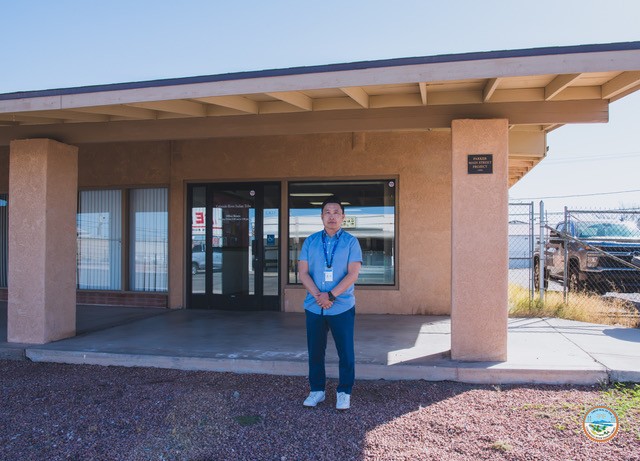
The Colorado River Indian Tribes Building and Safety Department is welcoming new director Alfred Mauer, whose background in inspections, compliance, and facility operations brings both technical expertise and a strong local connection to the role.

Mauer’s career began at just 18 years old working as a gold miner in northern Nevada. That early hands-on experience eventually led him into compliance, inspections, and administrative work. From underground mining operations, he later worked with Praxair at an air separation plant operating under strict federal regulations, including Homeland Security oversight. That experience helped shape his commitment to precision, safety, and doing things the right way.

Over the past five years, he has worked as a licensed building inspector while also operating his own inspection business. Managing everything from office communication and consulting to on-site inspections provided experience not only in technical building standards but also in customer service, project coordination, and helping facilities operate safely and efficiently.

Mauer also has a personal connection to the area. He attended elementary school in Parker before moving to northern Nevada and has now returned to serve the community. He says coming back to work with CRIT brings a strong sense of purpose and connection.

Now stepping into his new role, Mauer’s focus is clear: supporting safe, quality construction while helping tribal departments, businesses, and community members navigate the permitting and inspection process smoothly. The Building and Safety Department plays an important role in protecting the community by ensuring structures are built safely and responsibly, with an emphasis on prevention, communication, and long-term safety.

He emphasizes that the department is there to help guide people through the process, whether it involves new construction, renovations, or facility improvements. Clear communication and accessibility are key priorities as he settles into the position, helping ensure questions are answered early and projects move forward safely.

Having grown up around the community, Mauer says one of the things that stands out most about working at CRIT is the strong sense of family, pride, and connection among tribal members and employees. That sense of community motivates his commitment to safety and responsible development. Having witnessed preventable accidents in his career, he says his goal is always to promote safe structures that protect people first.

(more…)

CRIT Auto Welcomes a Familiar Leader

After 47 years of dedicated service, Winstill Humeumptewa Sr. has stepped into the role of Fleet Manager of CRIT Auto, bringing with him decades of experience, leadership, and deep pride in the work he does for the Colorado River Indian Tribes.

Winstill began working at CRIT Auto in 1979. Born and raised in the community, he returned home after completing his automotive education to put his skills to work serving his people. Over the years, he has worked his way through nearly every role in the department, gaining hands-on experience as a mechanic, supervisor, service manager, and most recently as Acting Auto Shop Fleet Manager.

His decision to apply for the manager position came after the retirement of former manager Fernando “Bo” Flores. Winstill credits Bo’s leadership, mentorship, and strong work ethic as a major influence and source of inspiration throughout his career. Having worked side by side with him for many years, Winstill felt prepared to take on the responsibility and continue moving the department forward.

Winstill oversees a fleet of more than 300 tribal vehicles serving multiple departments. His goals include rebuilding and strengthening his crew, improving shop organization, and modernizing operations. One of his immediate priorities is cleaning up the shop area and removing unused gas pumps and tanks that are no longer in service.

Supporting his staff is central to Winstill’s vision. He plans to keep his team up to date through trainings, educational videos, and courses, emphasizing that knowledge and skill development are key to quality service. He describes his leadership style as firm, noting that quality work is non-negotiable. Every vehicle, he says, should be safe, reliable, and properly tested before returning to service.

While CRIT Auto primarily services tribal vehicles, Winstill hopes to eventually reopen the shop to the community once staffing is full. He wants the community to know that even when repairs take time, the work is being done with care and commitment.

Winstill says he is proud of his crew, whom he considers family, and proud of the work they accomplish together every day. After nearly five decades at CRIT Auto, his dedication remains strong, driven by a desire to provide dependable service to the Tribes and give back to the community he calls home.

Congratulations to Winstill Humeumptewa Sr. on this new chapter as the Fleet Manager for CRIT Auto.

Article and Photos by CRIT Media Reporter Ariana Romero