
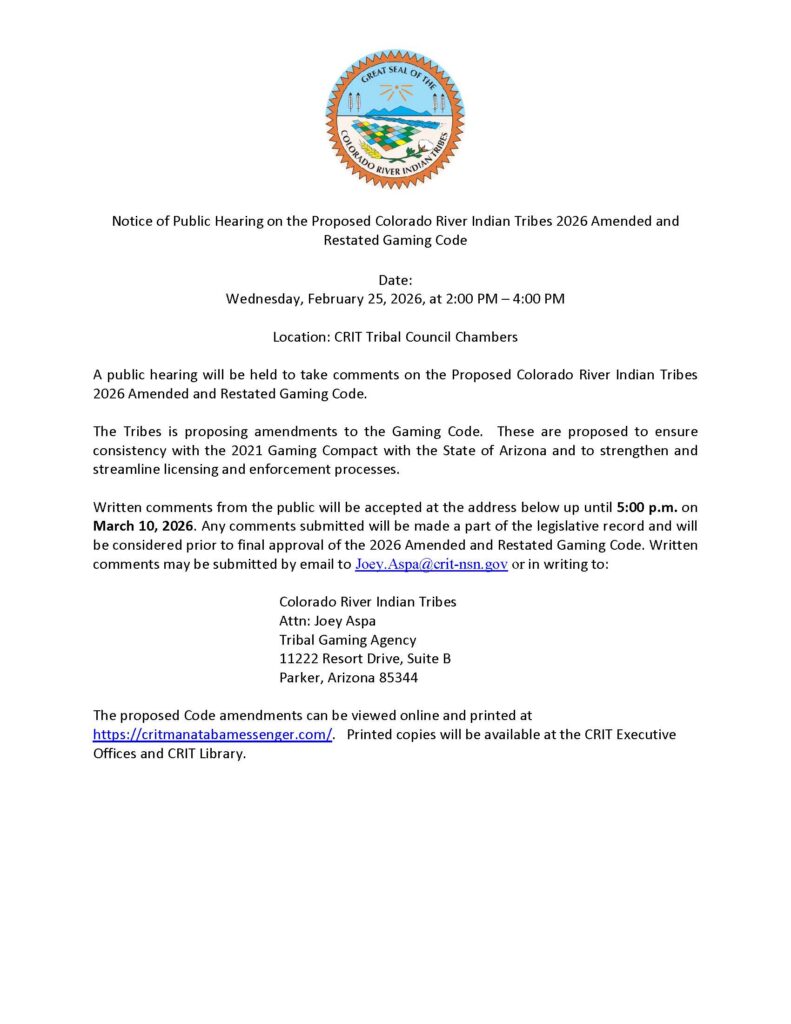
Follow the link below for the propsed amended code
2026 Amended and Restated Gaming Code_Public Hearing
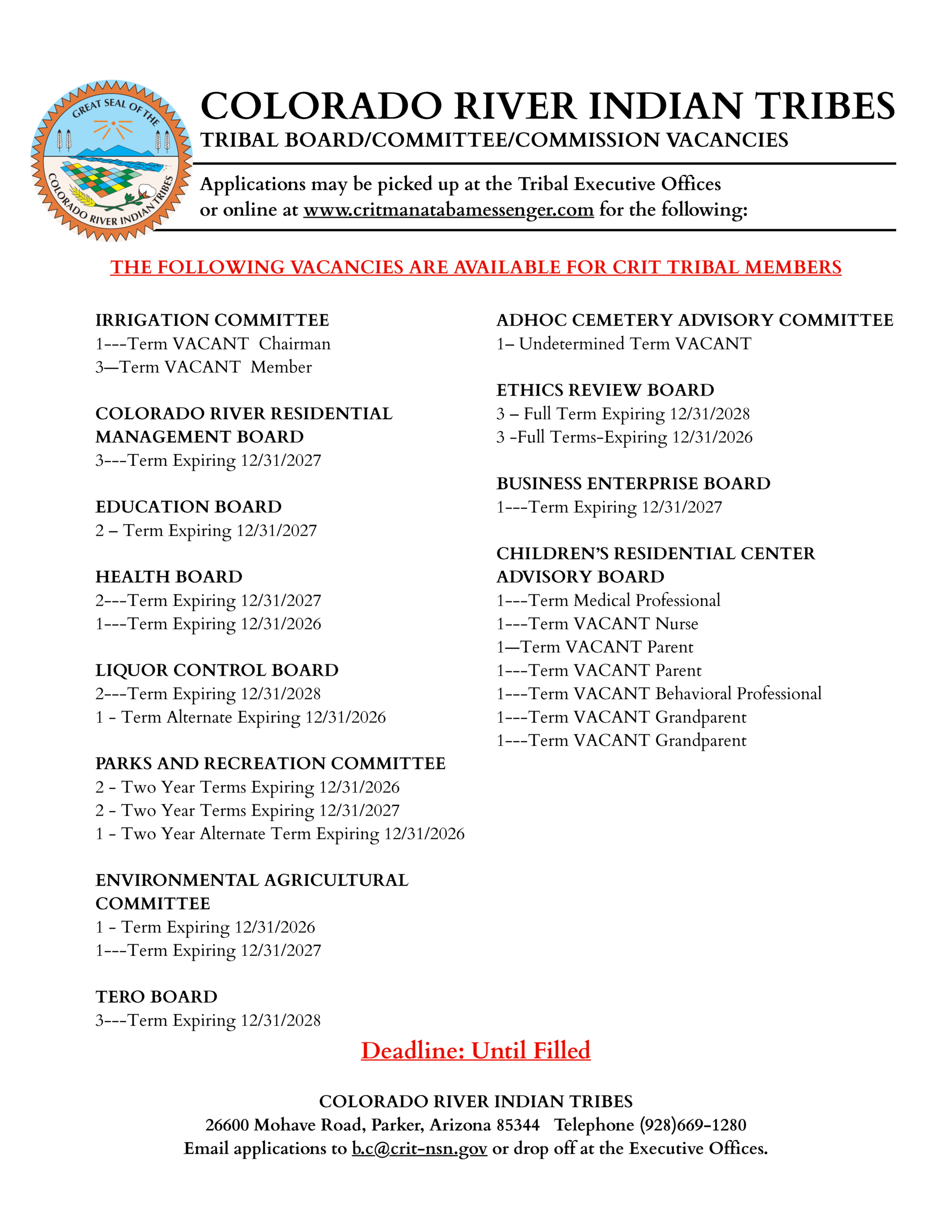
Follow the link below to download an application.
CRIT Tribal Board Vacancies Application 2026

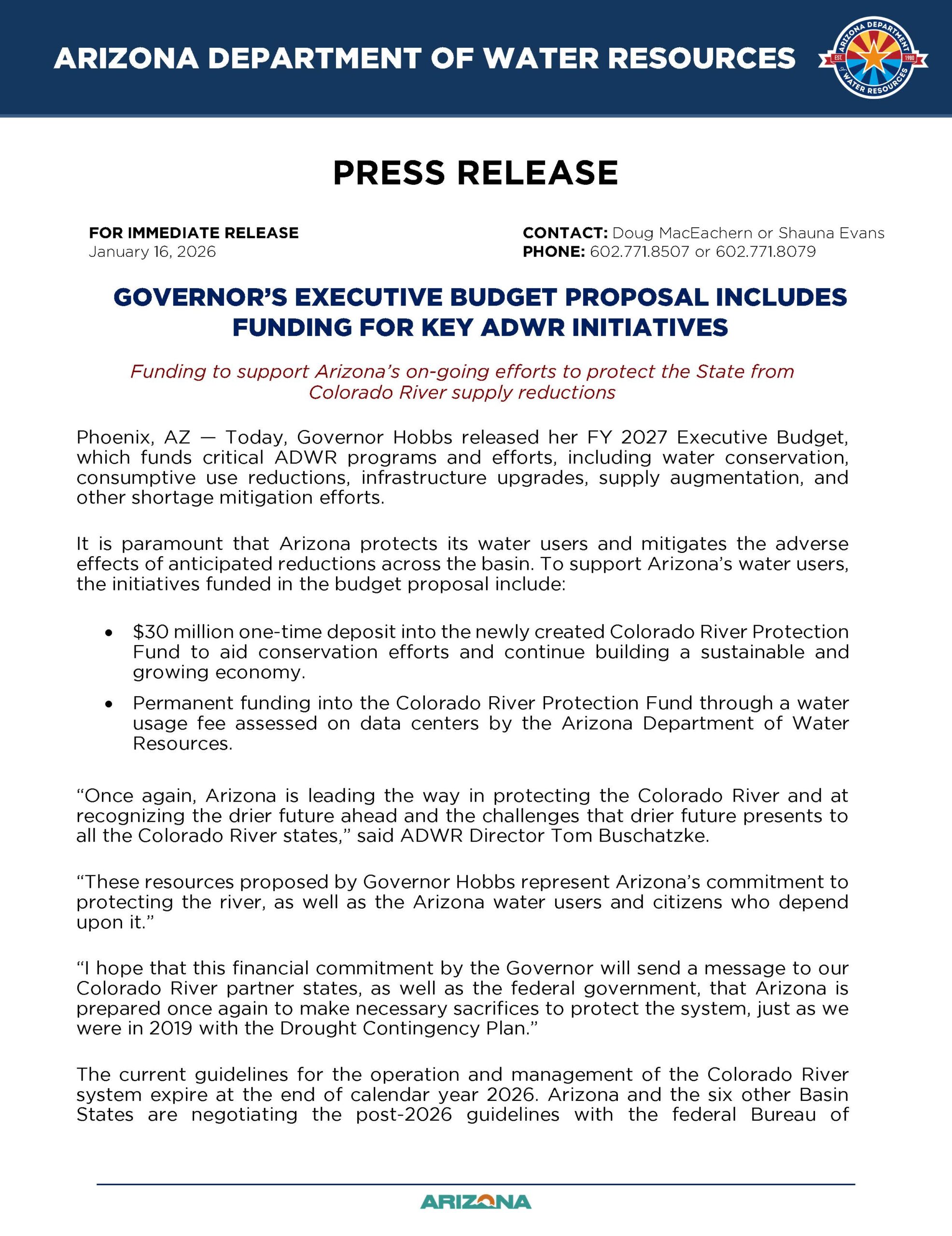
Arizona Budget Proposal Includes Major Funding for Colorado River Protection
On January 16, 2026, the Arizona Department of Water Resources (ADWR) shared details of Governor Katie Hobbs’ FY 2027 Executive Budget Proposal focused on preparing for long-term challenges facing the Colorado River. The plan includes new and expanded funding aimed at strengthening water security across Arizona in the face of ongoing Colorado River shortages.
Key points from the budget related to water:
Source:
Arizona Water News https://azwaternews.com/2026/01/16/fy2027_execbudgetproposal/
Our thanks to everyone who participated in the National Day for Truth and Reconciliation on September 30th
The day honors the children who never returned home as well as survivors of boarding schools, their families and communities. The day is also known as Orange Shirt Day to honor and raise awareness of the thousands of Indigenous children who were sent to residential schools.
Department staff who participated: Executive Offices, Public Defender, Media and Office of the Attorney General.

A quick-thinking CRIT Game Warden likely saved the life of an elderly motorist.
While on routine patrol in late June, Warden Alejandro Lopez III missed the turn off to Agnes Wilson Rd as he was returning from West Boundary patrol. As he turned his vehicle around, he noticed a vehicle facing northbound off the southbound shoulder of the road. He got out of his truck and walked to the back of the car to run the license plate and found a man lying in the bushes in the desert area.
The man told Warden Lopez he got out of his vehicle for a rest stop, fell over, and could not get back to his feet. He told Lopez that he had been lying there for over three hours in direct sunlight and he was having trouble breathing.
Warden Lopez Immediately requested medical attention for the man identified as 86-year-old Luis Gonzalez. Warden Lopez provided Mr. Gonzalez with water and improvised shade, keeping him calm as he waited for medical assistance to arrive.
Gonzalez was transported to the La Paz Regional Medical facility. Paramedics told investigators Mr. Gonzalez might not have survived if he had been exposed to the elements for another hour.
Chief Game Warden Woodrow Sharp said Warden Lopez’s attention to detail and patrol procedures led to Mr. Gonzalez being located and rescued from certain death had he not been found.
Nora Vasquez started her career with the Colorado River Indian Tribes on September 13th, 1984 as a cook’s aid at CRIT Head Start. Nora has held many titles At Head Start including Assistant Cook, Nutrition Coordinator, Head Cook and Nutrition Specialist. In 2018 Nora was promoted as the Nutrition Specialist/Family Service Advocate, A position she still holds today. The Tribal Council and Human Resource Department thank Nora for 40 years of continued service to the Colorado River Indian Tribes.

Department heads and managers for the Colorado River Indian Tribes met September 16th to exchange ideas and information. They received updates on local banking services from Wells Fargo and were introduced to new and acting directors.
These meetings are called on a quarterly basis by Chairwoman Flores to ensure communication, cooperation, collaboration, and coordination among department heads and managers.
Additional topics included CRIT’s travel policies and five-year plans for departments.
The meeting was held in the Mohave Room at the Blue Water Resort and Casino.