July 29, 2026 8:47 pm
CRIT Nation, Parker, AZ
July 29, 2026 8:47 pm
CRIT Nation, Parker, AZ

The Ten Tribes Partnership (TTP) is seeking a lead contractor. This contractor position is supported by the Colorado River Sustainability Campaign, a fiscally sponsored project of the New Venture Fund.

TTP Background

The TTP was formed in 1992 and is a coalition of ten federally recognized Upper and Lower Basin Tribes that hold water rights in the Colorado River Basin. The member Tribes are: Chemehuevi Indian Tribe, Cocopah Indian Tribe, Colorado River Indian Tribes, Fort Mojave Indian Tribe, Jicarilla Apache Nation, Navajo Nation, Quechan Indian Tribe, Southern Ute Indian Tribe, Ute Indian Tribe, and Ute Mountain Ute Tribe.

The goal of the TTP is to increase the influence of Tribes in Colorado River management and provide support for the protection and use of Tribal water resources. The Colorado River Basin is suffering from extended drought, and the impact of climate change is palpable. TTP is committed to developing a new management framework that uplifts tribal priorities ahead of the 2026 expiration of the 2007 Interim Guidelines. TTP has determined this to be a critical time to hire a Lead Contractor to coordinate its efforts.

(more…)


ATTENTION CRIT TRIBAL MEMBERS
Tribal Board/Committee/Commission Vacancies

Applications may be picked up at the Tribal Executive Offices or online at www.critmanatabamessenger.com for the following:

IRRIGATION COMMITTEE
1—Term VACANT Chairman
3—Term VACANT Member

EDUCATION BOARD
1 – Term Expiring 12/31/2025

LIQUOR CONTROL BOARD
1 – Term Alternate Expiring 12/31/2026

ENVIRONMENTAL AGRICULTURAL COMMITTEE
1 – Term Expiring 12/31/2026

ETHICS REVIEW BOARD
2 – Full Term Expiring 12/31/2025
3 -Full Terms-Expiring 12/31/2026

CHILDREN’S RESIDENTIAL CENTER ADVISORY BOARD
1—Term Medical Professional
1—Term VACANT Nurse
1—Term VACANT Parent
1—Term VACANT Behavioral Professional
1—Term VACANT Grandparent

ADHOC CEMETERY ADVISORY COMMITTEE
1– Undetermined Term VACANT

PARKS AND RECREATION COMMITTEE
2 – Two Year Terms Expiring 12/31/2026
2 – Two Year Terms Expiring 12/31/2027
1 – Two Year Alternate Term Expiring 12/31/2026

Deadline: Until Filled

COLORADO RIVER INDIAN TRIBES
26600 Mohave Road, Parker, Arizona 85344 Telephone (928)669-1280
Email applications to b.c@crit-nsn.gov or drop off at the Executive Offices.

Follow the link to download an application

2025BOARDAPPLICATIONS_09042025 (002)

Happy Birthday to our very own Ariana Romero! She has been flourishing in the Media Department of CRIT going to all the fun events in the community, writing articles, and becoming quite the photographer! Ariana has been a great proactive reporter providing insightful ideas on what the next story should be and how we can best showcase the wonderful CRIT Community. We are lucky to have her on our team and we wish her a wonderful birthday.

The Colorado River Indian Tribes Tribal Council has made a historic decision to protect the lifeblood of their Reservation. On November 6, 2025, the Council unanimously approved Resolution No. R-375-25, which proclaims the personhood status of the Colorado River under tribal law.

This resolution acknowledges the Colorado River as a living entity whose health and well-being are intrinsically linked to the well-being of the Colorado River Indian Tribes (CRIT) members. The Tribes’ deep-rooted connection to the river spans centuries, providing cultural identity, spiritual strength, food systems, and economic stability that continue to shape their community life today.

The resolution emphasizes the central role the river has played in defining the identity of the CRIT. It highlights that CRIT’s ancestors have preserved and protected these lands since before the establishment of the Colorado River Indian Reservation in 1865.

The Council underscores the crucial role the river plays in sustaining traditional practices, wildlife, and agriculture, including the federal irrigation systems authorized as early as 1867. Today, the Colorado River Indian Irrigation Project stands as a cornerstone of the tribal economy.

The resolution underscores significant legal milestones that acknowledged CRIT’s water rights. In the landmark 1964 and 2006 Arizona v. California U.S. Supreme Court decisions, the Tribes secured 719,248 acre-feet of water annually, ensuring their access to the river for generations to come.

By granting personhood to the River, the Tribal Council reaffirmed its sovereign duty to honor and protect it. This status mandates that the River’s well-being must be a priority in governance and decision-making moving forward.

As part of the resolution, the Attorney General and their staff will develop legal safeguards and propose updates to the CRIT Water Code and other relevant regulations. These updates may include the potential designation of the river as a protected cultural landscape.

Council members recognized that protecting the river is not merely a legal obligation but a continuation of cultural beliefs passed down through generations.

Through this declaration, CRIT demonstrates its unwavering commitment to stewardship. The resolution concludes with a resolute message: the Colorado River is, and will always remain, a vital entity deserving of respect, care, and protection for all future generations.

Article Written by CRIT Media Reporter Ariana Romero

News Update November 12, 2025

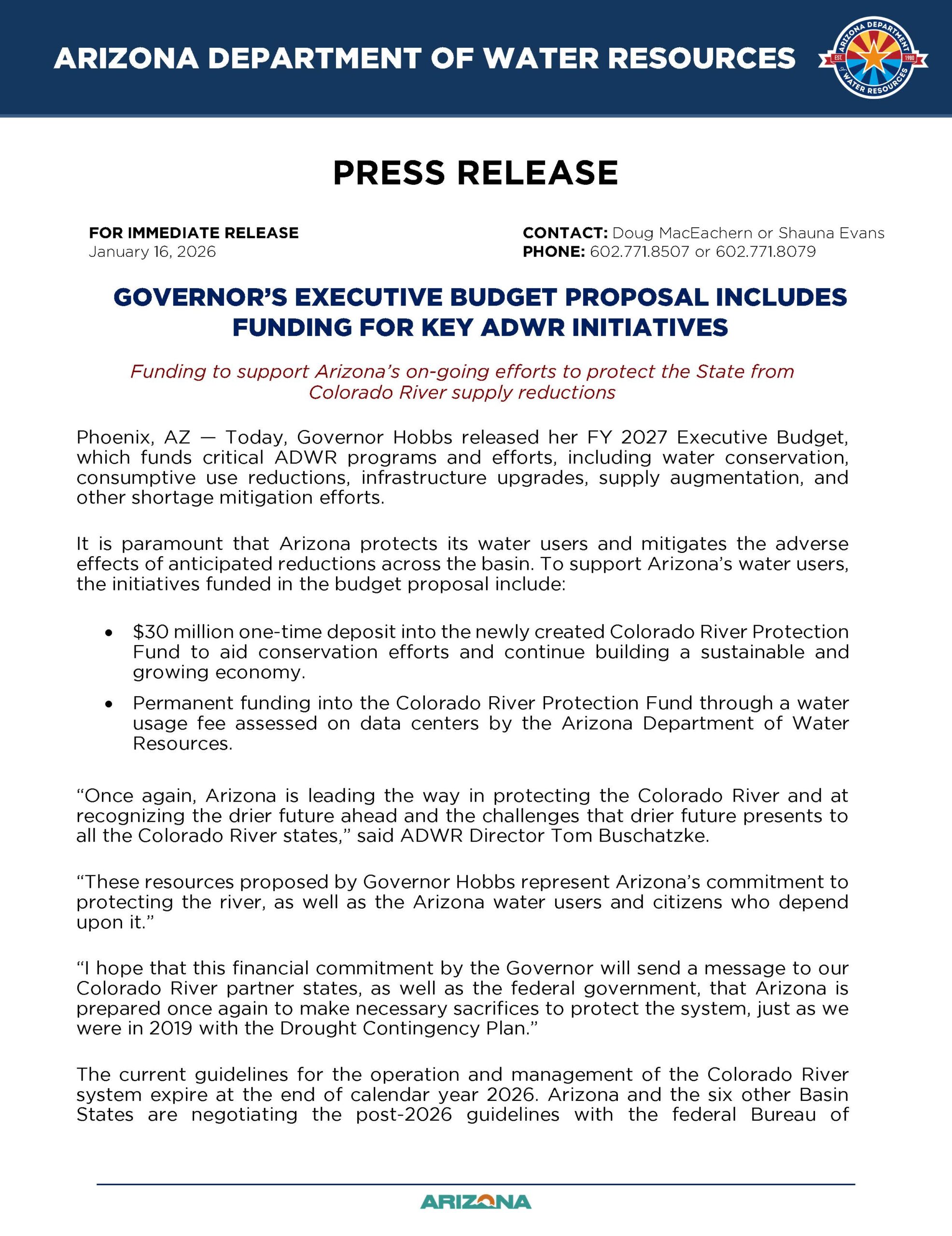
Negotiations over the future of the Colorado River have reached a standstill after all seven basin states failed to meet a key federal deadline. Reports from 12News and 8NewsNow confirm that the states were unable to agree on a new water-sharing plan, leaving the situation unresolved as the river continues to decline.

High Country News explains that the biggest disagreements involve how much each state should give up in the future. The upper Basin states want fewer mandatory reductions, while the Lower Basin states, including Arizona, say they have already taken the deepest cuts and cannot continue to absorb the majority of the impacts.

With no agreement in place, Arizona Governor Katie Hobbs has asked the Trump administration to intervene. She stated that Arizona has made significant sacrifices and cannot carry the weight of the reductions while other states refuse to commit to measurable cuts. If the states cannot reach a plan soon, the federal government may create one for them.

For the Colorado River Indian Tribes, the outcome of these negotiations has major importance. CRIT holds valuable senior water rights and relies on a stable and fair management plan to ensure long-term security for the community and the region.

For more information, you can read the news articles with the links below.

8NewsNow
https://www.8newsnow.com/news/local-news/colorado-river-negotiations-fail-to-meet-federal-deadline-for-7-state-agreement/

High Country News
https://www.hcn.org/articles/why-colorado-river-negotiations-are-so-difficult/


ABC 15 News
https://www.abc15.com/weather/impact-earth/why-gov-katie-hobbs-wants-trump-administration-to-broker-colorado-river-deal


12 News
/wednesday-is-deadline-for-7-state-including-arizona-to-negotiate-the-colorado-river

Department heads and managers for the Colorado River Indian Tribes met September 16th to exchange ideas and information. They received updates on local banking services from Wells Fargo and were introduced to new and acting directors.

These meetings are called on a quarterly basis by Chairwoman Flores to ensure communication, cooperation,  collaboration, and coordination among department heads and managers.

Additional topics included CRIT’s travel policies and five-year plans for departments.

The meeting was held in the Mohave Room at the Blue Water Resort and Casino.

Delivering a message of tribal sovereignty and unity, CRIT Chairwoman Amelia Flores gave opening remarks for a special meeting of the 30 Basin Tribes to discuss Colorado River water policy, allocation, and consultation with native communities. The meeting was held September 13th at Chairwoman Flores’ request.

In addition to Chairwoman Flores, CRIT Vice Chairman Dwight Lomayesva, Tribal Council members Anisa Patch and Bobby Page also attended the conference held Courtyard Scottsdale Marriott owned by the Salt River Pima Indian Community.

The focus of the meeting was to discuss post-2026 Colorado River Guidelines, which could have a profound impact on CRIT’s water rights, as well as multiple indigenous communities and reservations when it comes to Colorado River water allocations. CRIT has vowed to make sure it has a seat at the table to ensure its rights are protected.

Chairwoman Flores stated in opening remarks that the rights of all tribes must be protected, “The stakes for all of us are too high as to how the post 2026 (Colorado River Guidelines) impacts our water rights so we need to keep in constant communication with our trustee.”

Flores called upon the tribes to work together, “All the tribal nations are unique, but we are bound by one great river, the Colorado River.”

In addition to tribal leaders, United States Bureau of Reclamation Commissioner Camille Touton was also in attendance. Touton said she and federal officials were there to listen, “I can see every single leader here and I know the issues we are working through together as sovereign nations.”

Topics discussed included:
• Status of discussions with the Basin States – Reclamation.
• Alternatives development – will Reclamation protect tribal water rights?
• Schedule of release of documents – what can we expect to see and when?
• Is the consultation process working? How can it be improved?
• Future/follow-up meetings between Tribal Nations and Reclamation.

WASHINGTON – U.S. House Natural Resources Committee Ranking Member Raúl M. Grijalva (D-Ariz.) today released the following statement on a new policy that requires notifying tribal governments of any new mineral exploration on public lands managed by the Bureau of Land Management (BLM). The policy aligns with recommendations from the Biden-Harris administration’s Interagency Working Group (IWG) on Mining Laws, Regulation, and Permitting, which published a report outlining its findings last year.

“With so many of the critical minerals we need for clean energy lying within 35 miles of tribal lands, tribes must have a foremost role in new mining projects,” said Ranking Member Grijalva. “Making sure tribes are notified as early as possible in the mining process is a critical step toward that goal. As we continue to push to reform our antiquated mining system, I want to thank the Biden-Harris administration for their continued commitment to honoring tribal sovereignty and helping to ensure that our transition to a clean energy future is a just one.”

ADDITIONAL BACKGROUND

Ranking Member Grijalva has been a longstanding champion for reforming our more than 150-year-old Mining Law of 1872, which has no environmental review or tribal consultation requirements. On May 19, 2023, he and Sen. Martin Heinrich (D-N.M.) introduced House and Senate versions of the Clean Energy Minerals Reform Act to modernize our antiquated mining system. Among other important provisions, that legislation requires federal agencies to conduct early and meaningful consultation with tribes prior to permitting mining activities that impact tribal communities.