
July 28, 2026 8:35 pm
CRIT Nation, Parker, AZ
July 28, 2026 8:35 pm
CRIT Nation, Parker, AZ

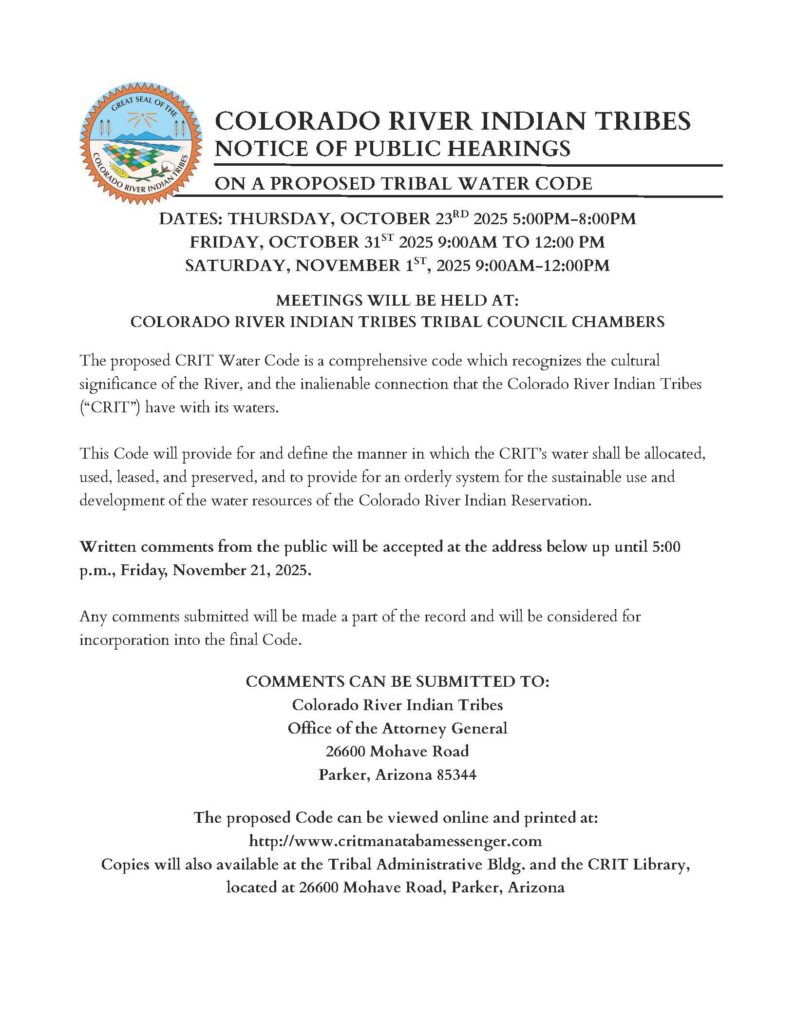
Follow the link below to review the draft water code

Draft code

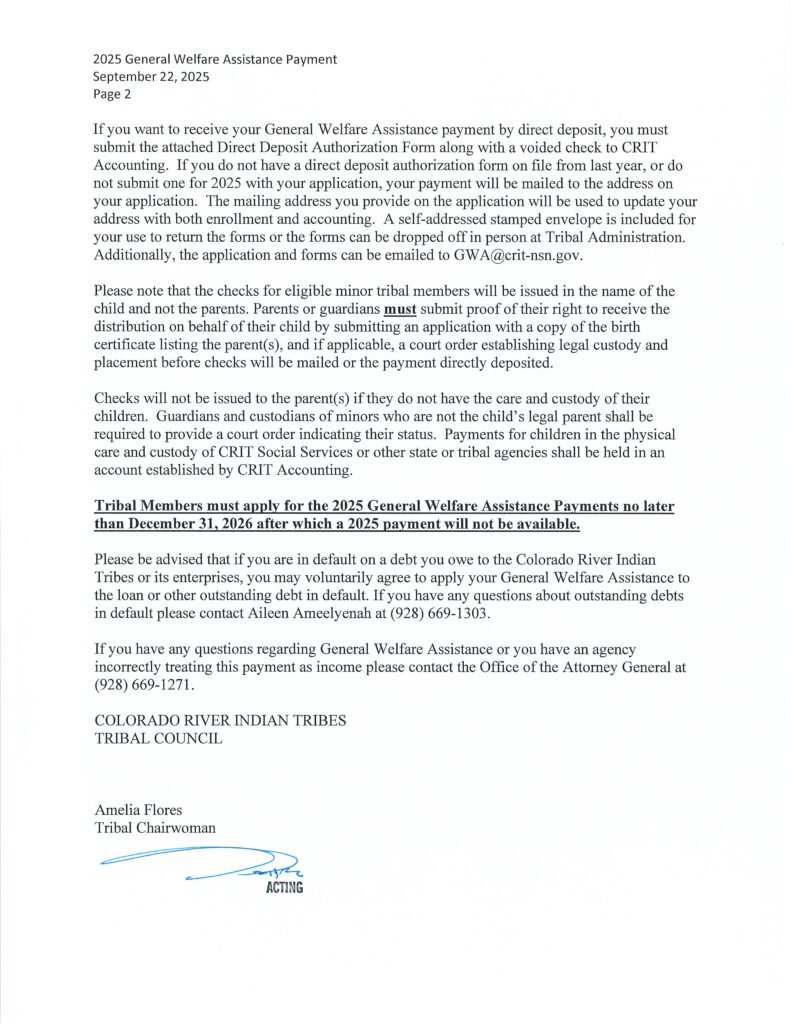
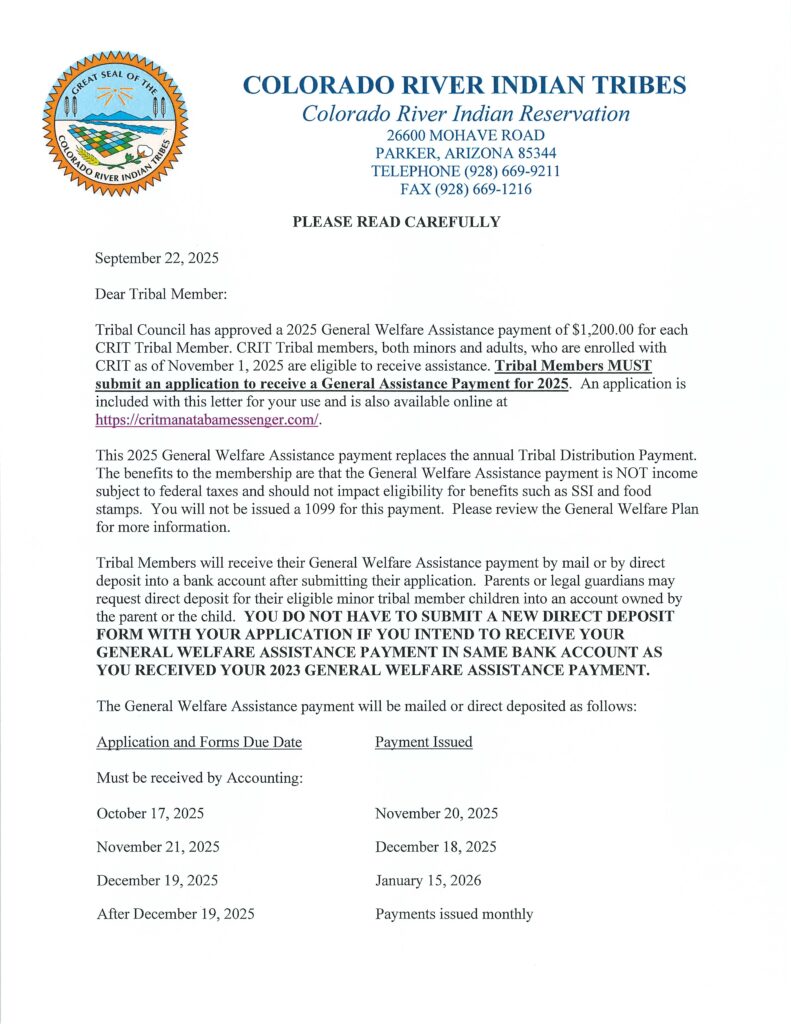
Update : CRIT has  extended the deadline date for the General Welfare Application from Oct 17 to Oct 24th at 5pm.

Please click the links to upload related forms

DirectDeposit_ZionsBank_2025_GWP

General Welfare Application Minors_09132025

General Welfare Application_Adult_09132025
 

The Ten Tribes Partnership (TTP) is seeking a lead contractor. This contractor position is supported by the Colorado River Sustainability Campaign, a fiscally sponsored project of the New Venture Fund.

TTP Background

The TTP was formed in 1992 and is a coalition of ten federally recognized Upper and Lower Basin Tribes that hold water rights in the Colorado River Basin. The member Tribes are: Chemehuevi Indian Tribe, Cocopah Indian Tribe, Colorado River Indian Tribes, Fort Mojave Indian Tribe, Jicarilla Apache Nation, Navajo Nation, Quechan Indian Tribe, Southern Ute Indian Tribe, Ute Indian Tribe, and Ute Mountain Ute Tribe.

The goal of the TTP is to increase the influence of Tribes in Colorado River management and provide support for the protection and use of Tribal water resources. The Colorado River Basin is suffering from extended drought, and the impact of climate change is palpable. TTP is committed to developing a new management framework that uplifts tribal priorities ahead of the 2026 expiration of the 2007 Interim Guidelines. TTP has determined this to be a critical time to hire a Lead Contractor to coordinate its efforts.

(more…)

July 13 reporting showed drought pressure moving from long-term forecasts into visible impacts across Arizona and the Upper Basin.

In southern Arizona, the San Pedro River recorded zero flow at a key monitoring point near Sierra Vista. The Arizona Republic reported that the river ran dry there for only the second time in 122 years of records. The San Pedro is one of Arizona’s last free-flowing rivers, and dry conditions along the river show how drought, groundwater pumping, and heat can affect local ecosystems.

Scottsdale continued reviewing its long-term water planning. KJZZ reported that city officials are preparing for possible Colorado River cuts, including a possible large water-use ordinance. KJZZ reported that Scottsdale relies on Colorado River water for about 70% of its supply, with some parts of the city depending on it even more. The city has also purchased water credits from Harquahala Valley and uses advanced water treatment and recharge as part of its water planning.

Arizona also extended groundwater-related support in Pinal County. AZ Free News reported that state lawmakers extended Pinal groundwater fee relief and irrigation project funding through 2030. The funding is tied to agricultural water planning in a region that has already faced reductions to Colorado River supplies.

Water demand from data centers remained part of the state’s water debate. The Cool Down reported that Arizona paused data center tax breaks for three years after public concern over water and power use. The issue shows how large technology projects are becoming part of water planning as the state considers future growth.

In the Upper Basin, Colorado water groups are working to keep more water in rivers during extreme drought. Steamboat Pilot & Today reported on efforts by the Colorado Water Trust to support river flows, including work connected to the Yampa River and reservoir releases.

The Salt Lake Tribune also reported on a new study measuring how much water Flaming Gorge Reservoir loses to evaporation. That information could help water managers better understand reservoir losses as Lake Powell and other parts of the system remain under pressure. (more…)

Reports show how water concerns are reaching different parts of the West, from city conservation programs in Arizona to tribal water settlements, drought impacts, and ongoing Colorado River negotiations.

In Arizona, cities are encouraging residents to use less water. SignalsAZ reported that Surprise is offering rebates for eligible water-saving improvements. 12News reported that Scottsdale residents can also receive rebates for conservation upgrades. These programs reflect how cities are trying to reduce demand as Colorado River supplies become less reliable.

Tribal water rights remained a major issue. Navajo Times reported that the Diné water settlement has stalled after objections from Colorado, New Mexico, Utah, and Wyoming. The settlement involves the Navajo Nation, Hopi Tribe, and San Juan Southern Paiute Tribe and is tied to water infrastructure and access in northeastern Arizona. The four Upper Basin states raised concerns about how the water could be used or leased in the future.

Drought impacts continued in Arizona. Congressman Eli Crane’s office reported that the U.S. Department of Agriculture issued drought disaster designations for several Arizona counties. Gila Valley Central reported that Graham and Greenlee counties were declared primary disaster areas because of drought. These designations can make assistance available to eligible farmers and producers.

The University of Arizona Water Resources Research Center released a toolkit for domestic well owners. The guide covers well maintenance, water quality, testing, and drought planning. It is especially relevant for rural residents who rely on private wells.

Water demand from data centers also remained part of the discussion. KTAR reported on concerns over whether data centers are draining Arizona’s water. As technology projects expand, their energy use, cooling needs, and long-term water demand are drawing more attention.

Across the West, drought pressure continued. KSL reported that experts are watching specific regions and industries facing severe drought impacts. Cowboy State Daily reported that an irrigation district in eastern Wyoming warned water could run out by early August.

Colorado River negotiations also remained unsettled. KNPR reported on where Southern Nevada stands as the current river management agreement nears expiration. KLAS reported that Colorado’s water commissioner said drought conversations remain difficult. KUTV reported that Upper and Lower Basin states failed to reach an agreement on Lake Powell.

Weather added more uncertainty. Several outlets reported rising odds of a strong El Niño. While El Niño can bring wetter conditions to some areas, it does not guarantee drought relief for the Colorado River system. Snowpack, runoff, and soil conditions will still determine how much water reaches reservoirs.

The reports show water planning happening on several fronts. Cities are offering rebates, rural residents are receiving well guidance, Arizona counties are facing drought designations, tribes are waiting on settlement progress, and Basin states are still negotiating future river rules. (more…)

Arizona cities are pressing for clearer answers on water they stored underground as the state prepares for possible Colorado River cuts.

KJZZ reported that Phoenix-area cities and the Arizona Water Banking Authority are in disagreement over how stored Colorado River water should be distributed during shortages. Since the late 1990s, excess Colorado River water has been stored underground as a backup supply. With new river rules expected and cuts likely for Central Arizona Project users, cities want to know how much water they will be allowed to recover, when it would be available, and what requirements may come with it.

The question is not just how much water exists underground. It is also how the Water Bank decides who gets access and how much should be saved for future shortages. KJZZ reported that Water Bank officials are considering policies that could limit distribution or require cities to show conservation efforts before receiving stored water.

Scottsdale is also adding to its stored-water portfolio. KJZZ reported that the city approved an $8.25 million purchase of water credits from Harquahala Valley through the Central Arizona Project. The credits represent water stored underground for future use. According to KJZZ, the purchase amounts to about 15,000 acre-feet of water and brings Scottsdale’s long-term water credits to just under 300,000 acre-feet.

The purchase shows how cities are looking beyond current deliveries and preparing for uncertainty. Stored credits can help provide backup during shortages, but they still depend on access, recovery, and long-term management.

Drought conditions are also affecting Arizona counties. Congressman Eli Crane’s office reported that the U.S. Department of Agriculture issued drought disaster designations for several Arizona counties. Gila, Pinal, and Yuma counties were elevated to primary disaster status in a later designation, while other counties were listed as contiguous. The designations can help make agricultural assistance available to eligible producers affected by drought.

Groundwater recharge remains part of the broader water planning conversation. Agri-Pulse reported that California lawmakers are again trying to address permitting delays for groundwater recharge projects. The bill discussed in the report would give farmers and water agencies more flexibility to capture high flows and move water underground when wet conditions allow. Supporters say current permitting can be too slow for short windows of available water.

The issue connects to Arizona’s own recharge discussions. Across the West, water managers are looking at ways to store more water underground during wet periods so communities and farms have more flexibility during dry years.

The legal side of western water also continues to grow. The Colorado Sun reported that the U.S. Supreme Court agreed to hear Nebraska’s lawsuit against Colorado over the proposed Perkins Canal. Nebraska says the canal is needed to bring South Platte River water into Nebraska under a 1923 compact. Colorado officials say the state is complying with the compact and will defend its water rights. (more…)

Arizona’s water coverage centered on a practical question: if the Colorado River keeps shrinking, how much backup water is actually available, and who can use it?

KJZZ reported that Phoenix-area cities are asking for clearer answers about Colorado River water stored underground by the Arizona Water Banking Authority. The Water Bank was created in 1996 to store excess Colorado River water underground for use during a shortage. Cities that rely on the Central Arizona Project say they need to know how much of that stored water they can access, when it would be available, and how it would be recovered.

The issue is becoming more urgent as federal officials consider new Colorado River operating rules. Arizona Farm Bureau News reported that Arizona water officials are pushing for the Lower Basin proposal as an alternative to deeper federal cuts. The proposal includes mandatory reductions across Arizona, California, and Nevada, along with additional voluntary savings through 2028.

The Arizona Farm Bureau also reported that the Central Arizona Project is now projecting a 14% shortage in its municipal water pool instead of 20%, partly by using water from Lake Pleasant and wells in Yuma. Even with that smaller projected shortage, cities and farms are still preparing for less water.

Agriculture remains a major part of the discussion. Arizona farmers are watching possible cuts closely because reductions to Colorado River water can affect planting decisions, crop choices, and operating costs. Those changes can also move beyond farms, reaching workers, local economies, and food supply chains.

Arizona is also looking at how to keep more water in the state. KJZZ reported that more than 95% of precipitation that falls in Arizona is lost to evapotranspiration. The reporting was based on the Arizona Tri-University Recharge and Water Reliability Project, which is studying ways to capture more rain, snowmelt, and runoff before it is lost to evaporation or plant use. The project is also looking at how more water can be moved into aquifers through recharge.

That research connects directly to questions about groundwater. As Colorado River supplies become less reliable, cities and rural areas are paying closer attention to underground storage, recharge, and long-term access to stored water.

The Desert Review reported that the Central Arizona Irrigation and Drainage District secured up to 10,000 acre-feet per year of new water supply from the Mojave Groundwater Bank in California. The agreement is another example of Arizona water users looking outside traditional supplies as Colorado River shortages continue.

Lake Powell also remained under pressure. The Guardian reported that the reservoir could fall to unprecedented lows after poor snowpack and limited spring runoff. KUTV and Newsweek reported on a proposal from scientists to move more water from Lake Powell to Lake Mead, arguing that storing more water in Lake Mead could reduce losses and protect downstream supplies. The idea is part of a larger debate over how the two major reservoirs should be managed as both remain low. (more…)

Lake Powell remained one of the biggest concerns. The Colorado Sun reported that low water levels are creating new pressure at Glen Canyon Dam, where federal officials are working to protect dam infrastructure as the reservoir drops. The report focused on cavitation, a problem caused when fast-moving water creates vapor bubbles that can damage dam equipment and concrete surfaces.

The issue shows how falling reservoir levels affect more than water storage. Lake Powell also supports hydropower generation, downstream releases, and dam operations. When the reservoir drops too low, federal managers have fewer options to move water through the system safely and efficiently.

Arizona water users are also watching federal planning closely. The Arizona Daily Star reported that a Colorado River water savings plan could reduce the effect of future cuts on Arizona users. The plan is part of ongoing Lower Basin negotiations as Arizona, California, and Nevada look for ways to conserve water and avoid deeper mandatory reductions.

Those negotiations remain unsettled. Fox 13 Salt Lake City reported that Colorado River governors said they are not at a stalemate, even as the deadline for new river rules gets closer. The current operating guidelines are set to expire after 2026, and the seven Basin states still need agreement on how future shortages will be shared.

For Arizona, Central Arizona Project water remains a major concern. The CAP canal moves Colorado River water to central and southern Arizona, including cities, farms, and tribal users. If future cuts fall heavily on CAP water, impacts would vary depending on each user’s legal priority, water portfolio, and access to stored supplies.

AMWUA reported on the importance of municipal access to stored water credits. Cities have stored water underground for years to prepare for shortages, but access to those credits becomes more important as Colorado River supplies become less reliable. Stored credits can help cities manage short-term gaps, but they are not a permanent replacement for long-term river reductions.

The idea of moving new water into Arizona also received attention. Some proposals have looked at whether abandoned energy pipelines could be used to bring water west. These ideas reflect the search for new supplies, but large importation projects often involve high costs, legal questions, energy demands, and environmental review. (more…)

Recent developments across the Colorado River Basin show how changes in water supply are beginning to affect recreation, agriculture, and future water planning. While the seven Basin states remain divided over how to manage the river, communities are already dealing with the effects of lower flows and looking at new ways to protect their water.

Colorado River negotiators recently made a rare public appearance together, but there was little indication that the states are closer to an agreement. Representatives from the Upper and Lower basins continue to disagree over how future water reductions should be shared and whether the next plan should offer long-term certainty or act as a temporary bridge.

Nevada negotiator John Entsminger said the latest Lower Basin proposal could provide a workable plan for the next few years and help keep the states out of court while discussions continue. Colorado negotiator Becky Mitchell questioned whether returning to negotiations every two years would build stability or simply create another series of temporary fixes.

The negotiators also discussed mediation as a possible next step. One idea would involve choosing three mediators: one selected by the Upper Basin, another by the Lower Basin, and a third selected by the first two. The ongoing disagreement is also making it difficult for Mexico, which receives Colorado River water under international agreements, to prepare for future shortages.

While those larger negotiations continue, uncertainty is reaching businesses that depend directly on the river. KNAU reported that Grand Canyon rafting companies are watching lower water levels near Lees Ferry following a historically dry winter and reduced releases from Lake Powell.

Rafting trips are still operating, and visitors may not notice a major difference today. However, business owners and river guides are concerned about what lower and less predictable flows could mean in the future. One company reported that bookings were down about 25% this year, although it was unclear whether water conditions were the main reason.

The concern shows how Colorado River operations support more than drinking water, agriculture, and hydropower. Releases from Glen Canyon Dam also affect rafting companies, guides, tourism, and communities connected to Grand Canyon recreation.

Arizona is also looking at less traditional ways to increase its water supply. Voice of San Diego reported that a private utility proposed using Arizona funding to help treat wastewater from the Tijuana River. The water would be treated and returned to Mexico, while Arizona could seek part of Mexico’s Colorado River allocation in exchange.

The proposal could initially produce more than 14,000 acre-feet of water each year, with the possibility of increasing that amount through future development. However, the project is still being studied and would involve complicated questions involving water quality, cost, environmental review, and agreements between the United States and Mexico.

Colorado, meanwhile, has taken action to reduce the damage left behind when agricultural water is sold and transferred to cities. A new state law will require farmland in the Arkansas River Basin to be revegetated before irrigation water can be moved to another use. (more…)

On April 1st, 2026, Senator Ruben Gallego visited the Colorado River Indian Reservation. Upon the visit, he came to the Tribal Council Chambers and met with Chairwoman Amelia Flores, Vice Chairman Dwight Lomayesva, Council Secretary Josephine Tahbo, Councilwoman Vanessa Welch, Councilman Billy Beeson, Councilman Tommy Drennan, Councilwoman Raeanne Patch, and Councilwoman Tracey Quillen. Chairwoman Amelia Flores and Councilman Drennan thanked him for coming to CRIT, and spoke on the pro-rata decisions that are being considered for the Colorado River in its recent publication of the Draft Environmental Impact Statement (DEIS). They expressed a deep concern for the decisions stating that pro-rata is in many ways unlawful, and goes directly against their seniority water rights.
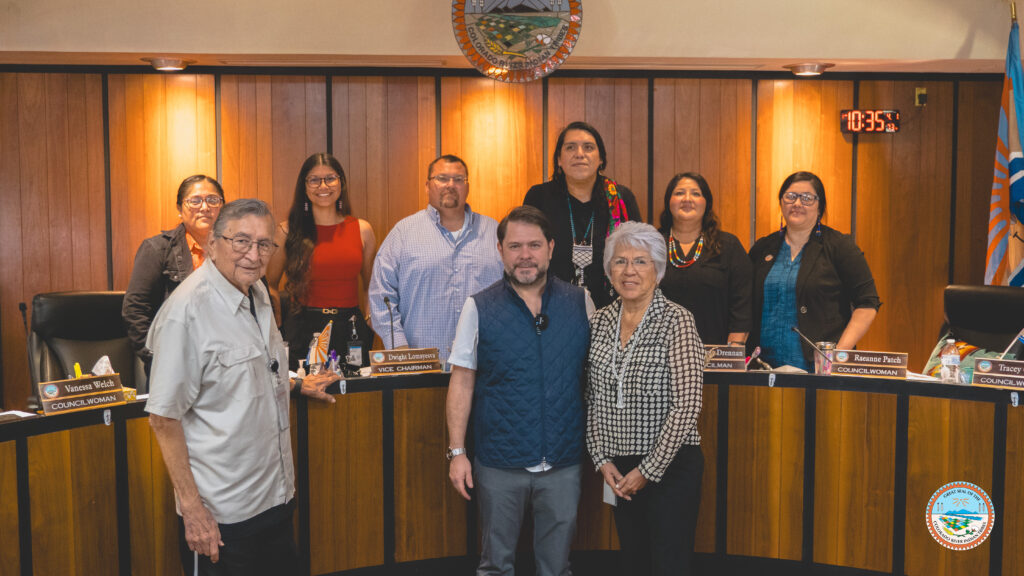
Furthermore, Senator Gallego took a small tour with Chairwoman Flores, members of Council, and lead water attorney John Bezdek with Joshua Moore as their tour guide on the reservation. The last stop was at the Colorado River Sewage System Joint Venture where they met with Town of Parker Mayor Randy Hartless, Vice Mayor Zafer Genc, Town Manager Nora Yackley, Council member Joshua Grenwalt, and Operations Manager Ashley Longanecker. The tour of the facility was led by Longanecker who emphasized the importance of fixing the sewage system for Parker and the Reservation, which was clearly displayed in its decaying state in need of desperate repairs. (more…)

A new federal policy proposal is threatening to Colorado River tribal water rights, and tribal leaders are fighting back. The Colorado River Indian Tribes (CRIT) issued a forceful set of comments in response to the Bureau of Reclamation’s Draft Environmental Impact Statement (DEIS) outlining proposed alternatives for post-2026 operations for Lake Powell and Lake Mead.

In its current form, the DEIS includes an analysis of several alternatives for Colorado River operations that would distribute water shortages by cutting water to all users on a pro-rata basis. By doing this, it aims to treat all users the same, regardless of priority date. For CRIT, which holds senior rights in the Lower Colorado River, rights that date back to 1865, and are protected under the Supreme Court decree in Arizona v. California. Such an approach would undermine the very legal foundation that secures the Tribe’s access to water. Making matters worse, the draft also relies on assumptions tied to current consumptive use. This framework risks penalizing CRIT for the Bureau of Indian Affairs’ (BIA) failure to efficiently operate and properly maintain the Colorado River Indian Irrigation Project, which is the primary means for CRIT to use its water.

If this draft is finalized without any changes, and these policies are put into action, some of the alternatives proposed in the report would represent significant policy shift for Colorado River management. Current operating agreements that govern the river expire at the end of 2026, which is the reason for federal officials to develop new guidelines intended to manage rising demand. Currently, there is extreme pressure to find solutions due to worsening drought conditions, declining reservoir levels, and increasing uncertainty across the basin.

In its response, CRIT asserts that several proposed federal approaches conflict with long-established water law and threaten to undermine the Tribe’s senior water rights. CRIT’s comment letter warns that without significant revision, the draft could place federal actions in violation of existing U.S. Supreme Court decrees. In its letter, Tribal Council made very clear to the Secretary of the Interior and Reclamation officials that it will take any actions it deems necessary to protect CRIT’s rights, including litigation before the Supreme Court.

Why Pro-rata should never be considered:

Pro-rata was put into consideration under the previous presidential administration, and continues on in the current government. This was one of several potential alternatives to address the significant shortages in Arizona, which stands to lose at least 27% of its entire water allocation. Under the Department of the Interior’s (DOI) pro-rata concept, they would address water shortages by cutting deliveries evenly among users based on the percentage of water they currently use (or consume), rather than on each user’s legal priority.

Priority Matters: First in Time – First in Right

A water-user’s ‘priority’ is like a place in line, users at the front of the line are usually those who established their right to use water first. They get their water first, and in full, while lower-priority users, who established their water rights later in time, get their full share of water if there is still enough to go around. Only in times of extraordinary shortage, and after all lower-priority users are cut to zero, would ‘first-priority’ users have to take less than they are legally entitled to use. This is a long-established truth about Western U.S. water law: though it can lead to harsh outcomes, first in time = first in right… and all western water-users know this is how water law works.

But under a pro-rata approach, the Priority system would conveniently disappear, and all water users, regardless of when their rights were established, would share reductions during times of shortage. For CRIT, whose water rights are among the most senior in the Lower Basin, a pro-rata system represents a fundamental shift away from long-standing legal principles that have historically governed how Colorado River water is distributed.

Pro-rata has been vehemently opposed by CRIT leaders as a violation of the law and an attack on CRIT tribal sovereignty. On two separate occasions in the past 6 months, leaders from DOI and Reclamation have met with Council. On both of those occasions, Tribal Council has been forceful that pro-rata shortages are illegal.

Due to a hotter and drier climate, reservoirs at Lake Mead and Lake Powell have dropped to historically low elevations, and federal officials warn that existing management strategies have not been sufficient to stabilize the system. The DEIS proposes a range of operational alternatives designed to balance two competing priorities; 1) maintaining water deliveries to users across seven states, and 2) protecting reservoir storage in order to maintain infrastructure integrity.

Federal officials state that new guidelines are needed to provide predictability to water users while adapting to increasingly dry conditions expected in the future. The proposed framework would guide operations for up to 20 years, beginning in October 2026. CRIT argues that portions of the draft plan conflict with established federal law and the Supreme Court Decree governing the Colorado River.

Water Rights and Infrastructure Challenges

CRIT’s response also highlights longstanding infrastructure challenges affecting the Colorado River Indian Irrigation Project (CRIIP). Since its original construction, the irrigation system serving the Reservation has seen little modernization or meaningful improvement to meet 21st-century operational standards. As a result, aging canals leak significant amounts of water into the ground before it ever reaches a field or crops, and the canals operate so inefficiently that enormous amounts of water is allowed to spill off the end of the system, straight back into the Colorado River, without ever being turned out onto a field.

Addressing this problem is no simple undertaking. The irrigation system is federally owned and managed by the Bureau of Indian Affairs (BIA), an agency that has faced decades of declining funding and limited operational capacity. According to CRIT’s response, these systemic challenges have prevented the Tribe from fully utilizing water.

The passage of the Colorado River Indian Tribes Water Resiliency Act of 2022 further strengthens this effort by granting CRIT the authority to store, conserve, and lease its water. Historically, the water has been lost through deteriorating canals can instead be preserved for tribal agriculture, community development, and, if the Tribe chooses, leased to generate revenue that directly benefits CRIT and its members. The Tribe’s adoption of its Water Code  and recognition of the Colorado River’s Personhood Status under tribal law further reinforces this framework of sovereignty and stewardship. One of the main goals for CRIT in pursuing these efforts is to expand agricultural operations across the reservation. These efforts will create greater opportunities for Tribal members and ensure long-term prosperity for the community and more importantly, for future generations.

CRIT also forcefully argues that Reclamation must acknowledge the Personhood Status of the Colorado River under tribal law. The Tribe claims that the DEIS must analyze the impacts on the Colorado River from diverting water for use in central Arizona. The water is best left in-stream to benefit and protect its status as a living entity, which provides spiritual, cultural, and religious benefits to tribal members.

Taken together, these developments underscore why CRIT views the current federal proposal as a defining moment. This is why pro-rata should never be considered, because it undermines all the progress CRIT has made to ensure it can use its water rights entirely, and within the long-established, existing legal framework. The Tribe’s response makes clear that decisions affecting the Colorado River cannot move forward without full recognition of tribal rights and authority. CRIT has signaled that it is prepared to defend those rights, and if necessary, take this matter to the United States Supreme Court.

Read the document in its entirety – Comments from the Colorado River Indian Tribes on the Draft Environmental Impact Statement on Post-2026 Operational Guidelines for Lake Powell and Lake Mead. Follow the link below.
BOR_Comments CRIT Draft Environmental Impact Statement on Post 2026 Operational Guidelines and Strategies for La

Chief Irataba stands among the most notable figures in Native American history. Some leaders are remembered for their war strategy and resistance, while others are known for diplomacy and negotiation. Rarely do those qualities come together in one leader. Chief Irataba was one of those rare individuals. Known by the Mohave people as fearless, and described by American settlers as peaceful and fair, Irataba helped shape the future of the Mohave people and the land that would later become the Colorado River Indian Reservation.

Irataba, whose Mohave name was Eecheyara Tav, meaning bright bird,” was born around 1814 along the Colorado River. Historical accounts describe him as a striking and commanding figure. Standing approximately six feet four inches tall, with a heavy jaw and broad shoulders, he was widely recognized for his intelligence, bravery, and leadership. Despite his powerful physical presence, those who encountered him often described his demeanor as calm and gentle. Historian Arthur Woodward referenced early descriptions of the Mohave leader, writing that Irataba was “a man six feet four inches tall, of very powerful frame, but very gentle and kind in demeanor.”
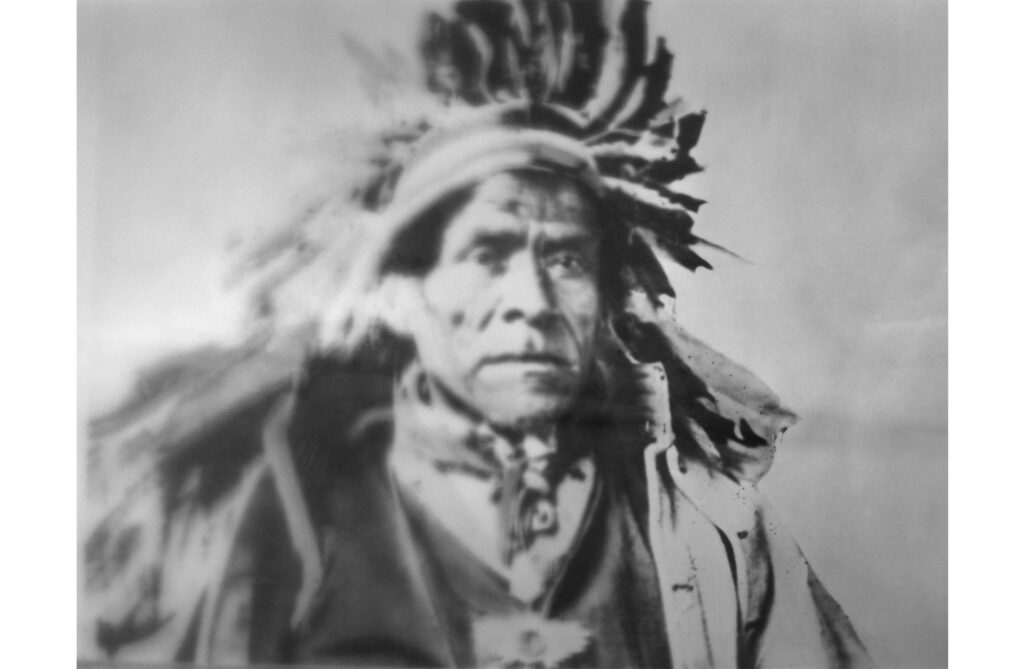
During the early nineteenth century, Mohave communities thrived along the Colorado River. The river provided fertile floodplains for farming and served as an important route for travel and trade among tribes throughout the region. Irataba rose to prominence during this time and became a war leader of the Kwanami, a group whose name has been interpreted as meaning “fearless.” His leadership earned him a reputation as both a warrior and a respected decision-maker within the community.

Accounts from the period suggest that Irataba’s influence extended beyond his own village. One early description noted that he “seemed to have great influence over neighboring tribes and acted in disputed questions as a kind of supreme judge.” His ability to mediate disputes and maintain relationships among tribes helped establish him as one of the most respected leaders in the Colorado River region.
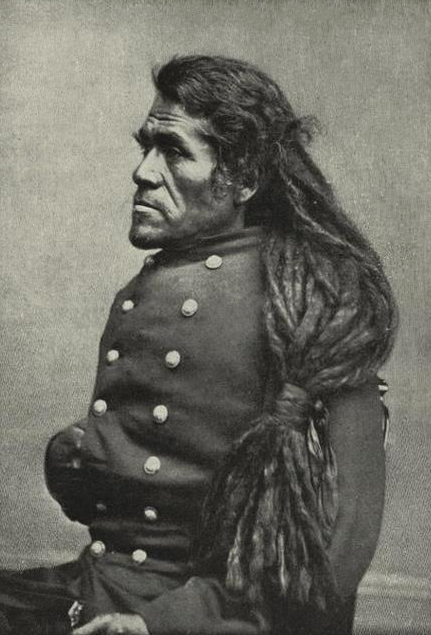
By the 1850s, the Colorado River began attracting increased attention from American explorers and the United States government as they searched for routes across the Southwest. One of the most notable expeditions during this time was led by Joseph Christmas Ives, who traveled along the river studying its geography and potential as a transportation route.

Historical accounts indicate that Irataba played an important role during these early encounters. Acting as a guide and intermediary, he helped facilitate communication between Mohave communities and American explorers traveling through the region. Newspaper reports from the time also recognized his authority. An article published in the Los Angeles Star in 1861 described Irataba as not only the chief of the Mohave people but someone who possessed more influence in the Colorado River country than any other chief in the district.

In 1864, Chief Irataba traveled to Washington, D.C., where he met with Abraham Lincoln and other federal officials. His visit brought national attention to the Mohave people and the challenges facing tribes along the Colorado River as settlers, miners, and military expeditions entered the region. On March 3, 1865, the Colorado River Indian Reservation was formally established by executive order issued by President Abraham Lincoln along the lower Colorado River. The reservation would eventually become home to the Mohave, Chemehuevi, Hopi, and Navajo peoples and remains the homeland of the Colorado River Indian Tribes today.

Chief Irataba continued to be a respected leader among the Mohave people throughout the later years of his life. He died in May of 1874 at his home along the Colorado River. Some historical accounts referred to him as “the Uncas of his tribe,” a comparison meant to recognize him as one of the last great leaders of the Mohave people during that era.

Today, many Mohave families continue to live in and around Parker, Arizona, within the Colorado River Indian Tribes community. The history of Chief Irataba is not only preserved in historical records but also through the families and descendants who remain connected to the land along the Colorado River. Generations of Mohave people have continued to live, work, and raise their families in the same region their ancestors once called home.

More than a historical figure, Chief Irataba’s legacy lives on through the people of the Colorado River Indian Tribes. His leadership during a time of great change helped shape the future of the Mohave people, and his story continues to be remembered as a symbol of strength, diplomacy, and resilience for generations to come.

Article written by CRIT Media Reporter Ariana Romero

Nineteen years ago, Mega Throw began, and despite temperatures reaching over 105 degrees, Mega Throw XIX returned to Ahakhav Tribal Preserve on the Colorado River Indian Tribes reservation. Hosted by Ase S’maav, the Mohave Bird Singers, the two-day gathering welcomed tribes from near and far, with songs and tradition carrying on through the heat.
Mega Throw XIX continues a tradition that began in 2004 with a small group wanting to learn and sing. What started as a grassroots effort has grown into an ongoing commitment to keeping songs, language, and teachings active. Throughout the weekend, the preserve filled with the sound of bird songs and the movement of dancers as participants and spectators came together, carrying that purpose forward through their presence and participation.
Despite the intense heat, participants remained committed, continuing to sing and dance throughout the weekend. The dedication shown reflected the importance of the gathering, as the circle remained strong and songs carried on without pause.
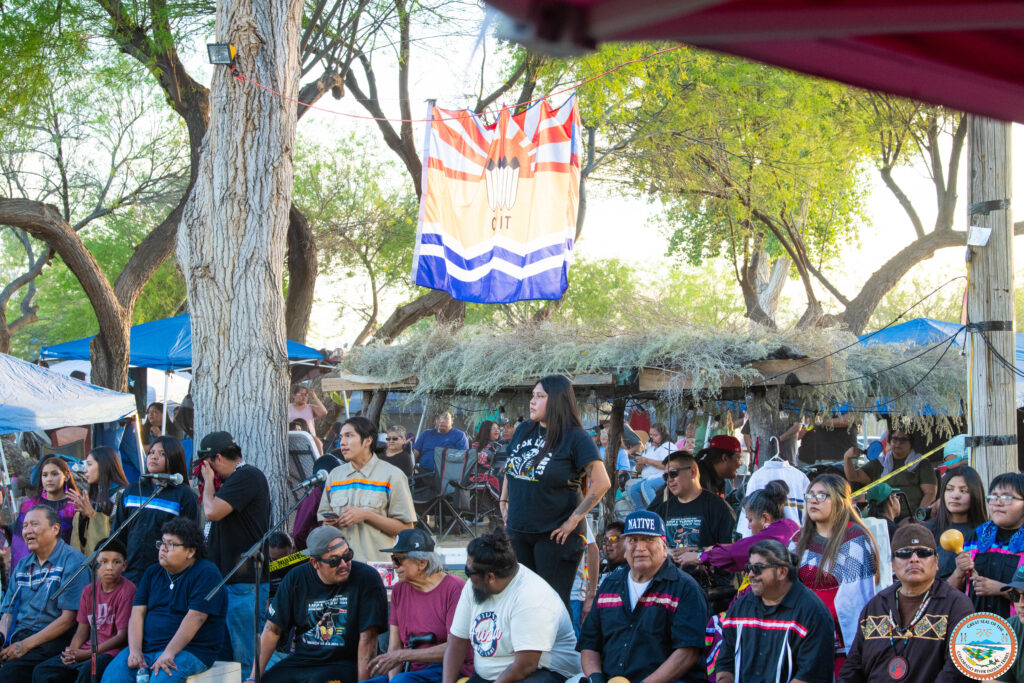
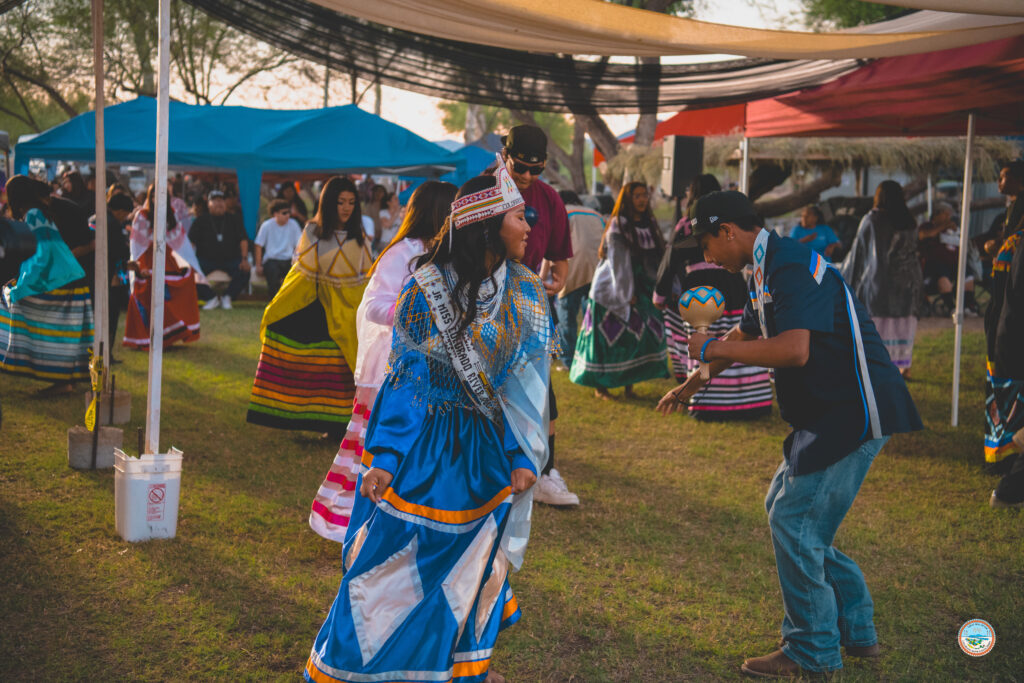
From the youngest participants to experienced singers, the event highlighted the role of youth in learning through participation. Tiny tots and youth dancers stepped into the circle, some shy and others confident, following the rhythm of the gourd and songs as they learned in real time. Families gathered under shaded canopies, watching, encouraging, and sharing in the experience together.

Singing groups stood shoulder to shoulder, their voices blending as they carried songs that have been maintained over generations. Each performance reflected not only skill, but a responsibility to uphold what has been taught and continue it with care and respect.
The event also created space for connection beyond the dance area. Mega throwers gathered for a potluck, shared meals under the gazebo, and spent time visiting with one another throughout the day. Vendors were also set up throughout the area, offering handmade items that showcased their artistry and craftsmanship. Food vendors provided a variety of options, including frybread, tacos, and burgers, along with sweet treats like snow cones, deep-fried Oreos, and funnel cakes—making sure there was something for everyone to enjoy.
As the songs carried into the evening and families remained gathered under the cottonwood trees, the weekend reflected a continued commitment to honoring tradition and ensuring it carries forward for future generations. Mega Throw XIX was a success, and a strong showing of the work and dedication of those who organized and supported the event.
Until we gather again in song and tradition for Mega Throw XX.

Article & Photos by CRIT Media Reporter Ariana Romero