July 28, 2026 11:28 pm
CRIT Nation, Parker, AZ
July 28, 2026 11:28 pm
CRIT Nation, Parker, AZ

Click the links below to download a form

Direct Deposit Authorization Form

General Welfare Application_09242024

General Welfare Application Minors_09242024

PLEASE READ CAREFULLY


Dear Tribal Member:

Tribal Council has approved a 2024 General Welfare Assistance payment of $2,000.00 for each CRIT Tribal Member. CRIT Tribal members, both minors and adults, who are enrolled with CRIT as of November 1, 2024 are eligible to receive assistance. Tribal Members MUST submit an application to receive a General Assistance Payment for 2024.

Click the links below to download a form

Direct Deposit Authorization Form

General Welfare Application_09242024

General Welfare Application Minors_09242024

This 2024 General Welfare Assistance payment replaces the annual Tribal Distribution Payment.  The benefits to the membership are that the General Welfare Assistance payment is NOT income subject to federal taxes and should not impact eligibility for benefits such as SSI and food stamps.  You will not be issued a 1099 for this payment.  Please review the General Welfare Plan for more information.

Tribal Members will receive their General Welfare Assistance payment by mail or by direct deposit into a bank account after submitting their application.  Parents or legal guardians may request direct deposit for their eligible minor tribal member children into an account owned by the parent or the child.  YOU DO NOT HAVE TO SUBMIT A NEW DIRECT DEPOSIT FORM WITH YOUR APPLICATION IF YOU INTEND TO RECEIVE YOUR GENERAL WELFARE ASSISTANCE PAYMENT IN SAME BANK ACCOUNT AS YOU RECEIVED YOUR 2023 GENERAL WELFARE ASSISTANCE PAYMENT.

The General Welfare Assistance payment will be mailed or direct deposited as follows:

Application and Forms Due Date                   Payment Issued

Must be received by Accounting:

October 18, 2024                                            November 21, 2024

November 22, 2024                                        December 19, 2024

December 20, 2024                                         January 16, 2025

After December 20, 2024                              Payments issued monthly on a rolling basis

and before December 31, 2025

If you want to receive your General Welfare Assistance payment by direct deposit, you must submit the attached Direct Deposit Authorization Form along with a voided check to CRIT Accounting.  If you do not have a direct deposit authorization form on file from last year, or do not submit one for 2024 with your application, your payment will be mailed to the address on your application.  The mailing address you provide on the application will be used to update your address with both enrollment and accounting.   You may have already  received written notification  along with  an application and a self-addressed stamped envelope for your use to return the forms or the forms can be dropped off in person at Tribal Administration.  Additionally, the application and forms can be emailed to GWA@crit-nsn.gov.

Please note that the checks for eligible minor tribal members will be issued in the name of the child and not the parents. Parents or guardians must submit proof of their right to receive the distribution on behalf of their child by submitting an application with a copy of the birth certificate listing the parent(s), and if applicable, a court order establishing legal custody and placement before checks will be mailed or the payment directly deposited.

Checks will not be issued to the parent(s) if they do not have the care and custody of their children.  Guardians and custodians of minors who are not the child’s legal parent shall be required to provide a court order indicating their status.  Payments for children in the physical care and custody of CRIT Social Services or other state or tribal agencies shall be held in an account established by CRIT Accounting.

Tribal Members must apply for the 2024 General Welfare Assistance Payments no later than December 31, 2025 after which a 2024 payment will not be available.

Please be advised that if you are in default on a debt you owe to the Colorado River Indian Tribes or its enterprises, you may voluntarily agree to apply your General Welfare Assistance to the loan or other outstanding debt in default.  If you have any questions about outstanding debts in default please contact Tracey Quillen at (928) 669-1239.

If you have any questions regarding General Welfare Assistance or you have an agency incorrectly treating this payment as income please contact the Office of the Attorney General at (928) 669-1271.

Click the links below to download a form

Direct Deposit Authorization Form

General Welfare Application_09242024

General Welfare Application Minors_09242024

Follow this link for more information including how to apply.

This position is located with the Bureau of Indian Affairs, Superintendent, Colorado River Agency in Poston, Arizona.

Duties

  • Responsible for supervising Lead Irrigation System Operators and Irrigation System Operators.
  • Receives water orders; takes daily measurements; maintains record of water delivery, reservoir inflow and outflow, and instream flows, calculates requirements for area served.
  • Operates project distribution facilities to regulate and deliver water in accordance with Bureau water project policies and procedures.
  • Responsible for constant surveillance and condition or irrigation related faculties. Recommends needed maintenance and schedules required repairs.
  • Plan work for subordinates, establish priorities and prepares schedules for its completion.


Federal officials again summoned governors from all seven Colorado River Basin states to Washington, D.C., signaling growing concern that negotiations remain stuck. Reports indicate the federal government is preparing to step in more forcefully if states cannot agree on near-term shortage management and a longer-term framework.

Governor Katie Hobbs is escalating efforts to restrict groundwater pumping tied to Saudi-backed alfalfa farming in La Paz County. The reporting highlights how years of unregulated groundwater use have drawn down aquifers connected to Colorado River–dependent regions.

New analysis outlines what may come next if Basin states fail to reach agreement, including deeper federal control, stricter shortage tiers, and more aggressive conservation.


Sources – January 23, 2026


Arizona Budget Proposal Includes Major Funding for Colorado River Protection

On January 16, 2026, the Arizona Department of Water Resources (ADWR) shared details of Governor Katie Hobbs’ FY 2027 Executive Budget Proposal focused on preparing for long-term challenges facing the Colorado River. The plan includes new and expanded funding aimed at strengthening water security across Arizona in the face of ongoing Colorado River shortages.

Key points from the budget related to water:

  • $30 million one-time deposit into a newly created Colorado River Protection Fund to support conservation efforts and short-term drought response.
  • Permanent funding mechanism for that Protection Fund to be supported by a water usage fee on data centers.
  • Continued investment in water conservation, shortage mitigation, supply augmentation, and water infrastructure upgrades.
  • A recognition that current Colorado River operating rules expire at the end of 2026, with negotiations underway to create a sustainable long-term framework.

Source:
Arizona Water News https://azwaternews.com/2026/01/16/fy2027_execbudgetproposal/

(more…)

Arizona announced new groundwater management rules for parts of La Paz County, expanding oversight in an area long known for unregulated pumping. The move follows increased scrutiny of agricultural water use and reflects a broader push to protect groundwater supplies as Colorado River shortages continue. La Paz County lies within CRIT’s region. Stronger groundwater rules help prevent over-pumping that can undermine surface water systems and threaten tribal water security.

A water policy expert argues that Basin states are unlikely to compromise without clear federal consequences. With post-2026 rules approaching, the federal government’s willingness to step in is seen as a key driver for progress. Federal involvement increases the importance of ensuring tribal water rights and sovereignty are explicitly recognized in any imposed or negotiated plan.

Multiple outlets report on the release of the draft post-2026 Colorado River management alternatives by the U.S. Bureau of Reclamation. The plan outlines several options for operating Lake Powell and Lake Mead, including deeper cuts and greater federal control if states fail to agree. Officials stress that public and stakeholder input is still open but time is limited. These alternatives could directly affect downstream water deliveries. CRIT’s senior water rights, sovereignty, and river stewardship must be included before any plan is finalized.

Arizona municipal water providers stress that collaboration during the legislative session will be essential to address shortages, infrastructure needs, and conservation goals tied to the Colorado River.

Legislation was introduced in Congress to formally codify a tribal water rights settlement, providing legal certainty and recognition of the tribe’s rights. Each tribal settlement strengthens the broader recognition of tribal water rights across the Colorado River Basin and reinforces sovereignty.

Reports highlight emerging technologies, including satellite tools and agricultural innovations, aimed at reducing water use and improving efficiency across the West. Technology can support conservation efforts, but it does not replace enforceable water rights or the need to protect river flows.

(more…)

Several outlets reported on the release of the Draft Environmental Impact Statement (EIS) by the U.S. Bureau of Reclamation, which outlines how the Colorado River could be managed after current rules expire in 2026.

The draft lays out five possible management alternatives for operating Lake Powell and Lake Mead, including options where the federal government steps in if Basin states cannot agree. Federal officials acknowledge that a temporary or stopgap deal may be necessary if negotiations remain stalled. These decisions will directly affect how water is released downstream.

As a senior water rights holder, CRIT’s rights and sovereignty must be protected in any final plan. The draft process is a critical opportunity for tribal input.

Coverage from Nevada and Utah outlets explains that while states continue negotiations, deep disagreements remain over how water cuts should be shared. Federal officials are signaling they are prepared to act if consensus is not reached.Some articles describe this moment as a turning point, where long-standing assumptions about water use are being challenged and previously “untouchable” practices are now on the table.

If states fail to agree, federal decisions could reshape river operations. Tribal nations must be included to ensure historic rights are not overlooked.

California-focused reporting explains how the draft federal plan could require additional water cuts, even during wet years. Officials emphasize that recent storms do not erase long-term shortages caused by overuse and climate change.

California’s use affects overall Basin stability. How cuts are distributed influences downstream reliability for Lower Basin users.

Multiple sources covered Arizona’s continued focus on groundwater protection, including new Active Management Areas and enforcement actions tied to large agricultural water users. These efforts are framed as necessary as Colorado River supplies remain uncertain.

As surface water becomes less reliable, pressure shifts to groundwater. Strong regulation helps prevent over-pumping that could undermine regional water security and tribal resources.

Nonprofit and policy reporting highlights a key admission from federal officials: a full, long-term Colorado River agreement may not be ready by 2026, making interim solutions likely. (more…)

Bureau of Reclamation – The Bureau of Reclamation released its long-awaited Draft Environmental Impact Statement outlining potential strategies for managing Lake Powell and Lake Mead after 2026, when current operating guidelines expire. The draft presents multiple alternatives, including scenarios where the federal government steps in if Basin states fail to reach agreement. No preferred alternative has been selected yet, keeping negotiations open.This document will directly shape how Colorado River water is managed in the future. Tribal water rights, sovereignty, and protections for the river itself must be recognized in any final decision.

Lake Powell Chronicle – This piece outlines which players are involved in current negotiations and what each is seeking, including states, tribes, and federal agencies.Who is “at the table” determines whose rights and values are reflected in the final outcome. Tribal voices remain essential.

Tucson Sentinel – Despite recent storms and heavy rainfall in Phoenix, much of Arizona remains in long-term drought. Experts caution that short-term rain does not replenish groundwater or stabilize Colorado River supplies. Reinforces that reliance on weather alone will not protect tribal water rights or the river.

Arizona Water News – Arizona Department of Water Resources hydrologists are conducting field investigations across multiple basins to better understand groundwater use and conditions. Increased groundwater scrutiny reflects growing pressure as Colorado River supplies tighten, which can affect regional water demand and policy.

KLAS CBS 8 – Forces aligning against healthy snowpack for Colorado River states

Experts warn that warming temperatures, dry spells, and climate trends are working against the development of a healthy snowpack, threatening future river flows. Snowpack is the river’s primary source. Poor conditions upstream affect all downstream users.

Colorado Public Radio / The Hill – House fails to override Trump veto of Colorado water project

Lawmakers failed to override a presidential veto blocking a major Colorado water infrastructure project, leaving future water deliveries uncertain.Delays in infrastructure add pressure to existing Colorado River supplies. (more…)

KGUN 9 Tucson – Group urges Sahuarita to review Hudbay groundwater agreement

Community advocates are calling for closer review of groundwater agreements tied to mining operations, citing long-term water security concerns.

Cave Creek/Carefree Independent – Water at the forefront of Tuesday meetings

Local leaders are increasingly focused on water planning as development and supply concerns grow.

Santa Rosa Press Democrat – California’s largest reservoir rises 36 feet as rains boost water supply statewide. Storms have boosted reservoir levels in California, but officials caution that snowpack remains below what is needed for long-term security.

GV Wire – Winter storms wipe out drought in California, for now

California officials stress that recent rains offer short-term relief but do not end the drought.

CBS News – Colorado’s snowpack woes continue into 2026

Colorado snowpack remains well below average, heightening concern for river flows later this year.

Salt Lake Tribune – The Great Salt Lake enters 2026 uncomfortably close to record lows.

Low water levels highlight the broader regional water crisis tied to climate change and overuse.

Engineering News-Record – At Lake Powell, engineering is outpacing Colorado River policy.

Engineers are adapting dam operations to keep the system functioning, even as policymakers lag behind on long-term solutions.

(more…)

Tribal Elders gathered for an unforgettable day of games, delicious food, and incredible entertainment. Elders enjoyed a hearty lunch, a beautiful fruit display, and variety of desserts in a festive Hawaiian atmosphere.

Guests at the recent Elders Luncheon had the chance to win raffle prizes and participate in games such as Simon Says, Hula Hoop, and Ball Toss. The highlight of the event was the Makai Show, which brought the spirit of the islands to life.

Elder women joined in learning to Hula dance, and the men at the event performed the Haka, a New Zealand ceremonial dance of warriors, proudly showcasing their moves!

To cap off the day, Elders lined up to take photos with the Makai dancers, capturing the perfect “Aloha” moment to remember this special celebration.

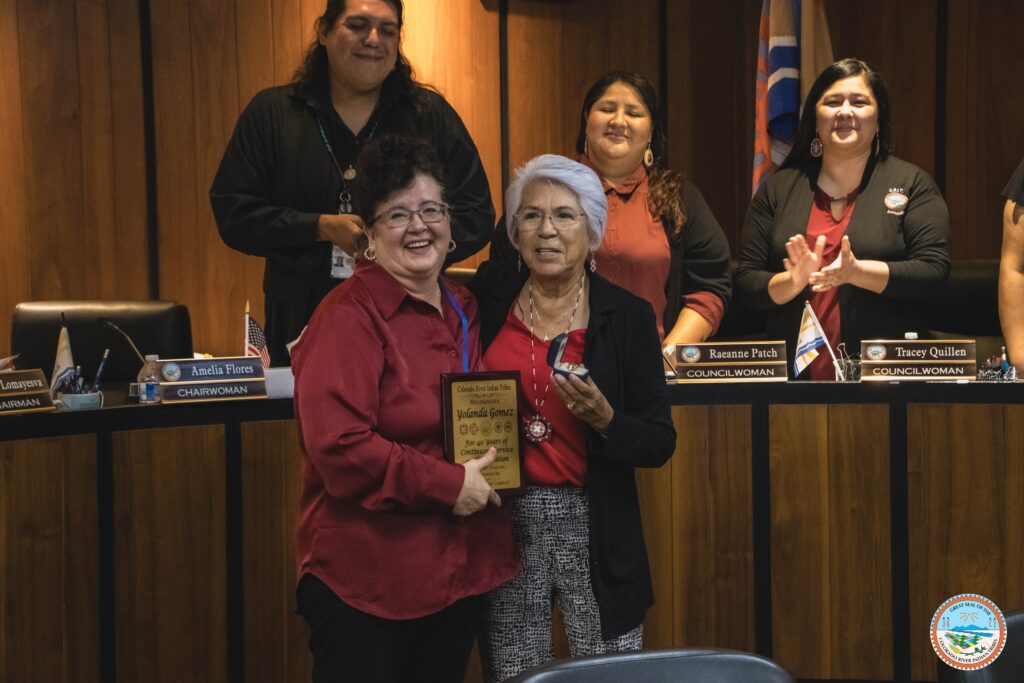
Frank Martinez Jr. was recently recognized for his dedicated years of service to Colorado River Indian Tribes.

Frank began his career with CRIT on July 7, 1980 as a Mechanic I in the Auto Shop Dept. Over the past 45+ years, he has earned numerous certifications, each one reflecting his dedication to keeping CRIT’s vehicles safe and reliable for our employees and community.

Frank has devoted his entire career — four and a half decades — to the Tribal Auto Shop, and his commitment has never wavered.

The Tribal Council and Human Resources Department extends its  deepest gratitude to Mr. Martinez for his remarkable service, loyalty, and expertise.

Please give a warm welcome to CRIT Fish & Game’s new wardens to its team, Madison Schmeling and tribal member Brandy Eddy. Both women bring unique experience, a love for the outdoors, and an exciting step forward for diversity in the department as the only two female wardens on the team.

Brandy Eddy previously worked as a Security Officer at BlueWater Casino. She shared her excitement about the upcoming hunting seasons and the opportunity to explore more of the reservation. Looking ahead, Brandy hopes to continue her training, complete the academy, and eventually move into a supervisory role within Fish and Game.

Madison Schmeling comes to the department with a degree in biology and chemistry, as well as hands-on experience in Animal Control. She has always wanted to become a Game Warden, calling it her “dream job.” Her passion for fishing, hunting, and spending time outdoors makes this a natural career path for her.

Both Brandy and Madison will begin their first step of training at the academy on August 17th in Yuma, Arizona.

The CRIT community looks forward to seeing their contributions to the protection and management of local wildlife and wishes them the very best in this new chapter of their careers.

Article Written by CRIT Reporter Ariana Romero


CRIT is proud to share exciting developments with ‘Amat Kuhwely, LLC which is expanding CRIT’s farming operations. With majority CRIT ownership, CRIT is entering a powerful new chapter: creating jobs, strengthening our economic sovereignty, and making full use of our water and land for the benefit of future generations.

Through an investment with Indigena Capital, this new venture will:
Invest over $23.7 million in the first two years
Create skilled trade and professional jobs
Expand CRIT’s water use rights on Reservation
Honor our heritage while building long-term prosperity

Learn more about the vision, impact, and opportunities of ‘Amat Kuhwely in our latest FAQ release.
Any comments, questions, or concerns you have about this new venture, please reach out to amatkuhwely@crit-nsn.gov and you can view the PDF online by clicking on this link: https://acrobat.adobe.com/id/urn:aaid:sc:va6c2:23d1fe0e-abd8-44e3-9d1a-07dbb8aa1160

(more…)