Arizona opened August with strong pushback to the federal government’s new framework for managing the Colorado River after 2026.
The Bureau of Reclamation’s Final Environmental Impact Statement lays out a 10-year framework for future operations at Lake Powell and Lake Mead. The current operating rules expire after 2026, and the seven Basin states have not reached a long-term agreement on how future shortages should be shared.
Under the federal framework, Arizona, California, and Nevada could face mandatory reductions in Colorado River use. The Department of the Interior said the plan allows Lower Basin shortages of up to 3 million acre-feet, depending on reservoir conditions. The Upper Basin states — Colorado, Utah, Wyoming, and New Mexico — would not face mandatory reductions for now.
Arizona officials and water leaders criticized that approach, saying it places too much of the burden on the Lower Basin and especially on Arizona. Fox 10 reported that the Central Arizona Project, which delivers Colorado River water to central and southern Arizona, raised concerns that the federal framework could lead to deeper cuts for the state. CAP serves cities, farms, and Tribal communities through its 336-mile canal system.
Several Arizona leaders said the state has already conserved significant amounts of Colorado River water and should not be forced to carry the largest share of future reductions. KNAU reported that Arizona officials called on Upper Basin states to do more to share the burden, while Upper Basin officials argued that drought and reduced snowpack already limit the amount of water available to them.
Central Arizona Project President Terry Goddard also criticized the federal plan. KTAR reported that Goddard said the plan requires Lower Basin states to cut water use while Upper Basin states face no mandatory reductions. CAP said it expects the final operating guidelines for 2027 and 2028 to better reflect the Lower Basin proposal, which would conserve more than 3.2 million acre-feet of water through 2028.
The issue is especially important for Arizona because cuts to Colorado River water would not affect every community the same way. ABC15 reported that reductions would hit Valley cities unevenly because Central Arizona Project water is delivered under a priority system. Some communities have stronger priority, stored water, other supplies, or Tribal water leases that may help reduce the impact. Others could be more exposed.
Phoenix said it is prepared for possible Colorado River reductions because of conservation, underground storage, diverse supplies, and long-term infrastructure planning. The city has also joined regional water-sharing efforts meant to help Arizona communities manage shortages.
Infrastructure is becoming a larger part of the state’s water planning. KJZZ reported that Salt River Project opened the Gilbert Road Pipeline, a $25 million project that will help Valley cities access stored groundwater during dry times. The pipeline connects water stored near the Granite Reef Underground Storage Project to the Arizona Canal, making it easier for cities to recover water they banked for shortage conditions.
The SRP project also involved the Salt River Pima-Maricopa Indian Community. KJZZ reported that the pipeline crosses part of the community near Mesa, and President Martin Harvier spoke at the ribbon-cutting, connecting the project to the long history of canal systems in the Valley.
Lake Powell remains one of the biggest concerns. KTAR reported that the reservoir could lose the ability to generate hydropower as early as March 2027 if water levels continue to fall. Glen Canyon Dam provides power for millions of people across the Southwest, and low reservoir levels can also affect dam infrastructure, releases through the Grand Canyon, and downstream operations. (more…)
The final days of July brought the clearest picture yet of how the federal government may manage the Colorado River after 2026.
The Bureau of Reclamation released its Final Environmental Impact Statement for future operations at Lake Powell and Lake Mead, setting up a 10-year framework for managing the river through 2036. The current operating rules expire after 2026, and the Basin states have not reached a long-term agreement on how future shortages should be shared.
The federal framework does not settle every question. Instead, it gives Reclamation room to adjust operations over shorter periods as river conditions change. The Department of the Interior said the preferred alternative allows for annual Lake Powell releases between 5 million and 12 million acre-feet, Lower Basin shortages of up to 3 million acre-feet, and new options to store conserved water in Lake Powell and Lake Mead for future use.
For Arizona, the proposal carries serious consequences. The Associated Press reported that Arizona, California, and Nevada would share reductions under the federal plan, while the Upper Basin states would not face mandatory cuts for now. The Lower Basin could be required to reduce use by up to 3 million acre-feet annually through 2036, depending on river conditions.
Arizona officials pushed back quickly. Gov. Katie Hobbs called parts of the federal framework unacceptable, and the Arizona Department of Water Resources said reductions of up to 3 million acre-feet per year, in priority, would harm Arizona water users and the state economy. ADWR said it wants the final Record of Decision and operating guidelines to follow the May 1 Lower Basin Proposal, which includes shared reductions among Arizona, California, and Nevada of 1.25 million acre-feet each year, plus 700,000 acre-feet of system conservation water.
Central Arizona Project also responded to the FEIS, saying future rules must recognize Arizona’s existing rights and the realities of how Colorado River water is used in the state. CAP delivers Colorado River water to central and southern Arizona, including cities, agriculture, and tribal users. Any major reduction to CAP supplies would affect communities differently depending on their water priority, stored supplies, and access to other sources.
Arizona communities were already preparing before the FEIS was released. KJZZ reported that Salt River Project opened the Gilbert Road Pipeline, a $25 million project that will help Valley cities access stored groundwater during dry times. The pipeline connects underground storage near the Granite Reef Underground Storage Project to the Arizona Canal, making it easier for cities to recover water they stored for shortage conditions.
That project also involved the Salt River Pima-Maricopa Indian Community. KJZZ reported that the pipeline crosses a portion of the community near Mesa, and President Martin Harvier spoke at the ribbon-cutting, connecting the project to the long history of canal systems in the Valley.
Stored water and infrastructure are becoming more important as cities look for backup supplies. City of Phoenix officials said the city is prepared for potential Colorado River cuts because of its diverse water portfolio, conservation work, underground storage, and investments in infrastructure. Other Arizona cities are also turning to conservation, including turf conversion programs and water-saving rebates.
In Queen Creek, local reporting said turf conversions are saving water and money. Fox 10 reported that Gilbert residents are seeing higher water rates, showing how water planning costs are reaching household budgets. KTAR reported that Kearny expects its current water supply to last through this year, but 2027 remains uncertain.
Drought conditions also continued across Arizona. Payson Roundup reported that Arizona has been designated a drought disaster area, while other local reports showed concern in rural communities that rely on limited supplies or groundwater. These conditions show how water shortages are not only a Colorado River issue. They also affect small towns, farms, local utilities, and private well users.
Lake Powell remained one of the most urgent concerns. KTAR reported that Lake Powell could lose the ability to generate hydropower by early 2027 if water levels continue to fall. CBS 5 Arizona’s Family also reported that the Colorado River crisis threatens both water supply and hydropower for millions of people. Low reservoir levels affect more than storage. They can affect dam operations, electricity generation, water deliveries, and the ability to manage future dry years.
Scientists are also working to better understand how much water is being lost from the system. Colorado Public Radio and KUNR reported that researchers are expanding evaporation monitoring across the Colorado River Basin. The work is meant to give water managers better information about how much water is lost from reservoirs and other parts of the system, an issue that becomes more important as Lake Mead and Lake Powell remain low.
The pressure is being felt outside Arizona as well. Nevada Independent reported that Nevada could lose a significant share of its Colorado River water under the federal framework, while Las Vegas-area reporting focused on conservation and what continued cuts could mean for Southern Nevada. California outlets reported that future Colorado River reductions could affect Southern California water planning, including agencies that depend on Colorado River supplies.
Public concern is also rising. A Walton Family Foundation poll found that residents across all seven Basin states view shrinking Colorado River supplies as a priority. KJZZ reported that Arizonans are worried about water and want elected officials to respond. Those findings reflect what many local water stories showed throughout July: the Colorado River issue is no longer limited to technical negotiations. It is showing up in city budgets, water rates, infrastructure projects, agriculture, energy, and household concerns.
By the end of July, the federal FEIS became the main turning point. It did not end the negotiations, but it set the stage for the next federal decision. Reclamation will still issue a Record of Decision and operating guidelines, which will provide more detail on how the framework will be used. (more…)
The Bureau of Reclamation has released its Final Environmental Impact Statement for future Colorado River operations, a major step toward deciding how Lake Powell and Lake Mead will be managed after 2026.
The document comes as the current river rules near expiration. The 2007 Interim Guidelines, the 2019 Drought Contingency Plans, and several related agreements are set to expire after the 2026 operating year. Those rules helped guide shortages and coordinated operations between Lake Powell and Lake Mead, but Reclamation said they have not been strong enough to stop the continued decline of the river’s two largest reservoirs.
Instead of adopting one fixed long-term operating plan, Reclamation’s preferred alternative creates a 10-year adaptive framework for operations from 2027 through 2036. Under that framework, operating guidelines could be issued in shorter periods, likely every two years, unless the Basin states reach a longer consensus agreement.
That approach gives the federal government more flexibility as river conditions change. It also shows that the seven Basin states have not yet reached a long-term agreement on how future shortages should be shared.
The Department of the Interior said the framework is meant to guide operations at Lake Powell and Lake Mead while leaving room for future agreements among the Basin states. The preferred alternative includes “sideboards,” or operating limits, that set the range of actions federal officials could use.
Those sideboards include annual releases from Lake Powell between 5 million and 12 million acre-feet, Lower Basin shortages of up to 3 million acre-feet, and new options to store conserved water in Lake Powell and Lake Mead for future use. The framework also allows voluntary Upper Basin conservation of up to 200,000 acre-feet, depending on hydrologic conditions.
Lake Powell and Lake Mead remain central to the federal planning process. Lake Powell helps regulate releases from the Upper Basin through Glen Canyon Dam, while Lake Mead supports Lower Basin deliveries to Arizona, California, and Nevada through Hoover Dam. When either reservoir drops too low, the risk is not only less stored water. Low levels can also affect hydropower, dam operations, deliveries, and the ability to respond to future dry years.
Reclamation’s Executive Summary says the Colorado River supports about 40 million people, nearly 5.5 million acres of agricultural land, ecological resources, hydropower, cultural resources, and communities across seven states and Mexico. It also identifies 30 federally recognized Tribes in the Basin, including the Colorado River Indian Tribes.
The Final EIS directly addresses Tribal concerns. Reclamation said Basin Tribes have expressed that the current approach to Colorado River management does not fully address their rights, needs, and interests. The document says future guidelines should provide more flexibility and predictability for Basin Tribes to benefit from their water rights and participate in voluntary conservation programs.
That language is important because it places Tribal Nations inside the future operating framework, not outside of it. For CRIT, that matters because the Tribe holds senior Colorado River rights and has agricultural, cultural, and governmental interests tied directly to the river.
The Arizona Department of Water Resources released a statement after the FEIS was published. ADWR said Arizona, California, and Nevada submitted a Lower Basin proposal to help stabilize Lake Powell and Lake Mead with more than 3 million acre-feet of water savings over two years. ADWR said the FEIS includes analysis that could allow many core parts of that proposal to move forward.
ADWR also raised concerns. The agency objected to parts of the federal framework that could allow Lower Basin reductions of up to 3 million acre-feet per year, in priority. ADWR said reductions at that level would harm Arizona water users and the state economy. The agency also said the framework does not include Upper Basin reductions or enough use of water stored in reservoirs above Lake Powell.
ADWR said it wants the forthcoming Record of Decision and operating guidelines to follow the May 1 Lower Basin Proposal. That plan includes shared reductions among Arizona, California, and Nevada of 1.25 million acre-feet each year, plus an additional 700,000 acre-feet of system conservation water.
The next major step will be the federal Record of Decision and operating guidelines. Those documents are expected to provide more detail on how operations will be handled through 2028 and how the broader framework will guide decisions through 2036.
For CRIT, the FEIS is significant because future operations at Lake Powell and Lake Mead shape the larger river system where the Tribe’s senior rights are exercised. CRIT is not in the same legal position as many junior-priority users, but federal rules on reservoir operations, conservation programs, shortage planning, and stored water can still influence Basin-wide policy. (more…)
July 16 reporting focused on what future Colorado River rules may need to account for: water users, reservoir levels, river health, and the cost of keeping the system operating.
KJZZ reported that environmental advocates want future Colorado River rules to leave some water for the river itself. The article focused on the Colorado River below Glen Canyon Dam, where river conditions are shaped by dam operations, reservoir levels, and releases from Lake Powell. Advocates told KJZZ that a healthier river system can also support the water supply system that cities, farms, and ecosystems depend on.
Lake Mead also remained under pressure. Water Online reported that the Metropolitan Water District of Southern California is partnering with the federal government to leave water in Lake Mead. The agreement is meant to help slow the reservoir’s decline while the Basin states continue working on new river rules.
Several Nevada outlets reported that Lake Mead is expected to keep dropping. KLAS reported that the reservoir could fall nearly 33 feet by June 2028, and the Las Vegas Review-Journal reported that forecasters expect Lake Mead to continue setting record lows over the next two years. KVVU also reported that Lake Mead is nearing its all-time low as Boulder City continues to raise concerns about a proposed data center and its power demands.
Lake Powell remained a major concern as well. St. George News reported that the reservoir reached a critical threshold amid the ongoing Colorado River crisis. Low levels at Lake Powell affect hydropower generation, releases through Glen Canyon Dam, and the overall operation of the river system.
Weather added another layer of uncertainty. CAP Know Your Water News reported that a possible “Super El Niño” could bring wetter conditions to parts of the Southwest, but it does not guarantee relief for the Colorado River Basin. CAP reported that snowpack, runoff, and conditions in the Upper Basin will still determine how much water reaches Lake Powell and Lake Mead.
In the Upper Basin, Colorado water officials announced a new state-run conservation program. Aspen Journalism reported that the program will use federal funding to pay water users to voluntarily reduce use in 2027 and 2028. The program is expected to include criteria meant to avoid negative community impacts, encourage participation across sectors, and support drought resiliency. (more…)
July reporting continued to focus on how Arizona and the wider Colorado River Basin are preparing for reduced water supplies, with attention on Tribal water leadership, advanced water purification, and low reservoir levels.
Lake Powell Chronicle reported on the growing role of Tribal Nations in Arizona water policy. The article focused on how Tribal water rights, settlements, and planning are becoming more central as the state and federal government respond to long-term shortages. The reporting also reflects a broader shift across the Basin, where Tribal Nations are not only water rights holders but key governments in future river decisions.
Arizona water agencies are also looking at new supply options. AMWUA reported on advanced water purification, a process that treats recycled water to drinking-water standards. The technology is receiving more attention as cities look for options beyond traditional surface water, groundwater, and stored credits.
At the same time, Lake Powell remains under serious pressure. ABC News reported that the reservoir is nearing “dead power pool,” the elevation where water levels become too low for Glen Canyon Dam to generate hydropower. Newsweek also reported on concerns about Lake Powell and Lake Mead, including ideas being discussed by scientists and water experts as both reservoirs remain low.
John Fleck at Inkstain described the reservoir conditions as a grim Colorado River milestone. The continued decline of Lake Powell and Lake Mead shows how storage, hydropower, and future water deliveries are tied together. When the reservoirs fall, the issue is not only how much water remains but how the system can continue operating.
California water issues also remained part of the regional picture. Smart Water Magazine reported that California voters rank water among their top priorities for the next governor. While California’s water system is different from Arizona’s, the state remains part of Colorado River negotiations and shares in decisions over future Lower Basin reductions.
The July reports show several parts of the water discussion moving at once. Tribal Nations are gaining more recognition in water policy. Cities are exploring advanced purification. Lake Powell and Lake Mead remain low. States are still facing pressure to plan for a river system that can no longer support all demands in the same way.
What does this mean for CRIT?
For CRIT, the reporting on Tribal water power is directly relevant. It shows that Tribal Nations are becoming more visible in statewide and Basin-wide water decisions, especially as shortages force governments to revisit how water is managed.
CRIT’s senior Colorado River rights are a major part of that larger water policy landscape. As Arizona cities look at reuse, purification, and future water supplies, Tribal rights and Tribal governments remain central to any complete discussion about the river’s future.
The Lake Powell reporting also matters because reservoir levels affect federal operations, hydropower, and shortage planning across the Basin. CRIT’s Water Code and Water Resiliency Act help guide local water management as those conditions change, while the Personhood Resolution reflects the Tribe’s cultural and environmental connection to the Colorado River. (more…)
July reporting continued to focus on how Arizona and the wider Colorado River Basin are preparing for reduced water supplies, with attention on Tribal water leadership, advanced water purification, and low reservoir levels.
Lake Powell Chronicle reported on the growing role of Tribal Nations in Arizona water policy. The article focused on how Tribal water rights, settlements, and planning are becoming more central as the state and federal government respond to long-term shortages. The reporting also reflects a broader shift across the Basin, where Tribal Nations are not only water rights holders but key governments in future river decisions.
Arizona water agencies are also looking at new supply options. AMWUA reported on advanced water purification, a process that treats recycled water to drinking-water standards. The technology is receiving more attention as cities look for options beyond traditional surface water, groundwater, and stored credits.
At the same time, Lake Powell remains under serious pressure. ABC News reported that the reservoir is nearing “dead power pool,” the elevation where water levels become too low for Glen Canyon Dam to generate hydropower. Newsweek also reported on concerns about Lake Powell and Lake Mead, including ideas being discussed by scientists and water experts as both reservoirs remain low.
John Fleck at Inkstain described the reservoir conditions as a grim Colorado River milestone. The continued decline of Lake Powell and Lake Mead shows how storage, hydropower, and future water deliveries are tied together. When the reservoirs fall, the issue is not only how much water remains but how the system can continue operating.
California water issues also remained part of the regional picture. Smart Water Magazine reported that California voters rank water among their top priorities for the next governor. While California’s water system is different from Arizona’s, the state remains part of Colorado River negotiations and shares in decisions over future Lower Basin reductions.
The July reports show several parts of the water discussion moving at once. Tribal Nations are gaining more recognition in water policy. Cities are exploring advanced purification. Lake Powell and Lake Mead remain low. States are still facing pressure to plan for a river system that can no longer support all demands in the same way.
What does this mean for CRIT?
For CRIT, the reporting on Tribal water power is directly relevant. It shows that Tribal Nations are becoming more visible in statewide and Basin-wide water decisions, especially as shortages force governments to revisit how water is managed. (more…)
The Colorado River is not just a water source for the Colorado River Indian Tribes (CRIT); it is the foundation of life, culture, and survival on the Reservation. It sustains farms and families, supports wildlife, and holds deep cultural and spiritual meaning for the Tribes who have lived along its banks for generations. For CRIT, decisions about the river are not abstract policy debates, they directly affect the Tribe’s ability to live, govern, and prosper for future generations.

That reality framed a series of high-level meetings held alongside the Colorado River Water Users Association (CRWUA) Conference, where CRIT was represented by a unified and prepared delegation consisting of Tribal Council, legal counsel, the CRIT Attorney General’s Office, Public Affairs, and the Tribe’s Washington, D.C. and Phoenix lobbying teams, all actively engaged in advancing and defending CRIT’s water rights and sovereignty.
This delegation engaged in multiple meetings with neighboring tribes, federal agencies, state representatives, and regional water districts. As the Colorado River Basin approaches major changes after 2026, these discussions focused on the future of the river, tribal water rights, and CRIT’s role as a sovereign water authority.
At the center of these discussions was a clear and unwavering position from CRIT: the Tribe’s senior water rights, tribal sovereignty, and responsibility to protect the Colorado River are not negotiable. CRIT Deputy Attorney General Travis Nez explained that the Tribe is expanding its agricultural footprint by investing in and growing farming operations on the Reservation. This ensures that the Tribe’s water is put to use on tribal lands to generate the greatest possible economic benefit for the community. While many water users across the Basin are reducing agricultural use, CRIT is intentionally increasing on-reservation water use to reclaim water that has historically gone unused and to convert it into long-term economic benefits for the Tribe.

CRIT leadership and the Tribe is fully cognizant that neighboring and downstream entities have economically benefited for decades from CRIT’s unused Colorado River allocation. This includes large regional water agencies such as the Metropolitan Water District of Southern California. Their Colorado River Aqueduct diverts water at Lake Havasu upstream of the CRIT Reservation, supporting municipal growth and generating substantial economic value. Simultaneously, CRIT’s own ability to fully use its water has long been constrained by outdated irrigation infrastructure constructed and controlled by the Bureau of Indian Affairs (BIA). (more…)
When people talk about climate change, it can sound political or exaggerated, but at its core, it’s about environmental changes we can measure over time. Scientists like Brad Udall, who studies long-term weather patterns, have found that the Earth’s average temperature has risen slightly over the past century, mostly because of how people consume energy. When coal, gas, or oil is burned, it releases gases that trap more heat in the atmosphere, like a blanket wrapped around the planet. Despite whether someone believes it is man-made or not, climate change forces us to pay attention, and develop methods to protect the land and water that sustain us.
On Monday, September 29th, Udall, an internationally recognized scientist on water and climate change from Colorado State University, visited the Colorado River Indian Reservation to share his latest findings on the Colorado River. He spoke with Tribal leaders about what the future may hold.
Udall is known for his research on the connection between climate change and river systems in the American West. He has spent decades studying how heat, drought, and rainfall affect water levels, especially in the Colorado River Basin. Additionally, Udall co-wrote parts of the U.S. National Climate Assessment, and has testified before the United States Congress about the effects of climate change on western water supplies. His work focuses on researching solutions that balance the needs of people, agriculture, and the environment.
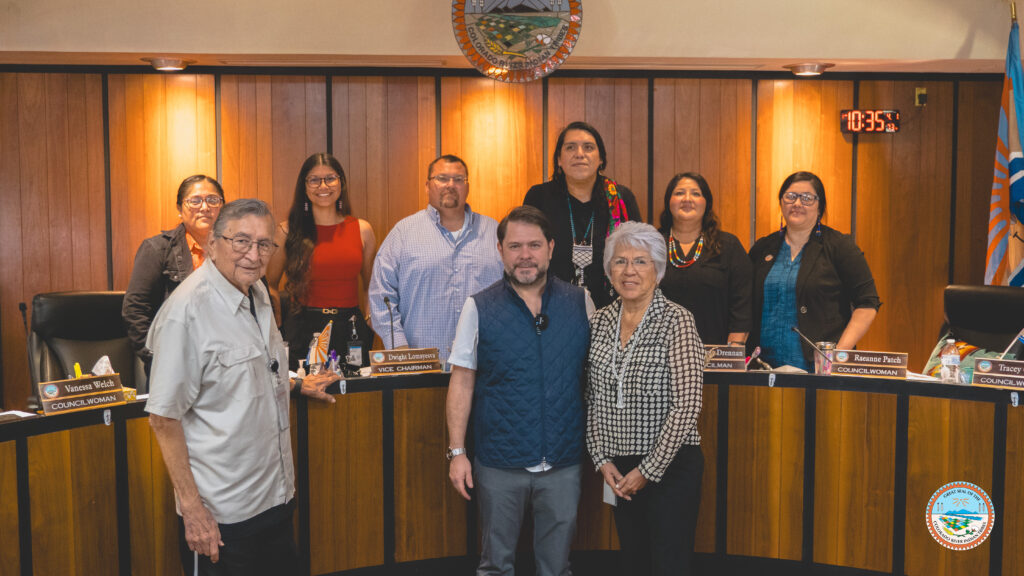
When Udall met with Tribal leadership at the Colorado River Indian Tribes (CRIT) Council Chambers, he was greeted by Chairwoman Amelia Flores, Councilwoman Vanessa Welch, CRIT Attorney General Rebecca Loudbear, CRIT Water Resources Director Dillion Esquerra, CRIT Realty Commercial Manager Herman “TJ” Lafoon Jr., and CRIT Lead Water Attorney John Bezdek.
During his presentation, Udall explained that flows in the Colorado River have dropped about 20% since the year 2000, and that precipitation – the rain and snow that feed the river – is also down about 20%. He said several studies have found that this isn’t just a temporary drought, but a long-term trend he believes is caused largely by human-driven climate change. Temperatures are rising across the Southwest, and according to Udall, “We are now on target for 3 degrees Celsius of warming by the year 2100.” Udall reiterated that his studies show this increase in temperatures is based on an average of estimates, and that temperatures in certain areas, including the desert southwest, could see higher increases.
Udall described the situation as serious and with little optimism. He shared that some scientists are exploring ideas like adding sulfur dioxide to the atmosphere to help cool the planet, though he said most researchers are cautious about such steps because they involve more human interference in nature. “It’s not a perfect solution,” he explained, “but it shows how far people are thinking about how to slow down the warming.” Councilwoman Vanessa Welsh was thankful for Udall’s frankness about the situation stating, “Many of us do know this, but we don’t hear it very often…We intend to protect the river as one of our own.” (more…)
The Department of Revenue and Finance Welcomes Director
The Colorado River Indian Tribes is pleased to welcome Andrew Quillen as the new Director of the Revenue and Finance Department.
Mr. Quillen is a CRIT tribal member who was born and raised in the community. He brings both professional experience and a deep personal connection to the reservation into his new leadership role. He has worked for the Tribes for the past three years and has steadily grown within the department.
Mr. Quillen earned his Bachelor of Arts degree in Business Administration with a concentration in management from the University of La Verne. Upon returning to Parker, he began his career with the Tribes as a tax examiner and revenue agent. He quickly found that the work aligned with his long-standing interest in business, compliance, and economic development.
When the former Revenue and Finance Director was elected to Tribal Council, Mr. Quillen felt it was the right time to step forward and continue the work the department had already established. His background in sales, service, and compliance has helped shape his understanding of how the department supports businesses and the community as a whole.
As a lifelong community member, Mr. Quillen understands the economic landscape of the reservation and the opportunities for growth. One of his personal goals is to see more tribal members become business owners. Being part of the reservation’s continued development is something that holds special meaning for him. (more…)
The Colorado River Indian Tribes Utilities Department has welcomed a familiar face into its leadership, naming Alex Covarrubias Jr. as the new Utilities Director.
Covarrubias is a Parker and Poston local who grew up in the community he now serves. His career in the water industry began in 2013, giving him more than a decade of hands-on and leadership experience in the field.
He started his professional journey working in Big River for three years before joining CRIT Utilities, where he served as Water Department Supervisor. During his time with the Tribe, Covarrubias gained valuable experience learning the day-to-day operations of the department and the importance of understanding the work from the ground up.
“Learning the ins and outs of the job builds character,” Covarrubias said. “I’m glad I was able to learn from the bottom.”
In 2022, he stepped away from CRIT Utilities to continue building his experience, working with the Rural Water Association of Arizona. Along with his previous roles, Covarrubias has spent years in management and believes that with a good attitude and strong work ethic, he can be an effective leader.
Returning to CRIT Utilities as Director is a full-circle moment for Covarrubias, and one he says he is excited about.
CRIT Utilities oversees essential services including water, wastewater, and solid waste for the reservation. Having spent years doing hands-on work in the field, Covarrubias believes that experience helps him better support his team. (more…)
TUCSON, Ariz. — The University of Arizona will host a special series of sign unveiling ceremonies on Friday, September 4, 2026, honoring the four languages of the Colorado River Indian Tribes (CRIT): Mohave, Chemehuevi, Hopi, & Navajo. These ceremonies represent an important milestone in an ongoing campus-wide initiative to elevate the visibility, recognition, and continued presence of Indigenous languages and cultural heritage within the campus community.
The events are organized by the University of Arizona’s Office of Native American Advancement & Tribal Engagement (NAATE) in collaboration with individual academic colleges. Students, faculty, staff, tribal community members, and the general public are invited to attend the progression of ceremonies throughout the day.
The schedule for the Friday ceremonies includes:
The celebration of Indigenous culture continues into the weekend with the Native American Heritage Game on Saturday, September 5, 2026. The Arizona Wildcats will face Northern Arizona at Casino Del Sol Stadium, with kick-off scheduled for 6:30 PM MST. Pre-game festivities at Bear Down Field will begin at 3:15 PM with the Bear Down Bash, featuring 18-minute cultural performances from each tribe. A traditional gift presentation will follow during the Wildcat Walk at 4:15 PM, leading up to an on-field tribal recognition ceremony during the second quarter of the football game.
For more operational schedules or to register for the unveiling events, please visit the official University of Arizona Event Page.