August 14, 2026 1:40 pm
CRIT Nation, Parker, AZ
August 14, 2026 1:40 pm
CRIT Nation, Parker, AZ

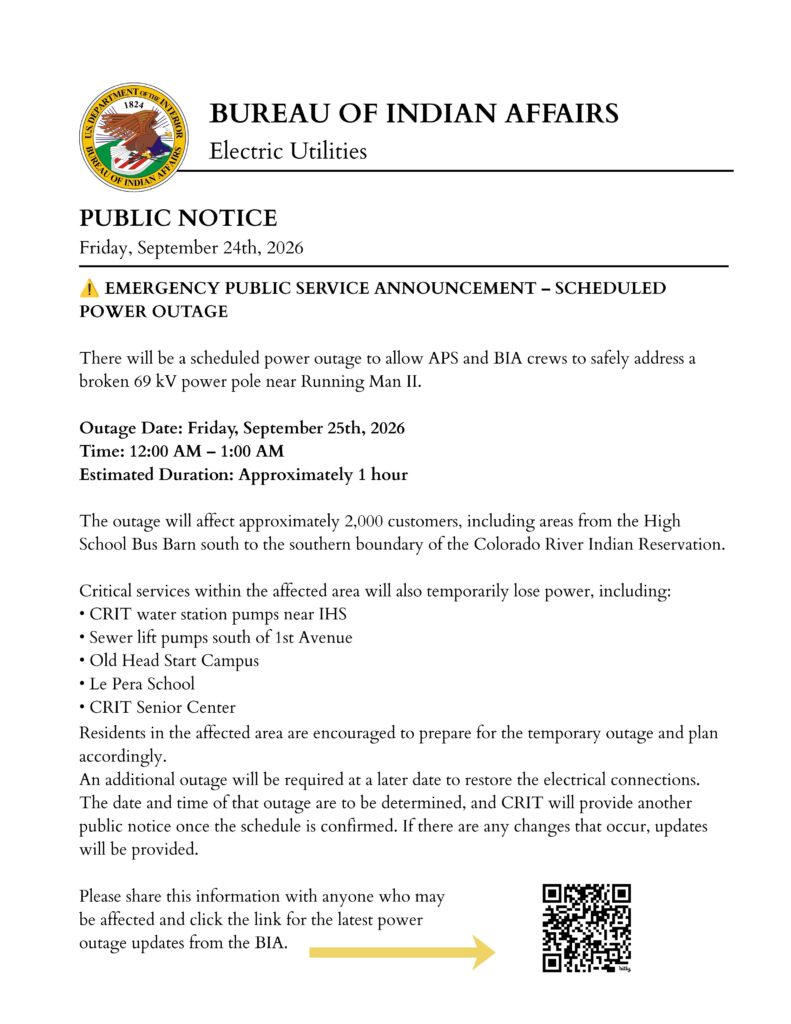
Según BIA Electric, Mochem Housing en el valle no se quedará sin electricidad.

Click the links below to download a form

Direct Deposit Authorization Form

General Welfare Application_09242024

General Welfare Application Minors_09242024

PLEASE READ CAREFULLY


Dear Tribal Member:

Tribal Council has approved a 2024 General Welfare Assistance payment of $2,000.00 for each CRIT Tribal Member. CRIT Tribal members, both minors and adults, who are enrolled with CRIT as of November 1, 2024 are eligible to receive assistance. Tribal Members MUST submit an application to receive a General Assistance Payment for 2024.

Click the links below to download a form

Direct Deposit Authorization Form

General Welfare Application_09242024

General Welfare Application Minors_09242024

This 2024 General Welfare Assistance payment replaces the annual Tribal Distribution Payment.  The benefits to the membership are that the General Welfare Assistance payment is NOT income subject to federal taxes and should not impact eligibility for benefits such as SSI and food stamps.  You will not be issued a 1099 for this payment.  Please review the General Welfare Plan for more information.

Tribal Members will receive their General Welfare Assistance payment by mail or by direct deposit into a bank account after submitting their application.  Parents or legal guardians may request direct deposit for their eligible minor tribal member children into an account owned by the parent or the child.  YOU DO NOT HAVE TO SUBMIT A NEW DIRECT DEPOSIT FORM WITH YOUR APPLICATION IF YOU INTEND TO RECEIVE YOUR GENERAL WELFARE ASSISTANCE PAYMENT IN SAME BANK ACCOUNT AS YOU RECEIVED YOUR 2023 GENERAL WELFARE ASSISTANCE PAYMENT.

The General Welfare Assistance payment will be mailed or direct deposited as follows:

Application and Forms Due Date                   Payment Issued

Must be received by Accounting:

October 18, 2024                                            November 21, 2024

November 22, 2024                                        December 19, 2024

December 20, 2024                                         January 16, 2025

After December 20, 2024                              Payments issued monthly on a rolling basis

and before December 31, 2025

If you want to receive your General Welfare Assistance payment by direct deposit, you must submit the attached Direct Deposit Authorization Form along with a voided check to CRIT Accounting.  If you do not have a direct deposit authorization form on file from last year, or do not submit one for 2024 with your application, your payment will be mailed to the address on your application.  The mailing address you provide on the application will be used to update your address with both enrollment and accounting.   You may have already  received written notification  along with  an application and a self-addressed stamped envelope for your use to return the forms or the forms can be dropped off in person at Tribal Administration.  Additionally, the application and forms can be emailed to GWA@crit-nsn.gov.

Please note that the checks for eligible minor tribal members will be issued in the name of the child and not the parents. Parents or guardians must submit proof of their right to receive the distribution on behalf of their child by submitting an application with a copy of the birth certificate listing the parent(s), and if applicable, a court order establishing legal custody and placement before checks will be mailed or the payment directly deposited.

Checks will not be issued to the parent(s) if they do not have the care and custody of their children.  Guardians and custodians of minors who are not the child’s legal parent shall be required to provide a court order indicating their status.  Payments for children in the physical care and custody of CRIT Social Services or other state or tribal agencies shall be held in an account established by CRIT Accounting.

Tribal Members must apply for the 2024 General Welfare Assistance Payments no later than December 31, 2025 after which a 2024 payment will not be available.

Please be advised that if you are in default on a debt you owe to the Colorado River Indian Tribes or its enterprises, you may voluntarily agree to apply your General Welfare Assistance to the loan or other outstanding debt in default.  If you have any questions about outstanding debts in default please contact Tracey Quillen at (928) 669-1239.

If you have any questions regarding General Welfare Assistance or you have an agency incorrectly treating this payment as income please contact the Office of the Attorney General at (928) 669-1271.

Click the links below to download a form

Direct Deposit Authorization Form

General Welfare Application_09242024

General Welfare Application Minors_09242024

Follow this link for more information including how to apply.

This position is located with the Bureau of Indian Affairs, Superintendent, Colorado River Agency in Poston, Arizona.

Duties

  • Responsible for supervising Lead Irrigation System Operators and Irrigation System Operators.
  • Receives water orders; takes daily measurements; maintains record of water delivery, reservoir inflow and outflow, and instream flows, calculates requirements for area served.
  • Operates project distribution facilities to regulate and deliver water in accordance with Bureau water project policies and procedures.
  • Responsible for constant surveillance and condition or irrigation related faculties. Recommends needed maintenance and schedules required repairs.
  • Plan work for subordinates, establish priorities and prepares schedules for its completion.


News Update November 12, 2025

Negotiations over the future of the Colorado River have reached a standstill after all seven basin states failed to meet a key federal deadline. Reports from 12News and 8NewsNow confirm that the states were unable to agree on a new water-sharing plan, leaving the situation unresolved as the river continues to decline.

High Country News explains that the biggest disagreements involve how much each state should give up in the future. The upper Basin states want fewer mandatory reductions, while the Lower Basin states, including Arizona, say they have already taken the deepest cuts and cannot continue to absorb the majority of the impacts.

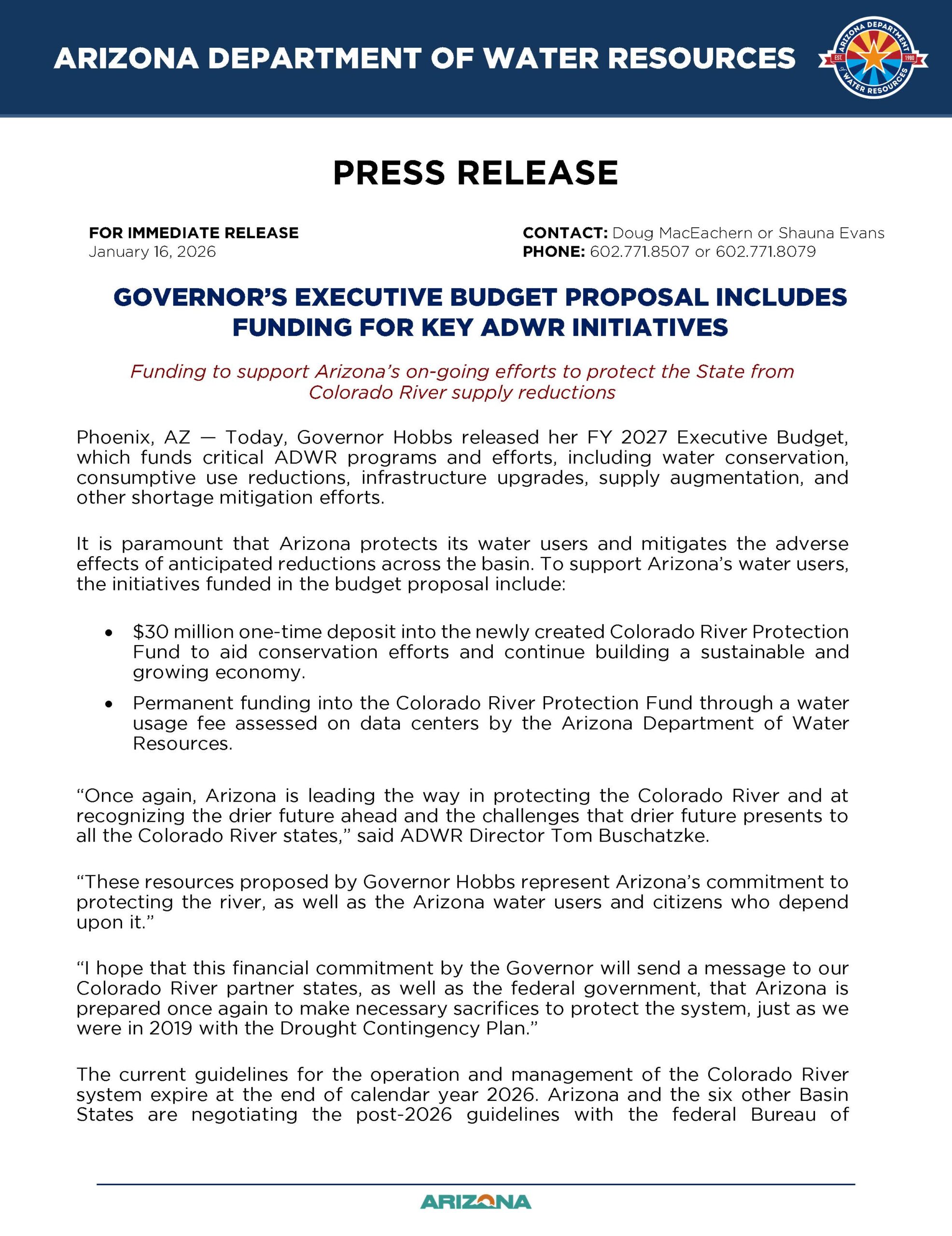
With no agreement in place, Arizona Governor Katie Hobbs has asked the Trump administration to intervene. She stated that Arizona has made significant sacrifices and cannot carry the weight of the reductions while other states refuse to commit to measurable cuts. If the states cannot reach a plan soon, the federal government may create one for them.

For the Colorado River Indian Tribes, the outcome of these negotiations has major importance. CRIT holds valuable senior water rights and relies on a stable and fair management plan to ensure long-term security for the community and the region.

For more information, you can read the news articles with the links below.

8NewsNow
https://www.8newsnow.com/news/local-news/colorado-river-negotiations-fail-to-meet-federal-deadline-for-7-state-agreement/

High Country News
https://www.hcn.org/articles/why-colorado-river-negotiations-are-so-difficult/


ABC 15 News
https://www.abc15.com/weather/impact-earth/why-gov-katie-hobbs-wants-trump-administration-to-broker-colorado-river-deal


12 News
/wednesday-is-deadline-for-7-state-including-arizona-to-negotiate-the-colorado-river

The Colorado River has faced historic drought and declining reservoir levels for more than two decades. In 2019, the Department of the Interior, Bureau of Reclamation, and representatives of the seven Colorado River Basin states signed the Drought Contingency Plans (DCP). The plans established coordinated conservation measures to reduce the risk of Lake Mead and Lake Powell falling to critically low levels.

The Colorado River Indian Tribes (CRIT) were among the Colorado River water users that voluntarily agreed to conserve water as part of the DCP. Between 2020 and 2022, the Tribes conserved 150,000 acre-feet of Colorado River water, helping keep additional water in Lake Mead. An acre-foot is enough water to cover one acre of land one foot deep.

CRIT received compensation for the 150,000 acre-feet it conserved. The effort also left approximately 10,000 acre-feet of additional water in Lake Mead. CRIT was not compensated for that portion, which became the Tribes’ Intentionally Created Surplus (ICS).

ICS is conserved water stored in Lake Mead for later use. The Bureau of Reclamation continues to credit the water to CRIT, similar to money held in a savings account. The balance is separate from the Tribes’ regular annual Colorado River allocation, and using it would not reduce CRIT’s allocation in future years.

Two rules govern CRIT’s ICS water. The first involves evaporation. The Bureau of Reclamation accounts for ICS as water stored at the top of the reservoir, making it subject to evaporation losses. Similar to water sitting in an uncovered container, water at the surface is the first to evaporate.

Those losses have reduced CRIT’s original ICS balance from approximately 10,000 acre-feet to 9,009 acre-feet. Water lost through evaporation cannot be recovered, and CRIT does not receive compensation for it. The longer the water remains in Lake Mead, the less CRIT has available to use or receive compensation for.

The second rule limits who may use ICS. It may only be used by the federal government or another entity that also holds ICS. Under the current rules, the Central Arizona Project, commonly known as CAP, and the Gila River Indian Community are the only eligible users for CRIT’s stored water.

CAP has approached Tribal Council about using the water in exchange for compensation. A possible agreement would allow CRIT to receive value from the remaining balance before additional water is lost through evaporation.

CRIT’s ICS is a finite Tribal resource created through conservation. Tribal Council is now considering how to use the remaining 9,009 acre-feet before evaporation further reduces its potential value.

On July 31, the Final Environmental Impact Statement (FEIS) was released for the Post-2026 Operational Guidelines and Strategies for Lake Powell and Lake Mead. The Colorado River Indian Tribes (CRIT) Attorney General’s Office swiftly responded upon its release. There are major highlights to note in both the comment letter and the FEIS.

The release of the FEIS is the next step in the process of Reclamation implementing an operations plan for the upcoming water year beginning on October 1. We expect a Record of Decision (ROD), where Reclamation will identify the overall operational parameters for Lake Powell and Lake Mead for the next 10 years, to be released later this week.

CRIT’s declaration of Personhood Status has made it into the official federal record through the FEIS. For the first time ever, Reclamation has acknowledged that the Colorado River is entitled to protection under CRIT law. While it may appear to be a small acknowledgment within this massive federal document, its significance should not be overlooked because it recognizes CRIT’s sovereign Tribal law and its role in protecting the River for generations to come.

Reclamation removed pro-rata distribution from the Preferred Alternative, as it had previously told Council they would (read about their visit here https://bit.ly/4z4Yl13). The letter acknowledges that the federal government has stated in the Preferred Alternative that it will not impact Tribal water entitlements and that any water transactions must be between willing parties.

While Reclamation removed pro-rata from the Preferred Alternative, it did not remove the language from its initial listing of alternatives. The Attorney General was clear that CRIT will always oppose any approach that could disregard the established priority system by allocating shortages proportionally among water users, including those with senior rights, instead of following the law and protecting senior Tribal rights.

Despite these important developments, Reclamation did not fully address CRIT’s earlier comments, and concerns remain with the Final EIS. It continues to incorrectly group CRIT with Tribes that receive water through the Central Arizona Project (CAP). CRIT’s water rights are directly from the Colorado River and are acknowledged in Arizona v. California as the senior-most Tribal right on the Colorado River, which makes CRIT’s water rights fundamentally different from those of Tribes in Central Arizona. Therefore, treating CRIT as though it is similarly situated to CAP Tribes is fundamentally wrong and risks obscuring the legal priority and unique status of CRIT’s water rights.

Just as importantly, CRIT again raised concerns about the lack of meaningful Tribal participation in the broader Basin States negotiation process. CRIT’s position is that Tribal Nations must have a meaningful role in shaping the decisions, not simply an opportunity to comment after those decisions have already taken form.

Quickly filing the comment letter before Reclamation takes any action, and identifying the items in the FEIS where Reclamation failed to address CRIT’s comments, are important parts of the legal process necessary to preserve CRIT’s rights for the future.

Read the comment letter in its entirety and the FEIS below.

Comment Letter
L_Colorado River Indian Tribes_Comments to BOR on Final EIS on Post-2026 Operation Guidelines for Lake Powell and Mead_08022026 

FEIS
https://www.usbr.gov/ColoradoRiverBasin/post2026/final-eis/index.html

Chairwoman Amelia Flores:
“The Colorado River Indian Tribes appreciates the continued engagement by the Bureau of Reclamation as the Post-2026 Colorado River operations process moves forward. In response to CRIT’s request Reclamation recently reached out to us and walked us through the portions of the final Environmental Impact Statement relating to changes made to the document in response to comments CRIT raised during the process, but we were not shown the entire statement.

We are encouraged that Reclamation has acknowledged in the final EIS the recent action taken by Tribal Council acknowledging the Colorado River is alive and entitled to protection under CRIT Tribal law.We are also encouraged the final preferred alternative does not include allocating shortages on a pro rata basis for all water users, but instead any allocation of shortages would occur through the existing priority system or through agreements between willing parties. As long as federal agencies follow the law CRIT’s senior water rights will be protected.

We remain concerned that the BIA’s failure to properly maintain our irrigation systems adversely impacts on our ability to conserve and properly use our Colorado River water allocation.

We are mindful of the significant shortages that will be borne by tribal and other water users elsewhere in Arizona and we remain hopeful that an agreement between the United States, and the seven basin states that respects tribal sovereignty will be reached.

At the same time, we remain concerned that the highly compressed schedule severely limits our ability to conduct a comprehensive review before the document becomes final. The conversation with Reclamation was helpful, but it was not government-to-government consultation. Going forward, as the preferred alternative is being implemented, CRIT expects true consultation that respects our sovereign status and provides adequate time for meaningful review and input.”

Vice Chairman Dwight Lomayesva:
“This consultation was a good start. Our immediate need is to protect CRIT’s allocation and ensure the federal government follows the law. When received, CRIT will evaluate the final EIS and protect the Tribe’s rights, resources, and future on the Colorado River.”