

August 14, 2026 4:41 pm
CRIT Nation, Parker, AZ
August 14, 2026 4:41 pm
CRIT Nation, Parker, AZ

The Colorado River Indian Tribes (CRIT) has issued a Request for Proposals (RFP) for the CPUC Broadband Deployment Phase I Project, a major infrastructure initiative aimed at expanding reliable, high-capacity internet service for Tribal communities and surrounding areas. Through this public bid process, CRIT is seeking qualified contractors to furnish, install, splice, and test outside plant fiber-optic infrastructure that will form the foundation of an expanded broadband network. The project will support improved connectivity along key regional corridors near the Reservation, including areas within San Bernardino and Riverside Counties and surrounding communities such as Blythe, Earp, and Parker Dam. This investment represents an important step toward strengthening digital access, supporting economic development, enhancing education and telehealth opportunities, and ensuring long-term technological resilience for CRIT members and neighboring communities. Proposals will be evaluated based on cost, qualifications, construction schedule, and Indian Preference in accordance with Tribal procurement policy.

Follow the links below for bidding information and specs.

Apendix A

Appendix B_CRIT CPUC_Phase 1_Contractor Bid Sheet_02.23.2026

Appendix C_CRIT CPUC_Phase I_Project Specifications_Sealed_02.23.2026

CRIT CPUC Phase I RFP_02.26.26

News Update November 12, 2025

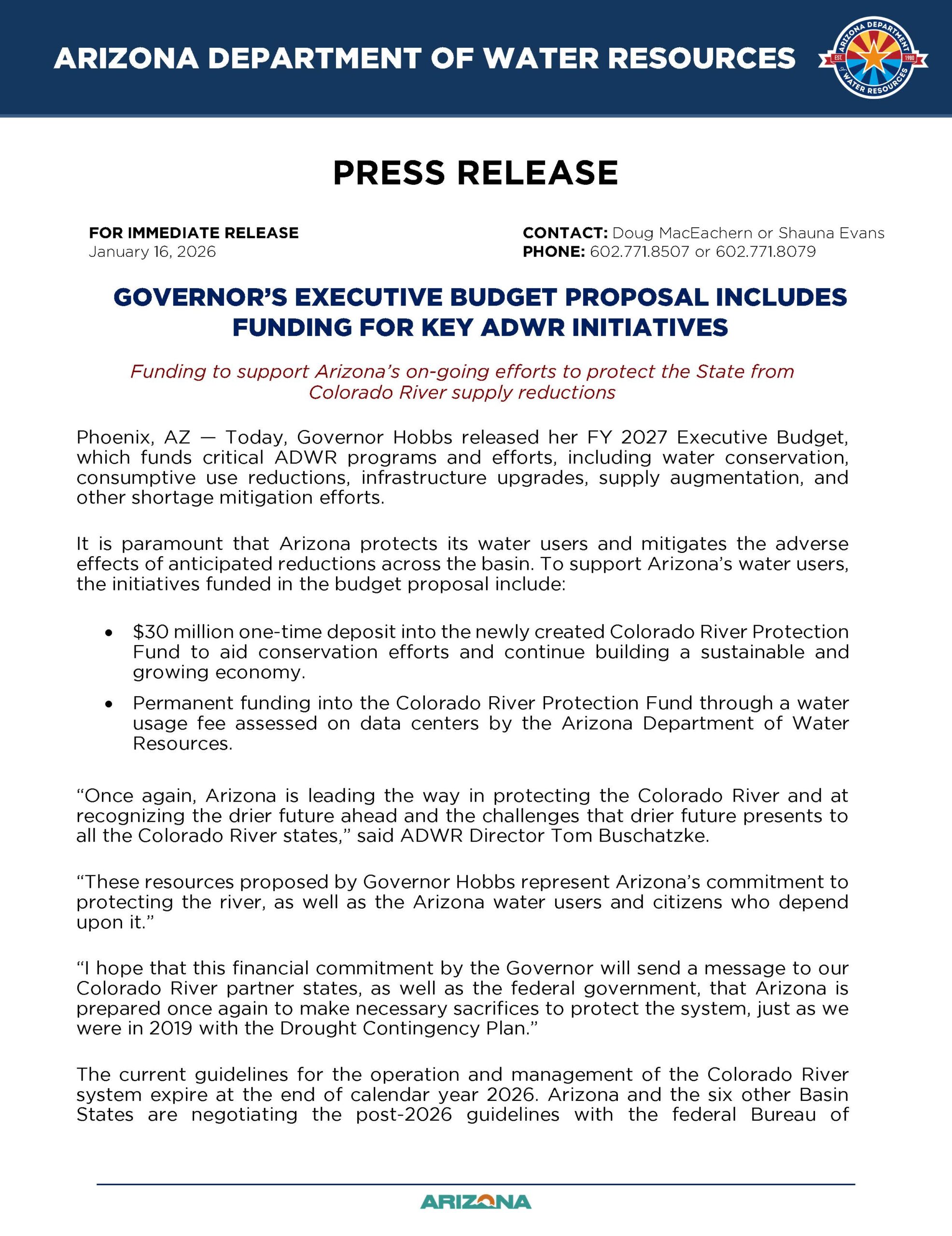
Negotiations over the future of the Colorado River have reached a standstill after all seven basin states failed to meet a key federal deadline. Reports from 12News and 8NewsNow confirm that the states were unable to agree on a new water-sharing plan, leaving the situation unresolved as the river continues to decline.

High Country News explains that the biggest disagreements involve how much each state should give up in the future. The upper Basin states want fewer mandatory reductions, while the Lower Basin states, including Arizona, say they have already taken the deepest cuts and cannot continue to absorb the majority of the impacts.

With no agreement in place, Arizona Governor Katie Hobbs has asked the Trump administration to intervene. She stated that Arizona has made significant sacrifices and cannot carry the weight of the reductions while other states refuse to commit to measurable cuts. If the states cannot reach a plan soon, the federal government may create one for them.

For the Colorado River Indian Tribes, the outcome of these negotiations has major importance. CRIT holds valuable senior water rights and relies on a stable and fair management plan to ensure long-term security for the community and the region.

For more information, you can read the news articles with the links below.

8NewsNow
https://www.8newsnow.com/news/local-news/colorado-river-negotiations-fail-to-meet-federal-deadline-for-7-state-agreement/

High Country News
https://www.hcn.org/articles/why-colorado-river-negotiations-are-so-difficult/


ABC 15 News
https://www.abc15.com/weather/impact-earth/why-gov-katie-hobbs-wants-trump-administration-to-broker-colorado-river-deal


12 News
/wednesday-is-deadline-for-7-state-including-arizona-to-negotiate-the-colorado-river

CRIT Chairwoman Amelia Flores, Vice Chairman Dwight Lomayesva, and Councilmember Bobby Page attended a symposium on the Colorado River held in September in Santa Fe, New Mexico. The symposium’s theme was Bridging Divides for a Resilient Future.

Chairwoman Flores stated that anytime tribal nations can speak about their tribal water rights as conferences like this makes this a historical achievement. She further stated it was an honor to represent CRIT.

Chairwoman Flores was on a panel entitled Paradigm Shift: Inclusive Approaches to Moving Forward. Panelists included (pictured left to right) were moderator: Anne Castle, U.S. Commissioner, Upper Colorado River Commission; Bidtah Becker, Chief Legal Counsel for the Navajo Nation Office of the President and Vice President; Amelia Flores, Chairwoman Colorado River Indian Tribes; Timothy Williams, Chairman Ft. Mojave Indian Tribe; and Lorelei Cloud, Vice-Chair, Southern Ute Tribe.

Vice Chairman Dwight Lomayesva spoke on a panel called Perspective from the Field Agriculture for the Next Century.  His panel included moderator Jennifer Gimbel, Senior Water Policy Scholar at the Colorado Water Center; Taylor Hawes, Colorado River Program Director for The Nature Conservancy; and Dwight Lomayesva, Vice-Chair, Colorado River Indian Tribes.

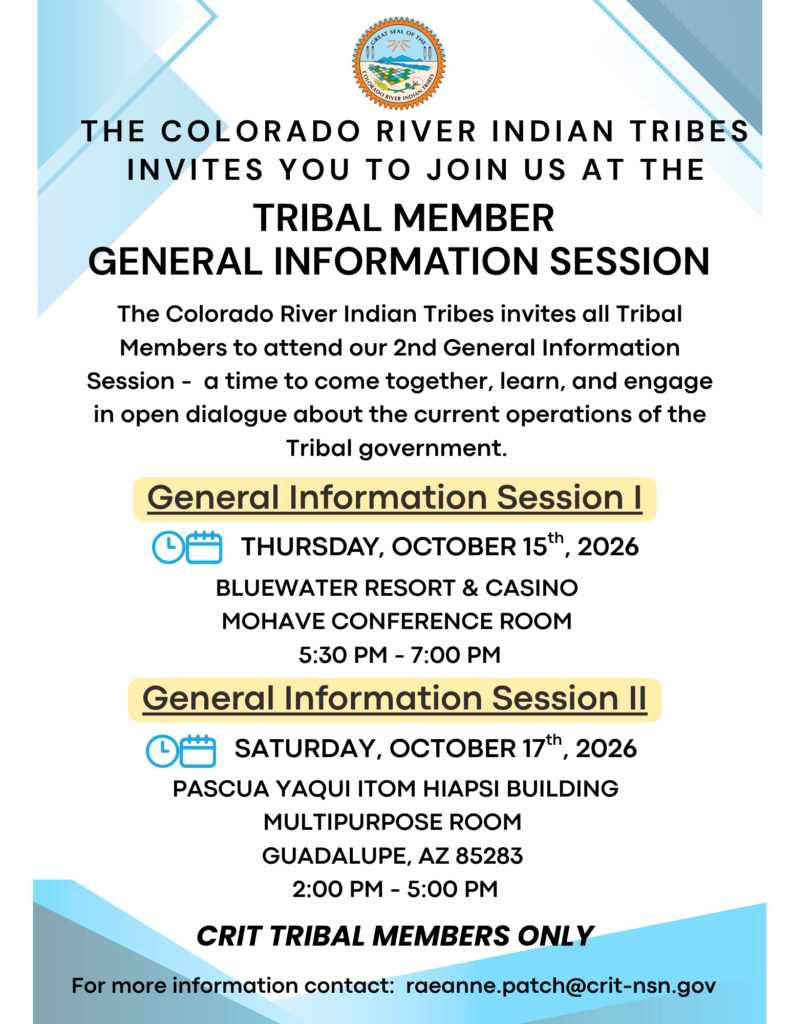
For a second time CRIT Chairwoman Amelia Flores and members of the Tribal Council provided updates, answered questions, and listened to concerns about issues surrounding Colorado River water.

About 80 people attended a meeting in August  at the Blue Water Resort and Casino. In opening remarks Chairwoman Flores said, “We ae stewards of our river and that’s why we are here tonight.”

CRIT’s water attorney John Bezdek then updated tribal members on the status of potential water leasing made possible by a new federal law as well as enabling documents recently signed between CRIT, the State of Arizona, and the US Department of Interior. Bezdek stressed that CRIT has made no agreements to lease its water off reservation. Bezdek’s presentation stated, “Any potential lease, water storage agreement, or other off-reservation use of water will only occur, as required in the Referendum, after it has been approved by tribal council majority vote only after a public hearing.

The Tribal Council is working diligently to ensure CRIT would get the best possible price in any water leasing agreement. As drought conditions persist, CRIT water becomes more valuable. That’s one of the reasons CRIT’s Tribal Council, its staff, and its legal team are working to protect CRIT’s SENIOR water rights. Recent legislation has greatly helped in that regard, but more can be done. That’s because agreements that manage the operations of the Colorado River expire in 2026.

Bezdek’s presentation states, “Tribal Council is actively engaged in meetings with federal and state officials as guidelines are developed for Colorado River operations post-2026 to ensure the Colorado River remains a living river while protecting the Tribes’ rights.”

CRIT is also looking at all options to make its irrigation systems more efficient and to hold the BIA accountable for failing to do so.

The BIA irrigation project returns between 47% and 50% of the water diverted back to the Colorado River without being used.  Most of the high return flow problems have been identified and solutions have been proposed, however, the BIA is NOT fixing the irrigation project. Leases will provide CRIT with funds to better capture this return-flow and increase project efficiency. This protects CRIT water from being taken in the future.

In response to a question, Tribal Councilmembers Jaymee Moore and Anisa Patch said the Tribal Council has been working to hold the BIA accountable at the local level and are now taking that effort to the next level by going higher up. (more…)

The Colorado River Indian Tribes Tribal Council held its quarterly Elders Luncheon on October 26th for tribal and federally recognized elders.

The event was held at the Blue Water Resort and Casino Showroom. The activities included a chair volleyball match between members of the Tribal Council and the CRIT Mo-Che-Ho-Na Chair Volleyball group.

The Department of Health and Social Services were on site giving out free blood sugar checks, as well as to showcase some of their departments. Staff also gave a presentation on best practices to stay in a healthy mindset as well as healthy eating habits.

Councilwoman Anisa Patch gave closing remarks thanking everyone involved in setting up the event as well as the elders who were able to come and enjoy the day.

Our thanks to everyone who participated in the National Day for Truth and Reconciliation on September 30th

The day honors the children who never returned home as well as survivors of boarding schools, their families and communities. The day is also known as Orange Shirt Day to honor and raise awareness of the thousands of Indigenous children who were sent to residential schools.

Department staff who participated: Executive Offices, Public Defender, Media and Office of the Attorney General.