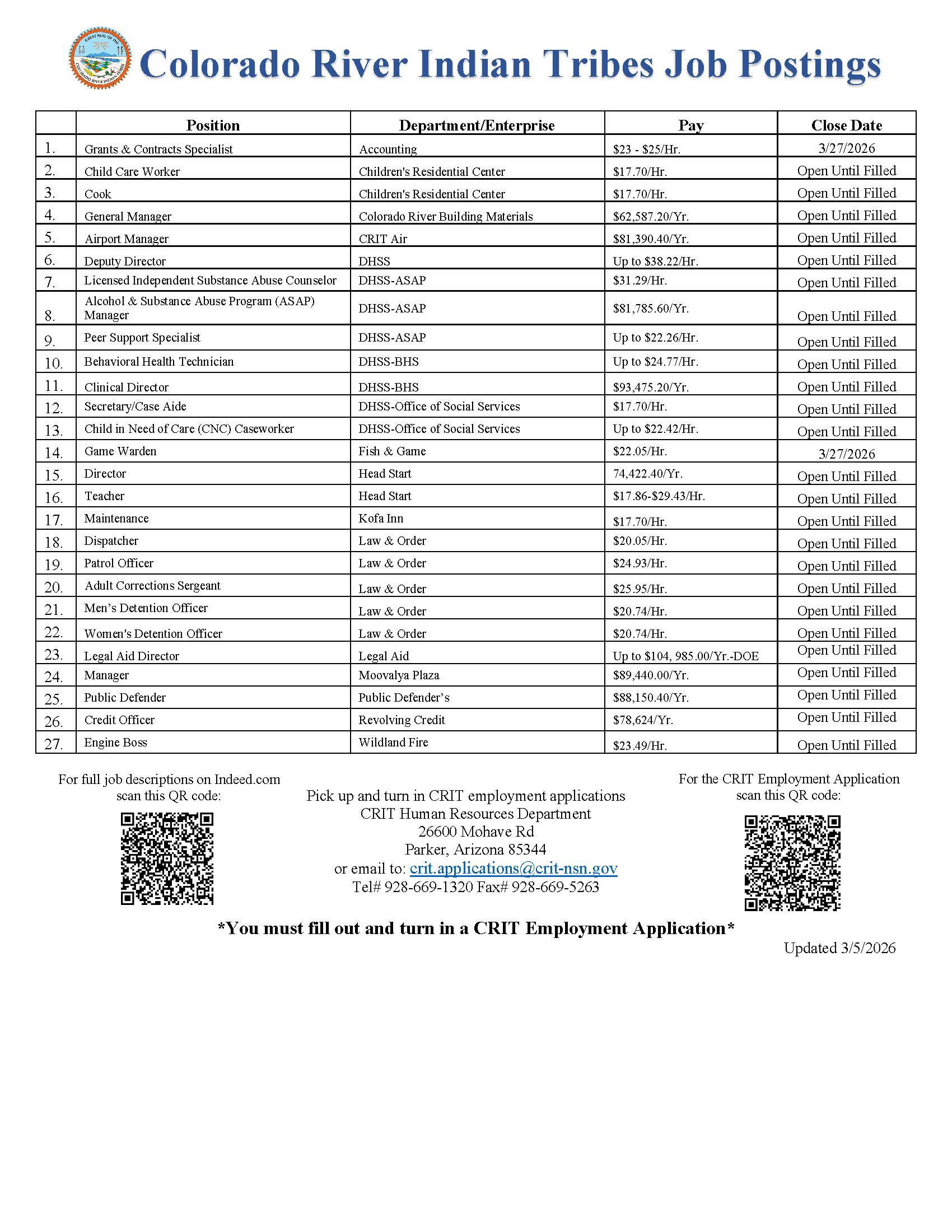
The Colorado River Indian Tribes (CRIT) has issued a Request for Proposals (RFP) for the CPUC Broadband Deployment Phase I Project, a major infrastructure initiative aimed at expanding reliable, high-capacity internet service for Tribal communities and surrounding areas. Through this public bid process, CRIT is seeking qualified contractors to furnish, install, splice, and test outside plant fiber-optic infrastructure that will form the foundation of an expanded broadband network. The project will support improved connectivity along key regional corridors near the Reservation, including areas within San Bernardino and Riverside Counties and surrounding communities such as Blythe, Earp, and Parker Dam. This investment represents an important step toward strengthening digital access, supporting economic development, enhancing education and telehealth opportunities, and ensuring long-term technological resilience for CRIT members and neighboring communities. Proposals will be evaluated based on cost, qualifications, construction schedule, and Indian Preference in accordance with Tribal procurement policy.
Follow the links below for bidding information and specs.
Appendix B_CRIT CPUC_Phase 1_Contractor Bid Sheet_02.23.2026
Appendix C_CRIT CPUC_Phase I_Project Specifications_Sealed_02.23.2026
Follow the link below for the propsed amended code
2026 Amended and Restated Gaming Code_Public Hearing

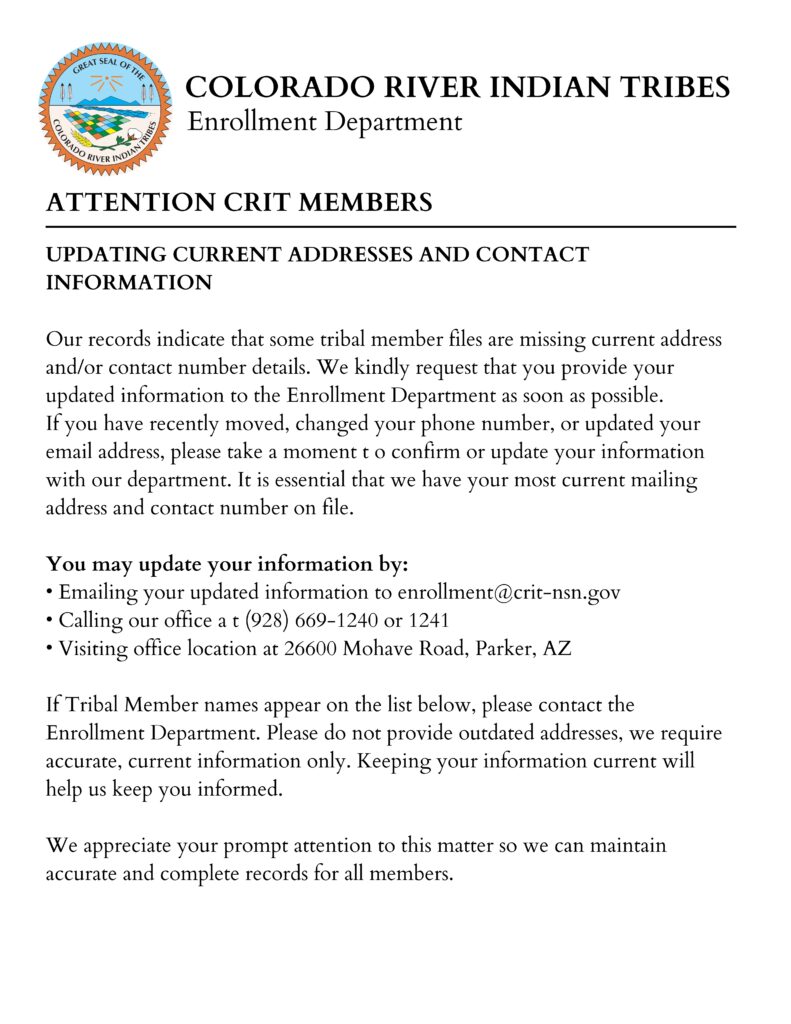
Follow the link below to download an application.
CRIT Tribal Board Vacancies Application 2026

The Colorado River Indian Tribes Tribal Council has made a historic decision to protect the lifeblood of their Reservation. On November 6, 2025, the Council unanimously approved Resolution No. R-375-25, which proclaims the personhood status of the Colorado River under tribal law.
This resolution acknowledges the Colorado River as a living entity whose health and well-being are intrinsically linked to the well-being of the Colorado River Indian Tribes (CRIT) members. The Tribes’ deep-rooted connection to the river spans centuries, providing cultural identity, spiritual strength, food systems, and economic stability that continue to shape their community life today.
The resolution emphasizes the central role the river has played in defining the identity of the CRIT. It highlights that CRIT’s ancestors have preserved and protected these lands since before the establishment of the Colorado River Indian Reservation in 1865.
The Council underscores the crucial role the river plays in sustaining traditional practices, wildlife, and agriculture, including the federal irrigation systems authorized as early as 1867. Today, the Colorado River Indian Irrigation Project stands as a cornerstone of the tribal economy.
The resolution underscores significant legal milestones that acknowledged CRIT’s water rights. In the landmark 1964 and 2006 Arizona v. California U.S. Supreme Court decisions, the Tribes secured 719,248 acre-feet of water annually, ensuring their access to the river for generations to come.
By granting personhood to the River, the Tribal Council reaffirmed its sovereign duty to honor and protect it. This status mandates that the River’s well-being must be a priority in governance and decision-making moving forward.
As part of the resolution, the Attorney General and their staff will develop legal safeguards and propose updates to the CRIT Water Code and other relevant regulations. These updates may include the potential designation of the river as a protected cultural landscape.
Council members recognized that protecting the river is not merely a legal obligation but a continuation of cultural beliefs passed down through generations.
Through this declaration, CRIT demonstrates its unwavering commitment to stewardship. The resolution concludes with a resolute message: the Colorado River is, and will always remain, a vital entity deserving of respect, care, and protection for all future generations.
Article Written by CRIT Media Reporter Ariana Romero
News Update November 12, 2025
Negotiations over the future of the Colorado River have reached a standstill after all seven basin states failed to meet a key federal deadline. Reports from 12News and 8NewsNow confirm that the states were unable to agree on a new water-sharing plan, leaving the situation unresolved as the river continues to decline.
High Country News explains that the biggest disagreements involve how much each state should give up in the future. The upper Basin states want fewer mandatory reductions, while the Lower Basin states, including Arizona, say they have already taken the deepest cuts and cannot continue to absorb the majority of the impacts.
With no agreement in place, Arizona Governor Katie Hobbs has asked the Trump administration to intervene. She stated that Arizona has made significant sacrifices and cannot carry the weight of the reductions while other states refuse to commit to measurable cuts. If the states cannot reach a plan soon, the federal government may create one for them.
For the Colorado River Indian Tribes, the outcome of these negotiations has major importance. CRIT holds valuable senior water rights and relies on a stable and fair management plan to ensure long-term security for the community and the region.
For more information, you can read the news articles with the links below.
High Country News
https://www.hcn.org/articles/why-colorado-river-negotiations-are-so-difficult/
12 News
/wednesday-is-deadline-for-7-state-including-arizona-to-negotiate-the-colorado-river
CRIT Media was formally invited to tour the Metropolitan Water District (MWD) facility in Parker, Arizona, alongside local business owners from Lake Havasu, Parker Area Chamber of Commerce, representatives, and local law enforcement agencies. The tour provided an inside look at the facility’s operations, including how water is stored and managed along the Colorado River system. Guests were also able to explore historic buildings constructed in the early 1930s, many of which still feature the nostalgic architecture and craftsmanship of that era.
Throughout the visit, MWD staff shared their passion for the work they do and the long history the district has in the Parker area. It is no secret that Colorado River Indian Tribes and MWD have maintained a longstanding relationship due to their close proximity and shared connection to the Colorado River. Employees like Gina Chavez, who was born and raised in Parker and grew up on MWD property, spoke about the importance of community outreach, local involvement, and helping create employment opportunities for residents in the area.
The tour highlighted not only the scale and complexity of water operations in the region, but also the deep local ties and history that continue to connect Parker, the Colorado River, and the people who work to manage one of the Southwest’s most important resources.
The Missing and Murdered Indigenous Women and People (MMIWP) movement brings awareness to the ongoing crisis of Indigenous people who have gone missing or been murdered across Tribal communities throughout North America. For decades, Indigenous families and advocates have called attention to the lack of media coverage, jurisdictional challenges, and limited resources that have contributed to many of these cases going unsolved or overlooked.
On Tuesday, May 5th, 2026 CRIT hosted an event honoring MMIWP, bringing the community together in remembrance, reflection, and support for affected families.
Several speakers courageously shared the stories of loved ones from the reservation who have gone missing or were tragically murdered and are not forgotten. Young girls spoke about the heartbreaking loss of their father, siblings shared memories of missing sisters, mothers, and grandparents.
A special thank you to Councilman Tommy Drennan for organizing the event with Janice Patch and other organizers of this very important day for CRIT and all of Indian Country.


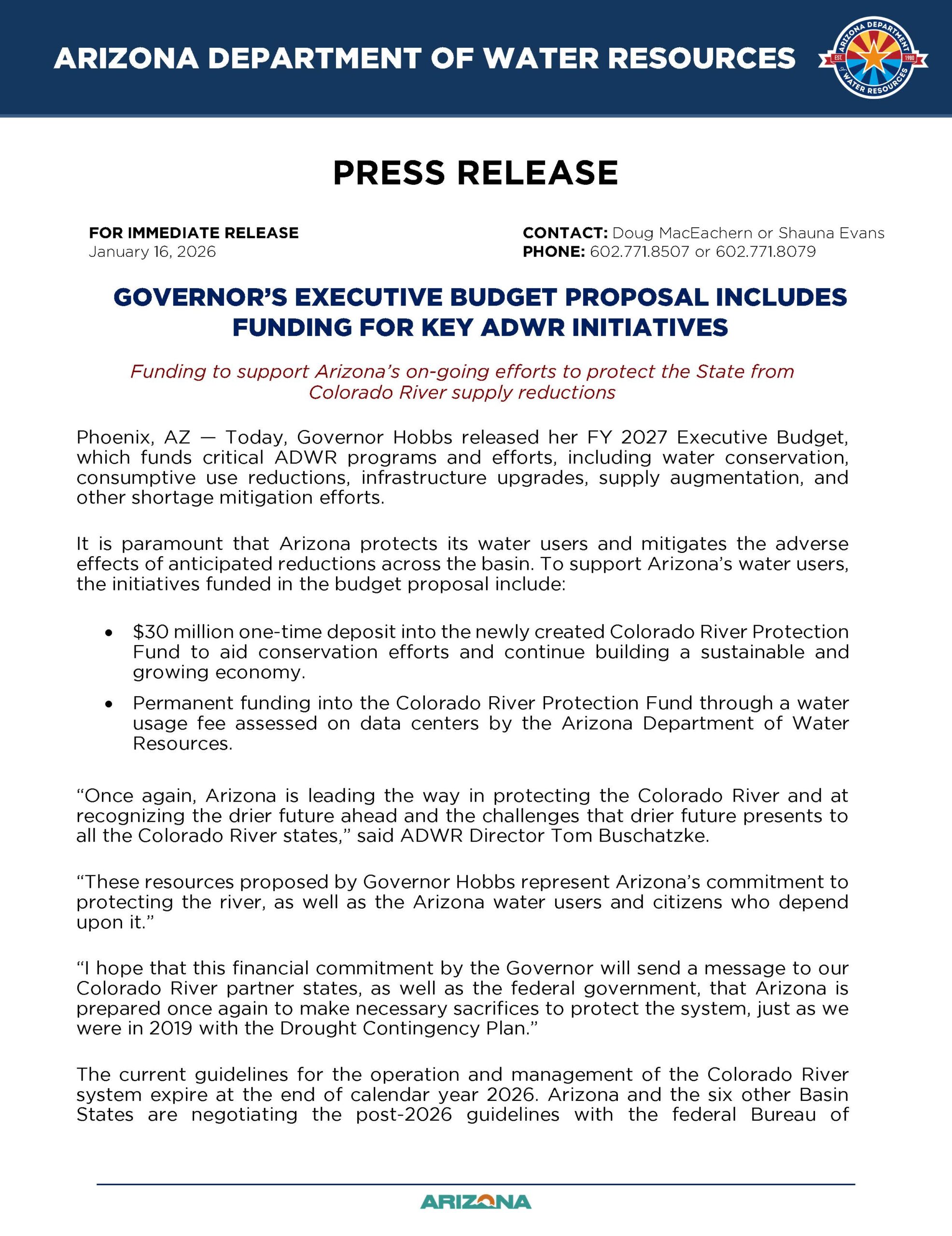
The Lower Basin States of Arizona, California, and Nevada have advanced a plan to stabilize the Colorado River through 2028, responding to declining reservoir levels, record low inflows to Lake Powell, and increasing risk of reaching critical elevations at both Lake Powell and Lake Mead.
Earlier in the post-2026 process, the Lower Basin took a significant step by proposing 1.25 million acre-feet in annual reductions, with an additional 250,000 acre-feet from Mexico, totaling approximately 1.5 million acre-feet per year.
This proposal builds on that foundation with an expanded system conservation program across the Lower Basin with an estimated contribution of at least 700,000 acre-feet. In total, the plan identifies up to 3.2 million acre-feet of water savings to the system through 2028.
The proposal is an integrated package addressing Lake Powell releases, Upper Initial Unit operations, Lower Basin reductions, additional conservation, use of Intentionally Created Surplus, and system infrastructure improvements. Lower Basin contributions are contingent on these coordinated operations to ensure system stability as well as appropriate funding.
“With this proposal, the Lower Basin is putting forth real action to stabilize water supply along the Colorado River. We’re putting forward additional measurable water contributions for the system. Without that, the system will continue to decline,” said JB Hamby “This proposal is about moving from ideas to implementation,” said John Entsminger. “It pairs real measurable water contributions with sensible dry-condition operations at Lake Powell and across the Upper Initial Units. Now is the time for every water user in the Basin to double down on water conservation as we face historically dry hydrology.”
“This proposal reflects the creativity and commitment of water users across the Lower Basin who continue to step forward with solutions that support the river,” said Tom Buschatzke. “We have shown that collaborative, voluntary efforts and reductions that are certain can produce meaningful water savings.” (more…)
Thai Yang, Broadband Director for the Colorado River Indian Tribes, is helping lead an exciting new chapter for connectivity across the CRIT community.
Yang has served with CRIT for the past two years, bringing with him a strong background in information technology, network systems, infrastructure deployment, and strategic project management. Before joining CRIT, he held technology leadership roles in hospitality, resort operations, and casino infrastructure, including more than 15 years as IT Director at Glen Ivy Hot Springs and earlier experience helping launch technology systems at Morongo Casino Resort & Spa.
“At CRIT, that experience now supports my mission to strengthen broadband infrastructure, improve digital access, and create long-term opportunities that will benefit current and future generations of our Tribal community,” Yang said.
As Broadband Director, Yang oversees the planning, funding, development, and implementation of broadband infrastructure projects across Tribal lands. The Broadband Department is responsible for securing grants, coordinating engineering and construction, managing vendors and consultants, meeting funding requirements, and preparing for future broadband growth.
For many people, broadband simply means internet access, but Yang explained that broadband is much more than that.
“Broadband is more than just connectivity—it is the foundation for education, healthcare, economic growth, public safety, and communication,” he said.
For the CRIT community, reliable broadband has the potential to improve daily life in many ways. Students can benefit from online learning and educational resources. Families can stay better connected and access important services. Elders may have greater access to telehealth and healthcare resources. Local businesses can grow through online services and e-commerce, while Tribal departments can improve operations, communication, and public service delivery. (more…)