March 2, 2026 3:07 pm
CRIT Nation, Parker, AZ
March 2, 2026 3:07 pm
CRIT Nation, Parker, AZ

KAWC Yuma Public Radio
As the federal deadline approaches, Colorado River stewards and water managers are openly debating which options remain viable to stabilize the river. Discussions now center on short-term operational changes, deeper conservation, and the possibility of federal intervention if states cannot agree.

Parker Pioneer
Local officials and residents raised concerns over proposed legislation that would allow groundwater transfers out of the McMullen Valley Basin, fearing it could accelerate depletion in western Arizona.

SignalsAZ
Queen Creek announced steps to secure its long-term water future through a mix of groundwater, imported water, and infrastructure investment.

NBC 9 News Denver / ABC4 Utah
Lawmakers and governors across the Basin are aligning legislative agendas around water security as negotiations intensify. Leaders acknowledge that compromise will be unavoidable.

Eurasia Review
An international analysis examines how climate change, overuse, and governance failures have pushed the Colorado River toward crisis, calling for coordinated action across jurisdictions.

Arizona House Committee on Natural Resources (Video)
Arizona Department of Water Resources Director Tom Buschatzke testified before lawmakers, outlining the seriousness of the Colorado River situation and the potential consequences if Basin states fail to reach agreement. He emphasized that Arizona remains highly vulnerable to deeper cuts under federal plans.

Colorado Sun
State water officials warn that drought forecasts and reservoir levels in Colorado are worse than previously expected, increasing urgency for action.

(more…)

January 26, 2026

ABC15 Arizona
The Central Arizona Project’s general manager warned that deeper Colorado River cuts would have severe impacts across Arizona, affecting municipal supplies, agriculture, and long-term planning. Officials stressed that Arizona is particularly vulnerable because CAP deliveries are among the first reduced during shortages.

Lake Havasu News Herald
Arizona lawmakers are weighing funding for drone-based cloud seeding programs aimed at increasing snowfall in key watersheds. Supporters see it as a potential tool to enhance runoff into the Colorado River system.

Arizona Republic
Mesa is finishing a $210 million water reuse pipeline that will reduce reliance on Colorado River water by recycling treated wastewater for non-drinking uses.

KJZZ
New aircraft equipped with laser technology will measure snow depth and water content across Arizona’s mountains, improving runoff forecasts.

Wyoming is exploring a voluntary program to conserve Colorado River water, potentially paying users to leave water in the river.

ABC15 Arizona
Seven Western governors, including Arizona’s governor, are traveling to Washington, D.C., as negotiations intensify and deadlines approach. States are scrambling to present unified positions ahead of federal meetings.

KUNR
Extraordinary winter warmth continues to suppress snowpack across much of the West. Officials warn that poor snow accumulation could require additional reservoir releases, including from Flaming Gorge, to meet downstream needs.

Colorado Sun
As data centers expand into Colorado, concerns are growing about their large water footprints in already-stressed regions.

(more…)

Federal officials again summoned governors from all seven Colorado River Basin states to Washington, D.C., signaling growing concern that negotiations remain stuck. Reports indicate the federal government is preparing to step in more forcefully if states cannot agree on near-term shortage management and a longer-term framework.

Governor Katie Hobbs is escalating efforts to restrict groundwater pumping tied to Saudi-backed alfalfa farming in La Paz County. The reporting highlights how years of unregulated groundwater use have drawn down aquifers connected to Colorado River–dependent regions.

New analysis outlines what may come next if Basin states fail to reach agreement, including deeper federal control, stricter shortage tiers, and more aggressive conservation.


Sources – January 23, 2026


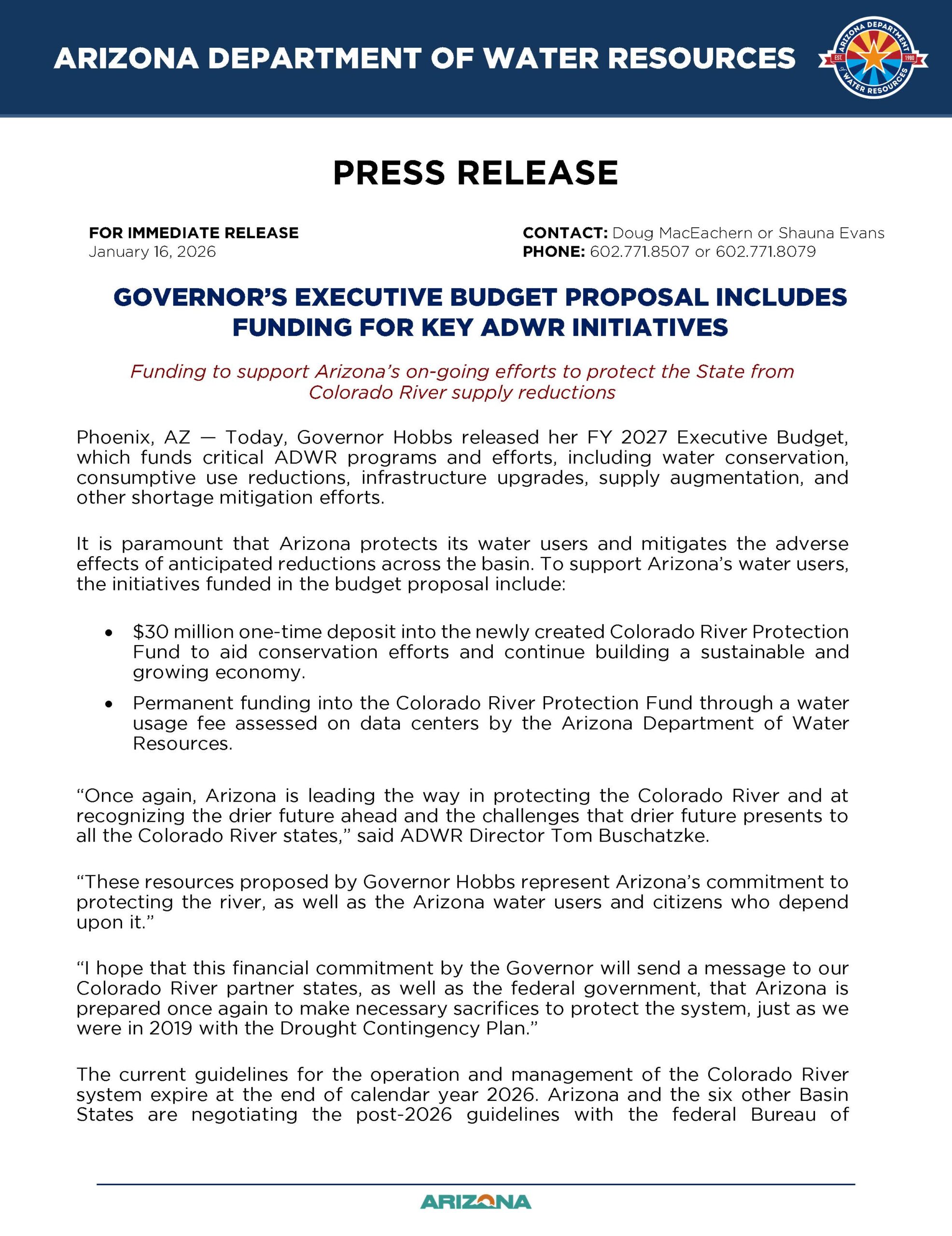
Arizona Budget Proposal Includes Major Funding for Colorado River Protection

On January 16, 2026, the Arizona Department of Water Resources (ADWR) shared details of Governor Katie Hobbs’ FY 2027 Executive Budget Proposal focused on preparing for long-term challenges facing the Colorado River. The plan includes new and expanded funding aimed at strengthening water security across Arizona in the face of ongoing Colorado River shortages.

Key points from the budget related to water:

  • $30 million one-time deposit into a newly created Colorado River Protection Fund to support conservation efforts and short-term drought response.
  • Permanent funding mechanism for that Protection Fund to be supported by a water usage fee on data centers.
  • Continued investment in water conservation, shortage mitigation, supply augmentation, and water infrastructure upgrades.
  • A recognition that current Colorado River operating rules expire at the end of 2026, with negotiations underway to create a sustainable long-term framework.

Source:
Arizona Water News https://azwaternews.com/2026/01/16/fy2027_execbudgetproposal/
(more…)

Arizona announced new groundwater management rules for parts of La Paz County, expanding oversight in an area long known for unregulated pumping. The move follows increased scrutiny of agricultural water use and reflects a broader push to protect groundwater supplies as Colorado River shortages continue. La Paz County lies within CRIT’s region. Stronger groundwater rules help prevent over-pumping that can undermine surface water systems and threaten tribal water security.

A water policy expert argues that Basin states are unlikely to compromise without clear federal consequences. With post-2026 rules approaching, the federal government’s willingness to step in is seen as a key driver for progress. Federal involvement increases the importance of ensuring tribal water rights and sovereignty are explicitly recognized in any imposed or negotiated plan.

Multiple outlets report on the release of the draft post-2026 Colorado River management alternatives by the U.S. Bureau of Reclamation. The plan outlines several options for operating Lake Powell and Lake Mead, including deeper cuts and greater federal control if states fail to agree. Officials stress that public and stakeholder input is still open but time is limited. These alternatives could directly affect downstream water deliveries. CRIT’s senior water rights, sovereignty, and river stewardship must be included before any plan is finalized.

Arizona municipal water providers stress that collaboration during the legislative session will be essential to address shortages, infrastructure needs, and conservation goals tied to the Colorado River.

Legislation was introduced in Congress to formally codify a tribal water rights settlement, providing legal certainty and recognition of the tribe’s rights. Each tribal settlement strengthens the broader recognition of tribal water rights across the Colorado River Basin and reinforces sovereignty.

Reports highlight emerging technologies, including satellite tools and agricultural innovations, aimed at reducing water use and improving efficiency across the West. Technology can support conservation efforts, but it does not replace enforceable water rights or the need to protect river flows.

(more…)

Several outlets reported on the release of the Draft Environmental Impact Statement (EIS) by the U.S. Bureau of Reclamation, which outlines how the Colorado River could be managed after current rules expire in 2026.

The draft lays out five possible management alternatives for operating Lake Powell and Lake Mead, including options where the federal government steps in if Basin states cannot agree. Federal officials acknowledge that a temporary or stopgap deal may be necessary if negotiations remain stalled. These decisions will directly affect how water is released downstream.

As a senior water rights holder, CRIT’s rights and sovereignty must be protected in any final plan. The draft process is a critical opportunity for tribal input.

Coverage from Nevada and Utah outlets explains that while states continue negotiations, deep disagreements remain over how water cuts should be shared. Federal officials are signaling they are prepared to act if consensus is not reached.Some articles describe this moment as a turning point, where long-standing assumptions about water use are being challenged and previously “untouchable” practices are now on the table.

If states fail to agree, federal decisions could reshape river operations. Tribal nations must be included to ensure historic rights are not overlooked.

California-focused reporting explains how the draft federal plan could require additional water cuts, even during wet years. Officials emphasize that recent storms do not erase long-term shortages caused by overuse and climate change.

California’s use affects overall Basin stability. How cuts are distributed influences downstream reliability for Lower Basin users.

Multiple sources covered Arizona’s continued focus on groundwater protection, including new Active Management Areas and enforcement actions tied to large agricultural water users. These efforts are framed as necessary as Colorado River supplies remain uncertain.

As surface water becomes less reliable, pressure shifts to groundwater. Strong regulation helps prevent over-pumping that could undermine regional water security and tribal resources.

Nonprofit and policy reporting highlights a key admission from federal officials: a full, long-term Colorado River agreement may not be ready by 2026, making interim solutions likely. (more…)

Navajo customs find a way to heal and reignite the strength of those in suffering and spiritual pain of what lingers in their heart, their mind, their body, their soul. But here, we have a film that questions and wrestles with the idea of how we feel out, process, and learn to forgive those who’ve done harm to us for no longer. FINDING HÓZHÓ, the newest film from writer/director/producer Travis Holt Hamilton, searches for that idea from within the protagonist Secody, a man whose silent dignity masks a history of childhood trauma left behind by the violence of his father, remembered as an angry and aggressive alcoholic. Now an older man, Secody is morally stuck on how to best care for his dying/bedridden elder father; he secretly wrestles with the emotional turmoil of not knowing how to confront his abuser and comfort his dying father. We jump back and forth between the present narrative and the 60s’ period flashbacks to show how Secody had to endure his father’s drunken rage(s), while also finding peace and serenity with his warm and loving grandfather, who teaches him the traditional Diné methods of beliefs and guidance. We see a different coin side of father figures within Secody’s life – one figure showing him what pain can bring by self-destruction, and another figure teaching what beauty and tranquility can be found with personal strength and faith rooted in traditional values. (A scene plays out in flashback with the grandfather and son looking after the depressed father, drowning in sorrow about his dead wife with a bottle; the grandfather tells his grandson, Your father is not a bad man, hes a broken man.” They carry him back home and spend the night traditional praying over him repeatedly, showing Secody what the bonds of family and holding hope in ones beauty does for our health & growth.)

What stood out on top of the story with the film itself, the reviewer found the production value to be a crowning achievement; in particular, the cinematography and direction seen on screen proves that the story has a backbone of visual style and gravitas of a filmmaker’s dedication to making a story based on the concept and company he keeps. Here, Hamilton finds the weight of the emotional journey in his character’s choices and reflections in facing the confrontation of familial bonds and those painful memories that we put to rest. The actors’ are all allowed to shine and breathe life into their on-screen personas’, with many of the cast having the strength to carry weight of dialogue while the main lead is left in silence of his own accord. By the end of the film (as per audience reactions at the screening), you’ll be needing the tissues to help handle the teary emotions we see in the finale of the film reinterpreting the themes of Hózhó being an internal spiritual awakening that anyone can ignite from within, from family, and from the values/beliefs we hold strong. Anyone of any generation can find something out of the story, as the reviewer recounts how much an audience engagement could be found in the Q/A section of the premiere – prompting discussions of elder’s recollections that touched on personal experiences they found identifiable through the film. It’s a beautiful film that stands as one of Hamilton’s most mature and enlightening features that showcases the humanity and culture of Diné customs and traditions. FINDING HÓZHÓ is a film that wants you to be emotionally and spiritually ready to find the light, beauty, and forgiveness to give ourselves from all the burdens of the world.
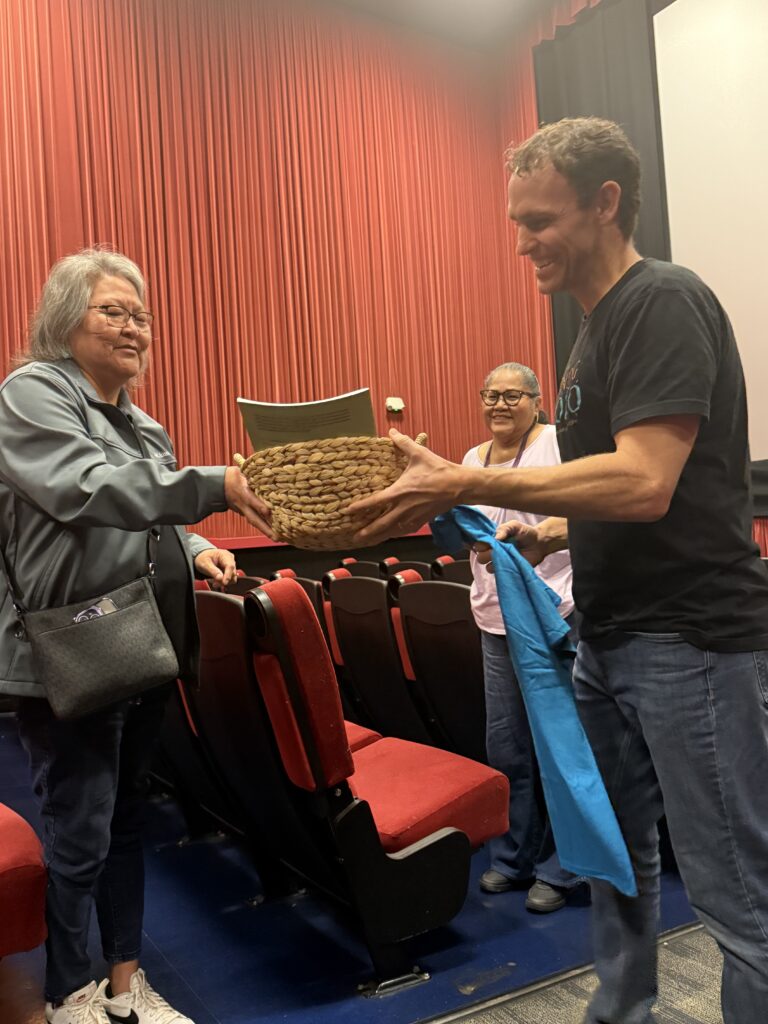
Holt Hamilton, in his steadfast devotion to furthering his filmmaking goals and working with the best talent/crews, finds solace in the audience he has acquired with his filmography. Speaking with him, you understand that the storytelling that he’s writing and formulating is based on the influences and ideas that surround him; and it’s no surprise seeing how much influence the honor and beauty of Navajo country has struck a cord with his sensibilities. We spoke with him after the screening –

CRIT MEDIA: How do you anticipate everything that you do with the challenges of filmmaking? What does the weight of this lifestyle feel like for you?

HAMILTON: I think the start of it was of just giving myself that goal: if I had one more chance to make a movie, what would I do? Not that the other films haven’t been a passion project or something, but there’s something about like, okay, what, there’s more thought, there’s a lot more prayer into it, there’s a lot more like, okay, what do I leave with? And so I think I set, that was one thing I think that really played into it.” (more…)

(LAS VEGAS) The Colorado River Indian Tribes (CRIT), the Gila River Indian Community (GRIC) and the Central Arizona Water Conservation District, which manages the Central Arizona Project, have signed an historic proclamation to work together to protect the Colorado River.

The three entities have had differing priorities and goals over the years regarding the River, but those differences do not prevent them from working together to safeguard the Colorado River which is suffering from drought and overuse.

The proclamation was signed during the Colorado River Water Users Association conference where multiple states, local and regional government entities, and the federal government have been trying to reach an accord on river water allocation and use.

CRIT, GRIC, and the CAP hope their proclamation can set an example and demonstrate the need for collaboration and conservation. The resolution states:

The Colorado River Indian Tribes, the Gila River Indian Community, and the Central Arizona Water Conservation District have been collaborative partners on various conservation projects to protect the Colorado River including the Pilot System Conservation Program, the Drought Contingency Plan and innovative water efficiency demonstration projects.

We commit to working on collaborative and creative partnerships that, consistent with our respective principles and values, utilize all the tools that are available to us through the Consolidated Decree in Arizona v. California, the Arizona Water Settlements Act, the 2007 Interim Guidelines, the Drought Contingency Plan, the System Use Agreement, the Colorado River Indian Tribes Water Resiliency Act of 2022, and the Arizona’s Groundwater Management Act, in addition to others.

Together, the Colorado River Indian Tribes, under its laws, including requiring preservation of the River as a living entity, the Gila River Indian Community and the Central Arizona Water Conservation District are committed to protecting the Colorado River and the needs of our respective tribal members while connecting much-needed resources to end users within the Central Arizona Water Conservation District service area.
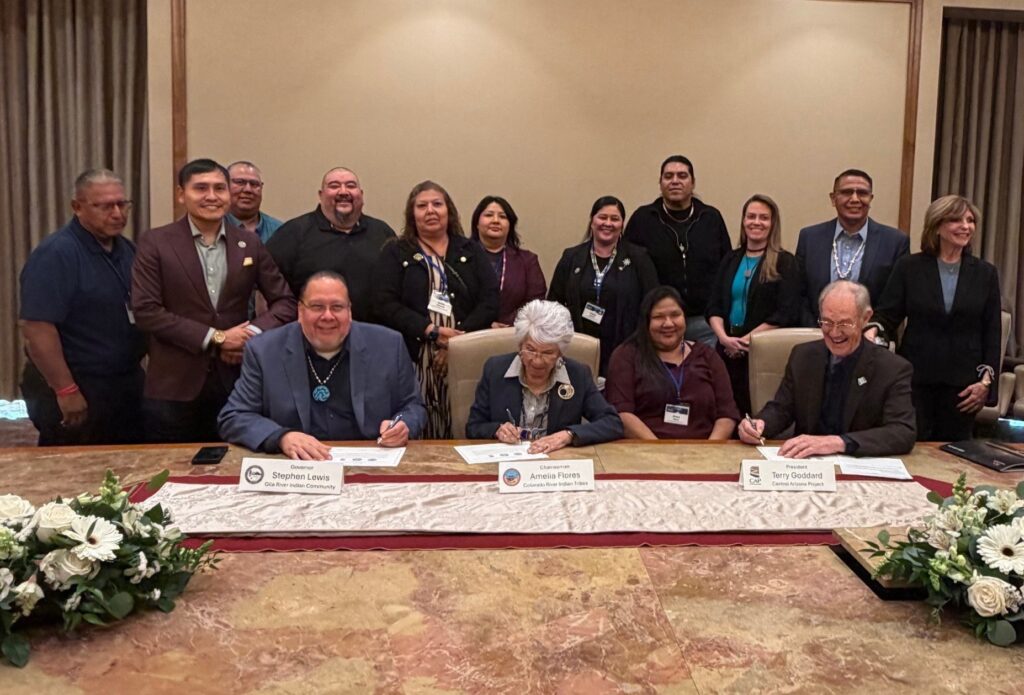
CRIT Chairwoman Amelia Flores said, “All of us who live in Arizona, native and non-native alike, are connected by water for without water, there is no life.  And it is that common thread that binds us, which has us here today, pledging to work together for the greater good of all who live in Arizona.” CRIT recently took the pioneering step to acknowledge personhood status for the Colorado River under Tribal Law. According to Chairwoman Flores, “CRIT will always put the Colorado River first.” (more…)

by Abigail Wilt
Cronkite News

PHOENIX – Natasha Bowman is a Navajo doula and student midwife. Her work centers around revitalizing traditional birthing through practices that have been overshadowed by Western medicine.

In traditional spaces, families are often there, supporting the mother through labor and birth. One of Bowman’s clients was the first woman in her family to have a home birth since her great-great-grandmother. The client was in the company of other women in her family and for the first time — her father.

Before the woman’s home birth, her father wasn’t allowed to be present for the births of his own children. His wife would labor at the hospital while he was at home and then return with their babies.

It was very different while his daughter was in labor. He was invited into the space and able to console her, rubbing her head and speaking to her as she moaned through contractions.

He sat in the living room during the active birth and told Bowman — through tears — that he wished he would have been there for the births of his children. He had no idea what his wife was going through until he saw his daughter go through it.

“Within the community, bringing in the aunts, the grandmas, the sisters, the cousins, bringing them all within that space, working as a community together. It’s beautiful to see everyone come together at a birth with the women around,” Bowman said.

Bowman explained that traditional births can often involve ceremonies, songs, holistic herbs, tinctures and the use of Native language alongside including family members.

Indigenous medicinal practices, alongside cultural and religious ceremonies, were considerably restricted under the 1883 Code of Indian Offenses, allowing authorities to withhold food, impose extra labor or jail people for up to 10 days for seeking or providing medicine or traditional healing.

Until the Congress passed the American Indian Religious Freedom Act in 1978, Native communities were largely forced to seek care within Western health systems.

“We see that we had our traditional birthing practices long ago. It was taken from us when hospitals came into our communities, and then our traditional birth ways were taken from us. They started telling us it was unsafe,” Bowman said.

Last year, the Centers for Medicare & Medicaid Services approved a Section 1115 waiver, allowing Medicaid to cover traditional healing. On Oct. 1, Arizona Health Care Cost Containment System,  AHCCCS, Arizona’s Medicaid agency, began reimbursing them, making Arizona one of the first states to do so. The initiative “aims to offer culturally appropriate options for eligible members.”

For tribal communities, this progress has been decades in the making.

“I’m really happy that, after over a decade, or to this point, that the advocates in our state didn’t give up and that we just kept moving it forward because we really understood the value of it,” said Kim Russell, the policy advisor at Sage Memorial Hospital on the Navajo Nation.

Hanley Manygoats is a traditional medicine practitioner (Hatalii) on the Navajo Nation. He grew up around traditional healing before becoming a practitioner himself. Lately, Manygoats went from seeing one person a month to three or four a week.

“It’s all part about healing, spiritual healing. It’s all about this being the one with nature, mother earth, father sky,” Manygoats said. “So we have all these stories that go with our traditional healing, our songs, our prayers. So it all starts with the origin stories.”

For many, he said, it’s the first time in decades they’ve been able to experience these healing ceremonies.

“When I do prayers for the elders, they get emotional because they haven’t heard prayers like this in a long time. The last time they had a prayer done was when their grandparents or their fathers and mothers were around. Now they’re gone,” he said.

Though AHCCCS coverage has allowed more people to seek traditional health care, Manygoats said the coverage is limited. (more…)

The Ahakhav Tribal Preserve is a treasured outdoor space for the Colorado River Indian Tribes community. Located along the beautiful Colorado River in Parker, the Preserve offers a peaceful and educational environment where families can explore nature, relax, and learn about the land we call home.

Newly hired Project Administrator, Marisol Chavira, has been dedicated to the Preserve for more than 20 years. Born and raised in Parker, she’s passionate about caring for the land and helping future generations enjoy it. After serving as the Administrative Assistant for many years, she began acting as the Project Administrator in 2021 and officially stepped into the role in November 2025.

Marisol shared that her favorite part about working at the Preserve is the quiet and comfort it brings. “It’s green, beautiful, and peaceful,” she said. “There’s so much for people to enjoy here.” From walking trails and bird watching to designated playground areas for families, the Preserve is an inviting space for all ages.

A typical day for the Preserve team includes maintaining the park, trimming trees, caring for the natural habitat, and working on grants to continue improving the area. One of Marisol’s favorite spots is Willow Beach, a scenic area where families can enjoy the water, shade, and open spaces.
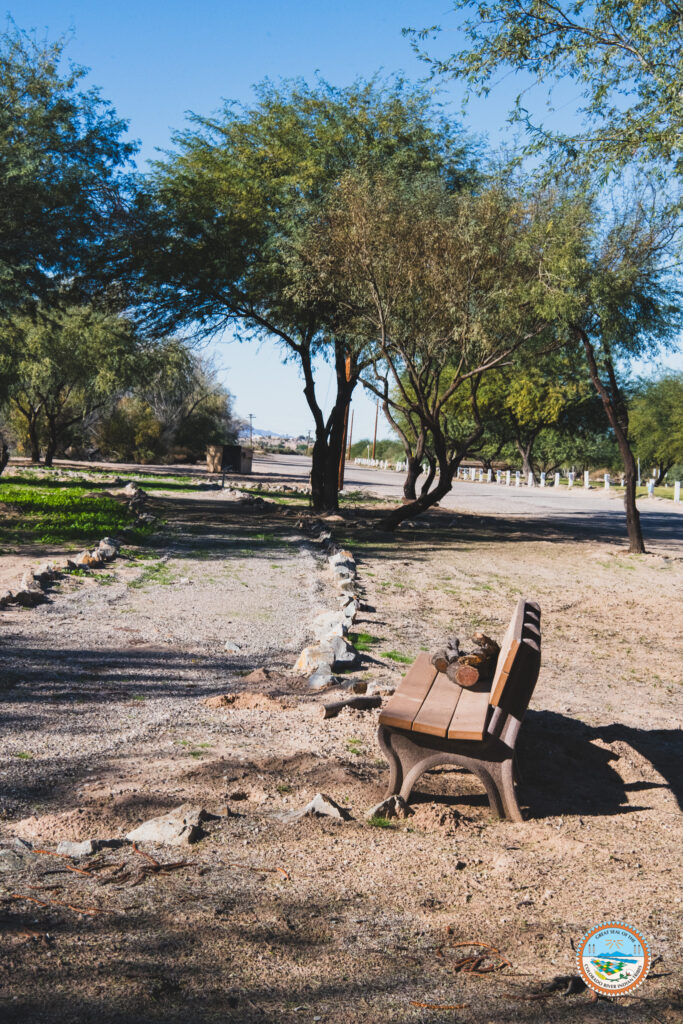
Fall is her favorite season at the Preserve because the changing leaves bring the area to life with color. She even recalled one memorable morning early in her career when a doe fell into a ditch. Without hesitation, she rushed in to help and ended up drenched but proud of what she did. It’s moments like these that show how much she cares for the wildlife and environment.

The Preserve is also home to important cultural resources. Marisol was surprised to learn just how many of the trees and plants hold cultural value and are monitored and preserved with great respect. Restoration continues to be a major focus. A recent grant supports the revegetation of native trees, including cottonwood, willows, and mesquite, helping to restore the natural habitat and strengthen the ecosystem for future generations. (more…)