November 25, 2026 3:15 am
CRIT Nation, Parker, AZ
November 25, 2026 3:15 am
CRIT Nation, Parker, AZ

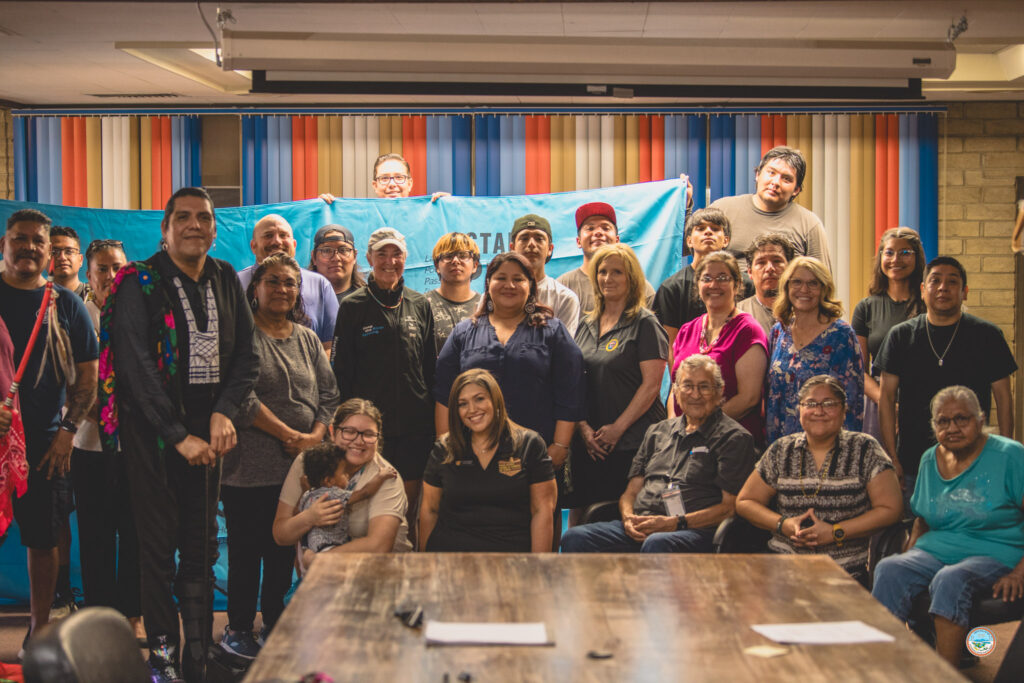
Following a series of historic ceremonies on Friday, September 4, 2026, the University of Arizona has permanently integrated the four native languages of the Colorado River Indian Tribes (CRIT) into its campus landscape. Organized by the university’s Office of Native American Advancement & Tribal Engagement (NAATE) in partnership with individual academic colleges, the Native Languages Campus Sign Initiative unveiled a progression of permanent building signs throughout the day to celebrate the Mohave, Chemehuevi, Hopi, and Navajo languages.

Members of the CRIT Tribal Council attended the sign ceremonies, including Treasurer Anisa Patch, Secretary Josephine Tahbo, Councilmember Vanessa Welch, and Councilmember Raeanne Patch.

The continuous initiative aims to elevate the visibility, recognition, and enduring presence of Indigenous communities within academic spaces. Levi Esquerra, Special Advisor for NAATE, explained that the permanent structural markers grew out of a linguistics department tradition where temporary language signs were posted for just one day each February to observe International Mother Language Day. “They used to put up tarps of native languages throughout campus at six o’clock in the morning, take them down by six, and they wanted permanent signage,” Esquerra said. “We started an initiative of reaching out to tribes and having them add language to our buildings… What makes CRIT so unique is, you know, CRIT is made up of four distinct tribes. And so we felt it was only correct to honor each of those tribes that make up the CRIT nation.”

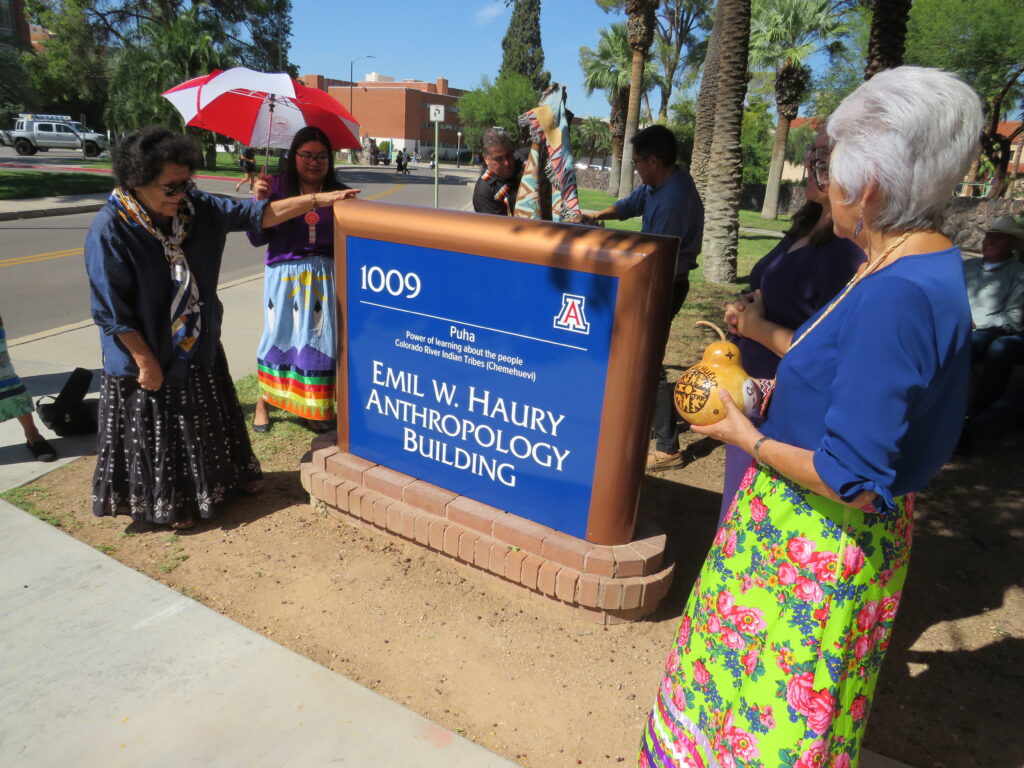
The day-long celebration began at 9:00 AM at the Emil W. Haury Anthropology Building, home to the School of Anthropology. The Chemehuevi language inscription “Puha” was added to the building’s sign, translating to the “Power of learning about the people.” School of Anthropology Director Rob Schon noted that the naming honors and renews structural ties established in 1954 when Emil Haury preserved Chemehuevi baskets for the Arizona State Museum. Reflecting on the word chosen for the sign, Schon remarked, “Phua is a sacred term… As interpreted here, Puha means power of learning about the people. There is no greater calling for an anthropologist to aspire to.” CRIT Chairwoman Amelia Flores highlighted the deep perseverance required to bring the project to fruition, stating, “When I first heard of the university asking the tribes in Arizona to name buildings, I approached him and I said, ‘Why not CRIT? Why not CRIT?’ … It’s taken this long. So thank you, my dear friend, for making this happen… Most tribes have only one, but CRIT, you have four.”
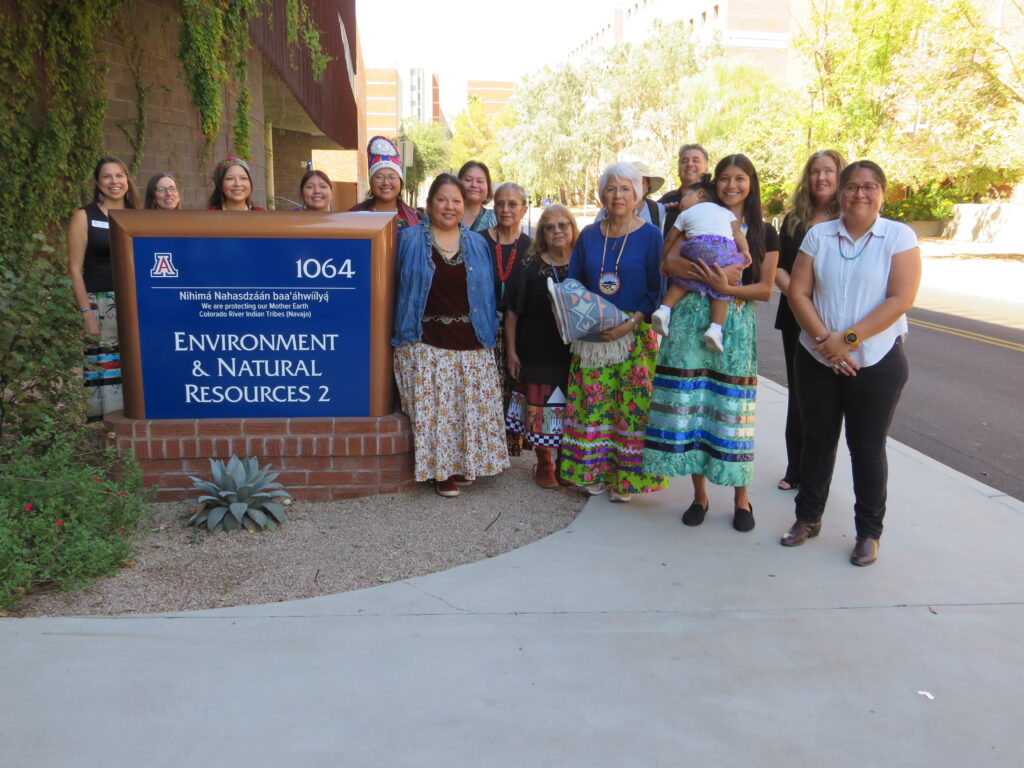
At 10:30 AM, the procession moved to the Environment and Natural Resources 2 (ENR2) Building to honor the CRIT Navajo language with the phrase “Nihimá Nahasdzáán baa’áhwíílyą́,” meaning “We are protecting Mother Earth.” During the ceremony, CRIT Navajo representative Harlietta Mitchell shared her family’s history of post-World War II relocation to the western Arizona desert, emphasizing that true ecological resilience requires a marriage of academic science and ancestral wisdom. “I hope this building will be more than a place where people study environmental science,” Mitchell said. “May it be a place where indigenous knowledge and scientific knowledge meet with respect.” Chairwoman Flores added, “This signage marks a permanent and visible commitment to honoring the first people of the land. When you see the words… they are a powerful, powerful declaration that indigenous knowledge and culture belongs in academia.” Navajo artist Nicole Pete also presented the history of the official CRIT Tribal Seal, which was designed by her grandfather, John Scott Sr., in 1966.
The afternoon continued at 1:00 PM at the Forbes Building, the home of the College of Agriculture, Life, and Environmental Sciences (CALES) and the Cooperative Extension. Honoring the CRIT Hopi language, the building’s new sign reads “Tutskwat, Sinmuy, pu’ Natwanit Kyaptsilalwa,” which translates to “Honoring the land, the people and the Harvest.” Professor Sheilah Nicholas detailed the deep, remote history inherent in the chosen Hopi vocabulary. “Means land, but the nuances of the Hopi perspective of land inherent in the word changes,” Nicholas explained. “…encompasses the understanding of land as place and a specific place where groups of people coalesced and became a distinct people…” (more…)
Written by CRIT Media Reporter Ariana Romero

“This river is everything to so many people. And yet so many of us treat it as if it’s nothing.”

Those words from ultradistance runner and water advocate Mina Guli carry added weight as the Colorado River faces more than two decades of drought, declining reservoir levels, and growing uncertainty over how the river will be managed in the years ahead.

For the Colorado River Indian Tribes, the future of the river is not a distant issue. CRIT lives along its banks, holds senior Colorado River water rights, and continues to play an active role in conversations surrounding conservation, management, and the river’s future.

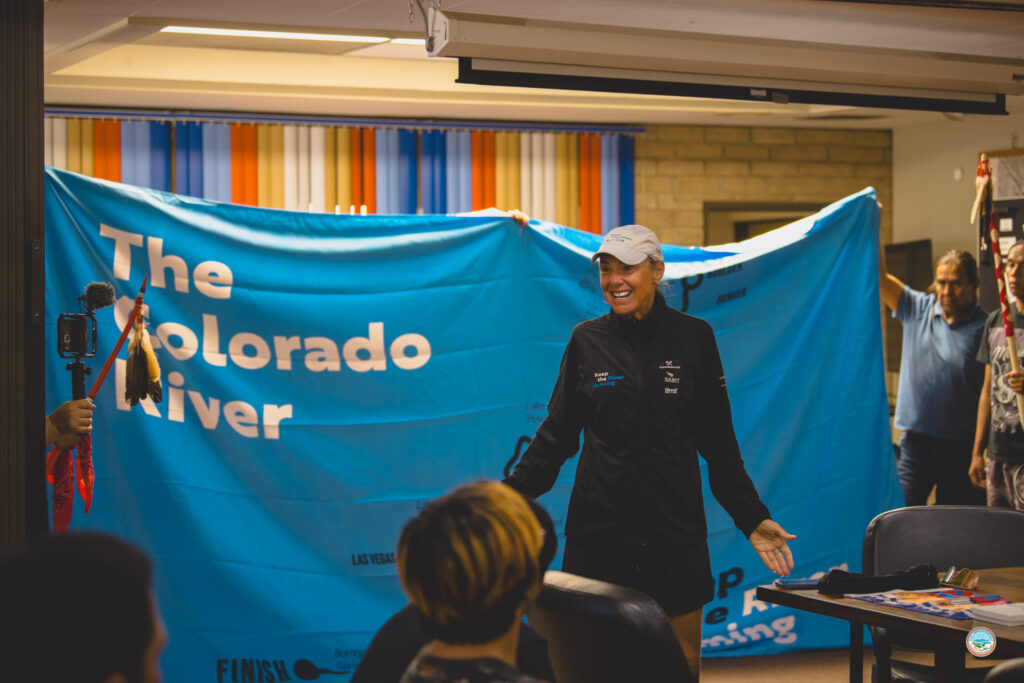
Those conditions gave added significance to Guli’s 2,000-mile “Keep the River Running” journey as it reached the Colorado River Indian Reservation.

Guli is running approximately 2,000 miles in 100 days along the Colorado River as part of her “Keep the River Running” campaign. Her journey follows the river through communities that depend on it, with a focus on raising awareness, listening to local voices, and encouraging cooperation around the river’s future.

Her CRIT visit began on the California side of the Reservation, where Councilman Tommy Drennan, Councilwoman Raeanne Patch, and Councilwoman Tracey Quillen greeted and welcomed her before the run.

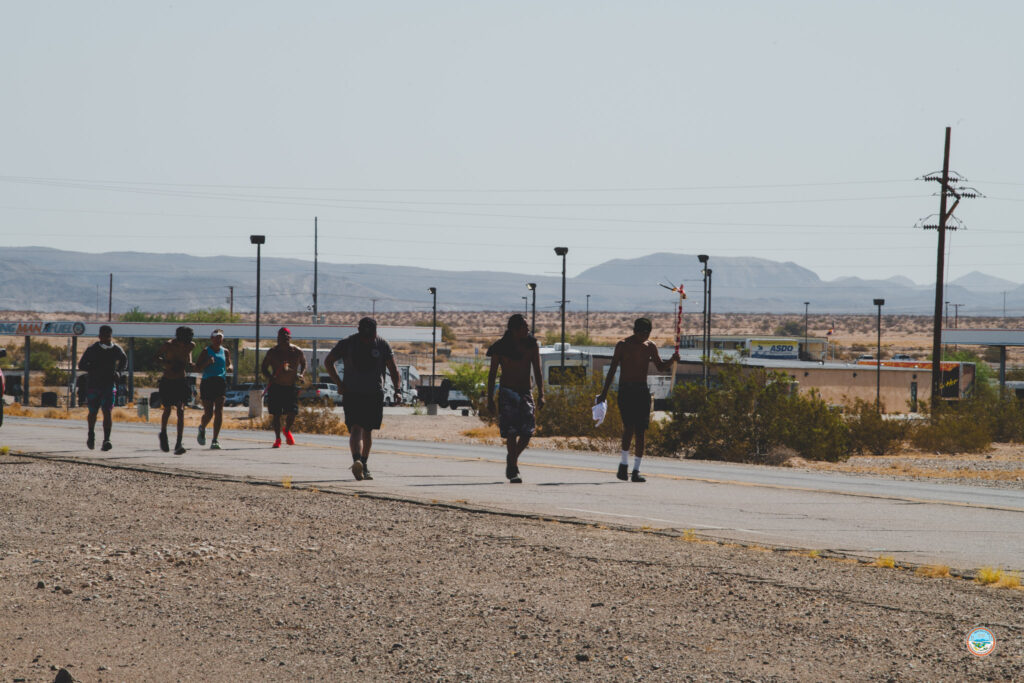
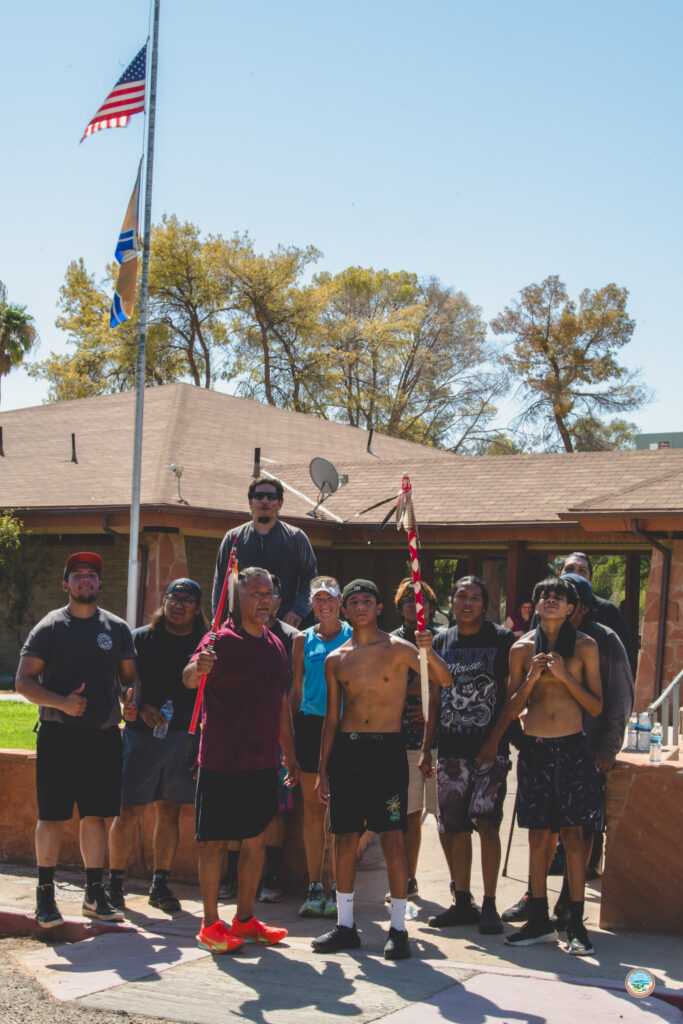
From there, members of the Mohave Runners, Adrian Pulido, Nolan Taliman, Irving Sharp, Elan Drennan-Webb, Joseph “Joe” Deleon, Aniah “AB” Booth, Mickey Anderson Jr., Joshua Mike, Oslette Johnson, and Chance Fisher joined Guli and ran alongside her through scorching desert heat. Together, they crossed the Colorado River from the California side into Arizona and continued through the community to the Tribal Council Chambers on Mohave Road.

The Mohave Runners brought a strong local presence to the event. Their participation reflected more than physical endurance. They were running beside a river that has sustained their community for generations, showing strength and determination while taking part in a larger effort focused on the future of the Colorado.

Guli said running alongside local people gave her a deeper understanding of the communities tied to the river.

“These are people who have spent their lives here and have so much to share and so much knowledge,” she said.

After the run, Guli, Tribal Council, and community members gathered inside the Tribal Council Chambers. Vice Chairman Dwight Lomayesva, Secretary Josephine Tahbo, Treasurer Anisa Patch, Councilwomen Tracey Quillen, Vanessa Welch, and Raeanne Patch, and Councilman Tommy Drennan were among those in attendance.

The Tribal Council welcomed Guli, presented her with a gift, and thanked her for bringing attention to the Colorado River and the people whose lives are connected to it.

During the gathering and her interview with CRIT Media, one message continued to surface: the importance of working together.

Guli spoke about the many challenges facing the river, including fragmentation among governments, communities, industries, and organizations. She said long-term solutions will require people to look beyond individual interests and focus on a shared future.

“Together doesn’t mean that the river is yours or mine,” Guli said. “It means that it’s ours.”

She also described what she called the “power of together,” saying the future of the river will depend on people being willing to listen to one another, include different perspectives, and work across boundaries.

For Guli, that includes Tribal communities whose relationship with the river goes back generations.

She said being at CRIT gave her the opportunity to listen directly to people who have lived with and understood the Colorado River “since time immemorial.” She also pointed to CRIT’s work involving legal personhood as an example of thinking about the river as more than simply a resource.

“The way to hear them is to be here,” she said. (more…)

(PARKER, Ariz.) The Colorado River Indian Tribes (CRIT) remains vigilant and recognizes the efforts brought forward in the release of the Record of Decision (ROD) for operations of Lake Powell and Lake Mead (2027–2036). The Bureau of Reclamation (BOR) is not imposing illegal water cuts on CRIT that it initially proposed in the draft EIS issued earlier this year.

CRIT recognizes the current water crisis impacts the millions of people who depend on the River including wildlife and natural habitats. CRIT’s own membership residing in the various towns, cities, states will be impacted by water shortages. Indeed, the Tribes’ deep-rooted connection to the River spans since time immemorial.

The ROD cites to formally include Tribal nations including CRIT in the Basin-wide consultation structure. CRIT has been seeking this for years and hopes the BOR keeps to their promise.

On behalf of the CRIT Tribal Council, Chairwoman Amelia Flores states, “The efforts of CRIT have made a difference. The numerous meetings and discussions between CRIT’s Tribal Council and the Bureau of Reclamation have clearly had an impact. In the ROD, the Bureau of Reclamation acknowledged they would follow the decree established in AZ v. California. This is of critical importance to CRIT, which holds the most senior Tribal rights in the Lower Basin.”

Tribal Council Member Tommy Drennan states, “We turn another page in this water crisis. We go forward to defend the river, our allocation, and the voice of our CRIT nation. It is progress, knowing that the US recognizes the need to work towards further solutions until the river recovers.  It is progress to know there are no illegal reductions facing our allocation today. We will continue to do what we must to keep the river alive.”

Councilmember Raeanne Patch states, “Given the critical status of the river, tribal consultation is mandatory in every discussion and decision regarding the Colorado River.”

Councilmember Anisa Patch states, “As the river’s natural ability to replenish itself falls further behind, CRIT continues defending our water allocation and traditional lifelines, navigating colonial processes.  We fight to preserve our livelihoods, the livelihoods of all living things who depend on this river to the changed landscapes ahead.”

Councilmember Tracey Quillen states, “I am proud of the work CRIT has done to bring us to this point, but our work is not finished. We remain vigilant in protecting our water and will continue working together to ensure that our rights are respected and protected for generations to come.”

The ROD preserves the legal status of CRIT’s water rights. It also clarified Reclamation will not rely on misdealing assumptions about CRIT’s water use in the FEIS (Final Environmental Impact Statement) regarding CRIT’s inability to entirely use its water resources.

However, the ROD also introduces a series of two-year operating frameworks under which additional reductions in water supply for central Arizona could be adopted if reservoir conditions worsen. As a result, CRIT will continue to proactively engage with Reclamation and other stakeholders throughout these successive two-year processes to fully protect CRIT’s water rights.

In November, the CRIT Tribal Council voted unanimously to proclaim Personhood Status for the Colorado River, acknowledging the Colorado River as a living entity whose health and well-being are intrinsically linked to the well-being of the Colorado River Indian Tribes (CRIT) members.

While the Tribal Council will stay engaged regarding CRIT’s water allocation, It will also continue to actively address the limitations in water delivery infrastructure which must be addressed by the federal government.

Flores added, “As this water crisis persists, CRIT continues conservation measures to preserve the life of the Colorado River.”

New World Screwworm detected near the border.

Follow the link for details.
Veterinarian-Stakeholder Comms-WOLKER-SIGNED

The Colorado River has faced historic drought and declining reservoir levels for more than two decades. In 2019, the Department of the Interior, Bureau of Reclamation, and representatives of the seven Colorado River Basin states signed the Drought Contingency Plans (DCP). The plans established coordinated conservation measures to reduce the risk of Lake Mead and Lake Powell falling to critically low levels.

The Colorado River Indian Tribes (CRIT) were among the Colorado River water users that voluntarily agreed to conserve water as part of the DCP. Between 2020 and 2022, the Tribes conserved 150,000 acre-feet of Colorado River water, helping keep additional water in Lake Mead. An acre-foot is enough water to cover one acre of land one foot deep.

CRIT received compensation for the 150,000 acre-feet it conserved. The effort also left approximately 10,000 acre-feet of additional water in Lake Mead. CRIT was not compensated for that portion, which became the Tribes’ Intentionally Created Surplus (ICS).

ICS is conserved water stored in Lake Mead for later use. The Bureau of Reclamation continues to credit the water to CRIT, similar to money held in a savings account. The balance is separate from the Tribes’ regular annual Colorado River allocation, and using it would not reduce CRIT’s allocation in future years.

Two rules govern CRIT’s ICS water. The first involves evaporation. The Bureau of Reclamation accounts for ICS as water stored at the top of the reservoir, making it subject to evaporation losses. Similar to water sitting in an uncovered container, water at the surface is the first to evaporate.

Those losses have reduced CRIT’s original ICS balance from approximately 10,000 acre-feet to 9,009 acre-feet. Water lost through evaporation cannot be recovered, and CRIT does not receive compensation for it. The longer the water remains in Lake Mead, the less CRIT has available to use or receive compensation for.

The second rule limits who may use ICS. It may only be used by the federal government or another entity that also holds ICS. Under the current rules, the Central Arizona Project, commonly known as CAP, and the Gila River Indian Community are the only eligible users for CRIT’s stored water.

CAP has approached Tribal Council about using the water in exchange for compensation. A possible agreement would allow CRIT to receive value from the remaining balance before additional water is lost through evaporation.

CRIT’s ICS is a finite Tribal resource created through conservation. Tribal Council is now considering how to use the remaining 9,009 acre-feet before evaporation further reduces its potential value.

On July 31, the Final Environmental Impact Statement (FEIS) was released for the Post-2026 Operational Guidelines and Strategies for Lake Powell and Lake Mead. The Colorado River Indian Tribes (CRIT) Attorney General’s Office swiftly responded upon its release. There are major highlights to note in both the comment letter and the FEIS.

The release of the FEIS is the next step in the process of Reclamation implementing an operations plan for the upcoming water year beginning on October 1. We expect a Record of Decision (ROD), where Reclamation will identify the overall operational parameters for Lake Powell and Lake Mead for the next 10 years, to be released later this week.

CRIT’s declaration of Personhood Status has made it into the official federal record through the FEIS. For the first time ever, Reclamation has acknowledged that the Colorado River is entitled to protection under CRIT law. While it may appear to be a small acknowledgment within this massive federal document, its significance should not be overlooked because it recognizes CRIT’s sovereign Tribal law and its role in protecting the River for generations to come.

Reclamation removed pro-rata distribution from the Preferred Alternative, as it had previously told Council they would (read about their visit here https://bit.ly/4z4Yl13). The letter acknowledges that the federal government has stated in the Preferred Alternative that it will not impact Tribal water entitlements and that any water transactions must be between willing parties.

While Reclamation removed pro-rata from the Preferred Alternative, it did not remove the language from its initial listing of alternatives. The Attorney General was clear that CRIT will always oppose any approach that could disregard the established priority system by allocating shortages proportionally among water users, including those with senior rights, instead of following the law and protecting senior Tribal rights.

Despite these important developments, Reclamation did not fully address CRIT’s earlier comments, and concerns remain with the Final EIS. It continues to incorrectly group CRIT with Tribes that receive water through the Central Arizona Project (CAP). CRIT’s water rights are directly from the Colorado River and are acknowledged in Arizona v. California as the senior-most Tribal right on the Colorado River, which makes CRIT’s water rights fundamentally different from those of Tribes in Central Arizona. Therefore, treating CRIT as though it is similarly situated to CAP Tribes is fundamentally wrong and risks obscuring the legal priority and unique status of CRIT’s water rights.

Just as importantly, CRIT again raised concerns about the lack of meaningful Tribal participation in the broader Basin States negotiation process. CRIT’s position is that Tribal Nations must have a meaningful role in shaping the decisions, not simply an opportunity to comment after those decisions have already taken form.

Quickly filing the comment letter before Reclamation takes any action, and identifying the items in the FEIS where Reclamation failed to address CRIT’s comments, are important parts of the legal process necessary to preserve CRIT’s rights for the future.

Read the comment letter in its entirety and the FEIS below.

Comment Letter
L_Colorado River Indian Tribes_Comments to BOR on Final EIS on Post-2026 Operation Guidelines for Lake Powell and Mead_08022026 

FEIS
https://www.usbr.gov/ColoradoRiverBasin/post2026/final-eis/index.html