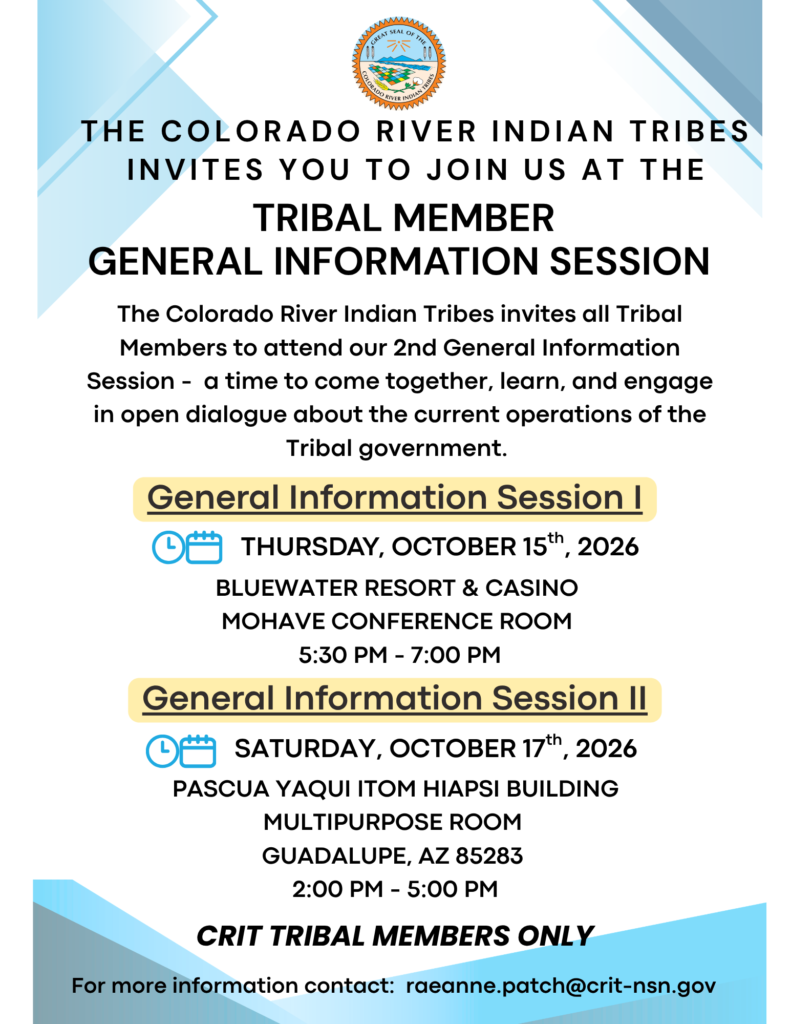
To download more information and an application please follow this link

Heavy fall rainfall brought a significant boost to Arizona’s local water supplies, even as the state continued preparing for deeper Colorado River reductions.
KJZZ reported that October and November inflows into the Salt and Verde river systems were about eight times greater than average and the highest recorded for that time of year.
In less than a week, Salt River Project reservoirs increased from 53% to 70% full. About 370,000 acre-feet of water was captured, enough to supply roughly half a year of demand within SRP’s Phoenix-area system.
Lake Powell and Lake Mead also gained water from recent storms, but officials continue to point to Upper Basin snowpack and spring runoff as the main factors for long-term recovery.
Phoenix is also preparing to move into Stage 2 of its drought management plan in January.
Under the plan, residents would be asked to voluntarily reduce water use by 5%, while city departments would target a 10% reduction. Conservation programs would also expand.
The move comes as Arizona, California, and Nevada continue negotiating future Colorado River reductions. KJZZ reported that Arizona could see about a 27% reduction in its Colorado River allocation, which could result in an approximately 50% reduction to Central Arizona Project supplies. Phoenix could see about a 30% reduction in its Colorado River water.
Phoenix plans to rely more on Salt and Verde River supplies, stored groundwater, groundwater pumping, and advanced water purification.
The Central Arizona Project is also changing how it spends conservation funding.
KJZZ reported that CAP decided to stop funding a cloud-seeding program in Colorado, Utah, and Wyoming that it had supported since 2007. Board members questioned whether the additional snowfall could be measured accurately enough to justify the cost.
Arizona’s legal challenge to the federal government’s Colorado River plan also remained active. ABC15 reported that the federal government requested more time to respond to the lawsuit filed by Nevada and joined by Arizona water interests.
Groundwater policy is also expected to remain a major issue in Arizona.
ABC15 reported that lawmakers plan to revisit groundwater management proposals during the next legislative session, including measures that could allow rural communities to establish local groundwater management programs.
Arizona has also expanded groundwater restrictions in some rural areas, including the Ranegras Plain in La Paz and Yuma counties.
Cities are investing in new water supplies as well. Peoria is moving forward with an advanced water purification facility and related infrastructure expected to cost more than $1 billion.
What does this mean for CRIT?
The recent rainfall improved water conditions in parts of Arizona, but the Salt and Verde systems are separate from the Colorado River system that supplies CRIT.
CRIT’s senior Colorado River rights also place the Tribe in a different position from junior-priority Central Arizona Project users facing deeper reductions.
However, low reservoir levels, federal operating decisions, and continued disagreements between Basin states remain important to CRIT because they affect management of the larger Colorado River system. (more…)
Recent storms brought significant rainfall across Arizona and the Four Corners, raising reservoir levels and increasing river flows. But water experts say the temporary boost does not change the Colorado River Basin’s long-term shortage.
In Arizona, Salt River Project increased releases from Bartlett and Stewart Mountain dams after historic rainfall sent large amounts of runoff into the Salt and Verde river systems. The releases pushed water through normally dry sections of the Salt River near Phoenix and helped create room in reservoirs for additional runoff.
The same storms also caused destructive flooding across Arizona, prompting a statewide emergency declaration.
Groundwater received some benefit from the rain, but recovery will be much slower. KOLD reported that a University of Arizona hydrologist said recent rainfall could help shallow groundwater supplies, while deeper aquifers around Tucson could take decades or even hundreds of years to recover.
Conditions also improved temporarily at Lake Powell. Cowboy State Daily reported that the reservoir gained more than 500,000 acre-feet between Oct. 21 and Oct. 28, raising the lake roughly nine to 10 feet. From its September low through late October, Powell gained about 600,000 acre-feet.
Even with that increase, Lake Powell remained only about 26% full and roughly 174 feet below full pool.
The recent gains also come as federal managers continue releasing water from Flaming Gorge Reservoir to support Lake Powell. Those releases have lowered Flaming Gorge and affected recreation and marina operations in Wyoming. (more…)
Arizona’s dispute over the federal Colorado River plan has officially moved into the courts, adding another layer of uncertainty as the state prepares for major reductions in its water supply.
KJZZ reported that the Arizona Department of Water Resources and the Central Arizona Project have both moved to join Nevada’s lawsuit challenging the federal government’s new Colorado River operating plan.
Nevada’s lawsuit asks the Interior Department to reconsider the plan for reducing water use in Arizona, California, and Nevada. Arizona and CAP argue that the federal government did not adequately consider the economic and community impacts of the reductions and placed too much of the burden on the Lower Basin.
The federal framework allows reductions to Arizona, California, and Nevada of up to 40% per year under some conditions, while requiring no new mandatory reductions from the Upper Basin states of Colorado, New Mexico, Utah, and Wyoming.
Arizona officials are also raising a larger legal question about whether the Upper Basin is meeting its obligations under the 1922 Colorado River Compact.
KJZZ reported that the current lawsuit does not directly ask the courts to settle that dispute. However, Arizona’s filings outline arguments that could eventually form the basis of a much larger interstate case before the U.S. Supreme Court.
Water experts interviewed by KJZZ described that possibility as a “nuclear option” because a state-versus-state Colorado River case could take years and create even greater uncertainty.
For now, Arizona, California, and Nevada are still attempting to negotiate how Lower Basin reductions will be divided. The federal rules could also be replaced if all seven Basin states eventually reach their own agreement.
While that legal fight continues, Arizona communities are developing their own strategies for living with less Colorado River water.
KJZZ reported that Queen Creek has spent years reducing its dependence on groundwater and developing additional supplies to support the fast-growing community.
The town is investing in groundwater from the Harquahala Valley in western Maricopa County. Queen Creek Utilities Director Marc Skocypec said the basin has more than 8 million acre-feet of identified groundwater, compared with Queen Creek’s current annual demand of about 30,000 acre-feet.
That water must still be pumped and transported to the southeast Valley, including through the Central Arizona Project canal. Those costs are being incorporated into a water resource fee charged to customers.
According to Skocypec, the fee is designed not only to pay for current water investments but also to help replace and replenish supplies over time so the town can continue demonstrating a 100-year water supply. (more…)
The final week of October brought another escalation in the legal fight over Colorado River cuts, while Tribal leaders continued pushing for a major Arizona water rights settlement and new research showed that groundwater reserves across the Basin are also declining.
The Central Arizona Project moved to join Nevada’s lawsuit challenging the federal government’s new Colorado River operating plan.
KJZZ reported that CAP filed to join the lawsuit after the Arizona Department of Water Resources made a similar move earlier in October. The lawsuit argues that the federal plan places too much of the burden on Arizona, California, and Nevada while requiring no comparable mandatory reductions from Colorado, New Mexico, Utah, and Wyoming.
CAP operates the 336-mile canal that delivers Colorado River water to central and southern Arizona. Under the federal framework, CAP could face some of the deepest reductions because of its junior priority within Arizona’s Colorado River allocation.
CAP General Manager Brenda Burman said the agency had spent years trying to avoid litigation but ultimately decided it needed to defend its water rights and its interpretation of the laws governing the river.
The lawsuit also raises questions about the 1922 Colorado River Compact. CAP and other Lower Basin interests argue that the Upper Basin has obligations to deliver sufficient water downstream and that the new federal plan does not adequately enforce those requirements.
Interior Secretary Doug Burgum pushed back on Arizona’s legal challenge during a visit to the state.
ABC15 reported that Burgum warned that taking the issue before a judge could create additional risk for Arizona because of the state’s relatively junior priority compared with other Colorado River users. He said the federal government developed the operating plan after the seven Basin states failed to reach their own agreement.
Despite the legal disagreement, both federal and Arizona officials acknowledged that the central problem remains the same: the Colorado River is producing less water, and the Basin still needs a longer-term solution.
While those legal questions continue, Tribal leaders in northeastern Arizona are asking Congress to finalize one of the largest Tribal water settlements in the state.
The Arizona Capitol Times reported that leaders from the Navajo Nation, Hopi Tribe, and San Juan Southern Paiute Tribe urged Congress to approve the Northeastern Arizona Indian Water Rights Settlement Act.
The legislation would resolve outstanding water claims for the three Tribes, fund a pipeline from Lake Powell, and establish trust funds to help build water infrastructure.
For the San Juan Southern Paiute Tribe, the legislation would also establish a reservation the Tribe has sought for decades.
The settlement would allow the Navajo Nation and Hopi Tribe to lease portions of their Upper Basin Colorado River water to other Arizona users. Tribal and water leaders said the agreement could provide greater certainty for both Tribal communities and other Colorado River users.
The discussion again highlighted a recurring issue with Tribal water rights: having a legal right to water does not necessarily mean a community has the infrastructure needed to use it.
Groundwater is facing its own challenges.
The University of Arizona Water Resources Research Center highlighted a new study documenting sustained groundwater losses throughout the Colorado River Basin over the past two decades.
Researchers found that groundwater depletion accelerated after 2019, particularly during the 2020–2022 drought. Higher temperatures, reduced precipitation, and increased water consumption all contributed to the losses.
The study found that groundwater storage in the Lower Basin is especially vulnerable because natural recharge is limited. Researchers examining Arizona’s Active Management Areas found that groundwater declines were linked largely to increased pumping during drought and reductions in Colorado River supplies.
The study also concluded that groundwater losses across the Colorado River Basin have exceeded losses from the system’s major surface reservoirs.
That finding is significant because groundwater is often treated as a backup when surface water supplies decline. If both systems are losing water at the same time, communities have fewer options during extended drought.
October storms did provide some short-term relief.
Arizona’s Family reported that Lake Powell gained about 12 feet in two weeks following recent storms. Despite the increase, the reservoir remained at approximately 25% capacity. Lake Mead remained even lower, at about 23% capacity. (more…)
As Arizona prepares for reduced Colorado River deliveries, the state is beginning to shift from years of saving water for future shortages to actually using some of those reserves.
KJZZ reported that the Arizona Water Banking Authority will use a one-year policy to fully “firm” water supplies lost by participating cities and utilities because of Colorado River shortages. Firming provides backup water to eligible users when their normal Central Arizona Project supplies are reduced.
The strategy could conserve up to 56,179 acre-feet in 2027 as cities and utilities rely on previously stored water rather than additional Colorado River deliveries.
The Water Banking Authority was created to store unused Colorado River water underground for future shortages. Arizona Water News reported that the agency is now entering a different phase. With less excess CAP water available for storage and shortages becoming more likely, the focus is shifting toward recovering and distributing the long-term storage credits accumulated over previous decades.
The Water Bank also has responsibilities for Tribal firming under the Arizona Water Settlements Act, along with providing backup supplies for certain municipal and industrial CAP users.
Stored water can help Arizona manage near-term shortages, but state officials are also considering how to bring entirely new supplies into Arizona over the longer term.
The Arizona Capitol Times reported that the Water Infrastructure Finance Authority of Arizona is studying five potential water importation projects. Together, the projects could eventually produce hundreds of thousands of acre-feet annually, although none have entered construction.
Among the projects being studied are desalination plants in Mexico and California, reclaimed-water projects involving Mexico, and proposals that could exchange new water supplies for portions of Colorado River allocations.
Two projects approved for further study in early October involve a proposed desalination plant near Mexico’s Gulf of California and a project that would recover and treat reclaimed water in Mexico for use as part of Arizona’s future supply.
Early estimates vary widely. The five projects could potentially produce nearly 1 million acre-feet annually under the highest estimates, while more conservative projections place the combined amount closer to 361,000 acre-feet.
Arizona’s expected Colorado River reduction is about 760,000 acre-feet per year, showing why state officials are considering several different options rather than relying on one project.
Cost remains one of the largest obstacles. Arizona lawmakers have provided WIFA about $386 million for long-term augmentation work, but individual desalination projects could cost billions of dollars.
While the state studies new supplies, some cities are also looking more closely at how much water new developments use.
KTAR reported that Scottsdale is considering a large-water-user ordinance in response to Colorado River reductions. City staff recommended requiring new large users to submit conservation plans, while council members also discussed additional review for projects expected to use more than 500,000 gallons of water per day.
The discussion reflects a broader question facing Arizona: how much water can be saved through conservation compared with how much new water needs to be developed.
ABC15 reported that agriculture accounts for nearly three-quarters of Arizona’s overall water use, significantly more than sectors such as golf courses or data centers. That makes agriculture an important part of statewide water discussions, particularly as officials look for ways to reduce demand while protecting Arizona’s economy and food production.
Conditions upstream show why those conversations continue.
KUNC reported that Blue Mesa Reservoir, historically Colorado’s largest body of water, fell below 20% full this year after a poor snowpack and prolonged drought.
Low water forced the Elk Creek Marina to close in early July, months earlier than usual, and affected recreation, fisheries, and agriculture. Farmers receiving water from the Gunnison River system also had to leave some fields dry or reduce production. (more…)
The new Colorado River water year began Oct. 1 under a different operating framework, but Arizona’s biggest reductions will not take effect until the start of 2027.
KJZZ reported that the new federal rules begin changing how much water is released from Lake Powell to Lake Mead as the 2027 water year gets underway. Arizona’s own reductions, however, are tied to the calendar year and are expected to begin Jan. 1.
Arizona, California, and Nevada are still working to finalize a Lower Basin agreement that would determine how the reductions are divided among water users. KJZZ reported that Arizona’s top water negotiator, Tom Buschatzke, remains optimistic that the three states can complete the agreement before the end of the year.
Under the current framework, Arizona is expected to reduce its Colorado River use by 760,000 acre-feet in 2027, assuming the Lower Basin states finalize their proposed sharing agreement. ABC15 reported that the reduction would equal about 27% of Arizona’s normal Colorado River allocation.
The exact impact on individual cities and water providers is still being worked out. Phoenix officials told ABC15 that the city does not yet have a final number for how much of the statewide reduction will be reflected in its Central Arizona Project supply.
Arizona Water News reported that the Arizona Water Banking Authority is entering a new phase. Created in 1996, the Water Bank stored unused portions of Arizona’s Colorado River entitlement underground and accumulated long-term storage credits that can be recovered during shortages.
Through 2024, the Water Bank had accumulated more than 4.4 million acre-feet of long-term storage credits, including approximately 3.8 million acre-feet for Arizona uses and more than 600,000 acre-feet on behalf of Nevada.
The Water Bank also has responsibilities for firming certain Central Arizona Project municipal and industrial supplies and for helping meet Arizona’s Tribal firming obligations under the Arizona Water Settlements Act.
As Colorado River shortages deepen, those stored supplies are becoming more important. Instead of focusing primarily on putting additional water underground, the Water Bank is increasingly preparing for the recovery and use of water that has already been stored.
Cronkite News reported that some rural residents around Chino Valley are already dealing with wells that have gone dry, forcing them to rely on water-hauling businesses and private storage tanks.
The Prescott Active Management Area has been considered outside of safe yield for more than two decades, meaning groundwater is being removed faster than it is being replaced. Local officials told Cronkite News that continued growth and groundwater pumping have contributed to declining water levels.
The situation is separate from the Colorado River shortage, but the two issues are connected through Arizona’s broader water supply. As Colorado River deliveries decline, groundwater and stored underground supplies are expected to play a larger role for some communities.
KUNR reported on new research showing that wildfire is burning more land in watersheds that provide water to communities across the West. Researchers analyzed more than 17,000 watersheds and found that the average amount of land burned annually nearly doubled in watersheds serving more than 100,000 people.
Wildfire can temporarily increase runoff, but it can also worsen water quality by sending sediment, nutrients, and debris into rivers, reservoirs, and water treatment systems. Those effects can continue for years after a fire. (more…)
On May 1st, 2024 students and staff from the Colorado River Indian Tribes Head Start program travelled to Avi Suquilla Airport in town for a field trip. They were greeted by Airport Manager Josh Philipps and his staff who explained how the airport worked, how the staff communicated with pilots, and how they fueled the aircraft and ensured safe flights for those coming to and from the airport.
During the trip the students were able to explore many types of aircraft including single propeller aircraft, jets, and medical helicopters. At the end of the field trip the students were treated to an ariel demonstration by a World War Two flying group.

The Arizona Department of Liquor Licenses and Control (ADLLC) Alcohol Awareness class was a recent outreach effort and community school event, where youth were presented with the concerns and dangers associated with underage drinking, and life ramifications thereafter. Thanks to everyone who made it possible.
A pair of recent power outages saw CRIT take action to ensure the health and safety of its members. A BIA outage impacted about 100 customers on June 7th. Power was restored by midafternoon. CRIT operated a number of cooling stations for those needing assistance.
A much larger outage effecting about 1,000 APS customers impacted the CRIT reservation and the Town of Parker on June 10th. CRIT once again opened cooling stations and initiated emergency plans. The outage began just after midnight. Full power was restored around 1pm that day.
The Sourdough fire burned about 715 acres before it was contained June 8th. The Sourdough Fire started on Wednesday, June 5th. Ground crews and aircraft battled the flames north of Ehrenberg. On June 6th, Nevada Team 3 took over management of the fire and provided extensive support in containment and securing the perimeter of the fire. CRIT Chairwoman Amelia Flores and members of the Tribal Council were regularly briefed on the efforts to control and contain the fire.