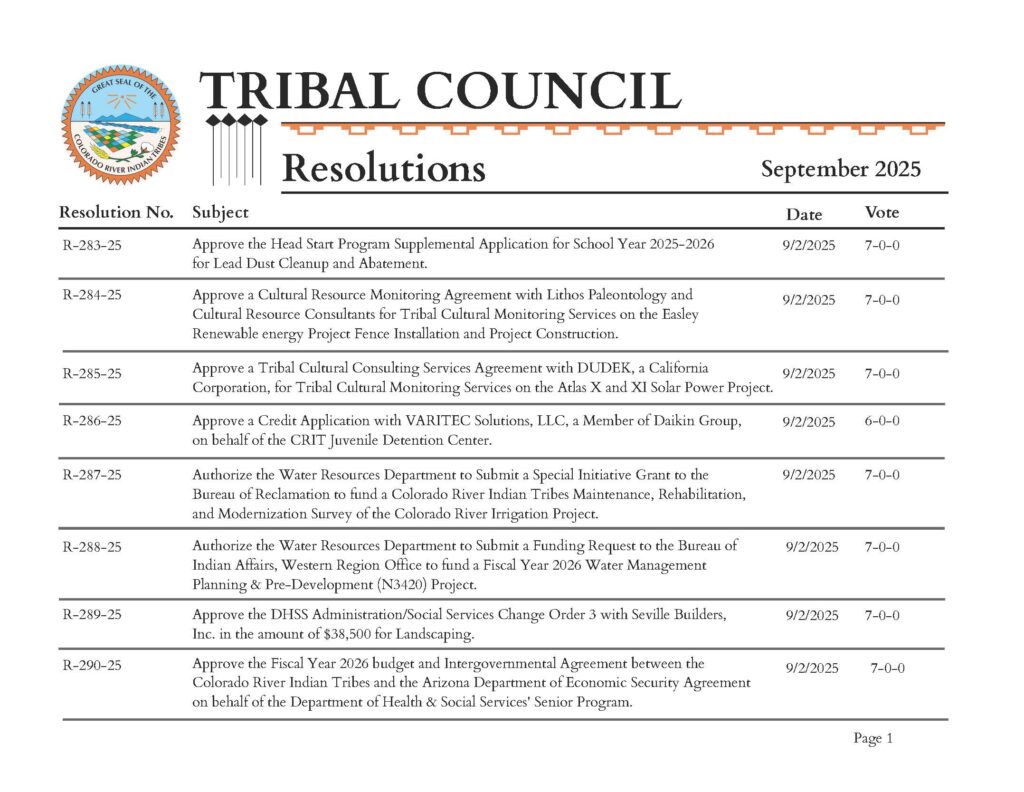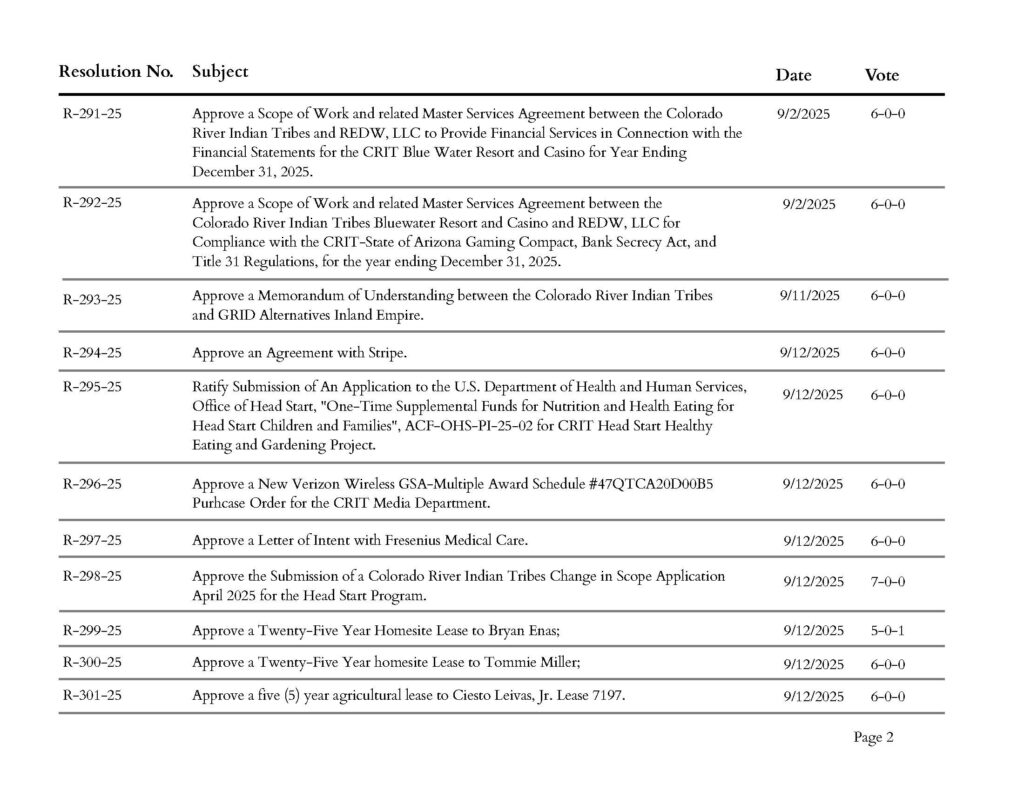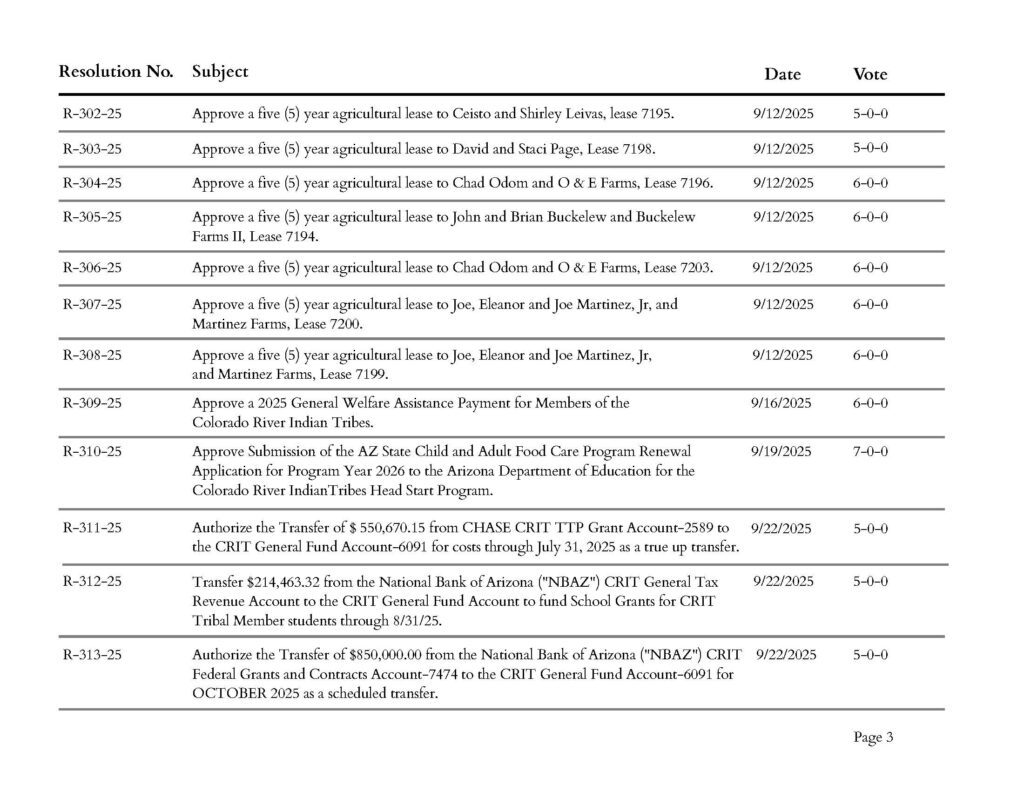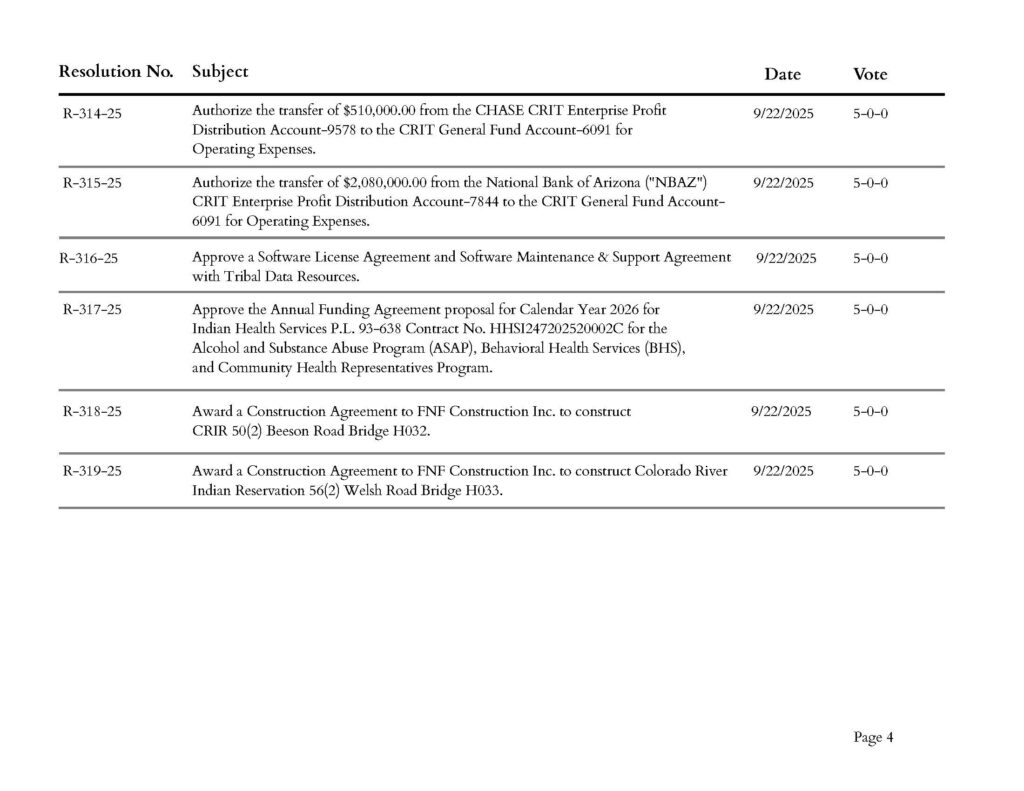

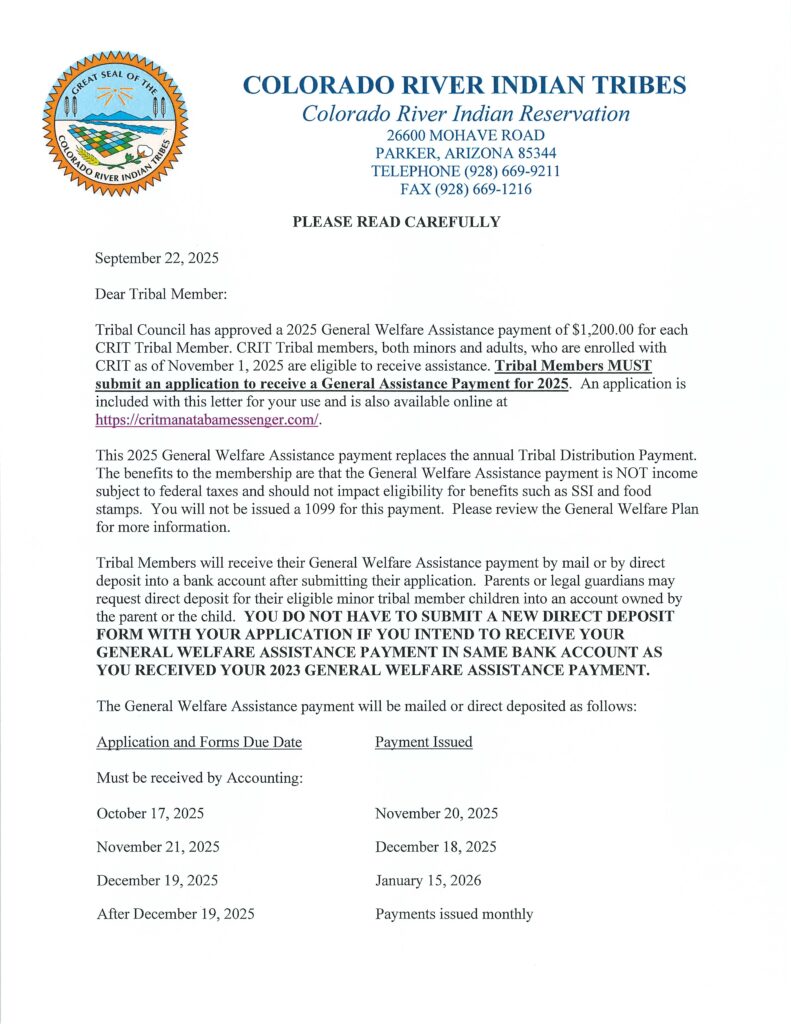
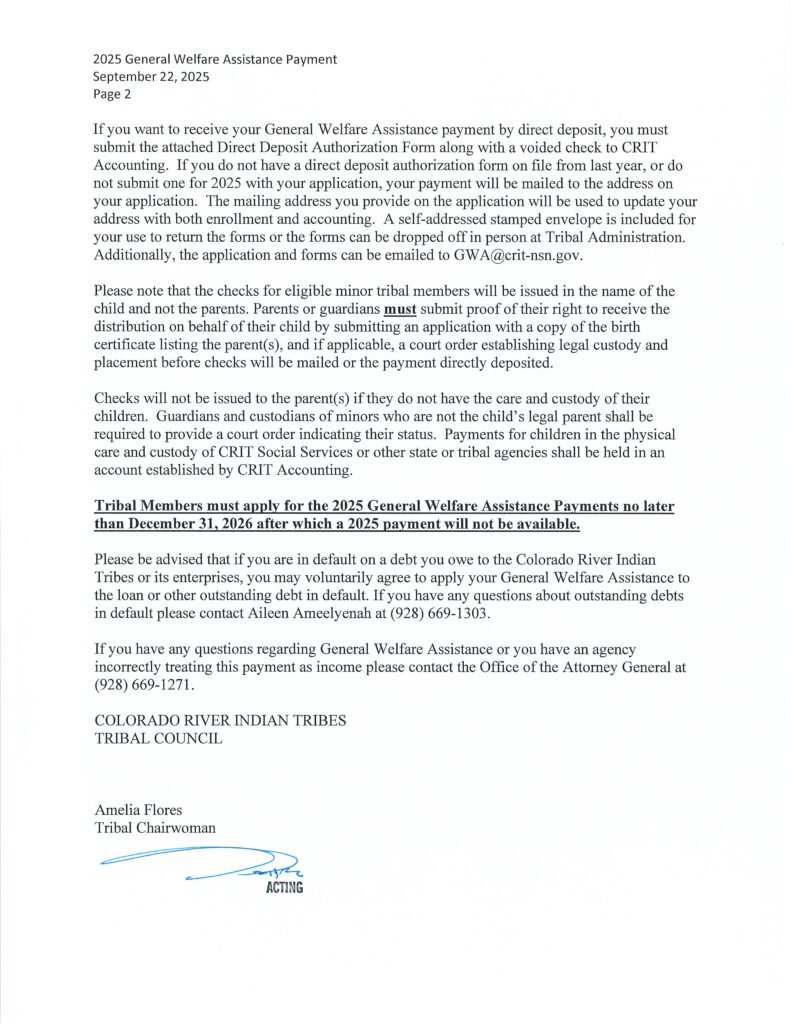
Update : CRIT has extended the deadline date for the General Welfare Application from Oct 17 to Oct 24th at 5pm.
Please click the links to upload related forms
DirectDeposit_ZionsBank_2025_GWP
General Welfare Application Minors_09132025
General Welfare Application_Adult_09132025
As Colorado River supplies remain under pressure, water agencies are investing in infrastructure to secure future deliveries while federal officials consider how declining reservoir levels affect hydropower and the river’s ecosystem.
One of the latest developments involves the Navajo Nation. Smart Water Magazine reported that the Bureau of Reclamation awarded an $81 million contract to Carstensen Contracting for construction of the final major segment of the Navajo-Gallup Water Supply Project in New Mexico.
The project is intended to bring reliable drinking water to nearly 250,000 people on the Navajo Nation and surrounding communities, fulfilling a longstanding water rights settlement. The newly awarded contract covers a pipeline connecting the Frank Chee Willetto Reservoir, east of Shiprock, to the San Juan Lateral Water Treatment Plant.
The San Juan Lateral is now more than 75% complete, with initial deliveries targeted for late 2028 and full completion expected by the end of 2029. Once finished, the broader Navajo-Gallup project will include approximately 300 miles of pipeline, two water treatment plants, and 19 pumping plants, addressing a longstanding infrastructure challenge in communities where many households still rely on hauling water.
In Arizona, cities are also developing additional water supplies ahead of federal Colorado River reductions.
12News reported that Peoria is spending $104 million on a water farm west of Tonopah to strengthen its long-term water supply. The investment is part of the city’s preparation for reduced Colorado River deliveries and reflects how communities are looking beyond their existing allocations to secure water for future needs.
Meanwhile, conditions at the Basin’s two largest reservoirs continue to influence federal water management decisions.
KLAS reported that two-year projections show Lake Mead potentially declining by approximately 40 feet while Lake Powell rises by a similar amount. The projected changes highlight how operations at one reservoir are connected to conditions throughout the Colorado River system.
Circle of Blue also examined how low water levels at Lake Powell are affecting decisions at Glen Canyon Dam. According to the report, the Bureau of Reclamation decided against certain environmental water releases this year because of concerns about hydropower generation.
Those releases would have helped rebuild eroded sandbars in the Grand Canyon and provided colder water to limit the reproduction of invasive smallmouth bass, which threaten native fish such as the humpback chub.
The proposed environmental releases would change the timing or temperature of water passing through Glen Canyon Dam rather than the total amount released over the year. However, using the dam’s bypass tubes would reduce electricity generation.
Reclamation said it is considering other measures to protect native fish, including removing invasive species and studying infrastructure that could regulate downstream water temperatures.
Water quality is also receiving attention elsewhere in Arizona.
KTAR reported that the Upper Verde River is nearing designation as an Outstanding Arizona Water, the state’s highest level of surface water quality protection. The designation would help protect the river from new discharges that permanently degrade its water quality.
The Upper Verde supports drinking water supplies, recreation, and habitat for several threatened and endangered species.
Together, these developments show how water management across the Basin involves more than dividing available supplies. Tribal communities are working toward reliable water deliveries, Arizona cities are developing additional resources, federal officials are balancing hydropower and ecosystem needs, and state agencies are considering stronger protections for rivers.
What does this mean for CRIT?
The Navajo-Gallup pipeline development is especially relevant because it illustrates the difference between holding water rights and having the infrastructure necessary to use them.
The project is fulfilling a longstanding Tribal water rights settlement by creating the physical system needed to deliver water to Navajo communities. It provides another example of how Tribal water management involves legal rights, infrastructure, federal commitments, and long-term planning. (more…)
Two Tribal Nations in Arizona have taken new steps to protect their water resources and culturally significant landscapes as the Colorado River Basin continues to face declining supplies and growing development demands.
KJZZ reported that the Hualapai Tribal Council recently approved a moratorium opposing the development of hyperscale data centers on its nearly one-million-acre reservation. The Tribe shares a 108-mile boundary with the Colorado River and raised concerns about the potential effects of large-scale data centers on water supplies, land, and the environment.
Hyperscale data centers are large facilities that support cloud computing and artificial intelligence. Depending on their design, these facilities can require substantial water for cooling and electricity generation.
Hualapai Chairman Duane Clarke told KJZZ that protecting the Tribe’s air, land, and water remains a priority. The resolution also states that outside entities and private developers cannot use or compromise Tribal resources without the Tribe’s free, prior, and informed consent.
The decision comes as other Colorado River communities consider similar developments. KJZZ reported that residents in Bullhead City have raised concerns about potential data center projects, while a proposed facility near Page has drawn opposition from the Navajo Nation’s LeChee Chapter.
Another development involving the Navajo Nation highlights the cultural significance of the Colorado River.
Grand Canyon Trust reported that the Navajo Nation has formally designated the confluence of the Little Colorado River and Colorado River as a sacred site under Tribal law.
Known as Tooh Ahidiilíní, the confluence is located within the Grand Canyon and holds cultural and spiritual significance for the Navajo people and other Indigenous communities.
The designation follows more than a decade of efforts by Navajo families and the Save the Confluence coalition. Those efforts included opposition to the proposed Grand Canyon Escalade development, which would have constructed a tramway, hotels, and other commercial facilities near the confluence.
The new legislation recognizes the confluence, Little Colorado River Gorge, and surrounding cultural landscape as a sacred site protected under the Navajo Nation Cultural Resources Protection Act.
Meanwhile, uncertainty continues over how the federal government will manage the Colorado River.
ABC15 reported that Nevada’s lawsuit challenging the new federal operating guidelines could potentially delay their implementation. Nevada argues that the plan places too much of the shortage burden on the Lower Basin states without adequately considering economic and public health consequences.
The state is seeking to block the plan before Oct. 1. If a court grants that request, existing operating rules and reductions could remain in place while the lawsuit proceeds.
University of Nevada, Las Vegas professor Tom Romero told ABC15 that litigation could encourage the Basin states to resume negotiations, but a court decision would not resolve the river’s declining water supply.
A Reuters analysis published Sept. 14 helps explain that underlying challenge. The report found that the Colorado River’s average annual natural flow declined from approximately 14.9 million acre-feet during the 20th century to 12.3 million acre-feet between 2000 and 2025.
Reuters also reported that water consumption exceeded the river’s natural supply in 16 of the last 24 years analyzed, with reservoirs making up the difference.
Together, these developments show how Colorado River management involves more than dividing water between states. Tribal governments are exercising their authority to protect resources and culturally significant places, while federal officials and water users continue working through legal disputes and a river system that is producing less water than in previous decades.
What does this mean for CRIT?
The Hualapai and Navajo Nation developments connect directly to CRIT’s ongoing work involving water sovereignty, resource protection, and the cultural significance of the Colorado River.
The Hualapai decision demonstrates how a Tribal government can use its authority to address proposed development and potential impacts on its natural resources. The Navajo Nation’s designation of the Confluence also provides an example of Tribal law being used to formally recognize and protect a culturally significant river landscape. (more…)
Colorado River shortages are raising questions about more than how much water each state receives. For Tribal Nations along the river, decisions about reservoir operations can affect their ability to use water they already have legal rights to.
Nevada Public Radio, in a report carried by Utah Public Radio, highlighted the Fort Mojave Indian Tribe’s concerns as the federal government moves forward with new Colorado River operating guidelines. The Tribe holds approximately 133,000 acre-feet of water rights annually, with much of that water supporting agricultural operations that help fund housing, healthcare, education, and other Tribal services.
Fort Mojave Chairman Timothy Williams told the news outlet that changing river levels are already affecting the Tribe’s ability to deliver water to its farms. Last winter, water levels dropped so low that one of the Tribe’s pumping stations could not draw water for four months. Farm manager Andrew Harter said continued low-water conditions could limit what the Tribe can grow.
The report also addressed a longstanding concern among Tribal Nations: despite holding substantial water rights, Tribes do not have the same formal role as the seven Basin states in negotiating the river’s operating rules.
Jay Weiner, a water attorney for the Quechan Indian Tribe and a member of the Water and Tribes Initiative leadership team, said Tribal governments have historically been excluded from important water management decisions. With 30 federally recognized Tribes in the Colorado River Basin, the issue extends beyond any one reservation.
The impact of future shortages is also becoming a concern for Arizona agriculture.
Cronkite News reported that the federal reductions planned for 2027 and 2028 are not expected to immediately affect Yuma-area farmers, who hold senior Colorado River water rights. Much of the reduction will instead affect the Central Arizona Project, which delivers water to central and southern Arizona.
However, Arizona Farm Bureau President John Boelts said farmers remain concerned about what happens after the two-year operating period. Yuma-area farms supply approximately 90% of the leafy greens consumed in the United States and Canada between October and April.
Central Arizona farmers have already experienced significant reductions. Cronkite News reported that many farmers who previously relied on CAP agricultural water lost access around 2023, forcing some to leave fields fallow or turn to groundwater.
Meanwhile, Arizona’s growing technology industry is adding another dimension to the water discussion.
A separate Cronkite News report examined concerns about data centers, which require water for cooling and indirectly through electricity generation. Water experts interviewed by the outlet said data centers are not responsible for the current Colorado River shortage, although their continued growth could increase pressure on Arizona’s limited supplies.
Arizona State University water law professor Rhett Larson said data centers are growing rapidly, but determining their total water use remains difficult because facilities use different cooling systems and many are not required to publicly disclose their consumption.
Together, the Sept. 11 reports highlight several connected issues facing the Colorado River Basin: protecting access to Tribal water rights, preparing agriculture for future reductions, and understanding how new development adds to water demand.
What does this mean for CRIT?
The Fort Mojave reporting is particularly relevant to CRIT because both Tribes hold senior Colorado River rights and depend on the river for agriculture, economic activity, and cultural traditions.
Fort Mojave’s experience also illustrates the difference between possessing water rights and being able to physically use that water. Changes in river elevation can affect pumping infrastructure even when a Tribe’s legal allocation remains unchanged.
For CRIT, the reporting reinforces the significance of Tribal participation in Colorado River negotiations. Decisions about reservoir operations, conservation, and future shortages can have practical consequences for Tribal governments that rely directly on the river.
The agricultural reporting also connects to CRIT’s farming operations. Although senior rights place CRIT in a different position than many junior-priority users, the wider discussion about agricultural water use, conservation, and future shortages remains relevant to the Tribe’s economic interests.
Sources
Utah Public Radio / Nevada Public Radio: “Tribes depend on the Colorado River, but don’t have a formal say in managing it”
https://www.upr.org/politics/2026-09-11/native-tribes-colorado-river-negotiations-mojave
Cronkite News: “Colorado River cuts haven’t hit Arizona farmers yet, but that might be coming”
https://cronkitenews.azpbs.org/2026/09/10/water-cuts-arizona-farms/
Cronkite News: “Don’t blame data centers for Arizona’s Colorado River cuts, water experts say”
https://cronkitenews.azpbs.org/2026/09/11/data-centers-water-colorado-river/
Colorado River negotiations are moving on several fronts, and this week one of those developments directly involved the Colorado River Indian Tribes.
The Central Arizona Water Conservation District Board approved an agreement with CRIT involving 9,009 acre-feet of Intentionally Created Surplus (ICS) water, while also authorizing the district to protect its rights through legal action if necessary as disputes over future Colorado River operations continue.
Central Arizona Project reported that the agreement involves Extraordinary Conservation Intentionally Created Surplus, or EC-ICS, created through fallowing activities at the CRIT farm in 2019 and 2020. Under the agreement, the Central Arizona Groundwater Replenishment District will acquire the right to take delivery of the 9,009 acre-feet currently held in CRIT’s ICS account.
If transferring the ICS is not feasible, CAP reported that CAWCD and CRIT would instead execute a lease for an equivalent amount of water under the same terms. The agreement also states that the two parties will look for additional opportunities to work together on water governance and management.
The same CAWCD meeting addressed the growing legal uncertainty surrounding Colorado River operations. The board authorized CAWCD to protect and defend its rights if legal action becomes necessary. CAP did not announce a new lawsuit at the meeting, but the authorization gives the district the ability to respond as disputes over the federal operating framework develop.
While Arizona water agencies consider their next steps, another agreement is taking shape farther downstream.
The United States and Mexico reached a Colorado River agreement covering 2027 and 2028. WaterWorld reported that Mexico’s annual deliveries will be reduced by 250,000 acre-feet during each of those years. Those reductions accompany the 1.25 million acre-feet in annual reductions planned for Lower Basin water users in Arizona, California and Nevada.
The agreement also continues cooperation between the two countries on salinity management, environmental programs and studies of potential new water supplies and desalination. If conditions worsen, the United States and Mexico agreed to discuss possible additional reductions in 2028. If Lake Mead improves significantly, the countries would discuss increasing Mexico’s deliveries.
The international agreement provides another piece of the short-term operating picture, but the seven Basin states still have not reached their own long-term agreement.
Arizona Water News reported that Arizona Department of Water Resources Director Tom Buschatzke continues to identify Upper Basin conservation as a major unresolved issue. During a PBS NewsHour Colorado River discussion, Buschatzke said Arizona wants the Upper Basin states to provide conservation that can be measured and delivered into Lake Powell with greater certainty. (more…)
The Colorado River’s new operating framework may provide short-term direction, but the larger fight over how the river should be divided is still unresolved.
University of Arizona News reported that the Bureau of Reclamation’s Aug. 21 decision sets operations for 2027 and 2028, with new guidelines to be reconsidered every two years after that as negotiations continue.
Under the framework, Arizona’s Colorado River deliveries will be reduced by 760,000 acre-feet. Sharon Megdal, director of the University of Arizona Water Resources Research Center, said the reductions are significant but not as deep as some earlier possibilities. She also noted that Tucson has spent years storing Central Arizona Project water underground, giving the city an additional supply to draw from during shortages.
The framework gives Arizona and other Lower Basin users some near-term certainty, but it does not settle the disagreement between the Upper and Lower basins.
Colorado Public Radio reported that the river’s 10-year flow at Lee’s Ferry may soon fall below a level that has become an important point in the debate over the 1922 Colorado River Compact.
The Compact states that the Upper Basin cannot cause flows at Lee’s Ferry to fall below 75 million acre-feet over any 10-year period. The question becomes more complicated when Mexico’s share of Colorado River water is included. Water experts interviewed by CPR said the Upper Basin disputes how much additional water it may be obligated to provide.
Officials estimate that the 10-year flow could fall below 82.5 million acre-feet by October. Some Lower Basin officials have pointed to that level as a possible legal trigger in the ongoing dispute over Compact obligations.
If the states cannot resolve those disagreements through negotiation, the issue could eventually reach the U.S. Supreme Court. CPR reported that both Upper and Lower Basin states are already preparing for possible litigation.
That would not be a quick process. The last major interstate Colorado River case, Arizona v. California, took more than a decade to reach a ruling, with additional decrees continuing for decades afterward.
Tribal water rights are also part of the legal landscape. CPR reported that 30 federally recognized Tribal Nations in the Colorado River Basin collectively hold rights to more than one-quarter of the river’s water. Some of those rights remain unresolved, while other Tribes still lack the infrastructure needed to fully use their water.
The KJZZ “Troubled Waters” project also highlights another concern: much of the negotiation over the river’s future has taken place behind closed doors. The reporting notes that Tribal leaders and transparency advocates have raised questions about who is included in negotiations and how decisions affecting the entire Basin are being made.
Together, the Sept. 9 reports show that the Basin is moving through two different processes at the same time. Arizona and other Lower Basin users are preparing for immediate reductions beginning in 2027, while the seven Basin states continue arguing over the much larger question of how the Colorado River should be managed over the long term.
What does this mean for CRIT?
The short-term framework provides more clarity about what will happen in 2027 and 2028, but the larger negotiations remain important.
CRIT’s senior Colorado River rights put the Tribe in a different legal position than many Central Arizona Project users. Still, disputes between the Upper and Lower basins could shape reservoir operations, federal decision-making, and the broader legal framework surrounding the river. (more…)
Arizona may have to use less Colorado River water than it has at any point in modern history, while water agencies are also preparing for possible legal fights and emergency reservoir operations.
KJZZ reported on a new analysis from independent Colorado River experts that described the reductions facing Arizona, California, and Nevada as “unprecedented.” The researchers said recent water use in the Lower Basin is already relatively low, leaving fewer easy conservation options if deeper cuts are required.
Arizona is expected to take the largest share of the 2027 and 2028 Lower Basin reductions. The Central Arizona Project would absorb much of that impact because of its junior priority within Arizona’s Colorado River allocation.
CAP leaders are also preparing for the possibility that the dispute could move into court. KJZZ reported that the Central Arizona Water Conservation District board took a procedural step that could allow future legal action over the federal Colorado River plan. The agency has not filed a lawsuit, but the move keeps that option open as Arizona evaluates the federal framework.
While legal and policy questions continue, federal officials are also trying to protect Lake Powell. KSL reported that the Bureau of Reclamation is releasing between 660,000 and 1 million acre-feet of additional water from Flaming Gorge Reservoir through April 2027. The releases are intended to help keep Lake Powell above critical elevations needed for dam operations and hydropower. Utah officials said Flaming Gorge cannot serve as a permanent solution to Lake Powell’s decline.
The additional release shows how connected the Upper and Lower basins are. Water stored hundreds of miles upstream can be moved to protect Lake Powell, which in turn affects releases into the Lower Basin and the larger operation of the Colorado River.
Boise State Public Radio and the Mountain West News Bureau analyzed Bureau of Reclamation data and found that irrigated agriculture accounted for about 65% of overall Colorado River consumptive use from 2000 through 2024. When evaporation is excluded and only human uses are considered, agriculture accounted for roughly 74%. Reservoir evaporation itself represented at least 12% of total use in the analysis.
The report also found differences in how water use is measured across the Basin. Lower Basin deliveries are generally measured directly from reservoirs and canals, while Upper Basin use is often estimated by calculating stream depletion and return flows. Those different systems can make exact comparisons difficult.
Groundwater pressures are developing alongside the Colorado River shortage. The Arizona Farm Bureau reported that the Willcox Basin is losing about 150,000 acre-feet more groundwater each year than is naturally replaced. Arizona’s proposed management approach would seek to cut that overdraft roughly in half over time, which could require significant reductions from agriculture.
Together, the Sept. 8 reports show that the next phase of Colorado River management will involve more than setting a shortage number. Arizona and other Basin states are dealing with legal questions, reservoir operations, agricultural demand, groundwater decline, and even disagreements over how water use should be measured.
What does this mean for CRIT?
These reports are especially relevant because the Tribe holds senior Colorado River rights and is a major agricultural water user directly along the river.
The CAP legal discussion mainly concerns users with different priorities than CRIT, but the larger dispute still matters. Decisions about Lake Powell, Lake Mead, and the division of shortages shape the river system where CRIT’s rights are exercised.
The Flaming Gorge releases also show how federal managers are using water throughout the Basin to protect critical reservoir elevations. Even though that water originates far upstream, the condition of Lake Powell affects the entire Colorado River system.
The water-use reporting is particularly relevant to agriculture. With agriculture representing the largest share of consumptive use Basin-wide, future conservation discussions are likely to continue focusing heavily on farms. For CRIT, that makes it important to distinguish the Tribe’s senior rights, agricultural economy, and existing water management from other categories of water use.
Sources
KJZZ, “Colorado River cuts could force ‘unprecedented’ low water use for Arizona, new study finds.”
https://www.kjzz.org/science/2026-09-08/colorado-river-cuts-could-force-unprecedented-low-water-use-for-arizona-new-study-finds
KJZZ, “CAP leaders take a step toward legal action over Arizona’s Colorado River water share.”
https://www.kjzz.org/politics/2026-09-05/cap-leaders-take-a-step-toward-legal-action-over-arizonas-colorado-river-water-share
KSL, “More water being released from Flaming Gorge to help Lake Powell.”
https://www.ksl.com/article/news/utah/environment/more-water-being-released-from-flaming-gorge-to-help-lake-powell/51621145
Boise State Public Radio, “Measuring the use of Colorado River water is harder than it looks.”
https://www.boisestatepublicradio.org/news/2026-09-08/measuring-the-use-of-colorado-river-water-is-harder-than-it-looks
Arizona Farm Bureau, “Willcox Plan Shakes Up Arizona Groundwater Policy.”
https://www.azfb.org/Article/arizona-groundwater-willcox-management-plan
The Arizona Department of Liquor Licenses and Control (ADLLC) Alcohol Awareness class was a recent outreach effort and community school event, where youth were presented with the concerns and dangers associated with underage drinking, and life ramifications thereafter. Thanks to everyone who made it possible.
A pair of recent power outages saw CRIT take action to ensure the health and safety of its members. A BIA outage impacted about 100 customers on June 7th. Power was restored by midafternoon. CRIT operated a number of cooling stations for those needing assistance.
A much larger outage effecting about 1,000 APS customers impacted the CRIT reservation and the Town of Parker on June 10th. CRIT once again opened cooling stations and initiated emergency plans. The outage began just after midnight. Full power was restored around 1pm that day.
The Sourdough fire burned about 715 acres before it was contained June 8th. The Sourdough Fire started on Wednesday, June 5th. Ground crews and aircraft battled the flames north of Ehrenberg. On June 6th, Nevada Team 3 took over management of the fire and provided extensive support in containment and securing the perimeter of the fire. CRIT Chairwoman Amelia Flores and members of the Tribal Council were regularly briefed on the efforts to control and contain the fire.

CRIT Chairwoman Amelia Flores recently attended a tribal leader roundtable with United States Interior Secretary Deb Haaland and Congressman Dr. Raul Ruiz to support the designation of the proposed Chuckwalla National Monument and expansion of Joshua Tree National Park. The meeting took place in North Shore, California.
CRIT was invited by Chairman Thomas Tortez Jr. of the Torres Martinez Desert Cahuilla Indians.
Chairwoman Flores spoke about the importance of protecting the fragile landscape that would make up the Chuckwalla National Monument.