July 28, 2026 11:25 pm
CRIT Nation, Parker, AZ
July 28, 2026 11:25 pm
CRIT Nation, Parker, AZ

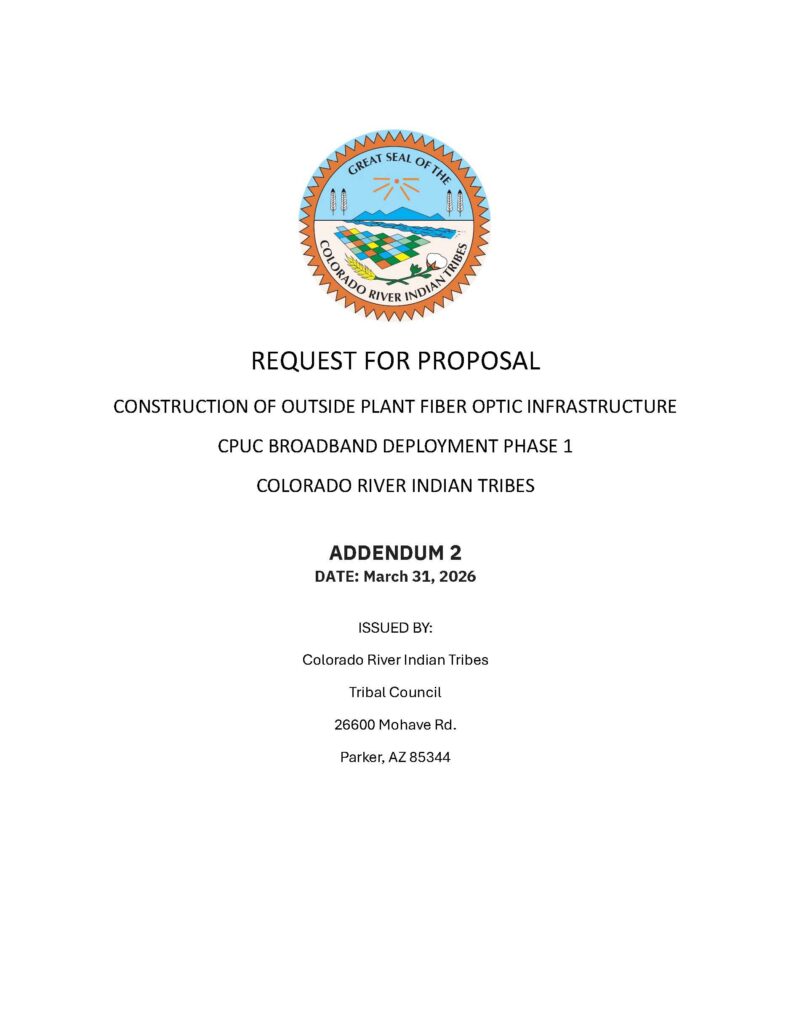
Notice to Contractors: The Colorado River Indian Tribes has issued Addendum 1 for the CPUC Broadband Deployment Phase I Request for Proposals for the construction of outside plant fiber optic infrastructure. This addendum includes answers to questions discussed during the March 17 pre-bid meeting, along with revisions to the construction specifications. Proposers are required to acknowledge receipt of Addendum 1 in the cover letter of their proposal.
Click the link for details

CRIT CPUC Phase I RFP_Addendum 1_03.24.26 (1) 

The Colorado River Indian Tribes (CRIT) is requesting proposals from qualified contractors for the renovation of a building located at 1405 S. Joshua Ave. in Parker, Arizona, which will serve as the future CRIT Broadband Operations Facility. The project will convert the existing structure into a secure, fully functional center to support CRIT’s expanding broadband network.

A pre-proposal site visit will take place on March 18, 2026 at 10:00 AM at the project location. Proposals are due by April 7, 2026 at 2:00 PM (Arizona Time).

Follow the link below for details.

REQUEST FOR PROPOSAL-Broadband building (002)


July 13 reporting showed drought pressure moving from long-term forecasts into visible impacts across Arizona and the Upper Basin.

In southern Arizona, the San Pedro River recorded zero flow at a key monitoring point near Sierra Vista. The Arizona Republic reported that the river ran dry there for only the second time in 122 years of records. The San Pedro is one of Arizona’s last free-flowing rivers, and dry conditions along the river show how drought, groundwater pumping, and heat can affect local ecosystems.

Scottsdale continued reviewing its long-term water planning. KJZZ reported that city officials are preparing for possible Colorado River cuts, including a possible large water-use ordinance. KJZZ reported that Scottsdale relies on Colorado River water for about 70% of its supply, with some parts of the city depending on it even more. The city has also purchased water credits from Harquahala Valley and uses advanced water treatment and recharge as part of its water planning.

Arizona also extended groundwater-related support in Pinal County. AZ Free News reported that state lawmakers extended Pinal groundwater fee relief and irrigation project funding through 2030. The funding is tied to agricultural water planning in a region that has already faced reductions to Colorado River supplies.

Water demand from data centers remained part of the state’s water debate. The Cool Down reported that Arizona paused data center tax breaks for three years after public concern over water and power use. The issue shows how large technology projects are becoming part of water planning as the state considers future growth.

In the Upper Basin, Colorado water groups are working to keep more water in rivers during extreme drought. Steamboat Pilot & Today reported on efforts by the Colorado Water Trust to support river flows, including work connected to the Yampa River and reservoir releases.

The Salt Lake Tribune also reported on a new study measuring how much water Flaming Gorge Reservoir loses to evaporation. That information could help water managers better understand reservoir losses as Lake Powell and other parts of the system remain under pressure. (more…)

Reports show how water concerns are reaching different parts of the West, from city conservation programs in Arizona to tribal water settlements, drought impacts, and ongoing Colorado River negotiations.

In Arizona, cities are encouraging residents to use less water. SignalsAZ reported that Surprise is offering rebates for eligible water-saving improvements. 12News reported that Scottsdale residents can also receive rebates for conservation upgrades. These programs reflect how cities are trying to reduce demand as Colorado River supplies become less reliable.

Tribal water rights remained a major issue. Navajo Times reported that the Diné water settlement has stalled after objections from Colorado, New Mexico, Utah, and Wyoming. The settlement involves the Navajo Nation, Hopi Tribe, and San Juan Southern Paiute Tribe and is tied to water infrastructure and access in northeastern Arizona. The four Upper Basin states raised concerns about how the water could be used or leased in the future.

Drought impacts continued in Arizona. Congressman Eli Crane’s office reported that the U.S. Department of Agriculture issued drought disaster designations for several Arizona counties. Gila Valley Central reported that Graham and Greenlee counties were declared primary disaster areas because of drought. These designations can make assistance available to eligible farmers and producers.

The University of Arizona Water Resources Research Center released a toolkit for domestic well owners. The guide covers well maintenance, water quality, testing, and drought planning. It is especially relevant for rural residents who rely on private wells.

Water demand from data centers also remained part of the discussion. KTAR reported on concerns over whether data centers are draining Arizona’s water. As technology projects expand, their energy use, cooling needs, and long-term water demand are drawing more attention.

Across the West, drought pressure continued. KSL reported that experts are watching specific regions and industries facing severe drought impacts. Cowboy State Daily reported that an irrigation district in eastern Wyoming warned water could run out by early August.

Colorado River negotiations also remained unsettled. KNPR reported on where Southern Nevada stands as the current river management agreement nears expiration. KLAS reported that Colorado’s water commissioner said drought conversations remain difficult. KUTV reported that Upper and Lower Basin states failed to reach an agreement on Lake Powell.

Weather added more uncertainty. Several outlets reported rising odds of a strong El Niño. While El Niño can bring wetter conditions to some areas, it does not guarantee drought relief for the Colorado River system. Snowpack, runoff, and soil conditions will still determine how much water reaches reservoirs.

The reports show water planning happening on several fronts. Cities are offering rebates, rural residents are receiving well guidance, Arizona counties are facing drought designations, tribes are waiting on settlement progress, and Basin states are still negotiating future river rules. (more…)

Arizona cities are pressing for clearer answers on water they stored underground as the state prepares for possible Colorado River cuts.

KJZZ reported that Phoenix-area cities and the Arizona Water Banking Authority are in disagreement over how stored Colorado River water should be distributed during shortages. Since the late 1990s, excess Colorado River water has been stored underground as a backup supply. With new river rules expected and cuts likely for Central Arizona Project users, cities want to know how much water they will be allowed to recover, when it would be available, and what requirements may come with it.

The question is not just how much water exists underground. It is also how the Water Bank decides who gets access and how much should be saved for future shortages. KJZZ reported that Water Bank officials are considering policies that could limit distribution or require cities to show conservation efforts before receiving stored water.

Scottsdale is also adding to its stored-water portfolio. KJZZ reported that the city approved an $8.25 million purchase of water credits from Harquahala Valley through the Central Arizona Project. The credits represent water stored underground for future use. According to KJZZ, the purchase amounts to about 15,000 acre-feet of water and brings Scottsdale’s long-term water credits to just under 300,000 acre-feet.

The purchase shows how cities are looking beyond current deliveries and preparing for uncertainty. Stored credits can help provide backup during shortages, but they still depend on access, recovery, and long-term management.

Drought conditions are also affecting Arizona counties. Congressman Eli Crane’s office reported that the U.S. Department of Agriculture issued drought disaster designations for several Arizona counties. Gila, Pinal, and Yuma counties were elevated to primary disaster status in a later designation, while other counties were listed as contiguous. The designations can help make agricultural assistance available to eligible producers affected by drought.

Groundwater recharge remains part of the broader water planning conversation. Agri-Pulse reported that California lawmakers are again trying to address permitting delays for groundwater recharge projects. The bill discussed in the report would give farmers and water agencies more flexibility to capture high flows and move water underground when wet conditions allow. Supporters say current permitting can be too slow for short windows of available water.

The issue connects to Arizona’s own recharge discussions. Across the West, water managers are looking at ways to store more water underground during wet periods so communities and farms have more flexibility during dry years.

The legal side of western water also continues to grow. The Colorado Sun reported that the U.S. Supreme Court agreed to hear Nebraska’s lawsuit against Colorado over the proposed Perkins Canal. Nebraska says the canal is needed to bring South Platte River water into Nebraska under a 1923 compact. Colorado officials say the state is complying with the compact and will defend its water rights. (more…)

Arizona’s water coverage centered on a practical question: if the Colorado River keeps shrinking, how much backup water is actually available, and who can use it?

KJZZ reported that Phoenix-area cities are asking for clearer answers about Colorado River water stored underground by the Arizona Water Banking Authority. The Water Bank was created in 1996 to store excess Colorado River water underground for use during a shortage. Cities that rely on the Central Arizona Project say they need to know how much of that stored water they can access, when it would be available, and how it would be recovered.

The issue is becoming more urgent as federal officials consider new Colorado River operating rules. Arizona Farm Bureau News reported that Arizona water officials are pushing for the Lower Basin proposal as an alternative to deeper federal cuts. The proposal includes mandatory reductions across Arizona, California, and Nevada, along with additional voluntary savings through 2028.

The Arizona Farm Bureau also reported that the Central Arizona Project is now projecting a 14% shortage in its municipal water pool instead of 20%, partly by using water from Lake Pleasant and wells in Yuma. Even with that smaller projected shortage, cities and farms are still preparing for less water.

Agriculture remains a major part of the discussion. Arizona farmers are watching possible cuts closely because reductions to Colorado River water can affect planting decisions, crop choices, and operating costs. Those changes can also move beyond farms, reaching workers, local economies, and food supply chains.

Arizona is also looking at how to keep more water in the state. KJZZ reported that more than 95% of precipitation that falls in Arizona is lost to evapotranspiration. The reporting was based on the Arizona Tri-University Recharge and Water Reliability Project, which is studying ways to capture more rain, snowmelt, and runoff before it is lost to evaporation or plant use. The project is also looking at how more water can be moved into aquifers through recharge.

That research connects directly to questions about groundwater. As Colorado River supplies become less reliable, cities and rural areas are paying closer attention to underground storage, recharge, and long-term access to stored water.

The Desert Review reported that the Central Arizona Irrigation and Drainage District secured up to 10,000 acre-feet per year of new water supply from the Mojave Groundwater Bank in California. The agreement is another example of Arizona water users looking outside traditional supplies as Colorado River shortages continue.

Lake Powell also remained under pressure. The Guardian reported that the reservoir could fall to unprecedented lows after poor snowpack and limited spring runoff. KUTV and Newsweek reported on a proposal from scientists to move more water from Lake Powell to Lake Mead, arguing that storing more water in Lake Mead could reduce losses and protect downstream supplies. The idea is part of a larger debate over how the two major reservoirs should be managed as both remain low. (more…)

Lake Powell remained one of the biggest concerns. The Colorado Sun reported that low water levels are creating new pressure at Glen Canyon Dam, where federal officials are working to protect dam infrastructure as the reservoir drops. The report focused on cavitation, a problem caused when fast-moving water creates vapor bubbles that can damage dam equipment and concrete surfaces.

The issue shows how falling reservoir levels affect more than water storage. Lake Powell also supports hydropower generation, downstream releases, and dam operations. When the reservoir drops too low, federal managers have fewer options to move water through the system safely and efficiently.

Arizona water users are also watching federal planning closely. The Arizona Daily Star reported that a Colorado River water savings plan could reduce the effect of future cuts on Arizona users. The plan is part of ongoing Lower Basin negotiations as Arizona, California, and Nevada look for ways to conserve water and avoid deeper mandatory reductions.

Those negotiations remain unsettled. Fox 13 Salt Lake City reported that Colorado River governors said they are not at a stalemate, even as the deadline for new river rules gets closer. The current operating guidelines are set to expire after 2026, and the seven Basin states still need agreement on how future shortages will be shared.

For Arizona, Central Arizona Project water remains a major concern. The CAP canal moves Colorado River water to central and southern Arizona, including cities, farms, and tribal users. If future cuts fall heavily on CAP water, impacts would vary depending on each user’s legal priority, water portfolio, and access to stored supplies.

AMWUA reported on the importance of municipal access to stored water credits. Cities have stored water underground for years to prepare for shortages, but access to those credits becomes more important as Colorado River supplies become less reliable. Stored credits can help cities manage short-term gaps, but they are not a permanent replacement for long-term river reductions.

The idea of moving new water into Arizona also received attention. Some proposals have looked at whether abandoned energy pipelines could be used to bring water west. These ideas reflect the search for new supplies, but large importation projects often involve high costs, legal questions, energy demands, and environmental review. (more…)

Recent developments across the Colorado River Basin show how changes in water supply are beginning to affect recreation, agriculture, and future water planning. While the seven Basin states remain divided over how to manage the river, communities are already dealing with the effects of lower flows and looking at new ways to protect their water.

Colorado River negotiators recently made a rare public appearance together, but there was little indication that the states are closer to an agreement. Representatives from the Upper and Lower basins continue to disagree over how future water reductions should be shared and whether the next plan should offer long-term certainty or act as a temporary bridge.

Nevada negotiator John Entsminger said the latest Lower Basin proposal could provide a workable plan for the next few years and help keep the states out of court while discussions continue. Colorado negotiator Becky Mitchell questioned whether returning to negotiations every two years would build stability or simply create another series of temporary fixes.

The negotiators also discussed mediation as a possible next step. One idea would involve choosing three mediators: one selected by the Upper Basin, another by the Lower Basin, and a third selected by the first two. The ongoing disagreement is also making it difficult for Mexico, which receives Colorado River water under international agreements, to prepare for future shortages.

While those larger negotiations continue, uncertainty is reaching businesses that depend directly on the river. KNAU reported that Grand Canyon rafting companies are watching lower water levels near Lees Ferry following a historically dry winter and reduced releases from Lake Powell.

Rafting trips are still operating, and visitors may not notice a major difference today. However, business owners and river guides are concerned about what lower and less predictable flows could mean in the future. One company reported that bookings were down about 25% this year, although it was unclear whether water conditions were the main reason.

The concern shows how Colorado River operations support more than drinking water, agriculture, and hydropower. Releases from Glen Canyon Dam also affect rafting companies, guides, tourism, and communities connected to Grand Canyon recreation.

Arizona is also looking at less traditional ways to increase its water supply. Voice of San Diego reported that a private utility proposed using Arizona funding to help treat wastewater from the Tijuana River. The water would be treated and returned to Mexico, while Arizona could seek part of Mexico’s Colorado River allocation in exchange.

The proposal could initially produce more than 14,000 acre-feet of water each year, with the possibility of increasing that amount through future development. However, the project is still being studied and would involve complicated questions involving water quality, cost, environmental review, and agreements between the United States and Mexico.

Colorado, meanwhile, has taken action to reduce the damage left behind when agricultural water is sold and transferred to cities. A new state law will require farmland in the Arkansas River Basin to be revegetated before irrigation water can be moved to another use. (more…)

Tribal Council Reforms Will Improve and Expand Agriculture On Tribal Lands

 Parker, Arizona. — Colorado River Indian Tribes (CRIT) Tribal Council announced a major investment in the Tribe’s farming businesses today following a landmark agreement by the Tribe to secure access to financial capital.  Under the terms of the agreement, the Tribe’s existing enterprise, CRIT Farms, will transform into ‘Amat Kuhwely, with an investment of $23 million in the coming years to upgrade and expand CRIT’s farming operation through optimization of the operation, and improving water use efficiency on the Farm.

“CRIT Farms has been the anchor of our agricultural economy and this investment empowers a great economic development opportunity for our Tribe,” said Amelia Flores, Chairwoman of the Colorado River Indian Tribes.  “CRIT’s members have told us that they want the most efficient, effectively run enterprises, and today’s announcement is a big step in that direction, as we grow our farming business.”

Founded in 1973 to provide revenue for the Colorado River Indian Tribes, CRIT Farms has become one of the largest farming operations in Western Arizona.  But after significant growth over the last fifty years, access to additional financial capital is necessary to sustain the Tribe’s position as a market leader.  Plans for bringing previously fallowed acreage back into production, expanding CRIT’s agricultural market reach, as well as developing CRIT’s unused California acreage (and water) are a cornerstone to this investment.

In partnership with CRIT, Indigena Capital will facilitate the investment of tens of millions of dollars to improve water efficiency and administrative capacity on the existing farm and will expand its operations in the coming years.  This investment will provide the capital necessary to address overdue investment in CRIT Farms infrastructure and help the Tribe continue to expand its strong position in the market for years to come.

“Our people must continue to receive the cultural and economic benefits from our water; we accomplished that today,” continued Chairwoman Flores. While Indigena Capital is the financial partner for the farming operation, under the terms of the agreement with Indigena, the tribe will maintain exclusive and sovereign control of CRIT’s water.

After five decades as CRIT Farms, the tribal farming operation is also rebranding as ‘Amat Kuhwely.  The new name—a Mohave language reference for what today is called Parker, the place that was dug, — better reflects CRIT’s ancestral connection to the land and water that provides economic bounty for its people.  “I have often stated that we have always been farmers, and we will always be farmers.   This  reinvestment is a confirmation of that,” said Chairwoman Flores.

The investments on the CRIT Reservation come at a critical time in the Colorado River Basin. As the U.S. Bureau of Reclamation undertakes an ambitious plan—known as the post-2026 guidelines—that will re-work how it manages the River, developing farming operations at CRIT opens a diverse array of additional prosperous opportunities for the Tribe. (more…)

The Colorado River Indian Tribes is moving closer to having high speed internet now that ground has been broken on a project to install a fiber optic network.

The groundbreaking ceremony took place December 18th outside the CRIT offices. Chairwoman Flores, the Tribal Council, representatives from the USDA, and Ackerman Consulting were among the attendees.

A $25 million grant from the USDA ReConnect program is funding the project to connect CRIT to a high speed fiber optic network spanning 191 miles. The timeline for competition is about five years.

CRIT Chairwoman Amelia Flores says this is not the end of the process as CRIT will be seeking more grant money for continued improvements. Flores said, “What broadband will bring to us will strengthen our sovereignty. It will strengthen future generations.” Flores then picked up a handful of soil and proclaimed, “This is part of us, and we will be bringing the fibers (fiber optic cable) into our soil. Literally we will be bringing into our soil our sovereignty. We will have control of our digital future.”

CRIT Project Coordinator Thai Yang said, “In today’s digital world, reliable internet access is no longer a luxury it is essential for education, businesses, healthcare, and connecting with loved ones. With this broadband expansion we are addressing a critical need and insuring no one is left behind.” (more…)

The Colorado River Indian Tribes is proud to announce work will soon begin on a new broadband project to bring high speed internet to the reservation in the near future.

There will be a groundbreaking ceremony on December 18th at 10 am near the monument sign at CRIT’s administration building located at 26600 Mohave Road in Parker.

CRIT is moving ahead with its broadband goals following a $25 million grant from the USDA ReConnect program to provide broadband infrastructure and services in rural areas. It will connect CRIT to a high speed fiber optic network spanning 191 miles.

The project is on a five-year timeline and when completed it will provide reliable and fast internet access, empowering CRIT to fully participate in the digital economy.

It will also create a valuable new resource for Tribal enterprises and help create new ones. The fiber optic network will also help students of all ages get improved access to online educational resources, and make it easier for Tribal members to access critical telehealth services.

CRIT Chairwoman Amelia Flores, members of the Tribal Council, representatives from the USDA, and representatives from Ackerman Consulting will be at the ceremony. Ackerman Consulting specializes in engineering broadband networks in rural and tribal communities.