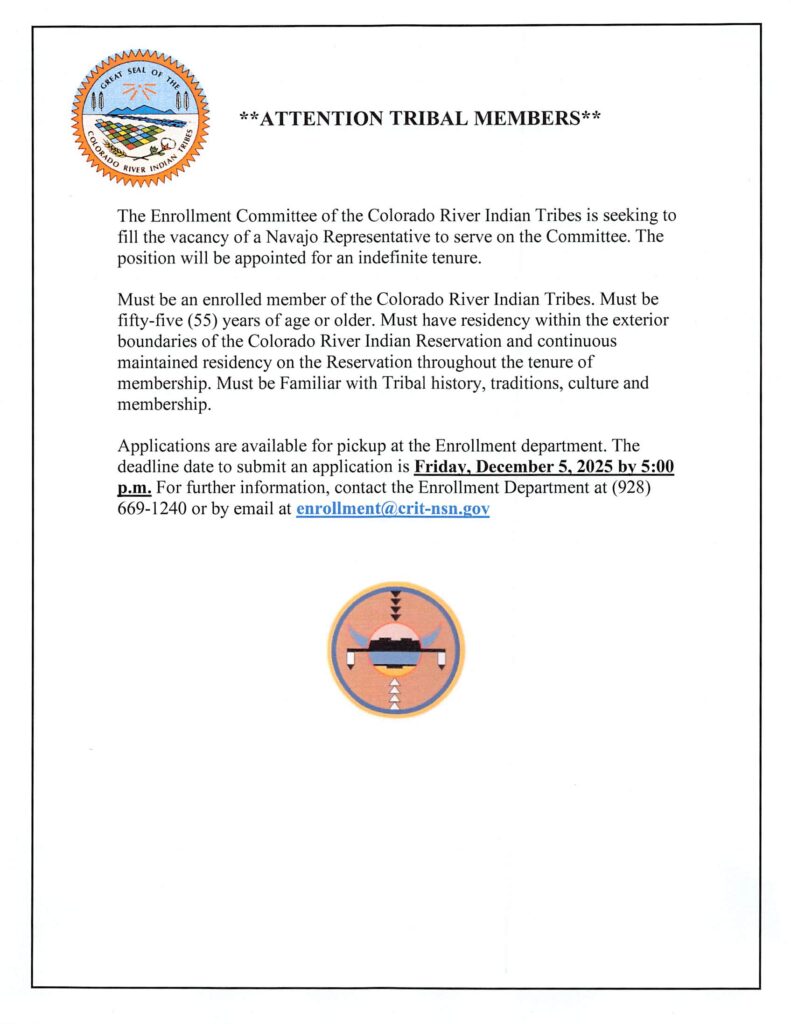

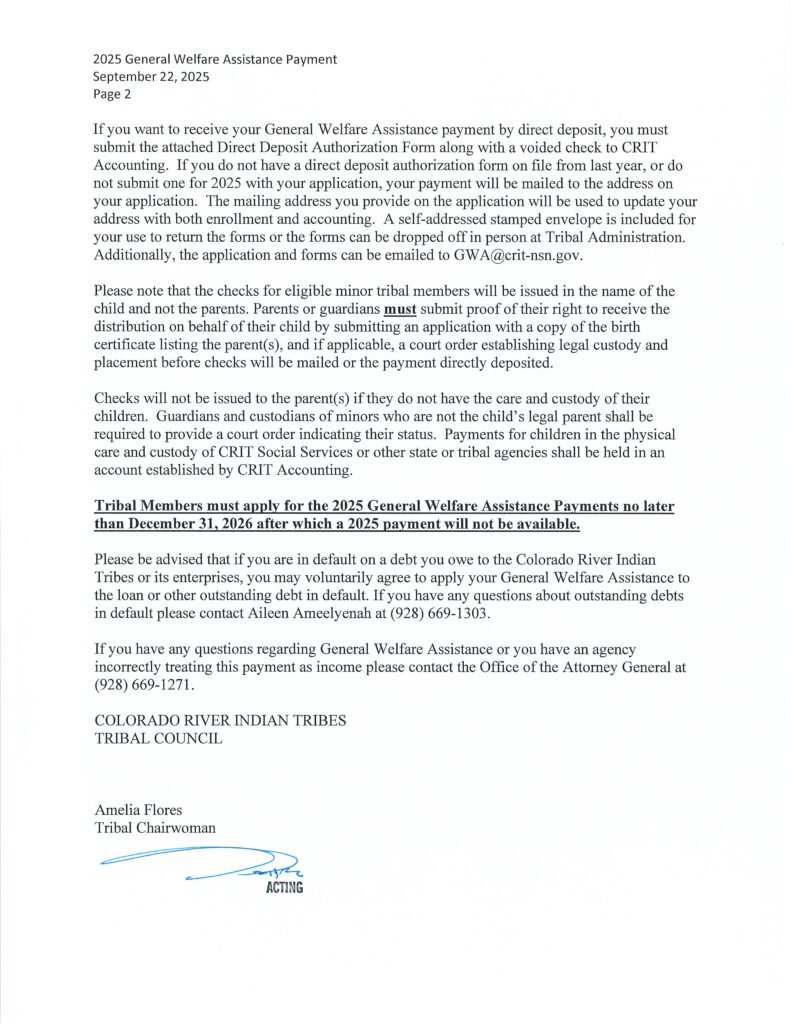
Update : CRIT has extended the deadline date for the General Welfare Application from Oct 17 to Oct 24th at 5pm.
Please click the links to upload related forms
DirectDeposit_ZionsBank_2025_GWP
General Welfare Application Minors_09132025
General Welfare Application_Adult_09132025
According to ASU News, recent snow surveys conducted by Arizona State University and the Salt River Project show that much of Arizona’s headwater snowpack has melted within just a few weeks. Warmer temperatures caused snow to melt earlier than expected, reducing the amount of water that can slowly feed rivers over time.
This rapid melt limits how much water reaches streams and reservoirs later in the season, making water supplies less reliable. Snowpack typically acts as a natural storage system, and when it disappears too quickly, more water is lost to evaporation or runoff that cannot be captured.
For CRIT, reduced and fast-melting snowpack directly impacts the Colorado River system, affecting how much water ultimately flows downstream and influencing long-term water availability.
According to Fox 10 Phoenix, Arizona is considering a potential agreement to purchase water from California as Colorado River tensions continue. State officials are exploring alternative ways to secure water supplies as negotiations over river allocations remain uncertain.
The idea reflects growing pressure on Arizona to find additional water sources as shortages become more likely. Any agreement would depend on legal, financial, and logistical factors, but it highlights how states are looking beyond traditional allocations.
For CRIT, interstate water deals could influence how Colorado River water is shared and managed, making it important to monitor how these agreements may affect overall allocation and Tribal water interests.
According to Courthouse News Service, a large agricultural company is seeking to pause a public nuisance lawsuit related to groundwater use in Arizona. The case centers on concerns that excessive groundwater pumping may be harming nearby communities and water supplies.
The lawsuit reflects ongoing tensions over groundwater regulation in Arizona, particularly in areas without strong oversight. Water use by large-scale agriculture continues to be a major issue as demand increases and supplies become more limited.
For CRIT, groundwater disputes are closely tied to the broader conversation about water management and protection, especially as pressure on Colorado River supplies pushes greater reliance on groundwater sources.
According to the Salt Lake Tribune, Lake Powell is heading toward potentially record-low levels as Colorado River states remain deadlocked in negotiations. Experts warn that declining inflows and ongoing drought conditions are pushing the reservoir closer to critical thresholds.
Low water levels at Lake Powell can impact hydropower generation and reduce the system’s ability to manage water deliveries across the basin. The lack of agreement between states is increasing uncertainty about how the situation will be addressed.
For CRIT, Lake Powell is a key part of the Colorado River system, and declining levels can affect how water is released downstream, influencing water availability and management decisions that impact Tribal communities.
According to CBS News, Denver Water has implemented mandatory restrictions limiting outdoor watering to just two days per week due to ongoing drought conditions. Officials say the restrictions are necessary to conserve water as supplies remain below normal.
Water providers across the West are taking similar steps as drought and low snowpack continue to strain resources. Conservation measures are becoming more common as utilities try to manage limited supplies.
For CRIT, increasing restrictions across the basin show how widespread water shortages have become, reinforcing the importance of careful management and protection of Colorado River water resources.
Sources
Ariana Romero
CRIT Media Reporter
According to the Arizona Capitol Times, cracks are beginning to show in Arizona’s previously unified position on Colorado River negotiations. Disagreements are emerging between state leaders and local communities over how water should be managed and protected as shortages worsen.
Some regions, particularly rural areas, are pushing back against policies they believe prioritize urban growth over local water security. These divisions highlight the increasing pressure Arizona faces as it works to defend its share of Colorado River water.
For CRIT, internal disagreements within Arizona matter because they can influence how the state approaches negotiations and allocation decisions, which ultimately affect Tribal water rights and the broader river system.
According to the Office of the Arizona Governor, Governor Katie Hobbs is expanding Arizona’s efforts to protect its Colorado River water by engaging national business leaders. The goal is to build broader support and strengthen Arizona’s position in ongoing negotiations over future river operations.
State officials are working to highlight the economic importance of Colorado River water and the potential impacts of shortages on industries and communities. This approach reflects how water issues are increasingly tied to economic and political strategy.
For CRIT, these efforts show how states are mobilizing additional influence in negotiations, which can shape how water is allocated and how Tribal interests are considered in future agreements.
According to the Las Vegas Review-Journal, a recent heat wave is accelerating snowmelt across the Colorado River Basin, raising concerns about reduced spring runoff. Experts warn that early melting can lead to less water reaching major reservoirs like Lake Powell and Lake Mead.
The situation is being described as a “blaring alarm” for the river, as warming temperatures continue to impact how water is stored and delivered. Reduced runoff could worsen already declining reservoir levels.
For CRIT, early snowmelt and reduced runoff directly affect how much water flows through the Colorado River system, influencing future water availability and management decisions. (more…)
According to CBS 5 Arizona’s Family, Yuma officials are preparing for possible Colorado River water cuts as negotiations over future river operations continue. Yuma, a major agricultural hub, depends heavily on Colorado River water, and local leaders say reductions could impact farming, jobs, and the regional economy.
As federal and state officials work toward new post-2026 guidelines, communities like Yuma are closely watching how water shortages will be distributed across the basin. The uncertainty reflects ongoing challenges in reaching agreement among the seven basin states.
For CRIT, impacts to Yuma highlight how reductions in Colorado River water can affect agriculture and economies across the region, reinforcing the importance of protecting water rights and ensuring fair allocation decisions.
According to KJZZ, water conservation efforts in Arizona are becoming increasingly expensive, and officials are exploring whether large corporations could help cover some of the costs. Programs aimed at reducing water use, such as paying farmers or industries to conserve water, require significant funding.
State leaders and water managers are looking at partnerships with businesses to support conservation efforts as Colorado River supplies continue to decline. The goal is to find sustainable ways to reduce water use without placing the entire financial burden on taxpayers.
For CRIT, this reflects a broader shift in how water conservation is being funded and managed. As water becomes more limited, decisions about who pays for conservation efforts will play a key role in shaping long-term water policy.
According to the U.S. Department of the Interior, nearly $889 million is being invested in water infrastructure projects across the western United States. The funding will support efforts to improve water storage, conservation, and system efficiency as drought conditions continue.
The investment is part of a larger federal effort to strengthen water systems and address long-term shortages in the Colorado River Basin and other regions. Projects may include upgrades to canals, reservoirs, and water delivery systems. (more…)
By Ariana Romero CRIT Media
According to CBS 5 Arizona’s Family, Yuma officials are preparing for possible Colorado River water cuts as negotiations over future river operations continue. Yuma, a major agricultural hub, depends heavily on Colorado River water, and local leaders say reductions could impact farming, jobs, and the regional economy.
As federal and state officials work toward new post-2026 guidelines, communities like Yuma are closely watching how water shortages will be distributed across the basin. The uncertainty reflects ongoing challenges in reaching agreement among the seven basin states.
For CRIT, impacts to Yuma highlight how reductions in Colorado River water can affect agriculture and economies across the region, reinforcing the importance of protecting water rights and ensuring fair allocation decisions.
According to KJZZ, water conservation efforts in Arizona are becoming increasingly expensive, and officials are exploring whether large corporations could help cover some of the costs. Programs aimed at reducing water use, such as paying farmers or industries to conserve water, require significant funding.
State leaders and water managers are looking at partnerships with businesses to support conservation efforts as Colorado River supplies continue to decline. The goal is to find sustainable ways to reduce water use without placing the entire financial burden on taxpayers.
For CRIT, this reflects a broader shift in how water conservation is being funded and managed. As water becomes more limited, decisions about who pays for conservation efforts will play a key role in shaping long-term water policy.
According to the Daily Independent, Governor Katie Hobbs is working to involve national business leaders in Arizona’s efforts to address Colorado River water challenges. The state is seeking support from major industries to help advocate for Arizona’s position in ongoing river negotiations.
The move comes as Arizona faces potential reductions in its Colorado River allocation and increasing pressure to secure long-term water supplies. State officials are expanding their approach by bringing in economic stakeholders to strengthen their position.
For CRIT, this shows how water negotiations are expanding beyond government agencies to include business interests. These broader coalitions could influence how water decisions are made and how resources are prioritized across the basin. (more…)
By Ariana Romero CRIT Media
According to the Arizona Mirror, rural Arizona residents are pushing back against a proposed bill that would allow a hedge fund to transport and sell groundwater from rural areas to cities like Phoenix. Opponents argue the measure could drain local water supplies and remove control from the communities that depend on those resources.
The proposal highlights growing tensions between rural and urban water needs as Arizona faces increasing pressure from Colorado River shortages. As cities look for new water sources, rural communities are raising concerns about long-term sustainability and fairness.
For CRIT, this issue reflects a larger pattern across the Southwest, where water is becoming a highly valuable and contested resource. Decisions about who controls and benefits from water supplies are directly tied to protecting Tribal water rights and ensuring long-term access.
According to Signals AZ, decisions being made about the Colorado River’s future could have significant impacts on Yuma, one of Arizona’s most important agricultural regions. Yuma relies heavily on Colorado River water to support farming and local economies.
As negotiations continue over how to manage the river after 2026, potential reductions in water allocations could affect crop production and economic stability in the region. Officials are closely monitoring how federal plans may shape future water deliveries.
For CRIT, impacts to regions like Yuma highlight how interconnected the Colorado River system is. Changes in water distribution anywhere along the river can affect the overall balance of the system and influence decisions that impact Tribal communities downstream.
According to KJZZ, there is renewed discussion about restarting the dormant desalination plant in Yuma as a way to supplement Colorado River supplies. The plant, which treats water from Mexico, has long been considered a potential tool to help offset water shortages in the region.
Supporters say reviving the plant could help increase available water as Colorado River supplies continue to decline. However, questions remain about cost, environmental impacts, and long-term feasibility.
For CRIT, desalination represents one of several strategies being explored to reduce pressure on the Colorado River. These types of projects could play a role in shaping future water availability across the basin.
According to CBS 5 Arizona’s Family, treated seawater is being considered as a potential solution to help Arizona address deeper Colorado River water cuts. The idea involves desalinating ocean water and transporting it inland to supplement existing supplies. (more…)
By Ariana Romero CRIT Media
According to the Arizona Department of Water Resources (ADWR), the February 2026 drought status report shows ongoing drought conditions across much of Arizona, with long-term dryness continuing to impact water supplies. While some areas have seen minor improvements, snowpack and precipitation levels remain below average in key regions that help feed rivers and groundwater systems.
These conditions are part of a broader trend across the Colorado River Basin, where reduced snowpack and warmer temperatures continue to limit water availability. Drought conditions not only affect surface water but also place increased pressure on groundwater resources as communities rely more heavily on alternative supplies.
For CRIT, ongoing drought conditions are critical because they directly impact the Colorado River system. Reduced water availability upstream can influence river flows, reservoir levels, and long-term water management decisions that affect Tribal water rights and future planning.
According to CBS 5 Arizona’s Family, two proposed Arizona bills would allow rural groundwater to be sold and transported to larger cities. Supporters say the legislation could help address water shortages in growing urban areas, while opponents argue it could drain rural water supplies and negatively impact local communities.
Residents in rural areas have raised concerns about losing control over their groundwater, especially as demand increases from cities facing Colorado River cutbacks. The issue highlights growing tension between rural and urban water needs in Arizona.
For CRIT, groundwater policy is closely tied to the broader conversation about water use and resource protection. As pressure on the Colorado River increases, decisions about groundwater transfers could reshape how water is distributed across the state and impact long-term water security.
According to the Payson Roundup, Arizona’s congressional delegation is متحد in opposing a federal plan that could reduce the state’s Colorado River water supply. Lawmakers argue the proposal would unfairly impact Arizona and are calling for a more balanced approach to managing shortages across the basin.
The opposition reflects ongoing disagreements between states and federal officials as new rules for managing the Colorado River after 2026 are developed. Arizona leaders say they are working to protect the state’s share of river water amid growing scarcity.
For CRIT, federal decisions about Colorado River allocations are especially important because they influence how water shortages are shared and how Tribal water rights are recognized within the system.
According to NOAA Drought.gov, snow drought conditions continue across much of the western United States, meaning there is less snowpack available to supply rivers like the Colorado River. Even when storms occur, warmer temperatures can cause snow to melt too early or fall as rain instead.
Snowpack acts as a natural storage system for water, slowly releasing runoff into rivers during the spring and summer. When snowpack is low, less water flows into reservoirs like Lake Powell and Lake Mead, which are critical to the Colorado River system.
For CRIT, snow drought conditions are a key concern because they directly affect how much water enters the Colorado River each year, influencing water availability for Tribal communities and long-term resource planning.
According to the Navajo Nation Office of the President and Vice President, President Buu Nygren is urging swift passage of a water rights settlement aimed at addressing long-standing water access challenges for the Navajo Nation. The settlement is intended to help secure water infrastructure and provide reliable access to water for communities that have faced shortages for generations.
Tribal leaders emphasize that water rights settlements are essential for ensuring that allocated water can actually be delivered and used, especially in areas lacking infrastructure.
For CRIT, this highlights the broader importance of Tribal water rights across the Colorado River Basin. Securing and developing water rights remains a key issue for Tribal Nations working to protect their resources and support their communities.
According to Tribal Business News, federal officials are warning of a funding gap as tribes support a proposed $5 billion Arizona water settlement. The settlement aims to resolve water rights issues and fund infrastructure projects, but concerns remain about whether sufficient federal funding will be available.
Tribal leaders continue to advocate for investment in water systems to ensure that water rights can be fully realized. Without funding, even legally secured water rights may remain difficult to access or use.
For CRIT, this reinforces the importance of both water rights and the infrastructure needed to support them. Funding decisions at the federal level can directly impact how Tribal Nations develop and protect their water resources.
CRIT’s 15th Annual Earth Day Celebration May 31 not only featured raffles, music, food, and information booths, it also provided Tribal Members the opportunity to learn about and weigh in on personhood status under Tribal Law for the Colorado River.
The event took place at the Ahakhav Preserve and ran from 8am to 11am.
CRIT Chairwoman Amelia Flores and Councilman Tommy Drennan were on site to provide information and answer questions about the personhood status issue under consideration by the CRIT Tribal Council.
Personhood status would mean that the Colorado River, along with its spiritual and cultural connection to CRIT, has the right to be protected under Tribal Law. It would acknowledge what members already know and believe, that the River is alive, and it is a part of every Tribal Member. It would direct current and future Tribal Councils to account for the needs of the River in decision-making as well as giving CRIT legal means to address the damage climate change is causing to the Colorado River. It would state that anyone doing business with CRIT will be required to address the needs of the Colorado River. (more…)
PARKER, AZ – May 23, 2025 – With a stadium full of proud families, friends, and community members, Parker High School honored the Class of 2025 with an unforgettable commencement ceremony at Joe Bush Stadium.
The evening began with the PHS Band performing “Pomp and Circumstance.” The PHS Choir followed with a stirring performance of the National Anthem.
The program included heartfelt speeches by Senior Class Officer Jacob Bailey, Salutatorian David Daly, and Valedictorian Maria Loudbear. Their words reflected on the challenges, growth, and milestones of the past four years, while also looking ahead with hope and determination. The ceremony also featured moving musical selections from Wicked, arranged by Jay Bocook and performed by the PHS Choir and Band.
 (more…)
David Corona started his career with the Colorado River Indian Tribes on December 2, 2004 as an EMT/Firefighter with the CRIT Fire Department.
Demonstrating exceptional commitment, skill and leadership, Mr. Corona was promoted to Captain in February of 2006, a role he still holds today.
Captain Corona has dedicated all his years of service with CRIT to the Fire Department. (more…)
Terrilynn “Kitty” Little started her career with the Colorado River Indian Tribes on May 22, 1985 as a Dispatcher Matron with the Law & Order Department. In 1986, she transferred to CRIT Auto and became the Parts Manager.
In 1989, Ms. Little transferred to the CRIT Fire Department and became the Assistant Fire Chief. Her commitment and expertise led her to be appointed in 2000 as the CRIT Fire Chief. Chief Little still holds this position today. (more…)