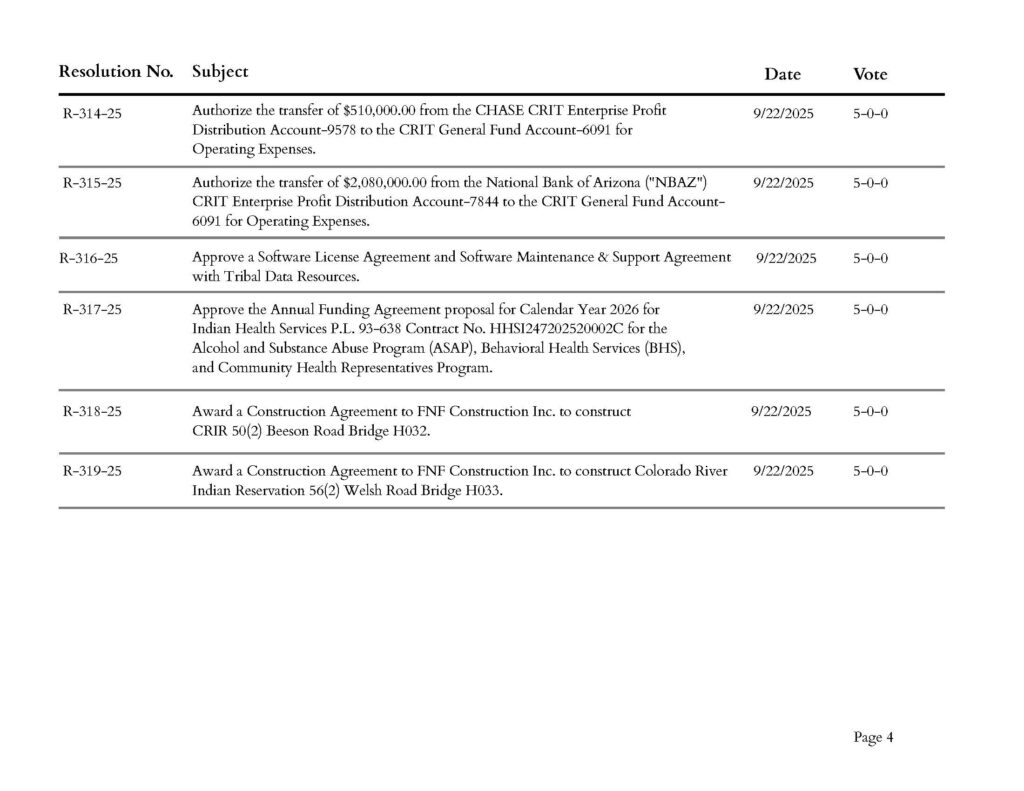

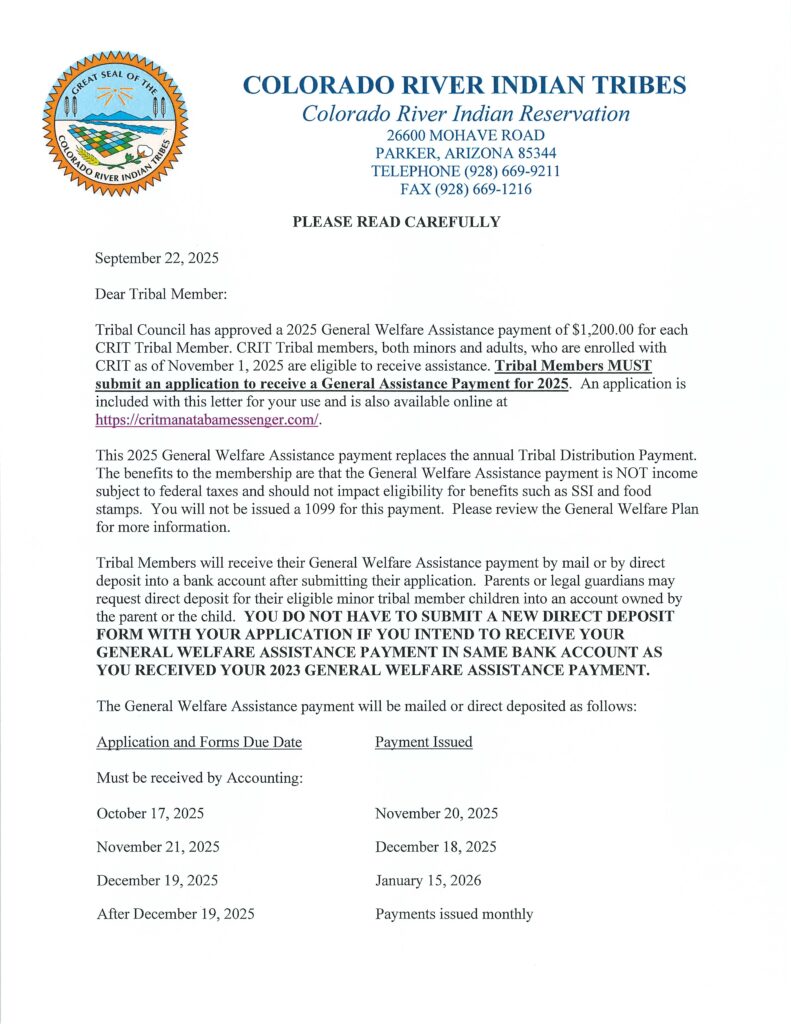
Update : CRIT has extended the deadline date for the General Welfare Application from Oct 17 to Oct 24th at 5pm.
Please click the links to upload related forms
DirectDeposit_ZionsBank_2025_GWP
General Welfare Application Minors_09132025
General Welfare Application_Adult_09132025
The Ten Tribes Partnership (TTP) is seeking a lead contractor. This contractor position is supported by the Colorado River Sustainability Campaign, a fiscally sponsored project of the New Venture Fund.
The TTP was formed in 1992 and is a coalition of ten federally recognized Upper and Lower Basin Tribes that hold water rights in the Colorado River Basin. The member Tribes are: Chemehuevi Indian Tribe, Cocopah Indian Tribe, Colorado River Indian Tribes, Fort Mojave Indian Tribe, Jicarilla Apache Nation, Navajo Nation, Quechan Indian Tribe, Southern Ute Indian Tribe, Ute Indian Tribe, and Ute Mountain Ute Tribe.
The goal of the TTP is to increase the influence of Tribes in Colorado River management and provide support for the protection and use of Tribal water resources. The Colorado River Basin is suffering from extended drought, and the impact of climate change is palpable. TTP is committed to developing a new management framework that uplifts tribal priorities ahead of the 2026 expiration of the 2007 Interim Guidelines. TTP has determined this to be a critical time to hire a Lead Contractor to coordinate its efforts.
According to KJZZ News, potential Colorado River cutbacks could increase operating costs for Arizona water utilities and even affect their credit ratings, which utilities rely on to fund infrastructure projects. Analysts say uncertainty around long-term river supplies makes financial planning more difficult and could raise costs tied to water treatment, delivery, and conservation investments. These financial ripple effects show how water shortages extend beyond environmental concerns into economic stability across the region. For CRIT, shifts in regional water costs and infrastructure planning can influence broader river management decisions that ultimately affect how tribal water rights are maintained and utilized.
Source: KJZZ News — https://www.kjzz.org/the-show/2026-02-11/colorado-river-cuts-could-increase-arizona-utilities-costs-and-affect-their-credit-ratings
According to the Sierra Vista Herald Review, basin states are facing an approaching deadline to agree on new Colorado River management guidelines before current rules expire. Ongoing disagreements between Upper Basin and Lower Basin states, combined with continued drought pressures, have slowed negotiations and raised concerns about potential legal disputes if a consensus is not reached. Federal oversight remains a key factor in shaping how future allocations will be determined. For CRIT, these negotiations are important because federal river management decisions directly affect how tribal water rights are recognized, protected, and incorporated into long-term basin planning.
Source: Sierra Vista Herald Review — https://www.myheraldreview.com/news/state/deadline-approaches-for-colorado-river-negotiations/article_5dd6fa1d-eed1-4d98-82f2-4a754853da3c.html
According to KTNV Channel 13 News in Las Vegas, low snowpack levels across the Mountain West are raising concerns about water supplies for Southern Nevada and the broader Colorado River Basin. Snowpack acts as a natural reservoir that feeds rivers and storage lakes during spring runoff, so below-average levels can reduce future water availability and increase pressure on already stressed reservoirs. Experts say continued dry conditions could complicate long-term water planning across the Southwest. For CRIT, declining snowpack is significant because reduced river flows can influence future allocation decisions and federal management strategies affecting tribal water resources.
Source: KTNV News — https://www.ktnv.com/news/why-low-snowpack-levels-raising-alarms-for-southern-nevada-water-supply
According to Newsweek, new data showing concerning water levels at Lake Powell is adding to ongoing worries about the long-term stability of the Colorado River system. Reservoir levels play a critical role in determining water deliveries, hydropower production, and shortage declarations throughout the Southwest. Continued drought conditions combined with sustained demand have kept pressure on the basin’s major storage systems. For CRIT, reservoir conditions remain important because federal water management decisions tied to storage levels directly affect how tribal water allocations are managed and protected.
Source: Newsweek — https://www.newsweek.com/lake-powell-water-levels-as-concerning-data-revealed-11500468
According to the Center for Colorado River Studies at Utah State University, Lake Powell and Lake Mead have recently shown differing storage trends, reflecting the complexity of managing water across the Colorado River system. Researchers say reservoir operations, inflows, releases, and ongoing drought conditions all contribute to shifting water levels that can affect supply planning throughout the basin. Understanding how these reservoirs interact is key to long-term river management decisions. For CRIT, these reservoir dynamics matter because federal operational decisions tied to storage levels directly influence how Colorado River water is allocated and protected for tribal communities.
Source: Center for Colorado River Studies — https://qanr.usu.edu/coloradoriver/news/blog-2026-2-9
According to KJZZ News, the Colorado River Basin is experiencing one of its driest winters in decades, with snowpack levels far below average in key areas that supply water to Lake Powell and Lake Mead. Scientists warn that reduced snowpack could lead to lower river flows this year, increasing pressure on already strained reservoirs and complicating ongoing negotiations over long-term water management. Because snowpack acts as the primary natural storage system for the river, weaker winters often translate into tighter water supplies downstream. For CRIT, these conditions matter because reduced river flows can influence future allocation decisions, federal management strategies, and long-term planning for tribal water resources.
Source: KJZZ News — https://www.kjzz.org/science/2026-02-09/the-colorado-river-is-having-its-driest-winter-in-decades
According to ABC News, record-low snowpack across much of the western United States is raising concerns about potential water shortages, wildfire risks, and continued stress on major river systems including the Colorado River. Experts say warmer temperatures and shifting precipitation patterns are reducing snow accumulation that normally feeds reservoirs during spring runoff. These trends could influence future water allocation planning as states and federal agencies work toward updated river management strategies. For CRIT, changes in snowpack levels matter because they directly affect Colorado River flows that shape long-term water availability and policy decisions impacting tribal communities.
Source: ABC News — https://abcnews.com/US/wireStory/record-snow-drought-western-us-raises-concern-spring-130016613
According to the San Mateo Daily Journal, a key deadline is approaching for Colorado River basin states to reach an agreement on new water management rules before current guidelines expire. Ongoing disagreements between upper and lower basin states, combined with persistent drought conditions, have slowed progress and increased concerns about potential legal disputes if consensus is not reached. Federal oversight plays a major role in shaping these negotiations, particularly for the Lower Basin where water allocations are closely regulated. For CRIT, these negotiations are significant because future federal river management decisions directly affect how tribal water rights are recognized, protected, and incorporated into basin planning.
Source: San Mateo Daily Journal — https://www.djournal.com/news/national/deadline-approaches-for-colorado-river-negotiations/article_5a129b32-06cb-50c0-8945-5186943db1db.html
According to KJZZ News, a new groundwater monitoring tool developed in Nevada is helping scientists better understand how groundwater pumping affects habitats, water availability, and long-term sustainability across the Mountain West. Researchers say improved data can support more informed water management decisions as communities balance development, agriculture, and environmental needs. Groundwater use is increasingly important as surface water supplies face ongoing pressure from drought and climate variability. For CRIT, regional groundwater management discussions matter because they influence broader basin water planning and long-term strategies for protecting tribal water resources.
Source: KJZZ News — https://www.kjzz.org/science/2026-02-08/a-nevada-groundwater-tool-highlights-strained-habitats-with-lessons-for-the-mountain-west
According to Reuters, the Colorado River has been identified as the most endangered river in the United States due to ongoing drought, rising demand, and increasing pressure on its limited water supplies. Experts say declining reservoir levels, climate impacts, and competing state interests continue to challenge long-term sustainability across the basin. The designation highlights growing national attention on the need for cooperative water management and conservation efforts. For CRIT, this recognition underscores the importance of protecting tribal water rights as regional policies evolve to address long-term river stability.
According to KJZZ News, Colorado River negotiators may be leaning toward a short-term agreement as states remain divided on a long-term plan for managing the river before current operating rules expire. Ongoing drought, climate pressures, and disagreements between Upper Basin and Lower Basin states have stalled progress, and some officials believe a temporary deal could help avoid a major court battle while allowing more time for negotiations. Is a five-year deal better than no deal? As Nevada water negotiator John Entsminger noted, “If the alternative is litigation… then a five-year deal starts pretty good,” reflecting concerns that legal disputes could complicate future water management even further. For CRIT, these discussions remain important because federal river management decisions, compact negotiations, and potential legal outcomes directly affect how tribal water rights are protected, recognized, and sustained for future generations.
According to AZ Free News, the Arizona House has approved an additional $1 million for the state’s Colorado River litigation fund, signaling growing concern that water allocation disputes could end up in court as negotiations over future river management continue. State leaders say the funding is meant to ensure Arizona is prepared to defend its interests if talks between basin states break down, reflecting increasing tension as drought, population growth, and competing demands strain the river system. Legal disputes have historically shaped water distribution in the Lower Basin, including the Arizona v. California Supreme Court decision that affirmed tribal water rights. For CRIT, continued legal developments around Colorado River allocations are significant because court decisions often influence how tribal water rights are protected, enforced, and recognized in future negotiations.
According to the Las Vegas Review-Journal, ongoing drought conditions and limited snowpack are increasing pressure on Colorado River water supplies, raising concerns that the basin may face even tighter shortages in the near future. Experts note that declining reservoir levels and continued demand across the Southwest make it harder to stabilize the system, especially as negotiations continue over future operating rules. Some officials warn that without significant conservation or improved conditions, legal disputes between basin states could become more likely. For CRIT, ongoing shortage risks matter because long-term river stability and federal allocation decisions directly influence how tribal water rights are protected and exercised.
According to Arizona Capitol Times, a judge is reviewing whether agricultural groundwater pumping by Fondomonte in western Arizona constitutes a public nuisance, a case that could shape future groundwater regulation statewide. The lawsuit argues that heavy pumping may be affecting nearby wells and water sustainability, highlighting ongoing tensions between agriculture, development, and long-term water conservation. Outcomes from cases like this can influence how groundwater use is monitored and regulated across Arizona. For CRIT, groundwater policy discussions are important because regional water management decisions can affect broader basin planning and long-term protection of tribal water resources.
According to Nevada Current, growing data center development across the Southwest is increasing demand for both water and power, raising concerns among regulators and rural communities about sustainability. Large technology facilities often require significant cooling resources, prompting discussions about infrastructure planning, water efficiency, and future resource allocation. As population growth and technology expansion continue, water demand from emerging industries is becoming part of broader basin conversations. For CRIT, rising industrial water demand across the region highlights the importance of protecting tribal water rights and ensuring long-term sustainability of Colorado River resources.
Article written by CRIT Media Reporter Ariana Romero
End of January 2026
Axios Phoenix
Governor Katie Hobbs traveled to Washington, D.C. to meet with federal officials and other Basin state governors as the deadline to reach a Colorado River agreement approaches. Arizona is pushing to avoid deeper mandatory cuts that would heavily affect Central Arizona Project deliveries.
Colorado Sun
Colorado Governor Jared Polis and the state’s top water negotiator joined the D.C. meetings, signaling growing urgency among Upper Basin states. Officials acknowledged drought forecasts are “exceedingly grim,” with reservoirs unlikely to recover soon.
Las Vegas Weekly
Nevada and six other Basin states are running out of time to agree on a plan for managing the shrinking Colorado River. If no consensus is reached, the federal government is expected to impose its own operating rules.
Rep. David Schweikert Press Release
Congressman Schweikert introduced the “Equal Access to the Colorado River Act,” claiming it would protect Arizona during future shortages. The proposal focuses on reallocating access during drought conditions.
Prescott eNews
Panels of experts and negotiators warned that despite ongoing talks, major disagreements remain unresolved. Some officials are openly preparing for legal and political fights if negotiations fail.
Post Independent
Colorado officials are signaling readiness to fight for their water allocations if no deal is reached, reflecting hardened positions among states.
Arizona Republic / State Affairs
New legislation would make it easier to move water from rural Arizona to growing cities, including changes affecting irrigation and groundwater use.
NBC Palm Springs / LA Times
California officials are debating how to manage water deliveries as federal Colorado River rules near expiration. Environmental groups warn that ecosystem collapse is possible if large diversions continue.
Nevada Independent
Nevada’s warmer winter may reduce snowpack and hydropower generation, potentially increasing water and energy costs for residents.
KJZZ
Arizona lawmakers advanced legislation to increase the state’s Colorado River litigation fund, signaling preparation for court battles if negotiations collapse. Colorado is doing the same, underscoring how close the basin is to legal confrontation rather than collaboration.
KJZZ
Central Arizona Project leaders warned that deep federal water cuts would severely impact Arizona communities, agriculture, and economies that rely on CAP deliveries.
Arizona Water News (ADWR)
Arizona’s water director told state lawmakers that the Colorado River is entering a “new paradigm” where historic rules no longer match hydrology or climate reality. Long-term shortages are now assumed, not hypothetical.
California Department of Water Resources
California announced increased State Water Project allocations following December storms, improving flexibility for cities and farms. Officials emphasized that this does not end long-term supply risks. (more…)
KAWC Yuma Public Radio
As the federal deadline approaches, Colorado River stewards and water managers are openly debating which options remain viable to stabilize the river. Discussions now center on short-term operational changes, deeper conservation, and the possibility of federal intervention if states cannot agree.
Parker Pioneer
Local officials and residents raised concerns over proposed legislation that would allow groundwater transfers out of the McMullen Valley Basin, fearing it could accelerate depletion in western Arizona.
SignalsAZ
Queen Creek announced steps to secure its long-term water future through a mix of groundwater, imported water, and infrastructure investment.
NBC 9 News Denver / ABC4 Utah
Lawmakers and governors across the Basin are aligning legislative agendas around water security as negotiations intensify. Leaders acknowledge that compromise will be unavoidable.
Eurasia Review
An international analysis examines how climate change, overuse, and governance failures have pushed the Colorado River toward crisis, calling for coordinated action across jurisdictions.
Arizona House Committee on Natural Resources (Video)
Arizona Department of Water Resources Director Tom Buschatzke testified before lawmakers, outlining the seriousness of the Colorado River situation and the potential consequences if Basin states fail to reach agreement. He emphasized that Arizona remains highly vulnerable to deeper cuts under federal plans.
Colorado Sun
State water officials warn that drought forecasts and reservoir levels in Colorado are worse than previously expected, increasing urgency for action.
January 26, 2026
ABC15 Arizona
The Central Arizona Project’s general manager warned that deeper Colorado River cuts would have severe impacts across Arizona, affecting municipal supplies, agriculture, and long-term planning. Officials stressed that Arizona is particularly vulnerable because CAP deliveries are among the first reduced during shortages.
Lake Havasu News Herald
Arizona lawmakers are weighing funding for drone-based cloud seeding programs aimed at increasing snowfall in key watersheds. Supporters see it as a potential tool to enhance runoff into the Colorado River system.
Arizona Republic
Mesa is finishing a $210 million water reuse pipeline that will reduce reliance on Colorado River water by recycling treated wastewater for non-drinking uses.
KJZZ
New aircraft equipped with laser technology will measure snow depth and water content across Arizona’s mountains, improving runoff forecasts.
Wyoming is exploring a voluntary program to conserve Colorado River water, potentially paying users to leave water in the river.
ABC15 Arizona
Seven Western governors, including Arizona’s governor, are traveling to Washington, D.C., as negotiations intensify and deadlines approach. States are scrambling to present unified positions ahead of federal meetings.
KUNR
Extraordinary winter warmth continues to suppress snowpack across much of the West. Officials warn that poor snow accumulation could require additional reservoir releases, including from Flaming Gorge, to meet downstream needs.
Colorado Sun
As data centers expand into Colorado, concerns are growing about their large water footprints in already-stressed regions.
Chairwoman Amelia Flores:
“The Colorado River Indian Tribes appreciates the continued engagement by the Bureau of Reclamation as the Post-2026 Colorado River operations process moves forward. In response to CRIT’s request Reclamation recently reached out to us and walked us through the portions of the final Environmental Impact Statement relating to changes made to the document in response to comments CRIT raised during the process, but we were not shown the entire statement.
We are encouraged that Reclamation has acknowledged in the final EIS the recent action taken by Tribal Council acknowledging the Colorado River is alive and entitled to protection under CRIT Tribal law.We are also encouraged the final preferred alternative does not include allocating shortages on a pro rata basis for all water users, but instead any allocation of shortages would occur through the existing priority system or through agreements between willing parties. As long as federal agencies follow the law CRIT’s senior water rights will be protected.
We remain concerned that the BIA’s failure to properly maintain our irrigation systems adversely impacts on our ability to conserve and properly use our Colorado River water allocation.
We are mindful of the significant shortages that will be borne by tribal and other water users elsewhere in Arizona and we remain hopeful that an agreement between the United States, and the seven basin states that respects tribal sovereignty will be reached.
At the same time, we remain concerned that the highly compressed schedule severely limits our ability to conduct a comprehensive review before the document becomes final. The conversation with Reclamation was helpful, but it was not government-to-government consultation. Going forward, as the preferred alternative is being implemented, CRIT expects true consultation that respects our sovereign status and provides adequate time for meaningful review and input.”
Vice Chairman Dwight Lomayesva:
“This consultation was a good start. Our immediate need is to protect CRIT’s allocation and ensure the federal government follows the law. When received, CRIT will evaluate the final EIS and protect the Tribe’s rights, resources, and future on the Colorado River.”
The CRIT Museum hosted a hands-on bark skirt construction class on July 16 at Lazy D Park, giving participants an opportunity to learn a traditional skill while connecting with cultural knowledge.
The class was led by traditional craftsman Richard Montague of the Fort Yuma Quechan Indian Reservation. Montague learned bark skirt construction and many other traditional skills from his grandparents, who are Quechan, Maricopa, and Mohave.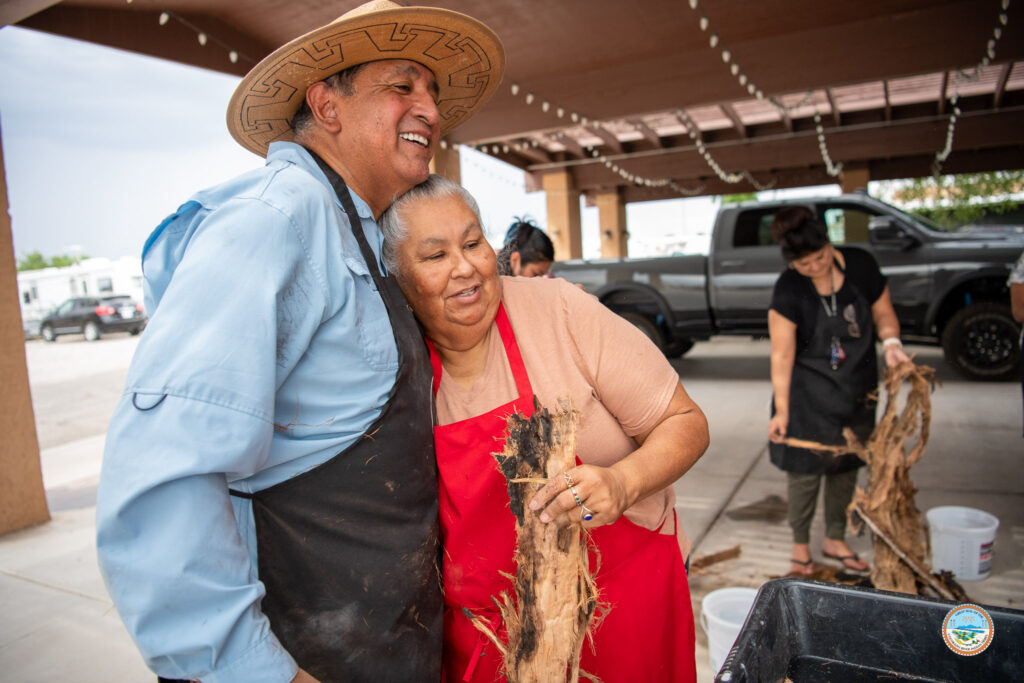
During two sessions, Montague guided participants through the process of creating a traditional bark skirt, from preparing harvested plant materials to constructing a finished skirt panel. All materials used during the workshop were harvested from the Tribes’ homelands.
Participants learned how to identify cured willow and cottonwood bark, recognize when the plants are ready to be harvested and carefully collect the bark in a way that allows the plants to continue growing. They also sorted and prepared the bark for weaving before learning how to attach it to a cordage belt foundation. (more…)
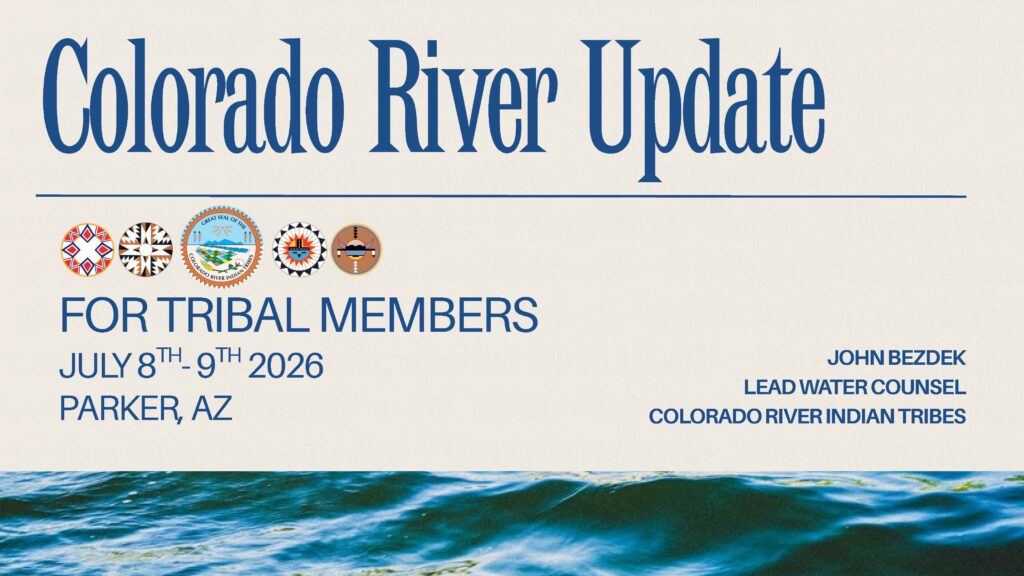
The Colorado River has always sustained the Colorado River Indian Tribes, and protecting it means understanding CRIT’s history, sovereignty, and senior water rights. This presentation by Lead Water Counsel John Bezdek walks Tribal Members through the timeline of CRIT’s connection to the river from the original establishment of the Reservation in 1865, to major court decisions, federal infrastructure, drought conditions, water shortages, and current efforts to protect CRIT’s future.
The update also explains why CRIT holds the senior-most Tribal water rights in the Colorado River Basin, what current shortage discussions could mean for the Tribe, why CRIT strongly opposes pro-rata reductions, and how Tribal Council and the CRIT Water Team are working to protect CRIT’s water resources for future generations. Tribal Members are encouraged to stay informed, remain vigilant, and continue protecting their connection to the river. Click on the link below to download the presentation.