September 12, 2026 6:16 am
CRIT Nation, Parker, AZ
September 12, 2026 6:16 am
CRIT Nation, Parker, AZ

Arizona’s water coverage centered on a practical question: if the Colorado River keeps shrinking, how much backup water is actually available, and who can use it?

KJZZ reported that Phoenix-area cities are asking for clearer answers about Colorado River water stored underground by the Arizona Water Banking Authority. The Water Bank was created in 1996 to store excess Colorado River water underground for use during a shortage. Cities that rely on the Central Arizona Project say they need to know how much of that stored water they can access, when it would be available, and how it would be recovered.

The issue is becoming more urgent as federal officials consider new Colorado River operating rules. Arizona Farm Bureau News reported that Arizona water officials are pushing for the Lower Basin proposal as an alternative to deeper federal cuts. The proposal includes mandatory reductions across Arizona, California, and Nevada, along with additional voluntary savings through 2028.

The Arizona Farm Bureau also reported that the Central Arizona Project is now projecting a 14% shortage in its municipal water pool instead of 20%, partly by using water from Lake Pleasant and wells in Yuma. Even with that smaller projected shortage, cities and farms are still preparing for less water.

Agriculture remains a major part of the discussion. Arizona farmers are watching possible cuts closely because reductions to Colorado River water can affect planting decisions, crop choices, and operating costs. Those changes can also move beyond farms, reaching workers, local economies, and food supply chains.

Arizona is also looking at how to keep more water in the state. KJZZ reported that more than 95% of precipitation that falls in Arizona is lost to evapotranspiration. The reporting was based on the Arizona Tri-University Recharge and Water Reliability Project, which is studying ways to capture more rain, snowmelt, and runoff before it is lost to evaporation or plant use. The project is also looking at how more water can be moved into aquifers through recharge.

That research connects directly to questions about groundwater. As Colorado River supplies become less reliable, cities and rural areas are paying closer attention to underground storage, recharge, and long-term access to stored water.

The Desert Review reported that the Central Arizona Irrigation and Drainage District secured up to 10,000 acre-feet per year of new water supply from the Mojave Groundwater Bank in California. The agreement is another example of Arizona water users looking outside traditional supplies as Colorado River shortages continue.

Lake Powell also remained under pressure. The Guardian reported that the reservoir could fall to unprecedented lows after poor snowpack and limited spring runoff. KUTV and Newsweek reported on a proposal from scientists to move more water from Lake Powell to Lake Mead, arguing that storing more water in Lake Mead could reduce losses and protect downstream supplies. The idea is part of a larger debate over how the two major reservoirs should be managed as both remain low. (more…)

Lake Powell remained one of the biggest concerns. The Colorado Sun reported that low water levels are creating new pressure at Glen Canyon Dam, where federal officials are working to protect dam infrastructure as the reservoir drops. The report focused on cavitation, a problem caused when fast-moving water creates vapor bubbles that can damage dam equipment and concrete surfaces.

The issue shows how falling reservoir levels affect more than water storage. Lake Powell also supports hydropower generation, downstream releases, and dam operations. When the reservoir drops too low, federal managers have fewer options to move water through the system safely and efficiently.

Arizona water users are also watching federal planning closely. The Arizona Daily Star reported that a Colorado River water savings plan could reduce the effect of future cuts on Arizona users. The plan is part of ongoing Lower Basin negotiations as Arizona, California, and Nevada look for ways to conserve water and avoid deeper mandatory reductions.

Those negotiations remain unsettled. Fox 13 Salt Lake City reported that Colorado River governors said they are not at a stalemate, even as the deadline for new river rules gets closer. The current operating guidelines are set to expire after 2026, and the seven Basin states still need agreement on how future shortages will be shared.

For Arizona, Central Arizona Project water remains a major concern. The CAP canal moves Colorado River water to central and southern Arizona, including cities, farms, and tribal users. If future cuts fall heavily on CAP water, impacts would vary depending on each user’s legal priority, water portfolio, and access to stored supplies.

AMWUA reported on the importance of municipal access to stored water credits. Cities have stored water underground for years to prepare for shortages, but access to those credits becomes more important as Colorado River supplies become less reliable. Stored credits can help cities manage short-term gaps, but they are not a permanent replacement for long-term river reductions.

The idea of moving new water into Arizona also received attention. Some proposals have looked at whether abandoned energy pipelines could be used to bring water west. These ideas reflect the search for new supplies, but large importation projects often involve high costs, legal questions, energy demands, and environmental review. (more…)

Recent developments across the Colorado River Basin show how changes in water supply are beginning to affect recreation, agriculture, and future water planning. While the seven Basin states remain divided over how to manage the river, communities are already dealing with the effects of lower flows and looking at new ways to protect their water.

Colorado River negotiators recently made a rare public appearance together, but there was little indication that the states are closer to an agreement. Representatives from the Upper and Lower basins continue to disagree over how future water reductions should be shared and whether the next plan should offer long-term certainty or act as a temporary bridge.

Nevada negotiator John Entsminger said the latest Lower Basin proposal could provide a workable plan for the next few years and help keep the states out of court while discussions continue. Colorado negotiator Becky Mitchell questioned whether returning to negotiations every two years would build stability or simply create another series of temporary fixes.

The negotiators also discussed mediation as a possible next step. One idea would involve choosing three mediators: one selected by the Upper Basin, another by the Lower Basin, and a third selected by the first two. The ongoing disagreement is also making it difficult for Mexico, which receives Colorado River water under international agreements, to prepare for future shortages.

While those larger negotiations continue, uncertainty is reaching businesses that depend directly on the river. KNAU reported that Grand Canyon rafting companies are watching lower water levels near Lees Ferry following a historically dry winter and reduced releases from Lake Powell.

Rafting trips are still operating, and visitors may not notice a major difference today. However, business owners and river guides are concerned about what lower and less predictable flows could mean in the future. One company reported that bookings were down about 25% this year, although it was unclear whether water conditions were the main reason.

The concern shows how Colorado River operations support more than drinking water, agriculture, and hydropower. Releases from Glen Canyon Dam also affect rafting companies, guides, tourism, and communities connected to Grand Canyon recreation.

Arizona is also looking at less traditional ways to increase its water supply. Voice of San Diego reported that a private utility proposed using Arizona funding to help treat wastewater from the Tijuana River. The water would be treated and returned to Mexico, while Arizona could seek part of Mexico’s Colorado River allocation in exchange.

The proposal could initially produce more than 14,000 acre-feet of water each year, with the possibility of increasing that amount through future development. However, the project is still being studied and would involve complicated questions involving water quality, cost, environmental review, and agreements between the United States and Mexico.

Colorado, meanwhile, has taken action to reduce the damage left behind when agricultural water is sold and transferred to cities. A new state law will require farmland in the Arkansas River Basin to be revegetated before irrigation water can be moved to another use. (more…)

As Colorado River negotiations remain stalled, water leaders across the West are looking beyond temporary reservoir protections and considering broader changes to how water is managed. Recent reports show growing interest in mediation, permanent groundwater conservation, less water-intensive agriculture, and stronger tribal participation in state water decisions.

Representatives from the seven Colorado River Basin states recently addressed criticism over their failure to reach an agreement for managing the river after the current operating rules expire. KJZZ reported that negotiators remain divided over how future reductions should be shared between the Upper and Lower basins, despite more than a year of talks and worsening conditions across the watershed.

The negotiators acknowledged the frustration surrounding the process but maintained that the disagreements involve difficult legal, economic, and hydrological questions. Some state representatives have suggested bringing in a mediator to help narrow the divide. Mediation could provide another path toward compromise, but it would not remove the central dispute over who should reduce water use and by how much.

While the states continue debating Colorado River operations, groundwater is becoming another area of concern. KJZZ examined whether Arizona could establish a program to voluntarily purchase and permanently retire groundwater rights, similar to a program being developed in Nevada. Nevada’s approach would pay willing water-right holders to stop pumping permanently in areas experiencing declining aquifers, threats to groundwater-dependent ecosystems, or conflicts between existing users. An assessment of more than 6,000 Nevada wells found that nearly 40% showed significant declines over several decades.

A similar program could offer Arizona another tool for addressing groundwater depletion, especially in rural basins where pumping can exceed natural recharge. However, the cost of purchasing water rights would vary by location, and a voluntary program would require stable funding and clear priorities. Buying back rights would not restore an aquifer immediately, but it could prevent additional pumping and reduce long-term pressure.

Agriculture is also being asked to adapt to shrinking supplies. The Colorado Sun reported that researchers and farmers are testing crops that require less water, including black-eyed peas and drought-tolerant grains. Black-eyed peas can reach strong production with considerably less water than some traditional crops and can withstand heat without showing the same level of stress.

The challenge is not only whether farmers can grow less-thirsty crops, but whether there is a reliable market for them. Farmers must consider processing, transportation, buyers, and prices before replacing established crops. Water conservation will be difficult to sustain if producers are asked to take on the financial risk alone. Researchers say successful transitions will require partnerships among farmers, universities, buyers, and public agencies.

New reporting also provides a clearer picture of agriculture on California tribal lands. The Public Policy Institute of California found that about 15,800 acres are irrigated annually on tribal reservations in the state, representing roughly 0.2% of California’s irrigated acreage and agricultural water use. Most irrigated tribal acreage is located within the Colorado River Basin.

The report found that tribal agriculture generally has a more balanced mix of crops than agriculture statewide, with fewer permanent orchards and vineyards and a greater share of annual crops, pasture, and vegetables. Because annual crops can be changed more easily from year to year, tribal agricultural operations may have more flexibility during drought. However, tribal producers still face challenges involving infrastructure, financing, water access, and unquantified rights.

California lawmakers are also considering a measure that would strengthen the role of tribes in water policymaking. Assembly Bill 2218 passed the State Assembly and would require certain state agencies to consult affected tribes when reviewing water rights and policies. The bill would also recognize historical inequities caused by state actions that excluded tribes from access to and control over water.

Supporters say existing tribal consultation policies are not always legally secure and can depend on executive decisions. The proposed law would provide a stronger requirement for agencies to consider tribal water uses, Indigenous knowledge, and ecosystem restoration when making water decisions. (more…)

While much of the latest Basin Brief coverage has been focused on the new interstate water-exchange agreement between Arizona, California, and Nevada, other reports show the growing consequences of the Basin’s worsening drought. Declining reservoirs are affecting wildlife, hydropower, recreation, and local economies, while new industrial development continues to raise questions about how limited water supplies should be used.

The environmental effects of the Colorado River crisis extend far beyond the millions of people who depend on the river for drinking water, agriculture, and power. ABC15 reported that at least 150 threatened species of mammals, reptiles, fish, and plants depend on the Colorado River. As federal officials work toward new rules for dividing the river, conservation experts say the future of the Basin must also account for the ecosystems that rely on healthy river flows.

The river’s decline can change water temperatures, damage habitat, and place additional pressure on native species. These environmental concerns show that decisions about shortages and reservoir operations are not only about how much water reaches cities and farms. They also determine whether the river can continue supporting the plants, animals, and landscapes that make up the Colorado River ecosystem.

The effects of emergency river operations are already being felt in the Upper Basin. WyoFile reported that additional releases from Flaming Gorge Reservoir are causing serious problems for recreation businesses and communities along the Wyoming-Utah border. Federal water managers plan to release about 1 million additional acre-feet from Flaming Gorge between April 2026 and April 2027 to support Lake Powell.

The releases are expected to lower Flaming Gorge by approximately 35 feet, bringing the reservoir to about 59% of capacity. Falling water levels have already damaged boat ramps and marina structures, caused cancellations, and raised concerns about access to drinking water, fishing, and the future of the local recreation economy.

Flaming Gorge serves as an emergency water bank for the broader Colorado River system, but drawing it down to protect Lake Powell shifts some of the consequences of drought upstream. Communities that depend on the reservoir for tourism and local business are being asked to absorb losses so the larger system can continue operating. Water managers have also warned that using Flaming Gorge now reduces its ability to provide the same emergency support during future dry years.

Colorado may also be moving toward a statewide drought emergency declaration as poor snowpack and dry conditions affect agriculture, waterways, and communities. The Upper Basin provides much of the Colorado River’s flow through mountain snowpack, meaning worsening drought in Colorado has consequences throughout the entire river system. When less water reaches the river’s headwaters, less water is available to refill Lake Powell and serve downstream users.

At the same time, growing industrial demand continues to raise concerns in the Lower Basin. Reports about proposed data centers near Lake Mead have led to questions about whether water-intensive development should continue in areas facing long-term shortages. Data centers require large amounts of electricity and, depending on their cooling systems, can also consume significant amounts of water.

Lake Mead remains at approximately 30% of capacity, yet Southern Nevada and other parts of the Southwest continue to attract new technology and industrial projects. The tension between economic development and water security is becoming harder to ignore. Communities must now consider whether new projects can be supported without placing additional pressure on residents, existing businesses, and the Colorado River. (more…)

Water leaders across the Southwest are looking at new ways to manage limited Colorado River supplies as the Basin continues to face drought, low reservoir levels, and uncertainty over future rules. Recent reports show that agencies are no longer only talking about emergency cuts. They are also exploring interstate exchanges, desalination, recycled water, local conservation, rate increases, and new federal leadership as the Colorado River system moves closer to a critical point.

Arizona Water News reported that the Bureau of Reclamation and water agencies from Arizona, California, and Nevada signed a Memorandum of Understanding at the Claude “Bud” Lewis Carlsbad Desalination Plant in California. The agreement is meant to explore a framework for future interstate water exchanges, allowing agencies to discuss partnerships around desalination, recycled water, and other supply projects that could benefit more than one state.

The MOU was signed by the Bureau of Reclamation, San Diego County Water Authority, Metropolitan Water District of Southern California, Southern Nevada Water Authority, Arizona Department of Water Resources, Central Arizona Project, and Salt River Project. According to the release, future exchanges would use existing infrastructure and would not change or reallocate existing water rights. Instead, the goal is to create more flexibility so agencies can share the benefits of new water supplies when and where they are needed most.

That kind of flexibility is becoming more important as long-term drought has reduced Colorado River system storage to about 36% of capacity. Arizona Water News reported that record-low snowpack and record-breaking heat have added more pressure to the river system, increasing risks to the water and power infrastructure that millions of people depend on.

NPR reported that San Diego, once one of the cities most dependent on the Colorado River, now has excess water it may be able to sell or exchange. The city has invested in water recycling, conservation, and the Carlsbad Desalination Plant, which produces about 50 million gallons of drinking water each day. The plant supplies about 7% to 10% of the region’s water.

The idea would not involve physically sending desalinated water to Arizona or Nevada. Instead, San Diego could use more desalinated water locally and leave some of its Colorado River supplies in Lake Mead for others to use. This kind of exchange could help the larger system by keeping more water in the reservoir while allowing participating agencies to benefit from new local supplies.

At the federal level, the Bureau of Reclamation may soon see new leadership. KJZZ reported that water leader Aubrey Bettencourt is likely to be nominated to run Reclamation, the top federal agency involved in Colorado River operations. Scott Cameron currently serves as the acting leader of Reclamation and oversees the agency at a time when decisions about Lake Mead, Lake Powell, and post-2026 river rules are especially important. Cameron has previously visited the CRIT Reservation, and hopefully CRIT will get the opportunity to meet and build a working relationship with the next Reclamation leader.

Local communities are also preparing for a future with less reliable Colorado River supplies. KJZZ reported that Scottsdale approved a 4.5% water rate increase, with part of the funding going toward additional water sources. Scottsdale receives about 70% of its water from the Colorado River, and Arizona is expected to face more reductions in its river allocation. The city is considering several options, including advanced water purification, groundwater from Harquahala Valley, and expanding Bartlett Dam on the Verde River.

Utah Public Radio reported that Lake Powell may be in worse condition than its surface elevation suggests. A new report from Colorado River experts warns that the Basin’s major reservoirs are sliding toward “devastating consequences” if water levels continue to drop. The report said another dry year could push Lake Powell and Lake Mead toward “run-of-the-river” conditions, meaning the reservoirs would lose much of their ability to store water for the future and would mainly pass water downstream.

The Colorado River’s future will depend on whether states, tribes, federal agencies, cities, and water users can agree on rules that reduce demand while protecting the river itself. New supply projects and flexible exchanges may help, but they cannot replace the need for serious conservation, fair long-term management, and meaningful tribal involvement.

What does this mean for CRIT? (more…)

When people talk about climate change, it can sound political or exaggerated, but at its core, it’s about environmental changes we can measure over time. Scientists like Brad Udall, who studies long-term weather patterns, have found that the Earth’s average temperature has risen slightly over the past century, mostly because of how people consume energy. When coal, gas, or oil is burned, it releases gases that trap more heat in the atmosphere, like a blanket wrapped around the planet. Despite whether someone believes it is man-made or not, climate change forces us to pay attention, and develop methods to protect the land and water that sustain us.

On Monday, September 29th, Udall, an internationally recognized scientist on water and climate change from Colorado State University, visited the Colorado River Indian Reservation to share his latest findings on the Colorado River. He spoke with Tribal leaders about what the future may hold.

Udall is known for his research on the connection between climate change and river systems in the American West. He has spent decades studying how heat, drought, and rainfall affect water levels, especially in the Colorado River Basin. Additionally, Udall co-wrote parts of the U.S. National Climate Assessment, and has testified before the United States Congress about the effects of climate change on western water supplies. His work focuses on researching solutions that balance the needs of people, agriculture, and the environment.

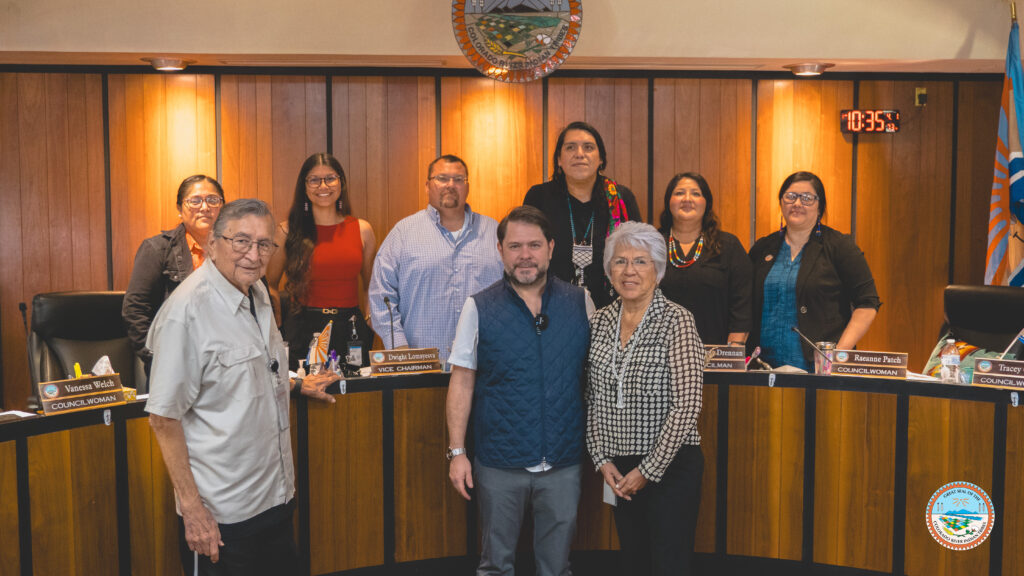
When Udall met with Tribal leadership at the Colorado River Indian Tribes (CRIT) Council Chambers, he was greeted by Chairwoman Amelia Flores, Councilwoman Vanessa Welch, CRIT Attorney General Rebecca Loudbear, CRIT Water Resources Director Dillion Esquerra, CRIT Realty Commercial Manager Herman “TJ” Lafoon Jr., and CRIT Lead Water Attorney John Bezdek.

During his presentation, Udall explained that flows in the Colorado River have dropped about 20% since the year 2000, and that precipitation – the rain and snow that feed the river – is also down about 20%. He said several studies have found that this isn’t just a temporary drought, but a long-term trend he believes is caused largely by human-driven climate change. Temperatures are rising across the Southwest, and according to Udall, “We are now on target for 3 degrees Celsius of warming by the year 2100.” Udall reiterated that his studies show this increase in temperatures is based on an average of estimates, and that temperatures in certain areas, including the desert southwest, could see higher increases.

Udall described the situation as serious and with little optimism. He shared that some scientists are exploring ideas like adding sulfur dioxide to the atmosphere to help cool the planet, though he said most researchers are cautious about such steps because they involve more human interference in nature. “It’s not a perfect solution,” he explained, “but it shows how far people are thinking about how to slow down the warming.” Councilwoman Vanessa Welsh was thankful for Udall’s frankness about the situation stating, “Many of us do know this, but we don’t hear it very often…We intend to protect the river as one of our own.” (more…)

The Department of Revenue and Finance Welcomes Director

The Colorado River Indian Tribes is pleased to welcome Andrew Quillen as the new Director of the Revenue and Finance Department.

Mr. Quillen is a CRIT tribal member who was born and raised in the community. He brings both professional experience and a deep personal connection to the reservation into his new leadership role. He has worked for the Tribes for the past three years and has steadily grown within the department.

Mr. Quillen earned his Bachelor of Arts degree in Business Administration with a concentration in management from the University of La Verne. Upon returning to Parker, he began his career with the Tribes as a tax examiner and revenue agent. He quickly found that the work aligned with his long-standing interest in business, compliance, and economic development.

When the former Revenue and Finance Director was elected to Tribal Council, Mr. Quillen felt it was the right time to step forward and continue the work the department had already established. His background in sales, service, and compliance has helped shape his understanding of how the department supports businesses and the community as a whole.

As a lifelong community member, Mr. Quillen understands the economic landscape of the reservation and the opportunities for growth. One of his personal goals is to see more tribal members become business owners. Being part of the reservation’s continued development is something that holds special meaning for him. (more…)

The Colorado River Indian Tribes Utilities Department has welcomed a familiar face into its leadership, naming Alex Covarrubias Jr. as the new Utilities Director.

Covarrubias is a Parker and Poston local who grew up in the community he now serves. His career in the water industry began in 2013, giving him more than a decade of hands-on and leadership experience in the field.

He started his professional journey working in Big River for three years before joining CRIT Utilities, where he served as Water Department Supervisor. During his time with the Tribe, Covarrubias gained valuable experience learning the day-to-day operations of the department and the importance of understanding the work from the ground up.

“Learning the ins and outs of the job builds character,” Covarrubias said. “I’m glad I was able to learn from the bottom.”

In 2022, he stepped away from CRIT Utilities to continue building his experience, working with the Rural Water Association of Arizona. Along with his previous roles, Covarrubias has spent years in management and believes that with a good attitude and strong work ethic, he can be an effective leader.

Returning to CRIT Utilities as Director is a full-circle moment for Covarrubias, and one he says he is excited about.

CRIT Utilities oversees essential services including water, wastewater, and solid waste for the reservation. Having spent years doing hands-on work in the field, Covarrubias believes that experience helps him better support his team. (more…)

Navajo customs find a way to heal and reignite the strength of those in suffering and spiritual pain of what lingers in their heart, their mind, their body, their soul. But here, we have a film that questions and wrestles with the idea of how we feel out, process, and learn to forgive those who’ve done harm to us for no longer. FINDING HÓZHÓ, the newest film from writer/director/producer Travis Holt Hamilton, searches for that idea from within the protagonist Secody, a man whose silent dignity masks a history of childhood trauma left behind by the violence of his father, remembered as an angry and aggressive alcoholic. Now an older man, Secody is morally stuck on how to best care for his dying/bedridden elder father; he secretly wrestles with the emotional turmoil of not knowing how to confront his abuser and comfort his dying father. We jump back and forth between the present narrative and the 60s’ period flashbacks to show how Secody had to endure his father’s drunken rage(s), while also finding peace and serenity with his warm and loving grandfather, who teaches him the traditional Diné methods of beliefs and guidance. We see a different coin side of father figures within Secody’s life – one figure showing him what pain can bring by self-destruction, and another figure teaching what beauty and tranquility can be found with personal strength and faith rooted in traditional values. (A scene plays out in flashback with the grandfather and son looking after the depressed father, drowning in sorrow about his dead wife with a bottle; the grandfather tells his grandson, Your father is not a bad man, hes a broken man.” They carry him back home and spend the night traditional praying over him repeatedly, showing Secody what the bonds of family and holding hope in ones beauty does for our health & growth.)

What stood out on top of the story with the film itself, the reviewer found the production value to be a crowning achievement; in particular, the cinematography and direction seen on screen proves that the story has a backbone of visual style and gravitas of a filmmaker’s dedication to making a story based on the concept and company he keeps. Here, Hamilton finds the weight of the emotional journey in his character’s choices and reflections in facing the confrontation of familial bonds and those painful memories that we put to rest. The actors’ are all allowed to shine and breathe life into their on-screen personas’, with many of the cast having the strength to carry weight of dialogue while the main lead is left in silence of his own accord. By the end of the film (as per audience reactions at the screening), you’ll be needing the tissues to help handle the teary emotions we see in the finale of the film reinterpreting the themes of Hózhó being an internal spiritual awakening that anyone can ignite from within, from family, and from the values/beliefs we hold strong. Anyone of any generation can find something out of the story, as the reviewer recounts how much an audience engagement could be found in the Q/A section of the premiere – prompting discussions of elder’s recollections that touched on personal experiences they found identifiable through the film. It’s a beautiful film that stands as one of Hamilton’s most mature and enlightening features that showcases the humanity and culture of Diné customs and traditions. FINDING HÓZHÓ is a film that wants you to be emotionally and spiritually ready to find the light, beauty, and forgiveness to give ourselves from all the burdens of the world.

Holt Hamilton, in his steadfast devotion to furthering his filmmaking goals and working with the best talent/crews, finds solace in the audience he has acquired with his filmography. Speaking with him, you understand that the storytelling that he’s writing and formulating is based on the influences and ideas that surround him; and it’s no surprise seeing how much influence the honor and beauty of Navajo country has struck a cord with his sensibilities. We spoke with him after the screening –

CRIT MEDIA: How do you anticipate everything that you do with the challenges of filmmaking? What does the weight of this lifestyle feel like for you?

HAMILTON: I think the start of it was of just giving myself that goal: if I had one more chance to make a movie, what would I do? Not that the other films haven’t been a passion project or something, but there’s something about like, okay, what, there’s more thought, there’s a lot more prayer into it, there’s a lot more like, okay, what do I leave with? And so I think I set, that was one thing I think that really played into it.” (more…)

TUCSON, Ariz. — The University of Arizona will host a special series of sign unveiling ceremonies on Friday, September 4, 2026, honoring the four languages of the Colorado River Indian Tribes (CRIT): Mohave, Chemehuevi, Hopi, & Navajo. These ceremonies represent an important milestone in an ongoing campus-wide initiative to elevate the visibility, recognition, and continued presence of Indigenous languages and cultural heritage within the campus community.

The events are organized by the University of Arizona’s Office of Native American Advancement & Tribal Engagement (NAATE) in collaboration with individual academic colleges. Students, faculty, staff, tribal community members, and the general public are invited to attend the progression of ceremonies throughout the day.

The schedule for the Friday ceremonies includes:

  • 9:00 AM – Emil W. Haury Anthropology Building (1009 E South Campus Dr): Honoring the CRIT Chemehuevi language. The ceremony features a welcome and land acknowledgment from Levi Esquerra (Special Advisor, NAATE), a prayer by Eloy DeLeon, remarks from Clarissa Robles Parra on behalf of the Office of the Provost, and an address by CRIT Chairwoman Amelia Flores. Cultural sharing will feature the Salt Song(s) and Red Foot, followed by refreshments.
  • 10:30 AM – Environment and Natural Resources 2 (ENR2) Building (1064 E Lowell St): Honoring the CRIT Navajo language. Hosted by Liz Petterson, Associate Director, Arizona Institute for Resilience, alongside CRIT Chairwoman Amelia Flores, and a Navajo language representative featuring a traditional blessing and cultural demonstration.
  • 1:00 PM – Forbes Building (1140 E South Campus Dr): Honoring the CRIT Hopi language with remarks from Dr. Edward Martin (Associate Dean, CALES Cooperative Extension), Professor Sheilah Nicholas, and Dean George W. Smith.
  • 2:30 PM – College of Education Building (1430 E 2nd St): Honoring the CRIT Mohave language. The concluding sign unveiling of the day will include introductions by students, remarks from CRIT Chairwoman Amelia Flores, and a final cultural demonstration.

The celebration of Indigenous culture continues into the weekend with the Native American Heritage Game on Saturday, September 5, 2026. The Arizona Wildcats will face Northern Arizona at Casino Del Sol Stadium, with kick-off scheduled for 6:30 PM MST. Pre-game festivities at Bear Down Field will begin at 3:15 PM with the Bear Down Bash, featuring 18-minute cultural performances from each tribe. A traditional gift presentation will follow during the Wildcat Walk at 4:15 PM, leading up to an on-field tribal recognition ceremony during the second quarter of the football game.

For more operational schedules or to register for the unveiling events, please visit the official University of Arizona Event Page.