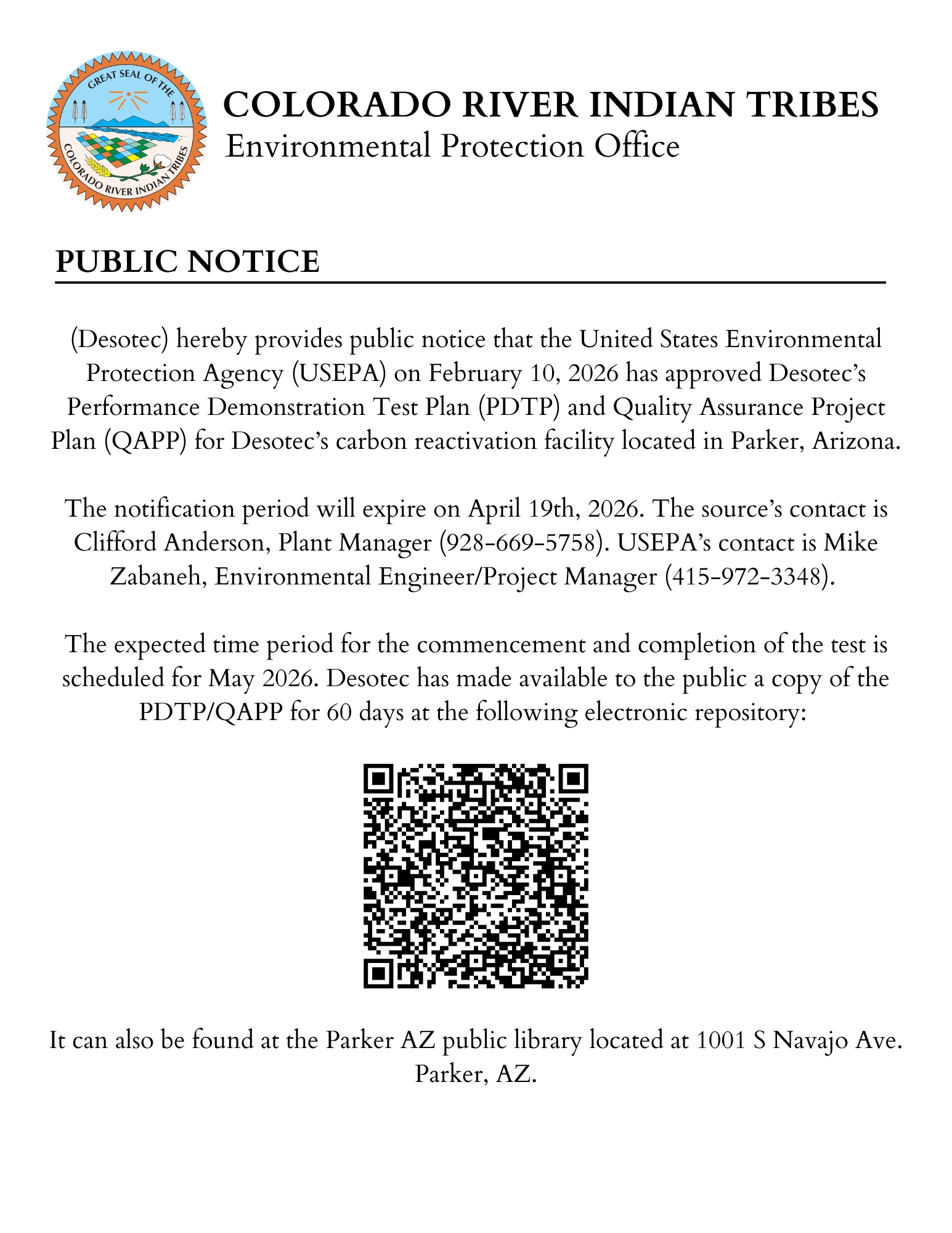
Follow the link below for the propsed amended code
2026 Amended and Restated Gaming Code_Public Hearing

For a second time CRIT Chairwoman Amelia Flores and members of the Tribal Council provided updates, answered questions, and listened to concerns about issues surrounding Colorado River water.
About 80 people attended a meeting in August at the Blue Water Resort and Casino. In opening remarks Chairwoman Flores said, “We ae stewards of our river and that’s why we are here tonight.”
CRIT’s water attorney John Bezdek then updated tribal members on the status of potential water leasing made possible by a new federal law as well as enabling documents recently signed between CRIT, the State of Arizona, and the US Department of Interior. Bezdek stressed that CRIT has made no agreements to lease its water off reservation. Bezdek’s presentation stated, “Any potential lease, water storage agreement, or other off-reservation use of water will only occur, as required in the Referendum, after it has been approved by tribal council majority vote only after a public hearing.
The Tribal Council is working diligently to ensure CRIT would get the best possible price in any water leasing agreement. As drought conditions persist, CRIT water becomes more valuable. That’s one of the reasons CRIT’s Tribal Council, its staff, and its legal team are working to protect CRIT’s SENIOR water rights. Recent legislation has greatly helped in that regard, but more can be done. That’s because agreements that manage the operations of the Colorado River expire in 2026.
Bezdek’s presentation states, “Tribal Council is actively engaged in meetings with federal and state officials as guidelines are developed for Colorado River operations post-2026 to ensure the Colorado River remains a living river while protecting the Tribes’ rights.”
CRIT is also looking at all options to make its irrigation systems more efficient and to hold the BIA accountable for failing to do so.
The BIA irrigation project returns between 47% and 50% of the water diverted back to the Colorado River without being used. Most of the high return flow problems have been identified and solutions have been proposed, however, the BIA is NOT fixing the irrigation project. Leases will provide CRIT with funds to better capture this return-flow and increase project efficiency. This protects CRIT water from being taken in the future.
In response to a question, Tribal Councilmembers Jaymee Moore and Anisa Patch said the Tribal Council has been working to hold the BIA accountable at the local level and are now taking that effort to the next level by going higher up. (more…)
The Colorado River Indian Tribes Tribal Council held its quarterly Elders Luncheon on October 26th for tribal and federally recognized elders.
The event was held at the Blue Water Resort and Casino Showroom. The activities included a chair volleyball match between members of the Tribal Council and the CRIT Mo-Che-Ho-Na Chair Volleyball group.
The Department of Health and Social Services were on site giving out free blood sugar checks, as well as to showcase some of their departments. Staff also gave a presentation on best practices to stay in a healthy mindset as well as healthy eating habits.
Councilwoman Anisa Patch gave closing remarks thanking everyone involved in setting up the event as well as the elders who were able to come and enjoy the day.


Our thanks to everyone who participated in the National Day for Truth and Reconciliation on September 30th
The day honors the children who never returned home as well as survivors of boarding schools, their families and communities. The day is also known as Orange Shirt Day to honor and raise awareness of the thousands of Indigenous children who were sent to residential schools.
Department staff who participated: Executive Offices, Public Defender, Media and Office of the Attorney General.

A quick-thinking CRIT Game Warden likely saved the life of an elderly motorist.
While on routine patrol in late June, Warden Alejandro Lopez III missed the turn off to Agnes Wilson Rd as he was returning from West Boundary patrol. As he turned his vehicle around, he noticed a vehicle facing northbound off the southbound shoulder of the road. He got out of his truck and walked to the back of the car to run the license plate and found a man lying in the bushes in the desert area.
The man told Warden Lopez he got out of his vehicle for a rest stop, fell over, and could not get back to his feet. He told Lopez that he had been lying there for over three hours in direct sunlight and he was having trouble breathing.
Warden Lopez Immediately requested medical attention for the man identified as 86-year-old Luis Gonzalez. Warden Lopez provided Mr. Gonzalez with water and improvised shade, keeping him calm as he waited for medical assistance to arrive.
Gonzalez was transported to the La Paz Regional Medical facility. Paramedics told investigators Mr. Gonzalez might not have survived if he had been exposed to the elements for another hour.
Chief Game Warden Woodrow Sharp said Warden Lopez’s attention to detail and patrol procedures led to Mr. Gonzalez being located and rescued from certain death had he not been found.