September 10, 2026 2:43 pm
CRIT Nation, Parker, AZ
September 10, 2026 2:43 pm
CRIT Nation, Parker, AZ

The Colorado River Indian Tribes Tribal Council has made a historic decision to protect the lifeblood of their Reservation. On November 6, 2025, the Council unanimously approved Resolution No. R-375-25, which proclaims the personhood status of the Colorado River under tribal law.

This resolution acknowledges the Colorado River as a living entity whose health and well-being are intrinsically linked to the well-being of the Colorado River Indian Tribes (CRIT) members. The Tribes’ deep-rooted connection to the river spans centuries, providing cultural identity, spiritual strength, food systems, and economic stability that continue to shape their community life today.

The resolution emphasizes the central role the river has played in defining the identity of the CRIT. It highlights that CRIT’s ancestors have preserved and protected these lands since before the establishment of the Colorado River Indian Reservation in 1865.

The Council underscores the crucial role the river plays in sustaining traditional practices, wildlife, and agriculture, including the federal irrigation systems authorized as early as 1867. Today, the Colorado River Indian Irrigation Project stands as a cornerstone of the tribal economy.

The resolution underscores significant legal milestones that acknowledged CRIT’s water rights. In the landmark 1964 and 2006 Arizona v. California U.S. Supreme Court decisions, the Tribes secured 719,248 acre-feet of water annually, ensuring their access to the river for generations to come.

By granting personhood to the River, the Tribal Council reaffirmed its sovereign duty to honor and protect it. This status mandates that the River’s well-being must be a priority in governance and decision-making moving forward.

As part of the resolution, the Attorney General and their staff will develop legal safeguards and propose updates to the CRIT Water Code and other relevant regulations. These updates may include the potential designation of the river as a protected cultural landscape.

Council members recognized that protecting the river is not merely a legal obligation but a continuation of cultural beliefs passed down through generations.

Through this declaration, CRIT demonstrates its unwavering commitment to stewardship. The resolution concludes with a resolute message: the Colorado River is, and will always remain, a vital entity deserving of respect, care, and protection for all future generations.

Article Written by CRIT Media Reporter Ariana Romero

News Update November 12, 2025

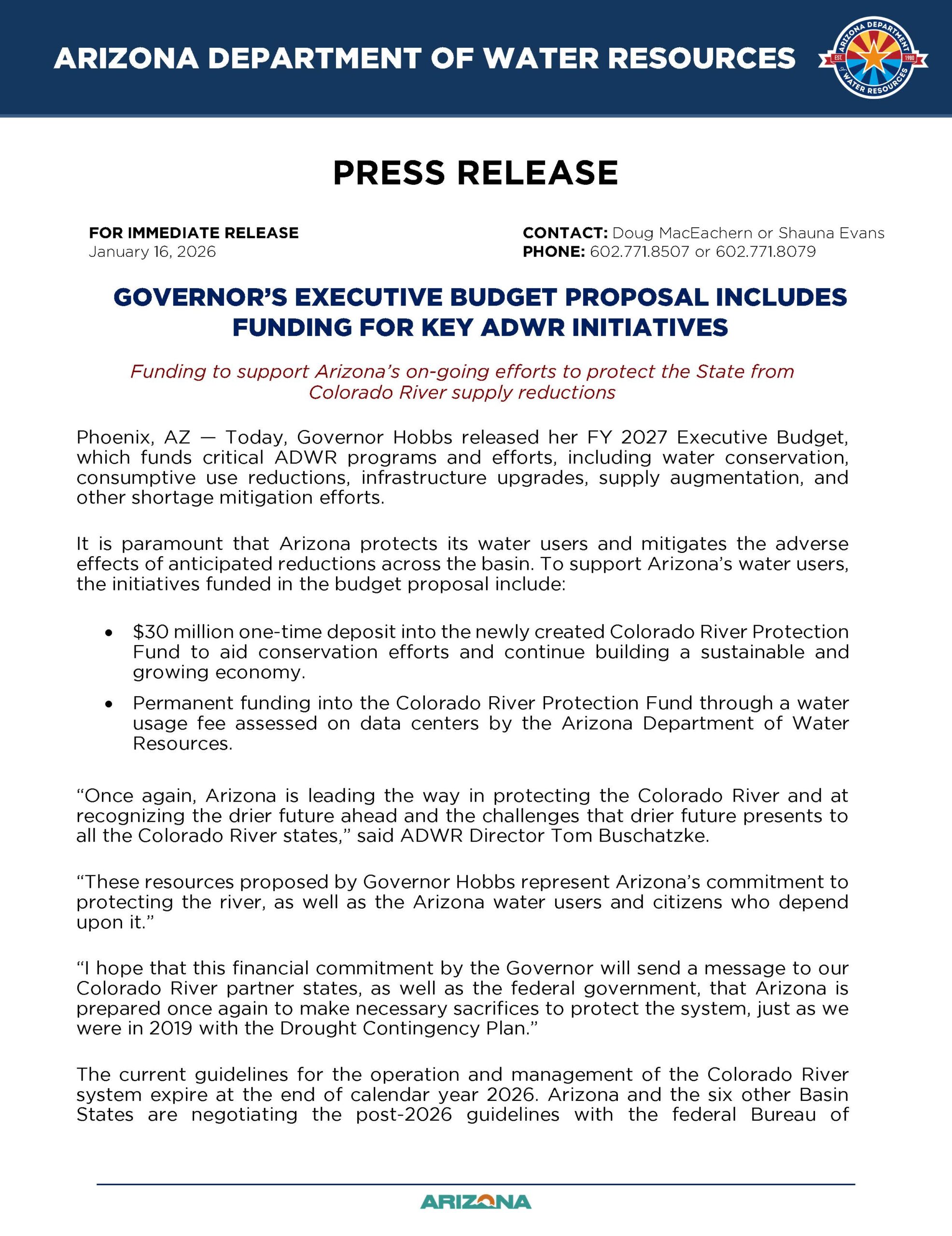
Negotiations over the future of the Colorado River have reached a standstill after all seven basin states failed to meet a key federal deadline. Reports from 12News and 8NewsNow confirm that the states were unable to agree on a new water-sharing plan, leaving the situation unresolved as the river continues to decline.

High Country News explains that the biggest disagreements involve how much each state should give up in the future. The upper Basin states want fewer mandatory reductions, while the Lower Basin states, including Arizona, say they have already taken the deepest cuts and cannot continue to absorb the majority of the impacts.

With no agreement in place, Arizona Governor Katie Hobbs has asked the Trump administration to intervene. She stated that Arizona has made significant sacrifices and cannot carry the weight of the reductions while other states refuse to commit to measurable cuts. If the states cannot reach a plan soon, the federal government may create one for them.

For the Colorado River Indian Tribes, the outcome of these negotiations has major importance. CRIT holds valuable senior water rights and relies on a stable and fair management plan to ensure long-term security for the community and the region.

For more information, you can read the news articles with the links below.

8NewsNow
https://www.8newsnow.com/news/local-news/colorado-river-negotiations-fail-to-meet-federal-deadline-for-7-state-agreement/

High Country News
https://www.hcn.org/articles/why-colorado-river-negotiations-are-so-difficult/


ABC 15 News
https://www.abc15.com/weather/impact-earth/why-gov-katie-hobbs-wants-trump-administration-to-broker-colorado-river-deal


12 News
/wednesday-is-deadline-for-7-state-including-arizona-to-negotiate-the-colorado-river

A quick-thinking CRIT Game Warden likely saved the life of an elderly motorist.

While on routine patrol in late June, Warden Alejandro Lopez III missed the turn off to Agnes Wilson Rd as he was returning from West Boundary patrol. As he turned his vehicle around, he noticed a vehicle facing northbound off the southbound shoulder of the road.  He got out of his truck and walked to the back of the car to run the license plate and found a man lying in the bushes in the desert area.

The man told Warden Lopez he got out of his vehicle for a rest stop, fell over, and could not get back to his feet. He told Lopez that he had been lying there for over three hours in direct sunlight and he was having trouble breathing.

Warden Lopez Immediately requested medical attention for the man identified as 86-year-old Luis Gonzalez.  Warden Lopez provided Mr. Gonzalez with water and improvised shade, keeping him calm as he waited for medical assistance to arrive.

Gonzalez was transported to the La Paz Regional Medical facility. Paramedics told investigators Mr. Gonzalez might not have survived if he had been exposed to the elements for another hour.

Chief Game Warden Woodrow Sharp said Warden Lopez’s attention to detail and patrol procedures led to Mr. Gonzalez being located and rescued from certain death had he not been found.

Nora Vasquez started her career with the Colorado River Indian Tribes on September 13th, 1984 as a cook’s aid at CRIT Head Start. Nora has held many titles At Head Start including Assistant Cook, Nutrition Coordinator, Head Cook and Nutrition Specialist. In 2018 Nora was promoted as the Nutrition Specialist/Family Service Advocate, A position she still holds today. The Tribal Council and Human Resource Department thank Nora for 40 years of continued service to the Colorado River Indian Tribes.

Department heads and managers for the Colorado River Indian Tribes met September 16th to exchange ideas and information. They received updates on local banking services from Wells Fargo and were introduced to new and acting directors.

These meetings are called on a quarterly basis by Chairwoman Flores to ensure communication, cooperation,  collaboration, and coordination among department heads and managers.

Additional topics included CRIT’s travel policies and five-year plans for departments.

The meeting was held in the Mohave Room at the Blue Water Resort and Casino.

Delivering a message of tribal sovereignty and unity, CRIT Chairwoman Amelia Flores gave opening remarks for a special meeting of the 30 Basin Tribes to discuss Colorado River water policy, allocation, and consultation with native communities. The meeting was held September 13th at Chairwoman Flores’ request.

In addition to Chairwoman Flores, CRIT Vice Chairman Dwight Lomayesva, Tribal Council members Anisa Patch and Bobby Page also attended the conference held Courtyard Scottsdale Marriott owned by the Salt River Pima Indian Community.

The focus of the meeting was to discuss post-2026 Colorado River Guidelines, which could have a profound impact on CRIT’s water rights, as well as multiple indigenous communities and reservations when it comes to Colorado River water allocations. CRIT has vowed to make sure it has a seat at the table to ensure its rights are protected.

Chairwoman Flores stated in opening remarks that the rights of all tribes must be protected, “The stakes for all of us are too high as to how the post 2026 (Colorado River Guidelines) impacts our water rights so we need to keep in constant communication with our trustee.”

Flores called upon the tribes to work together, “All the tribal nations are unique, but we are bound by one great river, the Colorado River.”

In addition to tribal leaders, United States Bureau of Reclamation Commissioner Camille Touton was also in attendance. Touton said she and federal officials were there to listen, “I can see every single leader here and I know the issues we are working through together as sovereign nations.”

Topics discussed included:
• Status of discussions with the Basin States – Reclamation.
• Alternatives development – will Reclamation protect tribal water rights?
• Schedule of release of documents – what can we expect to see and when?
• Is the consultation process working? How can it be improved?
• Future/follow-up meetings between Tribal Nations and Reclamation.

TUCSON, Ariz. — The University of Arizona will host a special series of sign unveiling ceremonies on Friday, September 4, 2026, honoring the four languages of the Colorado River Indian Tribes (CRIT): Mohave, Chemehuevi, Hopi, & Navajo. These ceremonies represent an important milestone in an ongoing campus-wide initiative to elevate the visibility, recognition, and continued presence of Indigenous languages and cultural heritage within the campus community.

The events are organized by the University of Arizona’s Office of Native American Advancement & Tribal Engagement (NAATE) in collaboration with individual academic colleges. Students, faculty, staff, tribal community members, and the general public are invited to attend the progression of ceremonies throughout the day.

The schedule for the Friday ceremonies includes:

  • 9:00 AM – Emil W. Haury Anthropology Building (1009 E South Campus Dr): Honoring the CRIT Chemehuevi language. The ceremony features a welcome and land acknowledgment from Levi Esquerra (Special Advisor, NAATE), a prayer by Eloy DeLeon, remarks from Clarissa Robles Parra on behalf of the Office of the Provost, and an address by CRIT Chairwoman Amelia Flores. Cultural sharing will feature the Salt Song(s) and Red Foot, followed by refreshments.
  • 10:30 AM – Environment and Natural Resources 2 (ENR2) Building (1064 E Lowell St): Honoring the CRIT Navajo language. Hosted by Liz Petterson, Associate Director, Arizona Institute for Resilience, alongside CRIT Chairwoman Amelia Flores, and a Navajo language representative featuring a traditional blessing and cultural demonstration.
  • 1:00 PM – Forbes Building (1140 E South Campus Dr): Honoring the CRIT Hopi language with remarks from Dr. Edward Martin (Associate Dean, CALES Cooperative Extension), Professor Sheilah Nicholas, and Dean George W. Smith.
  • 2:30 PM – College of Education Building (1430 E 2nd St): Honoring the CRIT Mohave language. The concluding sign unveiling of the day will include introductions by students, remarks from CRIT Chairwoman Amelia Flores, and a final cultural demonstration.

The celebration of Indigenous culture continues into the weekend with the Native American Heritage Game on Saturday, September 5, 2026. The Arizona Wildcats will face Northern Arizona at Casino Del Sol Stadium, with kick-off scheduled for 6:30 PM MST. Pre-game festivities at Bear Down Field will begin at 3:15 PM with the Bear Down Bash, featuring 18-minute cultural performances from each tribe. A traditional gift presentation will follow during the Wildcat Walk at 4:15 PM, leading up to an on-field tribal recognition ceremony during the second quarter of the football game.

For more operational schedules or to register for the unveiling events, please visit the official University of Arizona Event Page.