Help expand energy dominance and support Tribal energy futures with the Bureau of Indian Affairs (BIA)! We are pleased to announce 23 new hiring opportunities to help support energy development and permitting at BIA, with more opportunities coming soon.
All position announcements opened on 6/1/2026 and will close on Friday 6/12/2026, so act fast! We encourage all qualified applicants to submit application materials by applying online at USAJobs. Please help us spread the word and recruit high-qualitycandidates to help fulfill the BIA mission.
Positions include:
(1) Environmental Protection Specialist Series 28 (GS 11) at Southwest Regional Office
(Albuquerque, NM); DE-26-12973039-CAWY-SR;
(1) Environmental Protection Specialist Series 28 (GS 9/11) at Western Regional Office
(Phoenix, AZ); DE-26-12973039-CAWY-SR;
(2) Archeologist Series 193 (GS 7/11) at Southwest Regional Office (Albuquerque, NM);
DE-26-12973279-CAWV-MH;
(2) GIS Specialist Series 301 (GS 5/11) at Great Plains Regional Office (Aberdeen, SD);
DE-26-12973052-CAWV-JM;
(2) Geographic Information System Specialist Series 301 (GS 9/11) at Navajo Regional
Office (Gallup, NM); DE-26-12973052-CAWV-JM;
(1) Supervisory Engineer Technician (Petro) Series 802 (GS 11) at Osage Agency
(Pawhuska, OK); DE-26-12972843-CAWV-BSc;
(1) Realty Assistant Series 1101 (GS 7) at Farmington Indian Minerals Office (Farmington,
NM); DE-26-12972357-CAWV-TB;
(1) Realty Assistant (CM) Series 1101 (GS 5/7) at Anadarko Agency (Anadarko, OK); DE-
26-12972357-CAWV-TB; (more…)
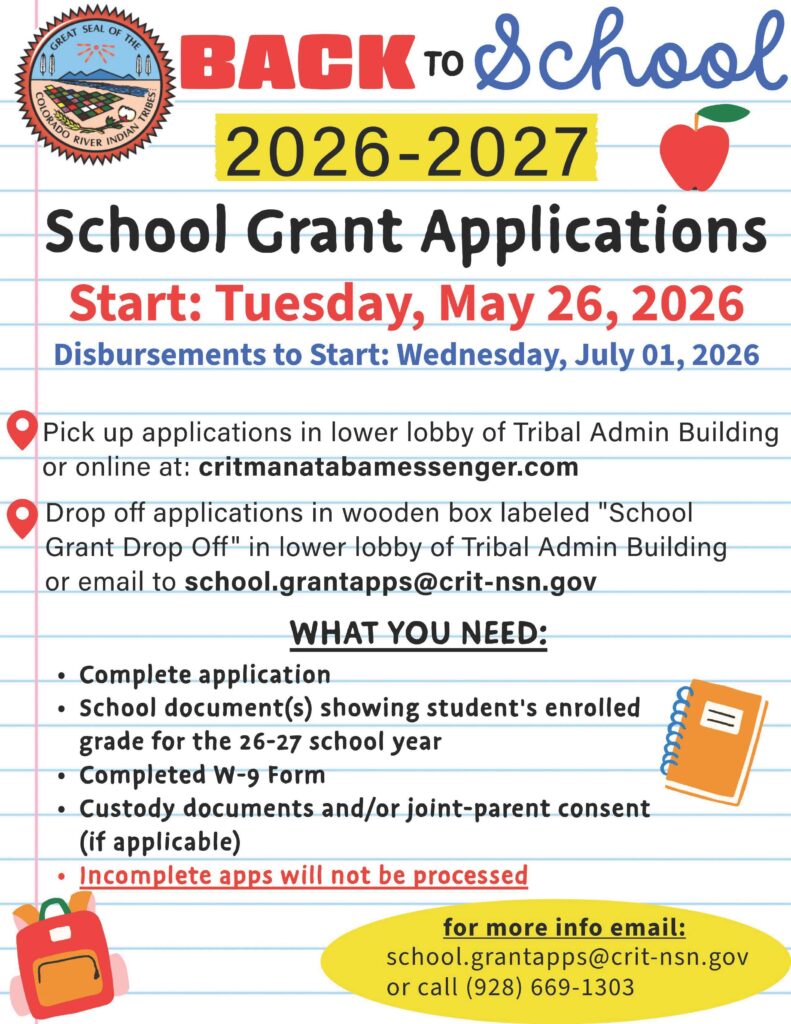
Click the link below to download the application
26-27 SG Application Policy (Fillable)


Arizona Budget Proposal Includes Major Funding for Colorado River Protection
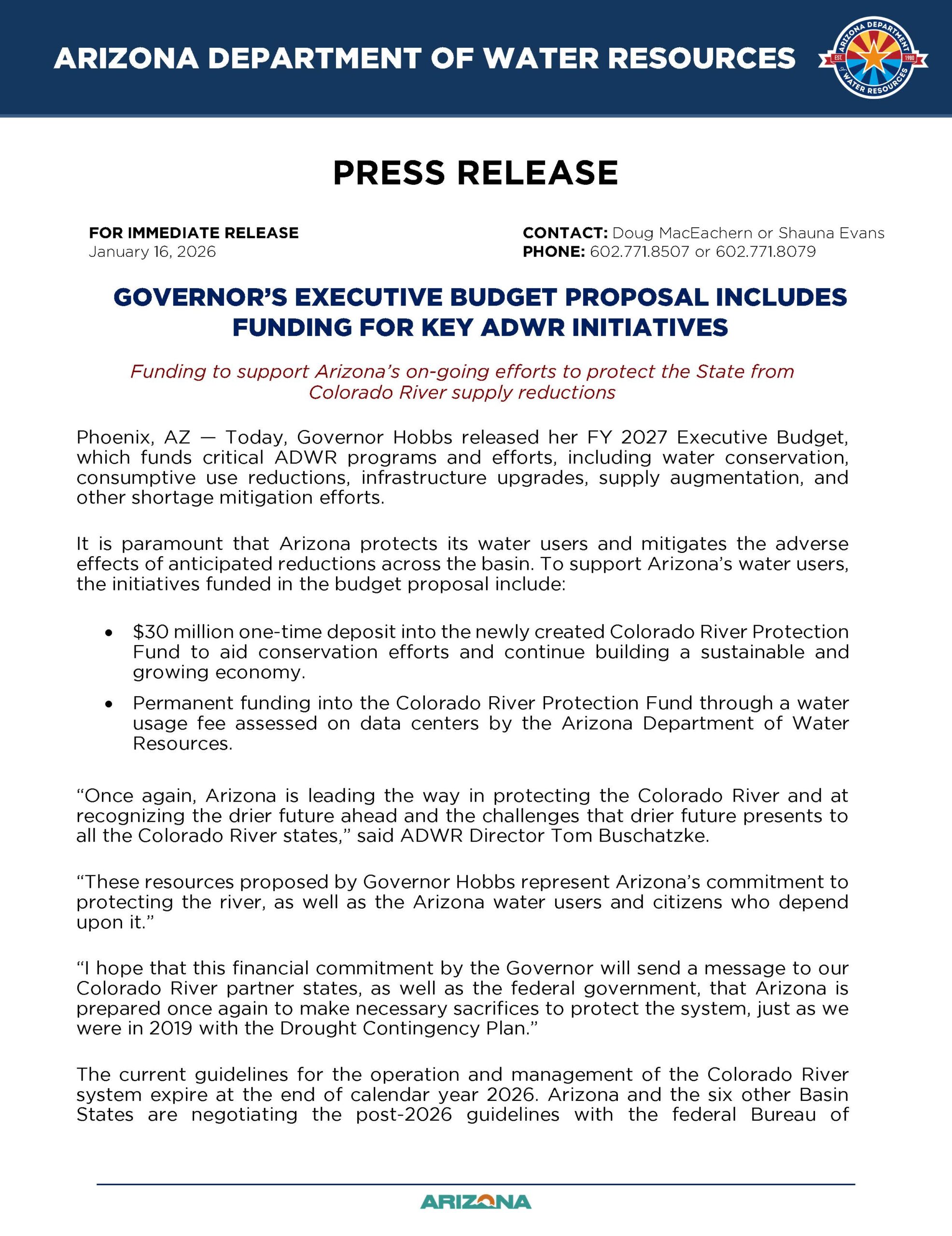
On January 16, 2026, the Arizona Department of Water Resources (ADWR) shared details of Governor Katie Hobbs’ FY 2027 Executive Budget Proposal focused on preparing for long-term challenges facing the Colorado River. The plan includes new and expanded funding aimed at strengthening water security across Arizona in the face of ongoing Colorado River shortages.
Key points from the budget related to water:
Source:
Arizona Water News https://azwaternews.com/2026/01/16/fy2027_execbudgetproposal/
From stunning cultural displays to family fun, hundreds attended the 50th Anniversary of the Colorado River Indian Tribes Native Fair and Expo.

Day one on November 20th started with a noon grand opening and free BBQ. It ended with the CRIT Royalty Pageant and the Miss CRIT Pageants. Pictured below are Allie Ray-Lynne Fisher who was crowned Little Miss CRIT. Trevani Rhiane Esquerra who was crowned Miss CRIT and Zian Enela Nash was crowned Junior Miss CRIT.

Day two on November 21st included the Children’s Regalia Showcase on the main stage.
CRIT Education recently held its annual CRIT Royalty Dance for the outgoing and incoming Little Miss, JR Miss & Miss CRIT contestants. CRIT Royalty started off the morning dancing for Le Pera Elementary. Opening remarks by outgoing Miss CRIT Jayde Booth included the importance of language, language preservation as well as Native American dance history. Outgoing Junior Miss CRIT Lily Deanne Dick and outgoing Little Miss CRIT Eimyah Ameelyenah wished contestants good luck on their journey for the title. The Mohave Bird Singers provided traditional bird songs.
The CRIT Senior Center held its annual Elders Halloween Party October 31st at the Mo-Ch-Ho-Na Center. The elders enjoyed several games including a cake walk and costume contest. Lunch was also served.
Loretta Lee, Benefits Coordinator and Contact Representative of the Parker Indian Health Center, was on site to provide information on Medicare, changes to purchased referred care, and Arizona Medicaid. Anyone with questions on the presentation can contact Loretta Lee at (928)-669-2137 .
Tribal Council members in attendance included Chairwoman Amelia Flores, Councilwoman Vanessa Welch, Councilwoman Jaymee Moore and Councilman J.D. Fisher.
Senior Center Program Director Jimi Mae Jackson wishes to thank everyone who attended.

CRIT Library recently hosted a read along for the students of CRIT Head-Start with Smokey Bear. The day started off with a short story, “It’s Fall” by Rene Kurilla. Smokey Bear read “Smokey’s story time”. The book touches on camping safety and fire safety and prevention. CRIT Fire was on site to give the kids a tour of their fire engine and other equipment used to help put out fires and save lives.