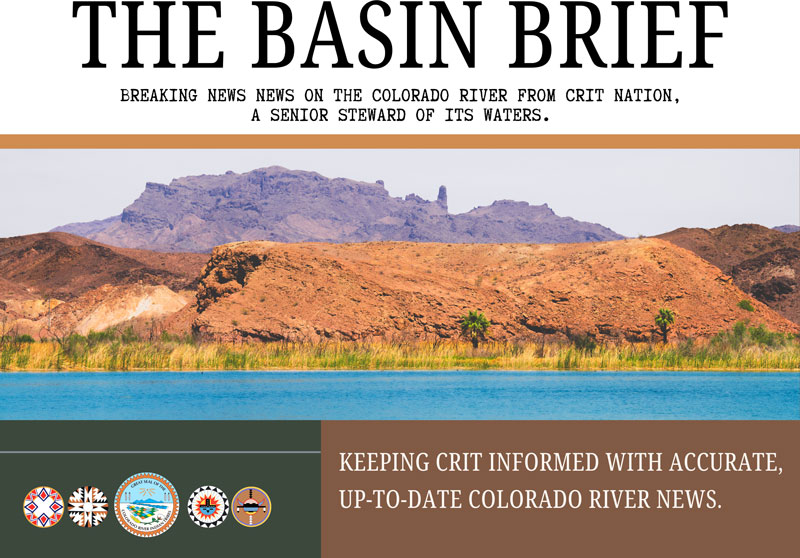
Bureau of Reclamation – The Bureau of Reclamation released its long-awaited Draft Environmental Impact Statement outlining potential strategies for managing Lake Powell and Lake Mead after 2026, when current operating guidelines expire. The draft presents multiple alternatives, including scenarios where the federal government steps in if Basin states fail to reach agreement. No preferred alternative has been selected yet, keeping negotiations open.This document will directly shape how Colorado River water is managed in the future. Tribal water rights, sovereignty, and protections for the river itself must be recognized in any final decision.
Lake Powell Chronicle – This piece outlines which players are involved in current negotiations and what each is seeking, including states, tribes, and federal agencies.Who is “at the table” determines whose rights and values are reflected in the final outcome. Tribal voices remain essential.
Tucson Sentinel – Despite recent storms and heavy rainfall in Phoenix, much of Arizona remains in long-term drought. Experts caution that short-term rain does not replenish groundwater or stabilize Colorado River supplies. Reinforces that reliance on weather alone will not protect tribal water rights or the river.
Arizona Water News – Arizona Department of Water Resources hydrologists are conducting field investigations across multiple basins to better understand groundwater use and conditions. Increased groundwater scrutiny reflects growing pressure as Colorado River supplies tighten, which can affect regional water demand and policy.
KLAS CBS 8 – Forces aligning against healthy snowpack for Colorado River states
Experts warn that warming temperatures, dry spells, and climate trends are working against the development of a healthy snowpack, threatening future river flows. Snowpack is the river’s primary source. Poor conditions upstream affect all downstream users.
Colorado Public Radio / The Hill – House fails to override Trump veto of Colorado water project
Lawmakers failed to override a presidential veto blocking a major Colorado water infrastructure project, leaving future water deliveries uncertain.Delays in infrastructure add pressure to existing Colorado River supplies. (more…)
KGUN 9 Tucson – Group urges Sahuarita to review Hudbay groundwater agreement
Community advocates are calling for closer review of groundwater agreements tied to mining operations, citing long-term water security concerns.
Cave Creek/Carefree Independent – Water at the forefront of Tuesday meetings
Local leaders are increasingly focused on water planning as development and supply concerns grow.
Santa Rosa Press Democrat – California’s largest reservoir rises 36 feet as rains boost water supply statewide. Storms have boosted reservoir levels in California, but officials caution that snowpack remains below what is needed for long-term security.
GV Wire – Winter storms wipe out drought in California, for now
California officials stress that recent rains offer short-term relief but do not end the drought.
CBS News – Colorado’s snowpack woes continue into 2026
Colorado snowpack remains well below average, heightening concern for river flows later this year.
Salt Lake Tribune – The Great Salt Lake enters 2026 uncomfortably close to record lows.
Low water levels highlight the broader regional water crisis tied to climate change and overuse.
Engineering News-Record – At Lake Powell, engineering is outpacing Colorado River policy.
Engineers are adapting dam operations to keep the system functioning, even as policymakers lag behind on long-term solutions.
KJZZ – Arizona water chiefs report movement in Colorado River talks, potential Lake Powell protections
Arizona water leaders say there is some movement in long-stalled Colorado River negotiations, including discussions around protecting critical elevations at Lake Powell. While no agreement has been reached, officials describe cautious progress as pressure mounts ahead of post-2026 management decisions.
Mohave Valley Daily News – Arizona bill would add $1 million to Colorado River legal fund
Arizona lawmakers are considering adding $1 million to the state’s legal fund to prepare for potential litigation if Colorado River negotiations fail. The proposal reflects how seriously states are preparing for court battles over water rights.
Nevada Current – Tribes stake their claim on the Colorado River, and help conserve it
This article highlights how tribes across the Basin are asserting their legal rights while also leading conservation efforts. It emphasizes tribes as both senior water rights holders and active stewards of the river.
Circle of Blue – Tribal Water Rights Settlement in Arizona Reintroduced in Congress
A long-standing tribal water rights settlement in Arizona has been reintroduced in Congress, aiming to resolve unresolved claims and provide certainty for tribes and non-tribal users alike.
KLAS CBS 8 Las Vegas – Water shortage in 2026: Pressure builds on Colorado River, Lake Mead
Officials warn that 2026 could bring increased pressure on Lake Mead and the Colorado River if snowpack and runoff do not improve. Water managers stress that short-term storms do not erase long-term shortages.
SFGate – America’s largest reservoir remains in peril
Despite recent storms, Lake Mead remains far below healthy levels. Experts caution against assuming drought is over, noting long-term structural shortages.
Newsweek – Where Lake Mead water levels stand amid heavy California rain
Lake Mead has seen limited gains, but experts stress that precipitation alone cannot resolve decades of overuse.
KUNC – Colorado ends 2025 with extremely low snowpack (more…)
As 2025 came to a close and 2026 began, water issues across Arizona and the Colorado River Basin remained front and center. New reporting highlighted continued uncertainty around Colorado River negotiations, growing concern over snowpack levels, and major developments in local groundwater and community water planning.
Local Groundwater and Community Water Planning
In western Arizona, the Parker Pioneer reports that an Active Management Area is being proposed for the Ranegras Plain. The proposal reflects growing concern over groundwater depletion and signals a shift toward stronger oversight in areas increasingly relied upon as Colorado River supplies tighten.
Meanwhile, years of uncertainty came to an end for residents of Rio Verde Foothills. Multiple Arizona outlets report that permanent water infrastructure is now coming online, including new pipelines and water filling stations. The long-awaited solution brings relief to residents, local businesses, and even animal sanctuaries, while also serving as a cautionary example of what can happen when development moves forward without secure water planning.
Snowpack and Weather Conditions Raise Red Flags
Snowpack remained a major concern across the Basin. Reports from KJZZ, KTAR News, CBS News, AP News, and several California outlets show that while recent storms boosted snowpack in parts of California, overall levels remain below average for this point in the season.
Officials with the Central Arizona Project acknowledged concern about snowpack levels, though they noted it is still early in the water year. Upstream, conditions appear more troubling. Colorado news outlets report historically low snowpack in some regions, while Utah coverage shows Lake Powell has dropped significantly over the past year, underscoring the fragile state of the system.
Late December also brought renewed uncertainty around water infrastructure projects. Coverage from KJZZ, Colorado outlets, and national public media reports on a presidential veto of a major Colorado water pipeline project. The decision disrupted financing for a project already underway and prompted calls from lawmakers to reconsider or override the veto. (more…)
By Ariana Romero
Reporter, CRIT Media
As 2025 comes to a close, new reporting shows Colorado River negotiations narrowing toward what many leaders describe as a final window for agreement, while local water solutions and long-term risks continue to take shape across the Southwest.
ABC15 Arizona reports that Colorado River states may only have one last realistic chance to reach a deal before federal intervention becomes unavoidable. With existing guidelines set to expire and reservoir conditions still fragile, officials warn that failure to compromise soon could lead to decisions being imposed rather than negotiated.
CBS 5 Arizona’s Family highlights what is at stake specifically for Arizona as talks drag on. The report notes that unresolved negotiations could affect everything from water deliveries to long-term planning for cities, tribes, agriculture, and industry, reinforcing why Arizona leaders are under pressure to help move talks forward.
Several opinion pieces stress the need for compromise in the Upper Basin. Phys.org and the Imperial Valley Press argue that without meaningful concessions, negotiations risk collapse, deepening divisions among states and prolonging uncertainty across the Basin.
At the local level, attention turned to Rio Verde Foothills, a community that famously ran out of water. The Arizona Republic, CBS 5, and AZ Big Media report that a permanent water solution has now been secured, ending years of uncertainty. However, the Arizona Republic notes that questions remain about the long-term cost of that solution, underscoring the financial realities of securing water in unregulated areas.
Water policy and development pressures remain closely linked. The Daily Independent reports that Valley water officials are urging legislators to invest more heavily in water resources, while opinion pieces from Nevada question whether the continued expansion of data centers is compatible with long-term water sustainability.
Conditions on the river itself remain mixed. Newsweek reports on how Lake Mead’s water levels changed throughout 2025, showing modest gains at times but continued overall vulnerability. Meanwhile, CBS News warns that Colorado is facing its worst snowpack on record for this point in the season, a troubling signal for future Colorado River flows, though experts say late-season storms could still offer some relief.
Despite tensions, collaboration remains a recurring theme. An opinion from the University of Colorado Boulder notes that Colorado River discussions continue to bring together unlikely partners through forums like the Colorado River Water Users Association, even as disagreements persist. Another Colorado Sun opinion stresses that public access to rivers and responsible stewardship must remain part of broader water policy discussions.
Together, these reports show a Basin approaching a crossroads. With negotiations nearing a critical moment, local water fixes highlighting real costs, and climate signals raising alarm, decisions made in the months ahead will play a major role in shaping the future of the Colorado River.
Sources
As the year comes to a close, new reporting underscores how unresolved negotiations, worsening climate impacts, and continued growth are colliding across the Colorado River Basin.
The Lake Havasu News-Herald reports that federal officials are demanding compromise from Basin states as water shortages deepen. Despite repeated warnings, states remain divided, prompting stronger signals that the federal government may intervene if agreements are not reached soon.
Several opinion pieces question long-held assumptions about water security. The Sun City Independent argues that Arizona’s promise of “assured” water is increasingly disconnected from reality, while national commentary emphasizes that decades of overuse and delayed action have left little room for error.
Weather extremes continued to dominate headlines. The Los Angeles Times reports that Southern California experienced its wettest Christmas holiday on record, highlighting the growing drought-to-deluge cycle driven by climate change. Despite heavy rain in some areas, drought conditions persist elsewhere, according to California and national drought summaries. In Colorado, the Denver Gazette reports snowpack levels are at the lowest ever recorded for this point in the season, raising serious concerns for future Colorado River flows.
Local and regional responses remain mixed. The Payson Roundup reports progress on water system improvements in Star Valley and a brief return to normal rainfall in Payson, though officials caution that short-term relief does not change long-term conditions. In Nevada, the Las Vegas Review-Journal reports that rapid growth in Las Vegas is continuing despite the Colorado River crisis, intensifying concerns about sustainability.
Across the Basin, journalists and experts reflected on the year’s biggest water stories. Aspen Journalism and Aspen Public Radio highlight how climate change is worsening drought conditions and pushing leaders toward difficult decisions in 2026. National Parks Traveler reports that declining Colorado River flows are already affecting national park sites along the river, signaling broader environmental consequences.
Some coverage points toward potential paths forward. Fox 13 in Utah explores ideas aimed at easing water conflicts, while opinion pieces emphasize the need for compromise among Upper Basin states. The Sierra Club highlights how Indigenous knowledge and stewardship can play a key role in adapting to climate change and managing water more sustainably.
The Colorado River is not just a water source for the Colorado River Indian Tribes (CRIT); it is the foundation of life, culture, and survival on the Reservation. It sustains farms and families, supports wildlife, and holds deep cultural and spiritual meaning for the Tribes who have lived along its banks for generations. For CRIT, decisions about the river are not abstract policy debates, they directly affect the Tribe’s ability to live, govern, and prosper for future generations.

That reality framed a series of high-level meetings held alongside the Colorado River Water Users Association (CRWUA) Conference, where CRIT was represented by a unified and prepared delegation consisting of Tribal Council, legal counsel, the CRIT Attorney General’s Office, Public Affairs, and the Tribe’s Washington, D.C. and Phoenix lobbying teams, all actively engaged in advancing and defending CRIT’s water rights and sovereignty.
This delegation engaged in multiple meetings with neighboring tribes, federal agencies, state representatives, and regional water districts. As the Colorado River Basin approaches major changes after 2026, these discussions focused on the future of the river, tribal water rights, and CRIT’s role as a sovereign water authority.
At the center of these discussions was a clear and unwavering position from CRIT: the Tribe’s senior water rights, tribal sovereignty, and responsibility to protect the Colorado River are not negotiable. CRIT Deputy Attorney General Travis Nez explained that the Tribe is expanding its agricultural footprint by investing in and growing farming operations on the Reservation. This ensures that the Tribe’s water is put to use on tribal lands to generate the greatest possible economic benefit for the community. While many water users across the Basin are reducing agricultural use, CRIT is intentionally increasing on-reservation water use to reclaim water that has historically gone unused and to convert it into long-term economic benefits for the Tribe.

CRIT leadership and the Tribe is fully cognizant that neighboring and downstream entities have economically benefited for decades from CRIT’s unused Colorado River allocation. This includes large regional water agencies such as the Metropolitan Water District of Southern California. Their Colorado River Aqueduct diverts water at Lake Havasu upstream of the CRIT Reservation, supporting municipal growth and generating substantial economic value. Simultaneously, CRIT’s own ability to fully use its water has long been constrained by outdated irrigation infrastructure constructed and controlled by the Bureau of Indian Affairs (BIA). (more…)
When people talk about climate change, it can sound political or exaggerated, but at its core, it’s about environmental changes we can measure over time. Scientists like Brad Udall, who studies long-term weather patterns, have found that the Earth’s average temperature has risen slightly over the past century, mostly because of how people consume energy. When coal, gas, or oil is burned, it releases gases that trap more heat in the atmosphere, like a blanket wrapped around the planet. Despite whether someone believes it is man-made or not, climate change forces us to pay attention, and develop methods to protect the land and water that sustain us.
On Monday, September 29th, Udall, an internationally recognized scientist on water and climate change from Colorado State University, visited the Colorado River Indian Reservation to share his latest findings on the Colorado River. He spoke with Tribal leaders about what the future may hold.
Udall is known for his research on the connection between climate change and river systems in the American West. He has spent decades studying how heat, drought, and rainfall affect water levels, especially in the Colorado River Basin. Additionally, Udall co-wrote parts of the U.S. National Climate Assessment, and has testified before the United States Congress about the effects of climate change on western water supplies. His work focuses on researching solutions that balance the needs of people, agriculture, and the environment.
When Udall met with Tribal leadership at the Colorado River Indian Tribes (CRIT) Council Chambers, he was greeted by Chairwoman Amelia Flores, Councilwoman Vanessa Welch, CRIT Attorney General Rebecca Loudbear, CRIT Water Resources Director Dillion Esquerra, CRIT Realty Commercial Manager Herman “TJ” Lafoon Jr., and CRIT Lead Water Attorney John Bezdek.
During his presentation, Udall explained that flows in the Colorado River have dropped about 20% since the year 2000, and that precipitation – the rain and snow that feed the river – is also down about 20%. He said several studies have found that this isn’t just a temporary drought, but a long-term trend he believes is caused largely by human-driven climate change. Temperatures are rising across the Southwest, and according to Udall, “We are now on target for 3 degrees Celsius of warming by the year 2100.” Udall reiterated that his studies show this increase in temperatures is based on an average of estimates, and that temperatures in certain areas, including the desert southwest, could see higher increases.
Udall described the situation as serious and with little optimism. He shared that some scientists are exploring ideas like adding sulfur dioxide to the atmosphere to help cool the planet, though he said most researchers are cautious about such steps because they involve more human interference in nature. “It’s not a perfect solution,” he explained, “but it shows how far people are thinking about how to slow down the warming.” Councilwoman Vanessa Welsh was thankful for Udall’s frankness about the situation stating, “Many of us do know this, but we don’t hear it very often…We intend to protect the river as one of our own.” (more…)
The Department of Revenue and Finance Welcomes Director
The Colorado River Indian Tribes is pleased to welcome Andrew Quillen as the new Director of the Revenue and Finance Department.
Mr. Quillen is a CRIT tribal member who was born and raised in the community. He brings both professional experience and a deep personal connection to the reservation into his new leadership role. He has worked for the Tribes for the past three years and has steadily grown within the department.
Mr. Quillen earned his Bachelor of Arts degree in Business Administration with a concentration in management from the University of La Verne. Upon returning to Parker, he began his career with the Tribes as a tax examiner and revenue agent. He quickly found that the work aligned with his long-standing interest in business, compliance, and economic development.
When the former Revenue and Finance Director was elected to Tribal Council, Mr. Quillen felt it was the right time to step forward and continue the work the department had already established. His background in sales, service, and compliance has helped shape his understanding of how the department supports businesses and the community as a whole.
As a lifelong community member, Mr. Quillen understands the economic landscape of the reservation and the opportunities for growth. One of his personal goals is to see more tribal members become business owners. Being part of the reservation’s continued development is something that holds special meaning for him. (more…)
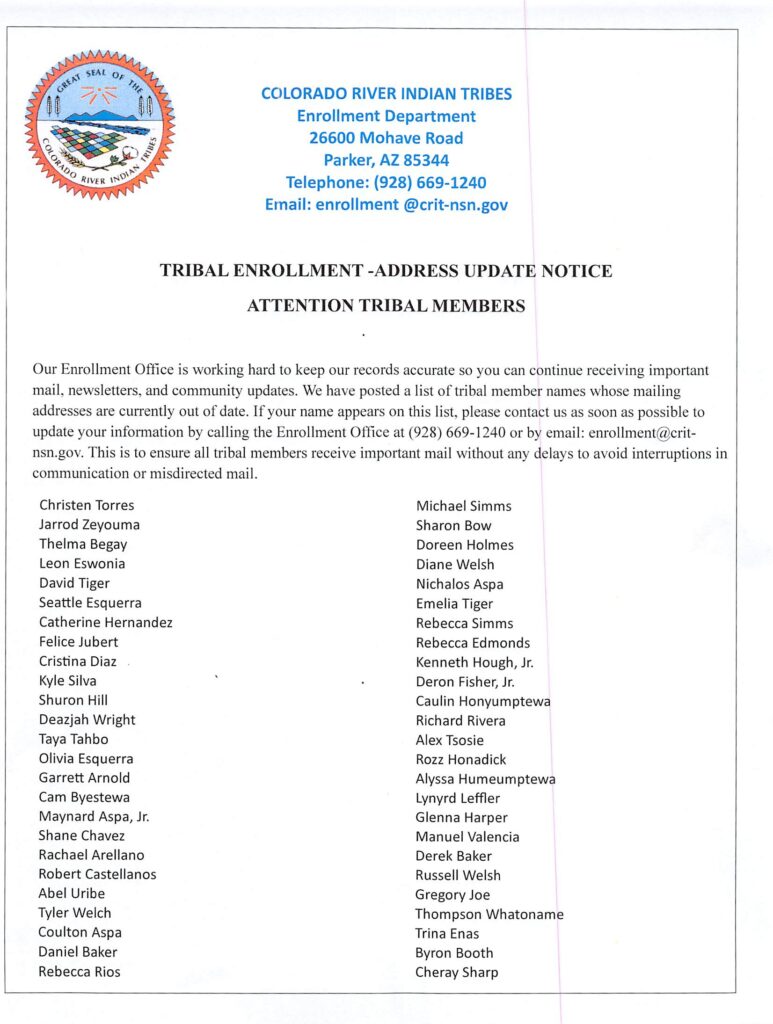
The Colorado River Indian Tribes Utilities Department has welcomed a familiar face into its leadership, naming Alex Covarrubias Jr. as the new Utilities Director.
Covarrubias is a Parker and Poston local who grew up in the community he now serves. His career in the water industry began in 2013, giving him more than a decade of hands-on and leadership experience in the field.
He started his professional journey working in Big River for three years before joining CRIT Utilities, where he served as Water Department Supervisor. During his time with the Tribe, Covarrubias gained valuable experience learning the day-to-day operations of the department and the importance of understanding the work from the ground up.
“Learning the ins and outs of the job builds character,” Covarrubias said. “I’m glad I was able to learn from the bottom.”
In 2022, he stepped away from CRIT Utilities to continue building his experience, working with the Rural Water Association of Arizona. Along with his previous roles, Covarrubias has spent years in management and believes that with a good attitude and strong work ethic, he can be an effective leader.
Returning to CRIT Utilities as Director is a full-circle moment for Covarrubias, and one he says he is excited about.
CRIT Utilities oversees essential services including water, wastewater, and solid waste for the reservation. Having spent years doing hands-on work in the field, Covarrubias believes that experience helps him better support his team. (more…)