
The Colorado River is not just a water source for the Colorado River Indian Tribes (CRIT); it is the foundation of life, culture, and survival on the Reservation. It sustains farms and families, supports wildlife, and holds deep cultural and spiritual meaning for the Tribes who have lived along its banks for generations. For CRIT, decisions about the river are not abstract policy debates, they directly affect the Tribe’s ability to live, govern, and prosper for future generations.
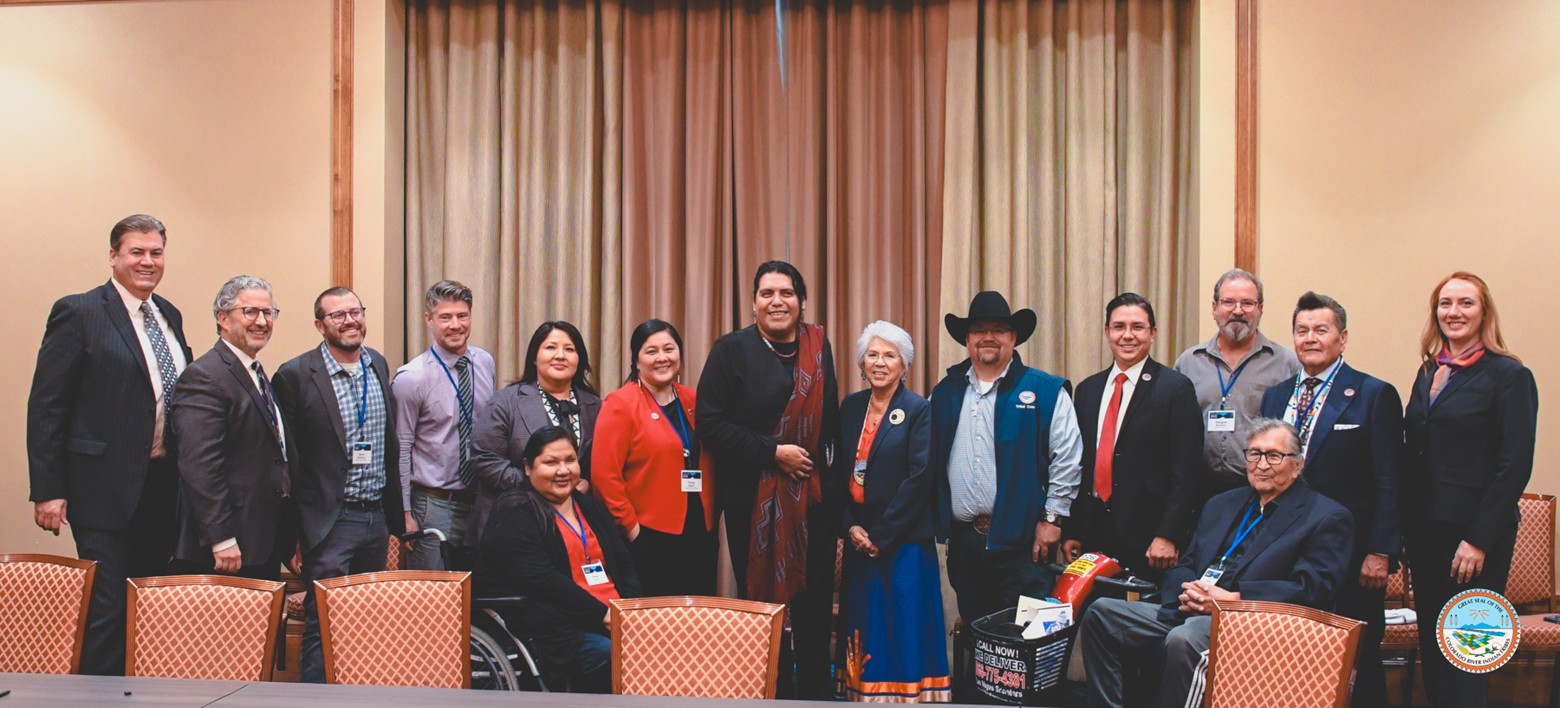
That reality framed a series of high-level meetings held alongside the Colorado River Water Users Association (CRWUA) Conference, where CRIT was represented by a unified and prepared delegation consisting of Tribal Council, legal counsel, the CRIT Attorney General’s Office, Public Affairs, and the Tribe’s Washington, D.C. and Phoenix lobbying teams, all actively engaged in advancing and defending CRIT’s water rights and sovereignty.
This delegation engaged in multiple meetings with neighboring tribes, federal agencies, state representatives, and regional water districts. As the Colorado River Basin approaches major changes after 2026, these discussions focused on the future of the river, tribal water rights, and CRIT’s role as a sovereign water authority.
At the center of these discussions was a clear and unwavering position from CRIT: the Tribe’s senior water rights, tribal sovereignty, and responsibility to protect the Colorado River are not negotiable. CRIT Deputy Attorney General Travis Nez explained that the Tribe is expanding its agricultural footprint by investing in and growing farming operations on the Reservation. This ensures that the Tribe’s water is put to use on tribal lands to generate the greatest possible economic benefit for the community. While many water users across the Basin are reducing agricultural use, CRIT is intentionally increasing on-reservation water use to reclaim water that has historically gone unused and to convert it into long-term economic benefits for the Tribe.
CRIT leadership and the Tribe is fully cognizant that neighboring and downstream entities have economically benefited for decades from CRIT’s unused Colorado River allocation. This includes large regional water agencies such as the Metropolitan Water District of Southern California. Their Colorado River Aqueduct diverts water at Lake Havasu upstream of the CRIT Reservation, supporting municipal growth and generating substantial economic value. Simultaneously, CRIT’s own ability to fully use its water has long been constrained by outdated irrigation infrastructure constructed and controlled by the Bureau of Indian Affairs (BIA).
For decades, federally recognized tribes along the Colorado River were excluded from major decision-making processes that directly impacted their water use and tribal lands. CRIT has been paramount in demanding a seat at the table. By enacting the Water Code and adopting Personhood Status through resolution, the Tribe has established a clear and unwavering position: the Colorado River will be protected and stewarded by its original and rightful caretakers.
Moving forward, CRIT emphasized that it will be an active and decisive participant in all water-related negotiations. This is not only to protect the water that flows through CRIT lands, but to also fully exercise its sovereign authority to utilize, manage, and, when appropriate, lease its water. Doing so would strengthen economic independence and long term self-sufficiency as a sovereign Tribal Nation within the United States.
These positions are not theoretical. They are grounded in enacted tribal and federal law. Through the adoption of Personhood Status for the Colorado River, CRIT formally recognizes the River as a living entity whose health and well-being must be considered in every decision made under tribal law. The CRIT Water Code further establishes the Tribe’s full authority to manage, regulate, protect, and control the use of its water resources, including permitting, enforcement, and off-reservation leasing under conditions set by Tribal Council. At the federal level, the Colorado River Indian Tribes Water Resiliency Act of 2022 affirms CRIT’s authority to enter into water leasing, exchange, storage, and conservation agreements for the economic well-being of the Tribe. Together, these actions create a clear legal, cultural, and regulatory framework that strengthens CRIT’s ability to protect the Colorado River while asserting sovereign control over its water resources.
A United Tribal Effort — With Respect for Sovereignty
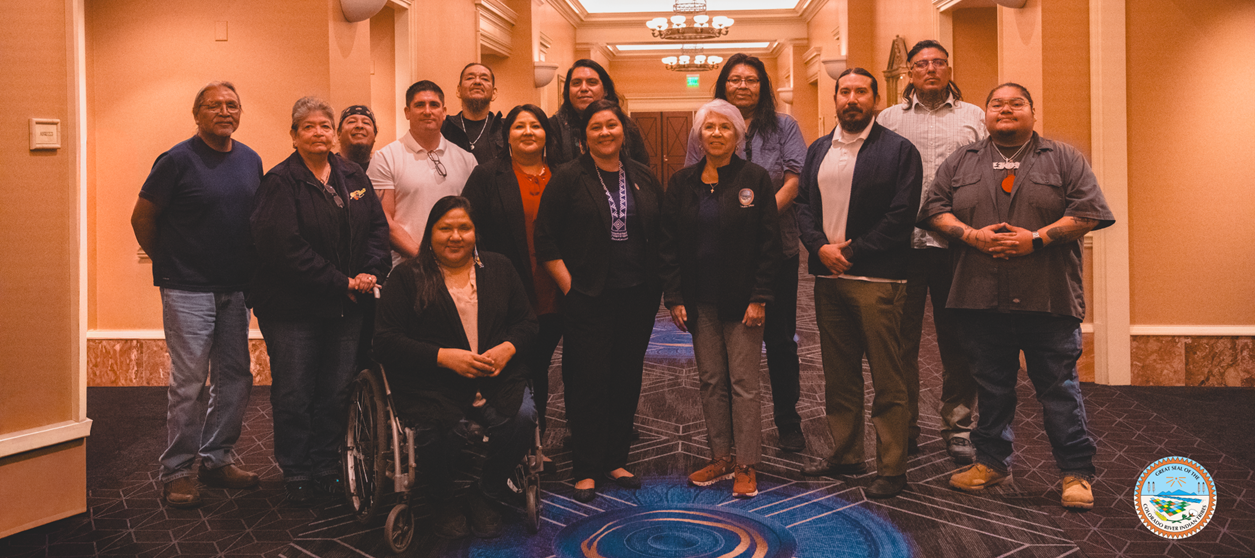
To begin the series of meetings, CRIT convened a gathering of the Five Tribes who hold Colorado River water rights recognized by the Supreme Court, CRIT, Yuma Quechan, Chemehuevi, Cocopah, and Fort Mojave (who was not in attendance) to reestablish dialogue and identify shared priorities. While each Tribe maintains its own leadership, laws, and water strategies, there was broad agreement that Tribes are strongest when they speak collectively on issues that affect them all.
Past tribal leaders emphasized that coalition-building is essential to defending tribal sovereignty, protecting natural resources, and ensuring that Tribes – not outside governments, retain authority over how tribal water is managed and used. During this discussion, CRIT Tribal Council shared the reasoning behind adopting Personhood Status for the Colorado River and enacting the CRIT Water Code as formal resolutions. These actions were presented as tools to strengthen tribal authority and long-term stewardship of the river.
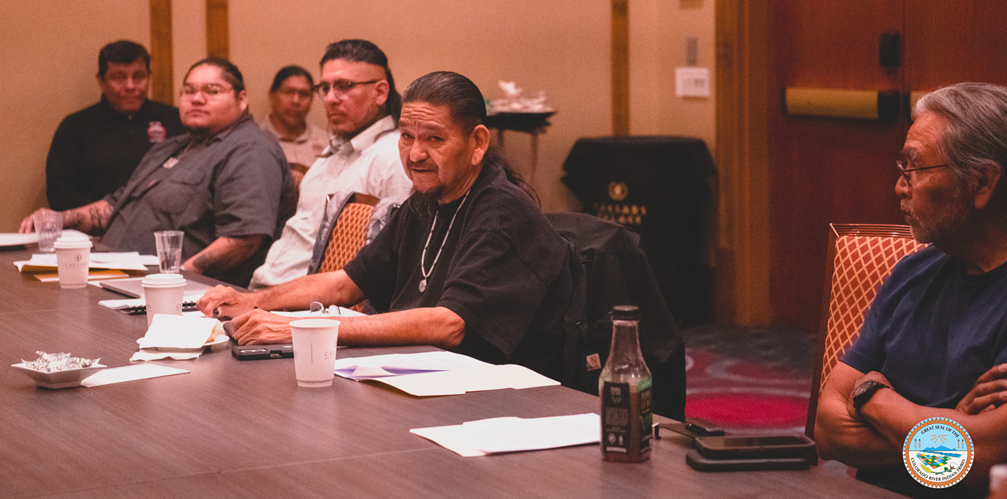
The discussion was open and substantive. Leaders posed thoughtful questions, including Chemehuevi Chairman Daniel Leivas, who acknowledged recognizing the river as a living entity could serve as a foundation for strengthening sovereignty within Chemehuevi lands.
Not every Tribe approaches these issues in the same way, and that reality was acknowledged openly and respectfully throughout the meeting. Unity does not require the surrender of sovereignty. Rather, it means standing together where interests align, particularly when engaging with federal and state decision-makers whose policies have basin-wide impacts.
Lead Water Attorney John Bezdek discusses Personhood Status at CRWUA Conference
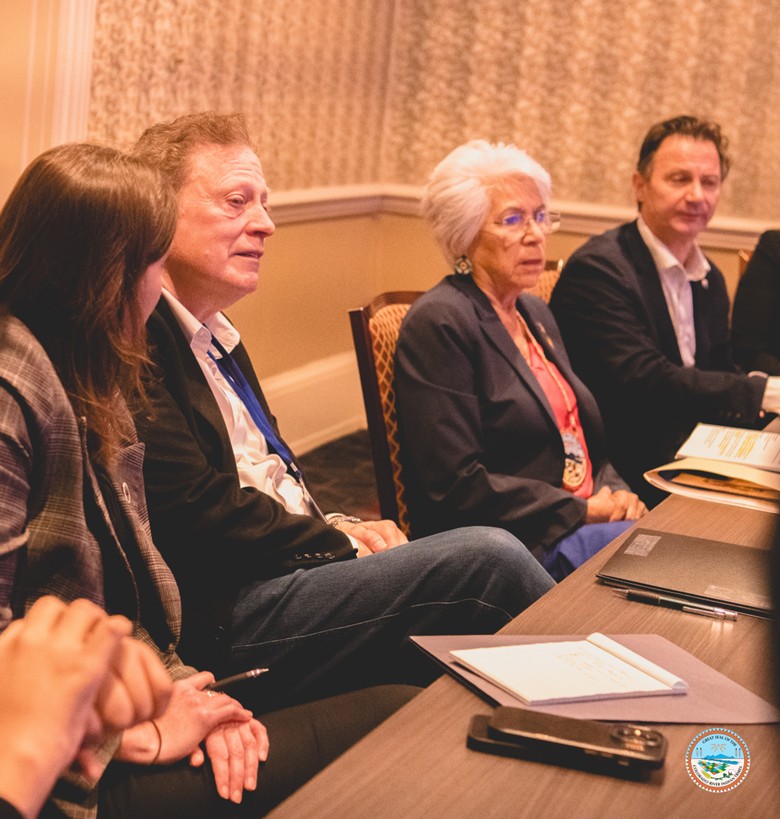
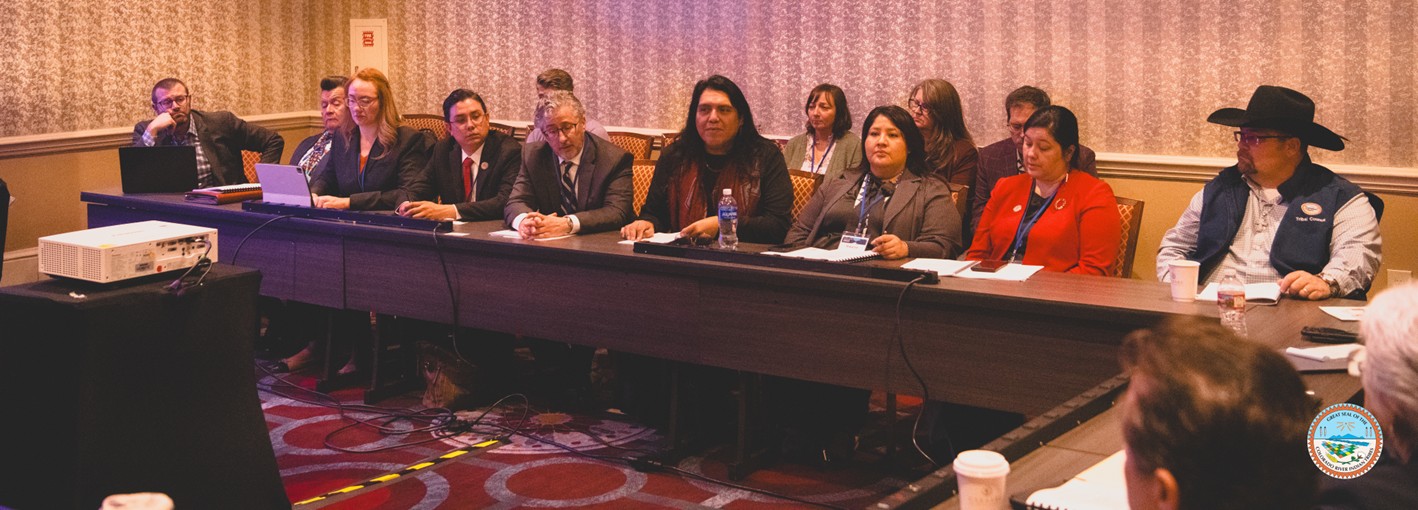
CRIT’s lead water attorney, John Bezdek, participated in a panel discussion alongside Jay Weiner, Counsel at Rosette LLP; Jenny Dumas, attorney for the Jicarilla Apache Nation; Jason Houter, in-house counsel for the Gila River Indian Community; and Dwight Witherspoon of the Navajo Department of Justice. The panel focused on Tribes’ Contributions to Conservation and Storage, during which Bezdek formally discussed CRIT’s tribal resolution of Personhood Status and the CRIT Water Code, remarks that were met with a round of applause from more than 100 attendees.
CRIT Personhood Status is not just an ideal – it is a road everyone should take
While at the conference, scientists and water researchers across the Colorado River Basin were passing out a free report on their research of the conditions of the Colorado River (link for this report can be found at the bottom of this article). In their report, they have made one point unmistakably clear: the river is in structural decline, and the era of relying on past hydrology is over. The Colorado River Research Group’s 2025 report describes current conditions as “dire,” noting that reservoir storage, once capable of buffering multiple years of drought is now largely depleted, with Lake Powell and Lake Mead together holding only a fraction of their historic capacity. Researchers Jonathan Overpeck and Brad Udall (link this to Brad Udall article) caution that warming temperatures and declining precipitation have permanently altered the river’s natural flows, concluding that future reductions are not a possibility, but a certainty.
 As the report bluntly states, “the status quo isn’t working,” and delaying difficult decisions only increases the risk of systemic failure across the basin. When Brad Udall visited CRIT back in September of 2025, he only reenforced this point – “I am not optimistic.”.
It is within this reality, not a hypothetical future, that CRIT has drawn a firm line. As post-2026 negotiations accelerate and long-standing water users reassess their positions, CRIT’s senior water rights, codified laws, and assertion of river personhood place the Tribe at the center of the basin’s most consequential decisions. State and regional water agencies are now paying close attention to CRIT not out of courtesy, but necessity. At a moment when the river can no longer sustain competing demands built on outdated assumptions, CRIT has made its position clear: sovereignty is not negotiable, stewardship is mandatory, and the Colorado River’s future must be shaped by those who have lived with, protected, and depended on it since time immemorial.
Citations for this article:
Colorado River Research Group, Colorado River Insights 2025: Dancing with Deadpool (Boulder: University of Colorado Boulder, 2025).
https://www.colorado.edu/center/gwc/ColoradoRiverInsights2025DancingWithDeadpool
Colorado River Indian Tribes Tribal Council, Resolution No. R-375-25: A Resolution to Proclaim Personhood Status for the Colorado River, November 6, 2025.
https://critmanatabamessenger.com/wp-content/uploads/2025/11/personhood-resolution.pdf
Colorado River Indian Tribes, CRIT Water Code (Parker, AZ: Colorado River Indian Tribes).
https://critmanatabamessenger.com/wp-content/uploads/2025/10/Draft-code.pdf
Colorado River Indian Tribes, Colorado River Indian Tribes Water Resiliency Act of 2022 (Parker, AZ: Colorado River Indian Tribes, 2022).
https://www.congress.gov/117/plaws/publ343/PLAW-117publ343.pdf