
Deputy Commissioner David Palumbo and Representatives from the Bureau of Reclamation (referred to as Reclamation) met with the Colorado River Indian Tribes (CRIT) Tribal Council on June 1st, 2026. This meeting was called a Government-to-Government consultation for on-going dialogue specifically regarding the development of the finalized Environmental Impact Statement (EIS). The EIS is a federal review of the different options being considered for operating major Colorado River dams and reservoirs after 2026, and the potential impacts of those options. In this meeting, representatives from Reclamation laid out developing plans they are calling Post 2026 Operational Guidelines and Strategies for Lake Powell and Lake Mead. In these guidelines, it will determine how the major Colorado River reservoirs, specifically Lake Powell and Lake Mead, are operated after the current rules expire. At the heart of Reclamation’s visit was the opportunity not only to explain its plans for the Colorado River and the Final EIS, but also to address CRIT’s major concerns with the Draft EIS. Most notably, the Draft EIS discusses the possibility of allocating shortages among all water users without regard to priority date. Priority date is the legal order that determines which water rights are senior and must be lawfully protected before junior users, to which CRIT has senior priority. This approach is known as pro rata allocation of shortages, and if applied, it will directly violate the Tribe’s senior water rights.
Reclamation’s presentation did not come with good news. According to its report, continued drought, climate variability, and historically low reservoir levels have created serious challenges for Colorado River operations. Representatives also explained that the Upper and Lower Basin states had not reached consensus on a Basin-wide proposal at the time of the meeting, making the federal decision-making process especially important. They discussed what they are calling a Preliminary Preferred Alternative: a 10-year framework that would establish broad operational principles and sideboards while allowing specific operational guidelines to be updated every two years. This method would provide flexibility rather than locking the Basin into a single fixed set of rules for the entire decade.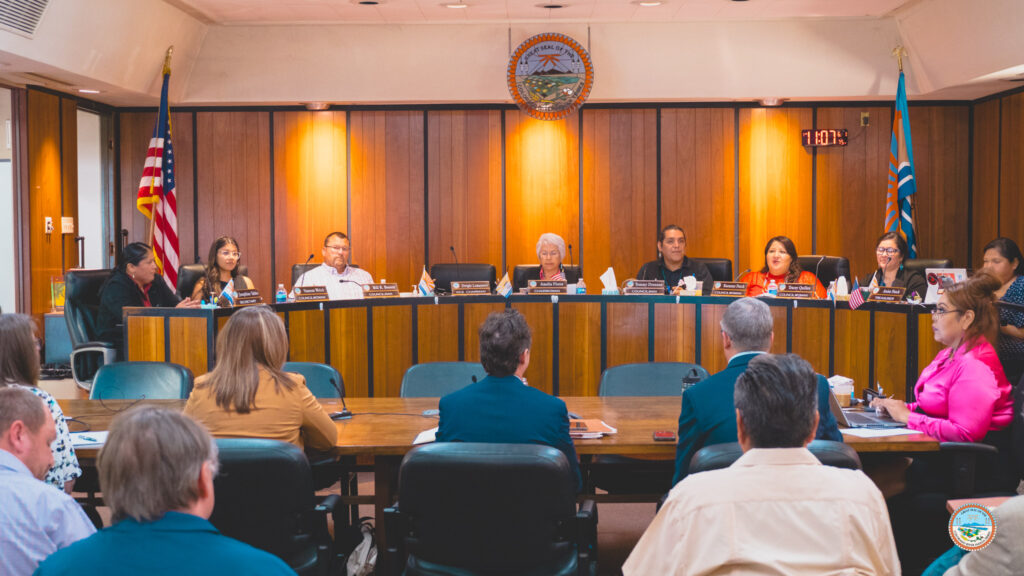
This means that Reclamation will decide operations for 2027–2028 first, then revisit operations for 2029–2030, and continue in two-year cycles. They said this might help tackle things in a real-time manner and adjust if required.
In response, CRIT Tribal Council members emphasized that the present crisis cannot be separated from the federal government’s long-standing obligations to the Tribe, including the need to address aging irrigation infrastructure and support CRIT’s ability to fully use and store its water. Council members expressed that, had those commitments been fulfilled earlier, CRIT and the Basin may be facing a very different situation today. Additionally, the conversation was centered mostly around pro rata, with all of Tribal Council members doubling down on making Reclamation commit to removing pro rata language in the final EIS.
Direct Quotes from Tribal Council state:
Chairwoman Amelia Flores: “The Colorado River Indian tribes is asking for your commitment to express in the final EIS that pro rata is illegal and be eliminated under these alternatives.”
Although Vice Chairman Dwight Lomayesva was not present for the meeting, he later stated that pro rata allocation runs counter to CRIT’s position and the water rights secured under the Arizona v. California decree. He said he firmly opposes any approach that would violate or diminish the Tribe’s senior water rights.
Councilwoman Vanessa Welch: “With respect to our rights and the laws, pro rata shouldn’t even be a part of the conversation. Will you agree to stop including pro rata in the documents?”
Councilman Tommy Drennan: “We need to know that when you are looking at pro rata methodology that its just that, hypotheticals that compare and contrast losses, to get to the ultimate solution. That is what Madam Chair is asking that you commit to, when you use that term, it sends fear to my membership. It leaves a bad taste in our mouth as Native People…Will they be accounted for? Will the EIS report read that it takes half of our water to push water through an irrigation canal designed by the Federal Government? Will it incorporate the calculations of who benefits from the return flow of CRIT?”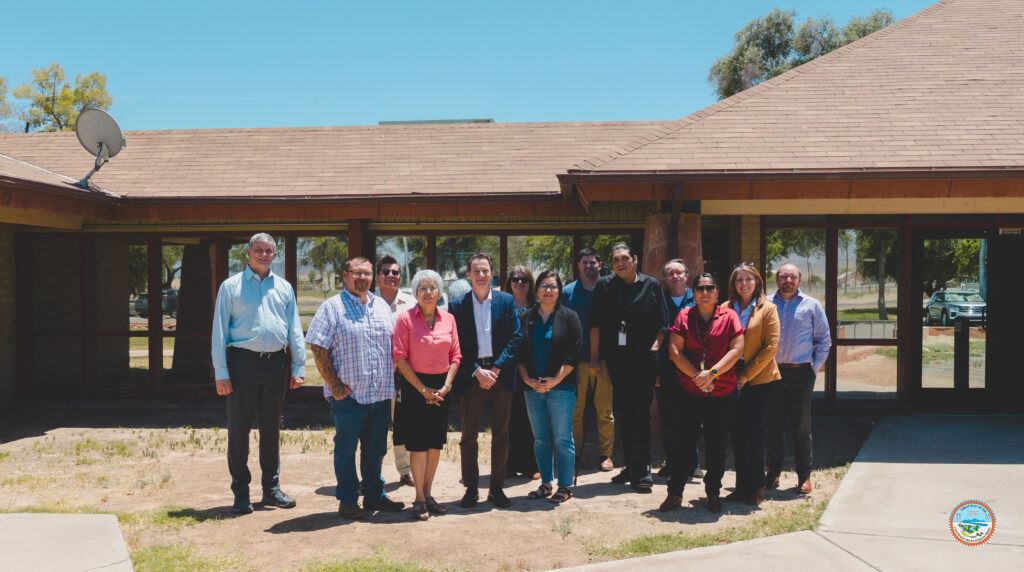
Reclamation’s Response:
When the Draft EIS was initially released, pro rata shortage concepts appeared throughout the document with no explanation of how they would apply to CRIT’s water rights. In several sections, pro rata is presented as a method for distributing Lower Basin shortages, but the document does not clearly state that any reductions involving Tribal water would have to be voluntary and could not override CRIT’s decreed senior water rights. Reclamation said it does not plan to remove the pro rata analysis entirely because it provides environmental coverage for voluntary water-sharing agreements that may be used to address shortages.
However, Reclamation representatives also specifically stated that neither Reclamation nor any other entity has the authority to reallocate CRIT’s water for someone else’s use.
They explained, “Other parties cannot consent to give up the Tribe’s water. It is a voluntary action by the Tribe as well. Nobody can come in and say three states consent, and therefore the Tribe has to do something. It is all on a voluntary basis, and by analyzing pro rata, we open up this voluntary world to everybody.”
For CRIT, that distinction is critical, and had only been stated in the meeting, not in the DEIS nor in the presentation slides. Councilman Drennan said, “We don’t exist like other Arizona tribes, if you throw CRIT in with other tribes you would think we all have the same type of rights, we have present and perfected rights – no CAP[1] tribe has that. Yet the impacts and everything that we are assessing and analyzing…needs to be made concise and transparent (in the EIS).” Without clearer language, pro rata can be read as placing CRIT water (which is first priority, senior users) in the same shortage-sharing framework as junior users (last priority users), despite CRIT’s long-established rights, agricultural economy, and deep historical and cultural connection to the Colorado River.
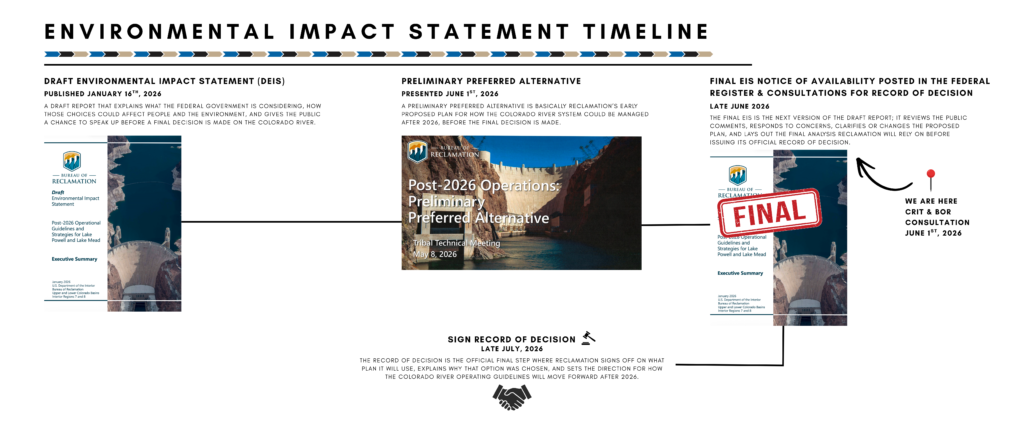
Understanding the timeline: The issue began when the DEIS included pro rata shortage concepts, raising serious concerns for CRIT because such language could be read as placing senior tribal water rights in the same reduction framework as junior water users. CRIT responded with a detailed comment letter opposing any approach that would disregard the priority system or weaken the Tribe’s decreed water rights. Reclamation has since acknowledged CRIT’s position by moving away from pro rata cuts to CRIT water in its Preliminary Preferred Alternative. Tribal Council has described this development as an important milestone in protecting the Tribe’s senior water rights. However, Council emphasized during the meeting that the process is not final. Until the Final EIS and Record of Decision is completed, CRIT continues to insist that any remaining pro rata language be written with absolute clarity: voluntary reductions by willing states or water users cannot be confused with involuntary reductions to CRIT’s senior water rights. Tribal leaders made clear that CRIT’s legal and technical experts must remain directly involved to ensure the final federal documents plainly state that CRIT’s water cannot be reduced, reallocated, or included in any pro rata shortage framework without the Tribe’s consent.
Reclamation repeatedly said it wants to maintain and strengthen its relationship with CRIT and committed to continued consultation as the process develops. Reinforcing their statement of commitment to “no longer seek to allocate across-the-board shortages to all water users as previously proposed, but instead follow current law and respect senior tribal rights.” (https://critmanatabamessenger.com/articles/news/update-on-post-2026-process-reclamation-accepts-tribal-council-position-no-pro-rata-cuts-on-crit-water/) CRIT leadership made clear that the Tribe wants more than informational updates, they expect meaningful inclusion, clear language, and recognition of CRIT’s unique legal and cultural position on the river.
Council Treasurer Anisa Patch: “We know what the analysis is, we’ve been watching the drop year after year. Its never been fair, and its never been right. I hope that this is being acknowledged and documented on your side as much as ours. This tribe is speaking not just for itself, but for all tribes, especially the ones that live among this river. We also ask that all this analysis be included in the EIS. Tribes should be in the room as major decision makers, not merely influencing it.”
Additional Questions/Conversations with Reclamation:
Councilwoman Tracey Quillen: “Will you commit to setting aside funds for the Colorado River Indian Tribes and Indian Country in the basin, with respect to the funds you mentioned that will be available for the Colorado River?”
Reclamation said future federal funding may come with legal restrictions or specific congressional requirements, therefore are unable to make a full commitment at this time. However, representatives said that if Reclamation receives discretionary funding, it would seriously consider setting aside funds for Tribal needs and would meet with CRIT to identify eligible infrastructure and other priority projects. They acknowledged that significant Tribal needs remain open and in need of funding.
Councilman Billy Beeson: “Since we’re talking about money, some of the sites you are going to today require funding. Does Reclamation have any funds that can help us fund these projects that have been identified by our staff here?”
Reclamation said it would examine the sites during the field tour and determine whether existing federal programs could support the proposed restoration or wetland work. Representatives explained that funding received via Inflation Reduction Act was largely obligated or already committed, but said there may be money available through other programs, including the Aquatic Ecosystem Restoration Program under the Bipartisan Infrastructure Law. They also said future congressional appropriations could provide additional opportunities.
Councilwoman Raeanne Patch: “CRIT wants to avoid fallowing any further land and disrupting our farmland and economy any further. Will the Bureau of Reclamation assist CRIT in a plan of crop mix and make available your legal and technical staff for that purpose?
Reclamation agreed that crop mix could be an important conservation tool, and committed to working directly with CRIT. Representatives said they would make Reclamation’s legal and technical staff available to meet with the Tribe and develop a durable crop-mix program that could reduce consumptive use without requiring additional land fallowing. They stressed that the program would need reliable water accounting and a structure capable of withstanding questions or challenges from other states and water users. Reclamation also recognized that CRIT’s work could help establish a model for similar programs elsewhere in the Basin.
Council Secretary Josephine Tahbo: “We’ve had some delays on the final design of the reservoir we had, can you give us some updates on that?”
Reclamation said they expect that to be finalized this month.
[1] CAP stands for the Central Arizona Project, a canal system that delivers Colorado River water to cities, farms, and Tribal communities in central and southern Arizona. Tribes receiving water through CAP have different legal and delivery arrangements than CRIT, which holds senior, decreed rights to water delivered directly from the Colorado River.