
Recent storms brought significant rainfall across Arizona and the Four Corners, raising reservoir levels and increasing river flows. But water experts say the temporary boost does not change the Colorado River Basin’s long-term shortage.
In Arizona, Salt River Project increased releases from Bartlett and Stewart Mountain dams after historic rainfall sent large amounts of runoff into the Salt and Verde river systems. The releases pushed water through normally dry sections of the Salt River near Phoenix and helped create room in reservoirs for additional runoff.
The same storms also caused destructive flooding across Arizona, prompting a statewide emergency declaration.
Groundwater received some benefit from the rain, but recovery will be much slower. KOLD reported that a University of Arizona hydrologist said recent rainfall could help shallow groundwater supplies, while deeper aquifers around Tucson could take decades or even hundreds of years to recover.
Conditions also improved temporarily at Lake Powell. Cowboy State Daily reported that the reservoir gained more than 500,000 acre-feet between Oct. 21 and Oct. 28, raising the lake roughly nine to 10 feet. From its September low through late October, Powell gained about 600,000 acre-feet.
Even with that increase, Lake Powell remained only about 26% full and roughly 174 feet below full pool.
The recent gains also come as federal managers continue releasing water from Flaming Gorge Reservoir to support Lake Powell. Those releases have lowered Flaming Gorge and affected recreation and marina operations in Wyoming. (more…)
Arizona’s dispute over the federal Colorado River plan has officially moved into the courts, adding another layer of uncertainty as the state prepares for major reductions in its water supply.
KJZZ reported that the Arizona Department of Water Resources and the Central Arizona Project have both moved to join Nevada’s lawsuit challenging the federal government’s new Colorado River operating plan.
Nevada’s lawsuit asks the Interior Department to reconsider the plan for reducing water use in Arizona, California, and Nevada. Arizona and CAP argue that the federal government did not adequately consider the economic and community impacts of the reductions and placed too much of the burden on the Lower Basin.
The federal framework allows reductions to Arizona, California, and Nevada of up to 40% per year under some conditions, while requiring no new mandatory reductions from the Upper Basin states of Colorado, New Mexico, Utah, and Wyoming.
Arizona officials are also raising a larger legal question about whether the Upper Basin is meeting its obligations under the 1922 Colorado River Compact.
KJZZ reported that the current lawsuit does not directly ask the courts to settle that dispute. However, Arizona’s filings outline arguments that could eventually form the basis of a much larger interstate case before the U.S. Supreme Court.
Water experts interviewed by KJZZ described that possibility as a “nuclear option” because a state-versus-state Colorado River case could take years and create even greater uncertainty.
For now, Arizona, California, and Nevada are still attempting to negotiate how Lower Basin reductions will be divided. The federal rules could also be replaced if all seven Basin states eventually reach their own agreement.
While that legal fight continues, Arizona communities are developing their own strategies for living with less Colorado River water.
KJZZ reported that Queen Creek has spent years reducing its dependence on groundwater and developing additional supplies to support the fast-growing community.
The town is investing in groundwater from the Harquahala Valley in western Maricopa County. Queen Creek Utilities Director Marc Skocypec said the basin has more than 8 million acre-feet of identified groundwater, compared with Queen Creek’s current annual demand of about 30,000 acre-feet.
That water must still be pumped and transported to the southeast Valley, including through the Central Arizona Project canal. Those costs are being incorporated into a water resource fee charged to customers.
According to Skocypec, the fee is designed not only to pay for current water investments but also to help replace and replenish supplies over time so the town can continue demonstrating a 100-year water supply. (more…)
The final week of October brought another escalation in the legal fight over Colorado River cuts, while Tribal leaders continued pushing for a major Arizona water rights settlement and new research showed that groundwater reserves across the Basin are also declining.
The Central Arizona Project moved to join Nevada’s lawsuit challenging the federal government’s new Colorado River operating plan.
KJZZ reported that CAP filed to join the lawsuit after the Arizona Department of Water Resources made a similar move earlier in October. The lawsuit argues that the federal plan places too much of the burden on Arizona, California, and Nevada while requiring no comparable mandatory reductions from Colorado, New Mexico, Utah, and Wyoming.
CAP operates the 336-mile canal that delivers Colorado River water to central and southern Arizona. Under the federal framework, CAP could face some of the deepest reductions because of its junior priority within Arizona’s Colorado River allocation.
CAP General Manager Brenda Burman said the agency had spent years trying to avoid litigation but ultimately decided it needed to defend its water rights and its interpretation of the laws governing the river.
The lawsuit also raises questions about the 1922 Colorado River Compact. CAP and other Lower Basin interests argue that the Upper Basin has obligations to deliver sufficient water downstream and that the new federal plan does not adequately enforce those requirements.
Interior Secretary Doug Burgum pushed back on Arizona’s legal challenge during a visit to the state.
ABC15 reported that Burgum warned that taking the issue before a judge could create additional risk for Arizona because of the state’s relatively junior priority compared with other Colorado River users. He said the federal government developed the operating plan after the seven Basin states failed to reach their own agreement.
Despite the legal disagreement, both federal and Arizona officials acknowledged that the central problem remains the same: the Colorado River is producing less water, and the Basin still needs a longer-term solution.
While those legal questions continue, Tribal leaders in northeastern Arizona are asking Congress to finalize one of the largest Tribal water settlements in the state.
The Arizona Capitol Times reported that leaders from the Navajo Nation, Hopi Tribe, and San Juan Southern Paiute Tribe urged Congress to approve the Northeastern Arizona Indian Water Rights Settlement Act.
The legislation would resolve outstanding water claims for the three Tribes, fund a pipeline from Lake Powell, and establish trust funds to help build water infrastructure.
For the San Juan Southern Paiute Tribe, the legislation would also establish a reservation the Tribe has sought for decades.
The settlement would allow the Navajo Nation and Hopi Tribe to lease portions of their Upper Basin Colorado River water to other Arizona users. Tribal and water leaders said the agreement could provide greater certainty for both Tribal communities and other Colorado River users.
The discussion again highlighted a recurring issue with Tribal water rights: having a legal right to water does not necessarily mean a community has the infrastructure needed to use it.
Groundwater is facing its own challenges.
The University of Arizona Water Resources Research Center highlighted a new study documenting sustained groundwater losses throughout the Colorado River Basin over the past two decades.
Researchers found that groundwater depletion accelerated after 2019, particularly during the 2020–2022 drought. Higher temperatures, reduced precipitation, and increased water consumption all contributed to the losses.
The study found that groundwater storage in the Lower Basin is especially vulnerable because natural recharge is limited. Researchers examining Arizona’s Active Management Areas found that groundwater declines were linked largely to increased pumping during drought and reductions in Colorado River supplies.
The study also concluded that groundwater losses across the Colorado River Basin have exceeded losses from the system’s major surface reservoirs.
That finding is significant because groundwater is often treated as a backup when surface water supplies decline. If both systems are losing water at the same time, communities have fewer options during extended drought.
October storms did provide some short-term relief.
Arizona’s Family reported that Lake Powell gained about 12 feet in two weeks following recent storms. Despite the increase, the reservoir remained at approximately 25% capacity. Lake Mead remained even lower, at about 23% capacity. (more…)
As Arizona prepares for reduced Colorado River deliveries, the state is beginning to shift from years of saving water for future shortages to actually using some of those reserves.
KJZZ reported that the Arizona Water Banking Authority will use a one-year policy to fully “firm” water supplies lost by participating cities and utilities because of Colorado River shortages. Firming provides backup water to eligible users when their normal Central Arizona Project supplies are reduced.
The strategy could conserve up to 56,179 acre-feet in 2027 as cities and utilities rely on previously stored water rather than additional Colorado River deliveries.
The Water Banking Authority was created to store unused Colorado River water underground for future shortages. Arizona Water News reported that the agency is now entering a different phase. With less excess CAP water available for storage and shortages becoming more likely, the focus is shifting toward recovering and distributing the long-term storage credits accumulated over previous decades.
The Water Bank also has responsibilities for Tribal firming under the Arizona Water Settlements Act, along with providing backup supplies for certain municipal and industrial CAP users.
Stored water can help Arizona manage near-term shortages, but state officials are also considering how to bring entirely new supplies into Arizona over the longer term.
The Arizona Capitol Times reported that the Water Infrastructure Finance Authority of Arizona is studying five potential water importation projects. Together, the projects could eventually produce hundreds of thousands of acre-feet annually, although none have entered construction.
Among the projects being studied are desalination plants in Mexico and California, reclaimed-water projects involving Mexico, and proposals that could exchange new water supplies for portions of Colorado River allocations.
Two projects approved for further study in early October involve a proposed desalination plant near Mexico’s Gulf of California and a project that would recover and treat reclaimed water in Mexico for use as part of Arizona’s future supply.
Early estimates vary widely. The five projects could potentially produce nearly 1 million acre-feet annually under the highest estimates, while more conservative projections place the combined amount closer to 361,000 acre-feet.
Arizona’s expected Colorado River reduction is about 760,000 acre-feet per year, showing why state officials are considering several different options rather than relying on one project.
Cost remains one of the largest obstacles. Arizona lawmakers have provided WIFA about $386 million for long-term augmentation work, but individual desalination projects could cost billions of dollars.
While the state studies new supplies, some cities are also looking more closely at how much water new developments use.
KTAR reported that Scottsdale is considering a large-water-user ordinance in response to Colorado River reductions. City staff recommended requiring new large users to submit conservation plans, while council members also discussed additional review for projects expected to use more than 500,000 gallons of water per day.
The discussion reflects a broader question facing Arizona: how much water can be saved through conservation compared with how much new water needs to be developed.
ABC15 reported that agriculture accounts for nearly three-quarters of Arizona’s overall water use, significantly more than sectors such as golf courses or data centers. That makes agriculture an important part of statewide water discussions, particularly as officials look for ways to reduce demand while protecting Arizona’s economy and food production.
Conditions upstream show why those conversations continue.
KUNC reported that Blue Mesa Reservoir, historically Colorado’s largest body of water, fell below 20% full this year after a poor snowpack and prolonged drought.
Low water forced the Elk Creek Marina to close in early July, months earlier than usual, and affected recreation, fisheries, and agriculture. Farmers receiving water from the Gunnison River system also had to leave some fields dry or reduce production. (more…)
The new Colorado River water year began Oct. 1 under a different operating framework, but Arizona’s biggest reductions will not take effect until the start of 2027.
KJZZ reported that the new federal rules begin changing how much water is released from Lake Powell to Lake Mead as the 2027 water year gets underway. Arizona’s own reductions, however, are tied to the calendar year and are expected to begin Jan. 1.
Arizona, California, and Nevada are still working to finalize a Lower Basin agreement that would determine how the reductions are divided among water users. KJZZ reported that Arizona’s top water negotiator, Tom Buschatzke, remains optimistic that the three states can complete the agreement before the end of the year.
Under the current framework, Arizona is expected to reduce its Colorado River use by 760,000 acre-feet in 2027, assuming the Lower Basin states finalize their proposed sharing agreement. ABC15 reported that the reduction would equal about 27% of Arizona’s normal Colorado River allocation.
The exact impact on individual cities and water providers is still being worked out. Phoenix officials told ABC15 that the city does not yet have a final number for how much of the statewide reduction will be reflected in its Central Arizona Project supply.
Arizona Water News reported that the Arizona Water Banking Authority is entering a new phase. Created in 1996, the Water Bank stored unused portions of Arizona’s Colorado River entitlement underground and accumulated long-term storage credits that can be recovered during shortages.
Through 2024, the Water Bank had accumulated more than 4.4 million acre-feet of long-term storage credits, including approximately 3.8 million acre-feet for Arizona uses and more than 600,000 acre-feet on behalf of Nevada.
The Water Bank also has responsibilities for firming certain Central Arizona Project municipal and industrial supplies and for helping meet Arizona’s Tribal firming obligations under the Arizona Water Settlements Act.
As Colorado River shortages deepen, those stored supplies are becoming more important. Instead of focusing primarily on putting additional water underground, the Water Bank is increasingly preparing for the recovery and use of water that has already been stored.
Cronkite News reported that some rural residents around Chino Valley are already dealing with wells that have gone dry, forcing them to rely on water-hauling businesses and private storage tanks.
The Prescott Active Management Area has been considered outside of safe yield for more than two decades, meaning groundwater is being removed faster than it is being replaced. Local officials told Cronkite News that continued growth and groundwater pumping have contributed to declining water levels.
The situation is separate from the Colorado River shortage, but the two issues are connected through Arizona’s broader water supply. As Colorado River deliveries decline, groundwater and stored underground supplies are expected to play a larger role for some communities.
KUNR reported on new research showing that wildfire is burning more land in watersheds that provide water to communities across the West. Researchers analyzed more than 17,000 watersheds and found that the average amount of land burned annually nearly doubled in watersheds serving more than 100,000 people.
Wildfire can temporarily increase runoff, but it can also worsen water quality by sending sediment, nutrients, and debris into rivers, reservoirs, and water treatment systems. Those effects can continue for years after a fire. (more…)
As September came to a close, Colorado River discussions shifted from announcing future cuts to a more difficult question: how will communities protect their water supplies as those reductions move closer.
In southwestern Arizona, Yuma officials are preparing for possible legal action on two separate water issues.
Arizona’s Family reported that the Yuma City Council unanimously authorized the city to prepare for legal action involving both Colorado River operating rules and a proposed transfer of Colorado River water from agricultural land in La Paz County to Queen Creek.
The proposed transfer involves water associated with GSC Farm. Yuma is joining Mohave and La Paz counties in challenging the transfer because local leaders are concerned about the precedent of moving water away from rural agricultural communities and toward growing metropolitan areas.
Yuma officials are also considering possible legal action involving the federal government’s new Colorado River operating guidelines. Mayor Doug Nicholls said Yuma wants to participate in addressing the river’s shortage but does not want agriculture to carry the entire burden. Yuma-area farms are an important source of winter produce for the United States.
At the same time, Arizona lawmakers are looking at another way to stretch the Colorado River supply.
KAWC reported on proposed federal legislation that would authorize restoration of the Yuma Desalting Plant, which was originally constructed to treat salty agricultural drainage water from the Wellton-Mohawk Irrigation and Drainage District.
The proposed Colorado River Basin Water Security and Infrastructure Act would authorize $19 billion for water projects throughout the Basin, including $1 billion to restore the Yuma plant. Supporters say treating agricultural drainage water could reduce the amount of Colorado River water needed to meet downstream delivery requirements.
Arizona cities are also investing in their own water systems.
ABC15 reported that Phoenix is constructing a new 20-million-gallon reservoir at the Union Hills Water Treatment Plant. Historically, about 40% of Phoenix’s delivered water has come from the Colorado River, and city officials said the additional storage will give the system more flexibility as supplies become less certain.
Scottsdale, meanwhile, is considering additional review for new developments expected to use large quantities of water. Under the proposal, developments projected to use more than 100,000 gallons per day could face additional city approval requirements. The proposal had not yet been adopted when the story was published.
Private companies are also becoming more involved in Colorado River conservation.
KJZZ reported that Amazon pledged $20 million toward water-saving projects in Arizona and California. One proposed project would improve irrigation efficiency with an unnamed Tribal Nation in northern Arizona.
The investment is part of a larger effort to bring private funding into Colorado River conservation. KJZZ noted, however, that the scale of the river’s shortage is much larger than any single corporate investment. Major conservation programs involving farms, cities and infrastructure can require billions of dollars.
While states, cities and private companies look for ways to conserve or develop additional supplies, Lake Powell continues to show why those efforts are becoming urgent.
A Sept. 29 report said Lake Powell stood at about 3,518 feet in elevation, roughly 28 feet above minimum power pool, the level where Glen Canyon Dam can no longer effectively generate hydropower.
The reservoir had already reached a modern record low earlier in September. If Lake Powell falls below minimum power pool, water could still move through Glen Canyon Dam, but hydropower production would stop and dam operations would become more difficult.
The report also noted that federal efforts to protect Lake Powell can create consequences downstream. Reducing releases from Powell helps preserve its elevation but sends less water toward Lake Mead, demonstrating the difficult tradeoffs involved in managing the two reservoirs together.
Late September also marked the end of an era in Colorado River management. KGNU reported that the 2007 Interim Guidelines, which have governed operations during much of the river’s prolonged drought, were scheduled to expire Oct. 1. Years of negotiations among the seven Basin states had failed to produce a replacement agreement, leaving the federal government’s new management framework to guide the next phase of river operations. (more…)
The Colorado River Indian Tribes’ second annual General Sessions meetings gave Tribal Members a closer look at the programs, services, and projects serving their community. Two meetings, one at BlueWater Resort & Casino for members living on the reservation and another for members in the Phoenix area, drew strong attendance, with hopes of welcoming even more participants in the years ahead. Councilwoman Raeanne Patch has championed these annual fall gatherings as an opportunity to strengthen communication between Tribal Members and their government. Each year, a different group of departments is highlighted, giving members an informal overview of their responsibilities, services, and contributions to CRIT. Councilwoman Patch’s goal is for each featured department head to attend and present directly to the membership.
This year, the Environmental Protection Office outlined its water and air quality programs, while Fish and Game highlighted conservation, reservation patrols, and youth education. The Tribal Historic Preservation Office explained how monitors protect sacred sites, ancestral lands, and cultural resources on and off the reservation. Updates on Tribal finances, the new Head Start facility, and proposed health facilities provided a broader picture of current operations and future plans. CRIT Media highlighted its efforts to keep members informed through the Manataba Messenger, 4 Tribes One Mic podcast, and digital storytelling.
Agriculture was another highlight, with ’Amat Kuwley Farms showcasing its role in CRIT’s economic future and stewardship of Colorado River water. General Manager Joshua Moore oversees production while building relationships with customers domestically and internationally. The farm reported impressive production accomplishments and plans to expand cultivation across available farmland, putting CRIT’s senior Colorado River water rights to productive use while generating revenue for the Tribes. Its alfalfa serves high-profile clientele, including Saudi royalty and owners of Kentucky Derby racehorses, helping establish a reputation for premium quality on the world stage. Moore’s work reflects a long-term commitment to building an agricultural enterprise that supports generations of Tribal Members while helping safeguard CRIT’s water rights.
Members who missed this year’s meetings are encouraged to watch for flyers announcing the next gatherings in fall 2027. Thank you to Councilwoman Raeanne Patch for organizing these annual opportunities for members to learn, connect, and stay informed about the work happening across CRIT.

By Nicole Jennings
A decade after college, 1L and 2026 Nash Scholar Lauren Drennan’s strong ties to her Indigenous community led her to pivot in her career path.
Growing up on the Colorado River Indian Tribal (CRIT) lands in rural Arizona, Drennan had always planned to go into agriculture, even choosing a STEM path for her undergrad studies at the University of Arizona. A self-proclaimed “farm kid,” Drennan had participated in 4-H as a child and raised animals on her family’s property.
But returning home to her tribe through internships while earning her degree convinced her there was another path for her. The internships centered around community programs in areas such as environmental preservation and restoration.
“That’s where I found my passion, working for my community in these outreach programs,” Drennan said. “Those tribal internships saved me because getting to connect back to my home and finding that thing that made me happy felt like it clicked.”
Drennan’s hometown of Parker is small and tight-knit, with many of the other residents numbering among her relatives.
“The services I worked for were for community and my family,” she said, crediting her mentors in the region with instilling a sense of civic-mindedness within her.
She went on to spend 10 years after her undergrad and graduate studies at the CRIT Department of Health and Social Services, which provides a variety of tribal programs ranging from mental health to senior support to child protective services. Drennan held a variety of roles in that time, including interim director, deputy director, coordinator, grant writer, budget specialist, and even HR staffer. (more…)
Article written by CRIT Media Reporter Ariana Romero
The young men of the Parker Broncs football team have shown strength, endurance, and determination throughout an incredible season. The Broncs remain undefeated at 8-0, but tonight, there is even more on the line.
Parker will take on Arizona Lutheran Academy in a battle for the 2A Metro 2 region title. Both teams enter the matchup undefeated in region play, with the Broncs looking to protect their perfect season in their final home game of the regular season.
Tonight will also mark Senior Night, giving the Parker community an opportunity to recognize the seniors who will take their home field one more time. After years of practices, games, and representing Parker High School, the seniors have a chance to close out their final home game with a region title on the line.
Kickoff is set for 7 p.m. at Joe Bush Stadium, and the Broncs are hoping to see the community pack the stands, get loud, and bring the energy.

Hard Work, Brotherhood, and One Goal
Being undefeated means a lot to this group of young men. The work behind their 8-0 record started long before Friday nights under the lights. Players trained through Parker’s extreme heat, spent hours lifting weights and conditioning, and continued working in the classroom to maintain the grades needed to compete.
During interviews with CRIT Media, one thing became clear: this is a TEAM.
When asked to describe their teammates and what has made this season special, the players gave many of the same answers: brotherhood, family, and best friends. Their similar responses reflected the bond they have built through long practices, workouts, wins, and challenges together.
That bond was just as noticeable while speaking with the team. The players were humble, polite, and proud to be Parker Broncs. Each showed respect for his teammates, coaches, and the game. While an undefeated record is something to celebrate, their focus remains on what is still ahead.
Their goal for the season is simple: keep winning and bring home the trophy. (more…)
Chairwoman Flores says CRIT And Tribal Governments must have a meaningful voice in decisions affecting the Colorado River and future generations
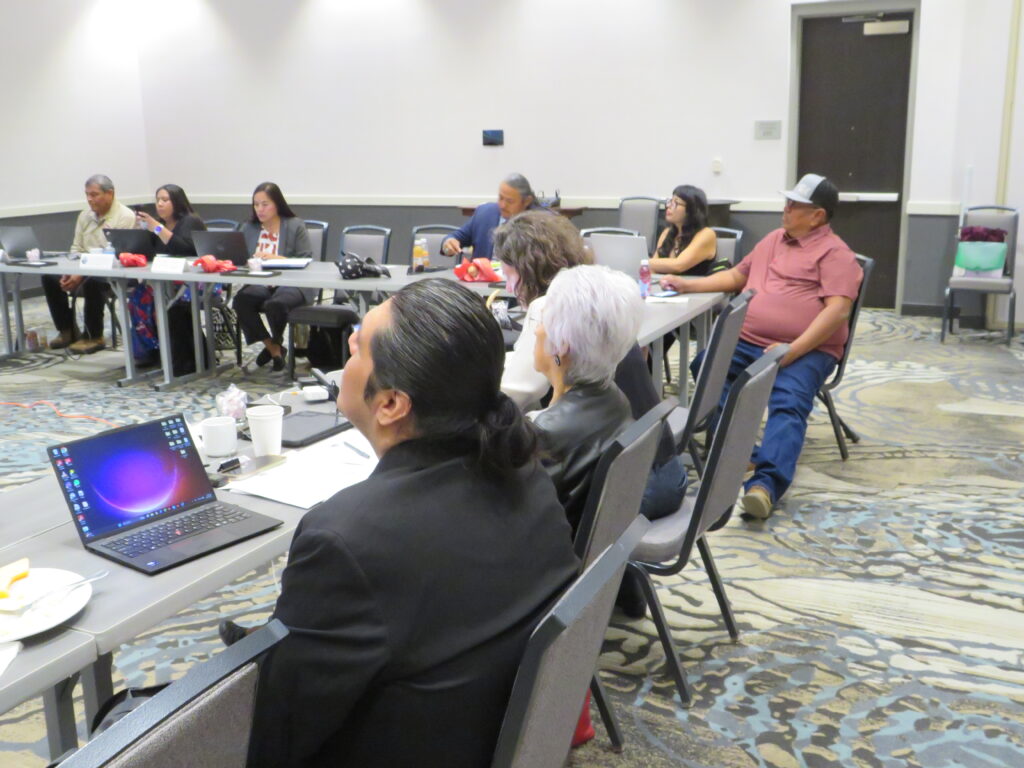
(SCOTTSDALE, Ariz.) Colorado River Indian Tribes leaders carried a message rooted in the Reservation’s past, present and future to the Ten Tribes Partnership meeting Wednesday: CRIT’s water rights must be protected, and tribal governments must have a meaningful voice in decisions shaping the Colorado River.
CRIT Chairwoman Amelia Flores chaired the October 14 meeting, joined on site by Tribal Councilmember Tommy Drennan. CRIT water attorney John Bezdek and other CRIT Tribal Council members participated remotely. CRIT’s presentation outlined the legal protections surrounding CRIT’s water rights and concerns about federal proposals that could threaten them.
With river levels declining and demand continuing to grow, Flores said tribal governments cannot remain on the sidelines as decisions are made about how the Colorado River is managed.
“We need to be included. We have the solutions,” Flores told representatives of the other tribes.
She said tribal leaders have spent years fighting for a meaningful role in Colorado River negotiations—decisions with direct consequences for CRIT lands, resources and future generations.
“I think we got a small corner of the room,” Flores said. “We’re allowed in, but yet we still are not at the table.”
Bezdek’s presentation focused on CRIT’s longstanding water rights, which were recognized by the U.S. Supreme Court in the landmark Arizona v. California decision in 1963 and the subsequent 1964 decree.
Those rights date to the establishment of the Colorado River Indian Reservation in 1865, predating Arizona statehood and the creation of the Bureau of Reclamation.
“Because at CRIT, we are not a contractor, our water rights predate the Bureau of Reclamation,” Bezdek said.
He explained that CRIT’s water rights are not subject to evaporation and transportation losses that can apply to other Colorado River water users.
At the center of CRIT’s concern are Bureau of Reclamation proposals to spread shortages proportionally among water users, regardless of their established rights. Bezdek said those “pro rata” reductions could erode the priority system that protects senior water rights, including CRIT’s.
Bezdek said the Bureau of Reclamation has included the possibility of proportional reductions in two recent environmental reviews, despite objections from CRIT.
He argued that such reductions would violate the Supreme Court decree, undermine the Winters doctrine protecting federally reserved tribal water rights and raise constitutional concerns.
“It would basically just write it out of existence,” Bezdek said of the Winters doctrine, warning against abandoning the priority system during water shortages.
He said CRIT successfully pushed back against the latest proposal, resulting in federal acknowledgment that water shortages would be handled through voluntary agreements or, absent such agreements, the existing priority system.
Still, Bezdek said the repeated appearance of proportional reductions in federal planning documents is reason for concern.
“We continue to remain vigilant because we believe this will come back again,” Bezdek said.
He emphasized that the issue extends well beyond CRIT.
“This is not just a CRIT issue. This is not just a five tribes issue. This is every tribe,” he said.
For CRIT, protecting its water rights is only part of the challenge. The Tribes’ ability to put that water to use on the Reservation also depends on the aging Colorado River Indian Irrigation Project, which serves tribal agricultural lands in Arizona.
Authorized in 1867, it is the oldest Indian irrigation project in the United States. Bezdek said years of inadequate federal funding have left the system in serious disrepair, with irrigation efficiency estimated at approximately 56% to 58%, according to his presentation.
He explained that water lost through the inefficient system eventually returns to the Colorado River, benefiting other water users while limiting CRIT’s ability to fully use its entitlement.
“They were the beneficiaries of the Bureau of Indian Affairs chronically underfunding the project,” Bezdek said, referring to other water users.
CRIT has received a Bureau of Reclamation grant to study what it would take to modernize the irrigation system to 21st-century standards. (more…)