
Location: Desert Sun Development #86 (100 Homes) Parker Arizona, 85344
Incident: Shooting
******Update******
At this time there is no more threat to the community. Taylor Goodman is now in custody at the CRIT Men’s Detention Facility. I would like to personally thank the community for sharing the post and spreading this information for people to see and help find this person. Thank you.
Cody Paddock, Chief of Police
Colorado River Indian Tribes Police Department
Date: September 20, 2026
Location: Desert Sun Development #86 (100 Homes) Parker Arizona, 85344
Incident: Shooting
At approximately 2:52 a.m. in the morning, CRIT Dispatch received 911 calls in reference to a possible break-in at #86 Desert Sun Development. As officers arrived on scene, they found an unresponsive male subject lying at the front doorway of the residence with a single gunshot wound.
Medical and Fire were called and responded to assist the subject with life saving measures. The male subject was pronounced deceased on scene by medical personnel. Bureau of Indian Affairs Investigator and Federal Bureau of Investigations were called and responded to the scene. At this time, it was stated that a male subject fled the scene, unknown direction of travel. This is currently an active investigation.
Person of interest: Taylor Joel Goodman, Native American, Height 5’09” Weight 300 Hair: brown, Eyes: Brown. If seen, do not approach the subject, he is considered armed and dangerous. Call 911 or CRIT Police Department.
If you have any information regarding this investigation, please call the CRIT Police Department at (928) 669-1277 or the TIPPS Hotline at (928) 669-5341
This case is being investigated by the CRIT Police Department, Federal Bureau of Investigations, Bureau of Indian Affairs. We will update as soon as more information is available.
Cody Paddock, Chief of Police
Colorado River Indian Tribes Police Department
The Colorado River Indian Tribes and the Central Arizona Water Conservation District (CAWCD) have reached an agreement to deliver 9,009 acre-feet of CRIT Intentionally Created Surplus (ICS) water to the CAWCD. This represents the last remaining water CRIT made available as part of the Drought Contingency Plan (DCP) that was agreed to back in 2019.
The ICS was previously conserved between 2020 and 2022, when in response to requests from the federal government, CRIT conserved water to help stabilize Lake Mead. CRIT conserved approximately 160,000 acre-feet and was compensated $38 million for 150,000 acre-feet of conservation (the average value of that water was approximately $254 per acre-foot). There was additional conserved water of approximately 10,009 acre-feet for which CRIT was never compensated. It was converted into ICS so it would not be lost and is still behind Hoover Dam in Lake Mead.
Under the agreement, the CAWCD will compensate CRIT at $590 per acre-foot, for a total of $5.3 million, to be executed in two payments.
The CAWCD is the public agency that operates and maintains the physical infrastructure of the Central Arizona Project (CAP).
The ICS Agreements include requirements to account for system and evaporation losses, accounting, and use. By entering into this agreement now, CRIT will avoid future reductions in its ICS to account for evaporation and system losses; CRIT’s ICS water has already been allocated a 10% reduction, which is why the account balance is now 9009 acre-feet. In addition to system losses and evaporation, there are also upcoming limitations that restrict ICS recovery when Lake Mead falls to certain elevations. In agreeing to allow CAWCD to recover CRIT’s ICS, Tribal Council is being proactive in gaining compensation for this remaining water made available in the DCP prior to this water being devalued or otherwise lost. (more…)
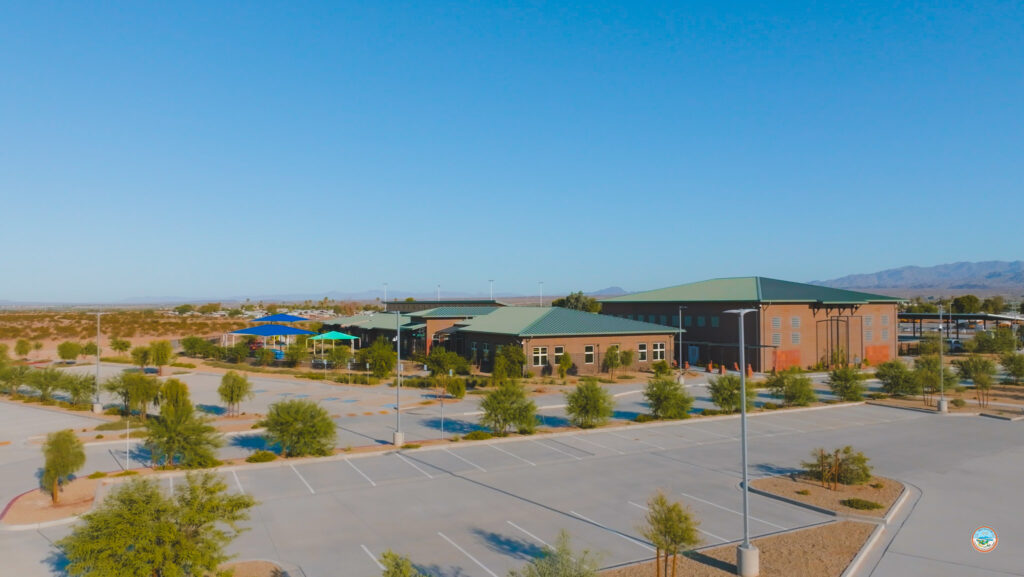
The Colorado River Indian Tribes’ new Head Start School is moving closer to opening, with the sewer system expected to be ready for final inspection during the week of September 21, 2026. Once final approvals are received, the project team will be able to move toward opening the new school.
The delay has been tied primarily to operation and capacity issues at the Joint Venture Sewer treatment facility. Because of those issues, the project team had to redesign the school’s sewer system so it would meet Joint Venture Sewer requirements before the facility could become operational.
That redesign required additional engineering work for a holding tank and lift station system. The system will temporarily store wastewater and then release it into the Joint Venture Sewer system in a controlled, timed discharge during non-peak hours. A contractor also had to be brought on to complete the additional installation and related work.
The project team has continued working closely with Joint Venture Sewer, CRIT Utilities, CRIT Building & Safety, the engineering team, and contractors to finish the required work and secure final approval.
When it opens, the new facility will include 10 classrooms, a large multi-purpose room with capacity for 500 people, a playground, a bus barn, and room for future expansion.
CRIT received a $13.8 million federal grant to help fund the project. CRIT is contributing another $7.2 million, bringing the total investment to nearly $20.8 million.
CRIT Chairwoman Amelia Flores said, “This represents a vital investment in our children. The benefits of this facility will be felt for generations as we seek to provide our children with the best possible head start as they prepare for school, life, and the opportunities that await. We want to thank everyone for their patience during this time. This is a momentous step forward in the right direction for the entire community, and we thank everyone who helped get us this far.”
Following a series of historic ceremonies on Friday, September 4, 2026, the University of Arizona has permanently integrated the four native languages of the Colorado River Indian Tribes (CRIT) into its campus landscape. Organized by the university’s Office of Native American Advancement & Tribal Engagement (NAATE) in partnership with individual academic colleges, the Native Languages Campus Sign Initiative unveiled a progression of permanent building signs throughout the day to celebrate the Mohave, Chemehuevi, Hopi, and Navajo languages.
Members of the CRIT Tribal Council attended the sign ceremonies, including Treasurer Anisa Patch, Secretary Josephine Tahbo, Councilmember Vanessa Welch, and Councilmember Raeanne Patch.
The continuous initiative aims to elevate the visibility, recognition, and enduring presence of Indigenous communities within academic spaces. Levi Esquerra, Special Advisor for NAATE, explained that the permanent structural markers grew out of a linguistics department tradition where temporary language signs were posted for just one day each February to observe International Mother Language Day. “They used to put up tarps of native languages throughout campus at six o’clock in the morning, take them down by six, and they wanted permanent signage,” Esquerra said. “We started an initiative of reaching out to tribes and having them add language to our buildings… What makes CRIT so unique is, you know, CRIT is made up of four distinct tribes. And so we felt it was only correct to honor each of those tribes that make up the CRIT nation.”
The day-long celebration began at 9:00 AM at the Emil W. Haury Anthropology Building, home to the School of Anthropology. The Chemehuevi language inscription “Puha” was added to the building’s sign, translating to the “Power of learning about the people.” School of Anthropology Director Rob Schon noted that the naming honors and renews structural ties established in 1954 when Emil Haury preserved Chemehuevi baskets for the Arizona State Museum. Reflecting on the word chosen for the sign, Schon remarked, “Phua is a sacred term… As interpreted here, Puha means power of learning about the people. There is no greater calling for an anthropologist to aspire to.” CRIT Chairwoman Amelia Flores highlighted the deep perseverance required to bring the project to fruition, stating, “When I first heard of the university asking the tribes in Arizona to name buildings, I approached him and I said, ‘Why not CRIT? Why not CRIT?’ … It’s taken this long. So thank you, my dear friend, for making this happen… Most tribes have only one, but CRIT, you have four.”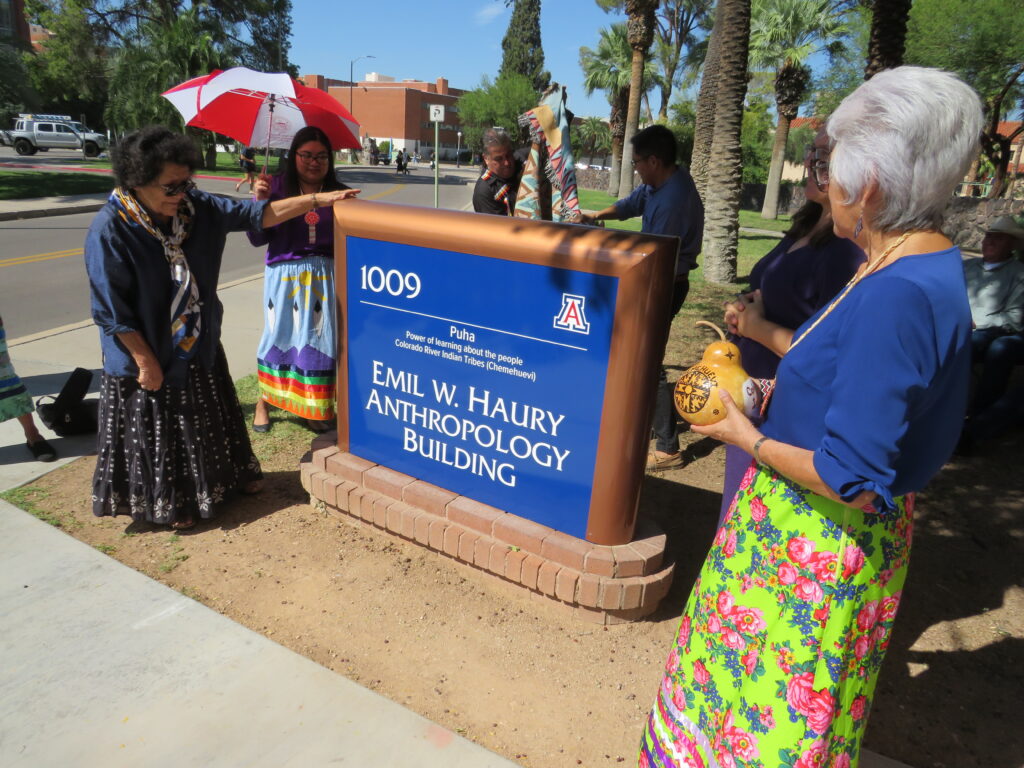
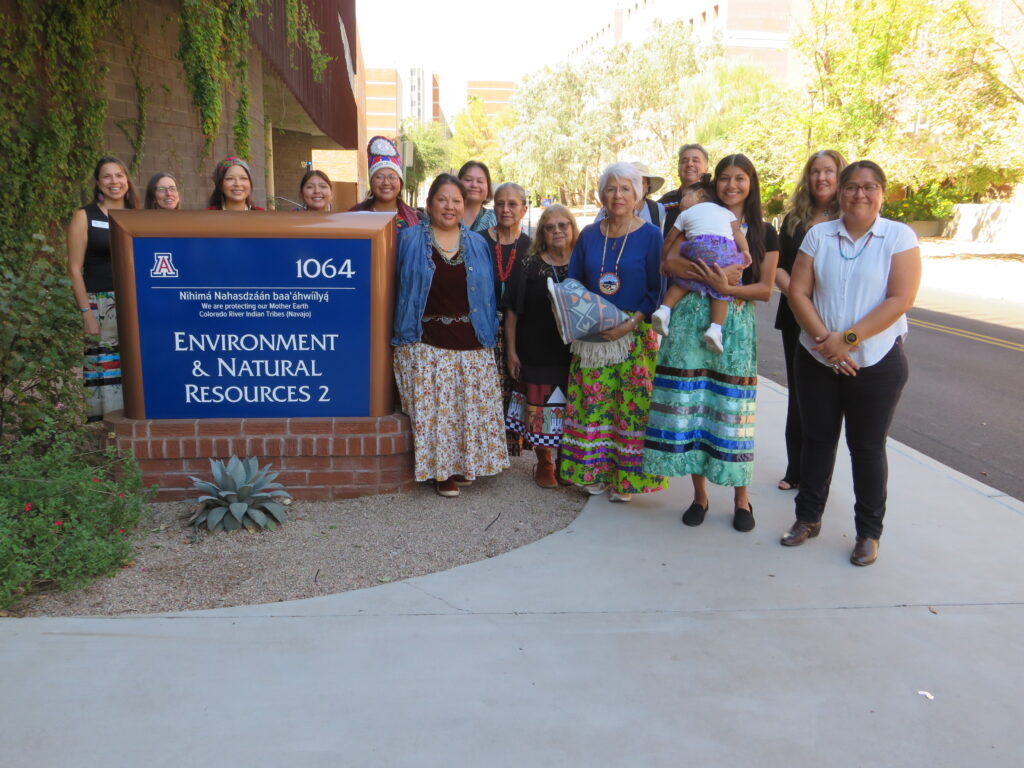
At 10:30 AM, the procession moved to the Environment and Natural Resources 2 (ENR2) Building to honor the CRIT Navajo language with the phrase “Nihimá Nahasdzáán baa’áhwíílyą́,” meaning “We are protecting Mother Earth.” During the ceremony, CRIT Navajo representative Harlietta Mitchell shared her family’s history of post-World War II relocation to the western Arizona desert, emphasizing that true ecological resilience requires a marriage of academic science and ancestral wisdom. “I hope this building will be more than a place where people study environmental science,” Mitchell said. “May it be a place where indigenous knowledge and scientific knowledge meet with respect.” Chairwoman Flores added, “This signage marks a permanent and visible commitment to honoring the first people of the land. When you see the words… they are a powerful, powerful declaration that indigenous knowledge and culture belongs in academia.” Navajo artist Nicole Pete also presented the history of the official CRIT Tribal Seal, which was designed by her grandfather, John Scott Sr., in 1966.
The afternoon continued at 1:00 PM at the Forbes Building, the home of the College of Agriculture, Life, and Environmental Sciences (CALES) and the Cooperative Extension. Honoring the CRIT Hopi language, the building’s new sign reads “Tutskwat, Sinmuy, pu’ Natwanit Kyaptsilalwa,” which translates to “Honoring the land, the people and the Harvest.” Professor Sheilah Nicholas detailed the deep, remote history inherent in the chosen Hopi vocabulary. “Means land, but the nuances of the Hopi perspective of land inherent in the word changes,” Nicholas explained. “…encompasses the understanding of land as place and a specific place where groups of people coalesced and became a distinct people…” (more…)