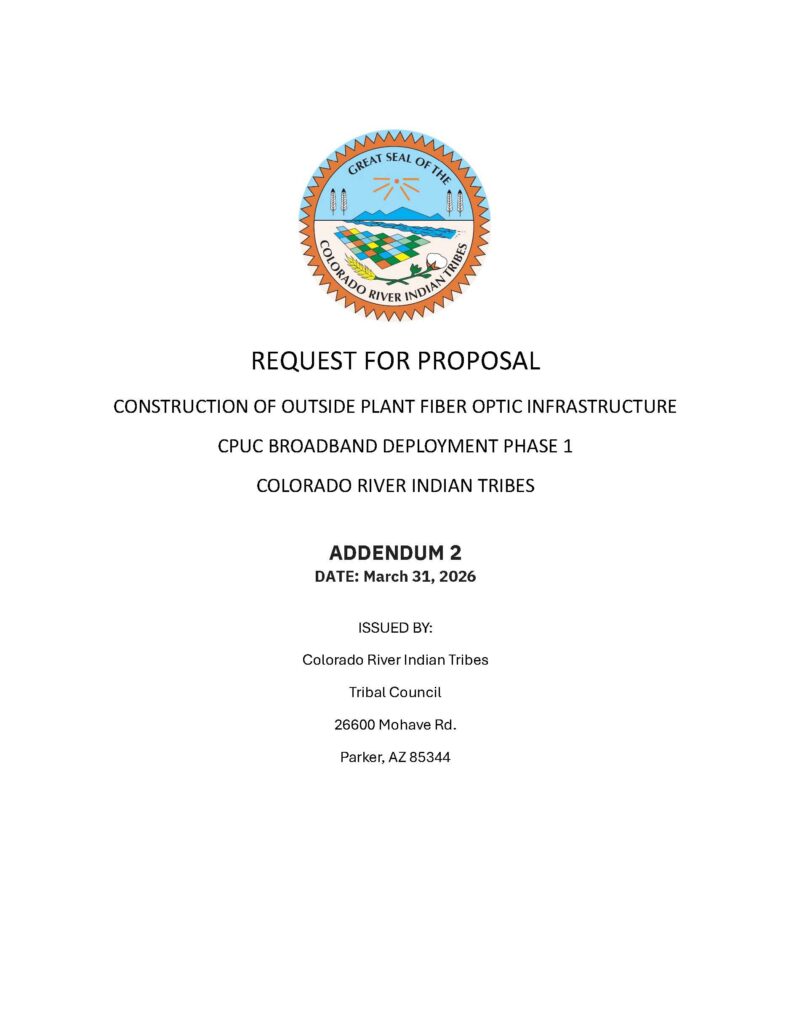
Notice to Contractors: The Colorado River Indian Tribes has issued Addendum 1 for the CPUC Broadband Deployment Phase I Request for Proposals for the construction of outside plant fiber optic infrastructure. This addendum includes answers to questions discussed during the March 17 pre-bid meeting, along with revisions to the construction specifications. Proposers are required to acknowledge receipt of Addendum 1 in the cover letter of their proposal.
Click the link for details
The Colorado River Indian Tribes (CRIT) is requesting proposals from qualified contractors for the renovation of a building located at 1405 S. Joshua Ave. in Parker, Arizona, which will serve as the future CRIT Broadband Operations Facility. The project will convert the existing structure into a secure, fully functional center to support CRIT’s expanding broadband network.
A pre-proposal site visit will take place on March 18, 2026 at 10:00 AM at the project location. Proposals are due by April 7, 2026 at 2:00 PM (Arizona Time).
Follow the link below for details.
REQUEST FOR PROPOSAL-Broadband building (002)
According to KJZZ News, environmental groups are warning of serious long-term impacts to the Colorado River system after negotiators missed another deadline to finalize future water management rules. Advocates say declining reservoir levels, ongoing drought, and delayed agreements could increase pressure on ecosystems, agriculture, and water supplies across the Southwest. The warnings highlight growing urgency for coordinated conservation and policy action. For CRIT, these discussions are important because federal decisions about river operations directly influence how tribal water rights are protected and how long-term water stability is maintained.
Source: KJZZ News — https://www.kjzz.org/politics/2026-02-19/environmental-groups-warn-of-dire-impacts-after-colorado-river-negotiators-miss-another-deadline
According to Nevada Public Radio, Colorado River negotiations continue to face challenges as states balance drought impacts, water demand, and competing priorities. Officials involved in the talks say progress has been uneven and that future agreements may require difficult compromises across the basin. Continued uncertainty highlights the complexity of managing the river under changing climate conditions. For CRIT, ongoing interstate negotiations remain important because federal and regional policy decisions directly affect how tribal water rights are recognized and protected.
Source: Nevada Public Radio — https://knpr.org/show/knprs-state-of-nevada/2026-02-20/nevadas-main-water-negotiator-talks-about-the-bumpy-road-ahead-in-the-colorado-river-discussions
According to Newsweek, recent data shows some improvement in Lake Mead water levels following storms and conservation efforts, offering cautious optimism for the Colorado River system. However, experts note that long-term drought conditions still pose significant challenges and continued conservation will remain essential. Reservoir levels remain a key factor in determining water deliveries across the basin. For CRIT, reservoir conditions remain important because federal operational decisions tied to storage levels directly affect how tribal water allocations are managed and protected.
Source: Newsweek — https://www.newsweek.com/lake-mead-water-levels-get-good-news-11557968
According to Arizona Water News, Arizona and its Lower Basin partners say they remain committed to finding common ground on new Colorado River operating rules despite stalled negotiations among the seven basin states. Officials emphasized continued collaboration with federal agencies and neighboring states to stabilize water supplies beyond 2026 as drought conditions persist. The effort reflects ongoing attempts to balance conservation, water demand, and long-term river sustainability. For CRIT, these negotiations remain important because federal and interstate agreements directly influence how tribal water rights are recognized and protected in future Colorado River management decisions.
Source: Arizona Water News — https://www.azwater.gov/news/articles/2026-02-19
According to the Navajo Times, federal officials are moving forward with developing new Colorado River operating guidelines even as state negotiations remain stalled. The Department of the Interior is continuing its environmental review process to prepare for post-2026 river management, highlighting the federal government’s role when states cannot reach consensus. Tribal consultation remains part of that process. For CRIT, federal involvement is significant because Colorado River policies shaped at the federal level directly affect tribal water rights, long-term planning, and regional water security.
Source: Navajo Times — https://navajotimes.com/reznews/federal-officials-move-forward-on-colorado-river-operating-rules-as-state-negotiations-stall/
According to ABC 15 Arizona, tribal nations along the Colorado River are among those with the most at stake as negotiations over future water allocations continue. Tribal leaders emphasize the importance of protecting established water rights while ensuring sustainable solutions to ongoing drought conditions. The article highlights how tribal participation is increasingly central in discussions about the river’s future. For CRIT, these conversations are especially important because tribal sovereignty and water rights remain critical factors in how Colorado River resources are managed across the basin. (more…)
According to CBS 5 Arizona’s Family, Arizona could face deeper Colorado River water cuts following missed negotiation deadlines, raising concerns about future water supply stability across the state. Officials say ongoing drought and reduced reservoir levels continue to challenge long-term planning efforts. These developments may lead to increased federal involvement in river management decisions. For CRIT, potential cutbacks are important because federal allocation decisions directly influence how tribal water rights are maintained and protected.
Source: CBS 5 Arizona’s Family — https://www.azfamily.com/2026/02/17/arizona-faces-major-colorado-river-water-cuts-deadline-passes/
According to the Colorado Sun, new forecasts suggest Lake Powell could reach critically low levels that threaten hydropower production and water deliveries if drought conditions persist. Reservoir storage plays a central role in determining how water is distributed across the Colorado River Basin. Experts say ongoing climate pressures and declining inflows continue to complicate long-term planning. For CRIT, reservoir conditions remain important because federal operational decisions tied to storage levels directly affect how tribal water allocations are managed and protected.
Source: Colorado Sun — https://coloradosun.com/2026/02/18/lake-powell-forecast-critical-lows-federal-study/
According to AZPM News, Colorado River basin states missed another federal deadline to reach agreement on future water reductions, increasing the likelihood of additional cutbacks across the Southwest. Officials warn that continued drought and declining reservoir levels could force tougher decisions about water allocation in the coming years. The missed deadline highlights growing uncertainty about long-term river management. For CRIT, potential water reductions and federal policy decisions directly influence how tribal water rights are protected and incorporated into basin planning.
Source: AZPM News — https://news.azpm.org/s/102728-arizona-and-western-states-miss-colorado-river-water-deadline-as-cuts-loom/
According to Newsweek, Lake Powell water levels could drop to critical levels sooner than expected, raising concerns about hydropower production and water deliveries across the Colorado River Basin. Experts say continued drought, reduced snowpack, and high demand are contributing to declining reservoir storage. These conditions add urgency to ongoing negotiations about future river operations. For CRIT, reservoir levels are important because federal decisions tied to storage conditions directly affect how tribal water allocations are managed and sustained.
Source: Newsweek — https://www.newsweek.com/lake-powell-water-could-drop-to-critical-levels-sooner-than-expected-11531274
According to Pinal Central, the Gila River Indian Community expressed concern over the lack of agreement among Colorado River basin states, noting the importance of tribal voices in ongoing water negotiations. Tribal leaders emphasized the need for sustainable solutions that recognize existing water rights while addressing long-term drought conditions. The statement highlights growing awareness of tribal participation in basin discussions. For CRIT, tribal engagement in Colorado River negotiations is significant because it reinforces the importance of protecting tribal sovereignty and water rights across the region.
Source: Pinal Central — https://www.pinalcentral.com/sacaton_central/gric-laments-lack-of-deal-over-colorado-river-water/article_cb91f461-07de-4f88-8d70-c3dec3b96c67.html
A recent statement from Colorado River Commissioner JB Hamby says California and other Lower Basin states have been working with federal officials and neighboring states to develop new long-term operating rules for the Colorado River after 2026. He noted that the original 1922 Colorado River Compact was based on water supply estimates that no longer match today’s reality, as river flows have declined over the past 25 years while demand continues to grow.
According to the statement, California, Arizona, and Nevada committed to major conservation efforts in recent years and have already exceeded planned water savings meant to stabilize Lake Mead and Lake Powell. However, disagreements remain between Upper Basin and Lower Basin states about how future reductions should be shared, and negotiators have not yet reached a final agreement.
For CRIT, these ongoing negotiations are important because federal Colorado River policies, interstate agreements, and conservation requirements directly influence how tribal water rights are protected, managed, and incorporated into long-term river planning that affects the entire region.
Source: https://crb.ca.gov/2026/02/statement-from-jb-hamby-colorado-river-commissioner-for-california/
February 14, 2026
According to the U.S. Department of the Interior, federal officials are moving forward with new operating guidelines for the Colorado River even though the seven basin states have not yet reached full agreement. The updated rules, expected by October 2026, are meant to provide stability for water deliveries, power generation, and long-term management as drought conditions and declining inflows continue to strain the river system. Interior Secretary Doug Burgum said discussions with states, Tribal Nations, and Mexico are ongoing, but federal action is needed to ensure future reliability of the river.
The Colorado River supplies water to about 40 million people, supports millions of acres of farmland, generates hydropower, and serves 30 Tribal Nations, making it one of the most important water sources in the West. Federal officials are currently accepting public comments on the draft environmental review that will guide future reservoir operations.
For CRIT, these federal guidelines are important because Colorado River management decisions directly affect how tribal water rights are protected, how water is allocated in the Lower Basin, and how long-term planning supports the Tribe’s water security, economy, and future generations.
Source: U.S. Department of the Interior / Bureau of Reclamation press release
On Friday, October 3, 2025, the Colorado River Indian Tribes kicked off Native American Days with a lively celebration at Manataba Park under the tin shed, bringing together community members, families, and visitors for a day full of culture, food, games, and laughter.
The event opened with Tribal Council presentations, led by Councilwoman Raeanne Patch, Councilman Billy Beeson, Councilman Tommy Drennan, and Treasurer Anisa Patch. Their presence set the tone for a meaningful day of honoring culture and community. Following a blessing by Carol Claw Hammond, the crowd gathered for a hearty lunch of pitted meat, tortillas, macaroni salad, and beans. A feast that kept everyone smiling and full throughout the day.
Vendors brought extra flavor to the celebration with NDN Joe, who kept the crowd refreshed with his famous beverages, while Carrie Burns offered custom cups, popcorn, and sweet treats. Terri Lynn’s snow cones and piccadillys were a big hit, especially under the warm afternoon sun. Visitors also enjoyed the Hopi booth, which raffled off beautiful jewelry, and the Chemehuevi booth, which shared crafts to enjoy and make. The Regional Center for Border Health joined in, connecting with the community and offering helpful resources.
Throughout the day, families enjoyed a wide variety of activities. Native language bingo quickly became a favorite, teaching words from the four tribal languages—Mohave, Chemehuevi, Hopi, and Navajo—in a fun and interactive way. Smiles and laughter filled the air as people competed for prizes while learning more about their heritage.
The regalia presentations were a true highlight of the afternoon. Toddlers charmed the crowd in their tiny regalia while older youth and adults showcased beautifully crafted dresses and traditional wear. The pride and joy that radiated from each participant created a powerful reminder of the beauty and strength of tradition. (more…)
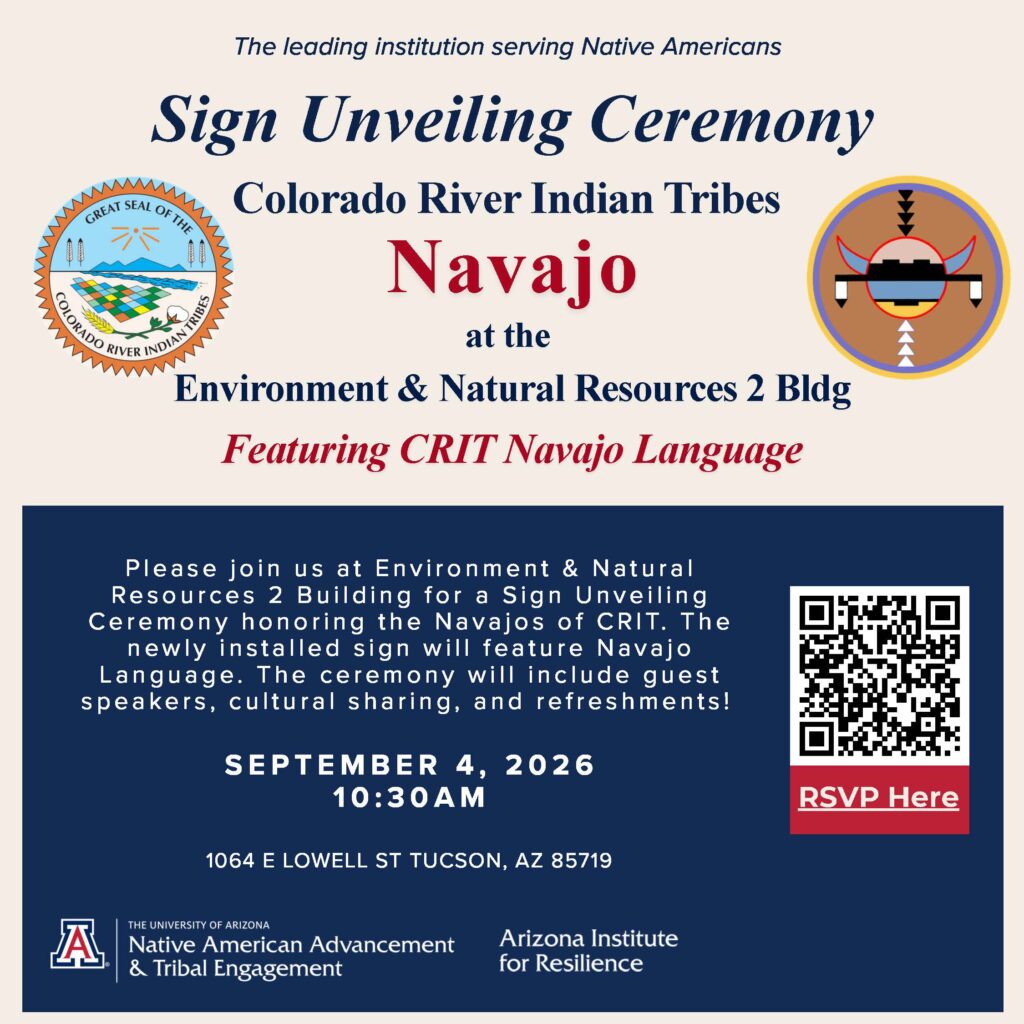
The Colorado River Indian Tribes (CRIT) is honoring a historic milestone this year with the 80th Anniversary of the Hopi and Navajo Migration to what is now known as the CRIT Reservation. The celebration not only commemorates the journey of the Hopi and Navajo people in 1945 but also reflects on the cultural richness and resilience they brought with them, shaping CRIT as we know it today.
In 1945, following World War II, the Bureau of Indian Affairs initiated a relocation project that brought both Hopi and Navajo families from northern and northeastern Arizona to the CRIT Reservation. They joined the Mohave and Chemehuevi people already living on the land, forming what is now a unique and diverse community of four distinct tribal groups. For the Hopi, this migration continued their long tradition of settled village life. Known for their deep connection to religion and ceremony, the Hopi brought their agricultural expertise in dry farming as well as their renowned artistry — pottery, overlay jewelry, and kachina doll carving. The Navajo, also part of this relocation, carried with them strong traditions of craftsmanship and resilience. They were celebrated silversmiths, a skill believed to have been introduced by Spaniards, and Navajo women were widely known for their weaving of colorful intricate rugs. (more…)