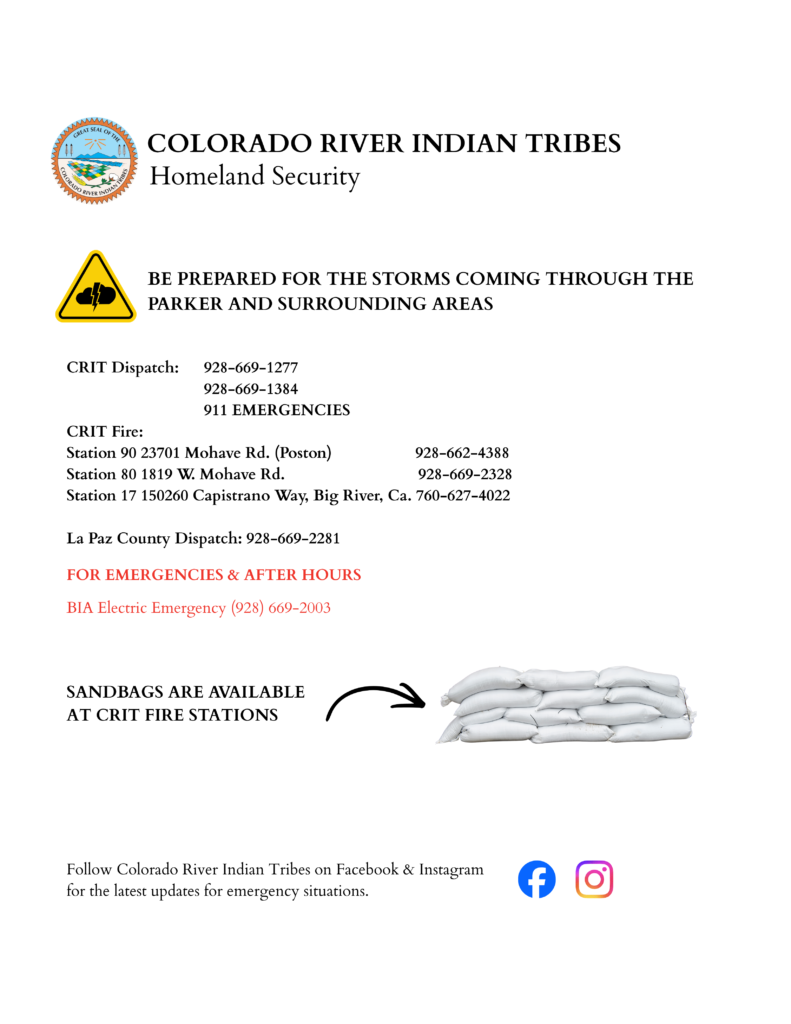
Según BIA Electric, Mochem Housing en el valle no se quedará sin electricidad.


Según BIA Electric, Mochem Housing en el valle no se quedará sin electricidad.
Click the links below to download a form
Direct Deposit Authorization Form
General Welfare Application_09242024
General Welfare Application Minors_09242024
PLEASE READ CAREFULLY
Dear Tribal Member:
Tribal Council has approved a 2024 General Welfare Assistance payment of $2,000.00 for each CRIT Tribal Member. CRIT Tribal members, both minors and adults, who are enrolled with CRIT as of November 1, 2024 are eligible to receive assistance. Tribal Members MUST submit an application to receive a General Assistance Payment for 2024.
Click the links below to download a form
Direct Deposit Authorization Form
General Welfare Application_09242024
General Welfare Application Minors_09242024
This 2024 General Welfare Assistance payment replaces the annual Tribal Distribution Payment. The benefits to the membership are that the General Welfare Assistance payment is NOT income subject to federal taxes and should not impact eligibility for benefits such as SSI and food stamps. You will not be issued a 1099 for this payment. Please review the General Welfare Plan for more information.
Tribal Members will receive their General Welfare Assistance payment by mail or by direct deposit into a bank account after submitting their application. Parents or legal guardians may request direct deposit for their eligible minor tribal member children into an account owned by the parent or the child. YOU DO NOT HAVE TO SUBMIT A NEW DIRECT DEPOSIT FORM WITH YOUR APPLICATION IF YOU INTEND TO RECEIVE YOUR GENERAL WELFARE ASSISTANCE PAYMENT IN SAME BANK ACCOUNT AS YOU RECEIVED YOUR 2023 GENERAL WELFARE ASSISTANCE PAYMENT.
The General Welfare Assistance payment will be mailed or direct deposited as follows:
Application and Forms Due Date Payment Issued
Must be received by Accounting:
October 18, 2024 November 21, 2024
November 22, 2024 December 19, 2024
December 20, 2024 January 16, 2025
After December 20, 2024 Payments issued monthly on a rolling basis
and before December 31, 2025
If you want to receive your General Welfare Assistance payment by direct deposit, you must submit the attached Direct Deposit Authorization Form along with a voided check to CRIT Accounting. If you do not have a direct deposit authorization form on file from last year, or do not submit one for 2024 with your application, your payment will be mailed to the address on your application. The mailing address you provide on the application will be used to update your address with both enrollment and accounting. You may have already received written notification along with an application and a self-addressed stamped envelope for your use to return the forms or the forms can be dropped off in person at Tribal Administration. Additionally, the application and forms can be emailed to GWA@crit-nsn.gov.
Please note that the checks for eligible minor tribal members will be issued in the name of the child and not the parents. Parents or guardians must submit proof of their right to receive the distribution on behalf of their child by submitting an application with a copy of the birth certificate listing the parent(s), and if applicable, a court order establishing legal custody and placement before checks will be mailed or the payment directly deposited.
Checks will not be issued to the parent(s) if they do not have the care and custody of their children. Guardians and custodians of minors who are not the child’s legal parent shall be required to provide a court order indicating their status. Payments for children in the physical care and custody of CRIT Social Services or other state or tribal agencies shall be held in an account established by CRIT Accounting.
Tribal Members must apply for the 2024 General Welfare Assistance Payments no later than December 31, 2025 after which a 2024 payment will not be available.
Please be advised that if you are in default on a debt you owe to the Colorado River Indian Tribes or its enterprises, you may voluntarily agree to apply your General Welfare Assistance to the loan or other outstanding debt in default. If you have any questions about outstanding debts in default please contact Tracey Quillen at (928) 669-1239.
If you have any questions regarding General Welfare Assistance or you have an agency incorrectly treating this payment as income please contact the Office of the Attorney General at (928) 669-1271.
Click the links below to download a form
Direct Deposit Authorization Form
Follow this link for more information including how to apply.
This position is located with the Bureau of Indian Affairs, Superintendent, Colorado River Agency in Poston, Arizona.
Arizona opened August with strong pushback to the federal government’s new framework for managing the Colorado River after 2026.
The Bureau of Reclamation’s Final Environmental Impact Statement lays out a 10-year framework for future operations at Lake Powell and Lake Mead. The current operating rules expire after 2026, and the seven Basin states have not reached a long-term agreement on how future shortages should be shared.
Under the federal framework, Arizona, California, and Nevada could face mandatory reductions in Colorado River use. The Department of the Interior said the plan allows Lower Basin shortages of up to 3 million acre-feet, depending on reservoir conditions. The Upper Basin states — Colorado, Utah, Wyoming, and New Mexico — would not face mandatory reductions for now.
Arizona officials and water leaders criticized that approach, saying it places too much of the burden on the Lower Basin and especially on Arizona. Fox 10 reported that the Central Arizona Project, which delivers Colorado River water to central and southern Arizona, raised concerns that the federal framework could lead to deeper cuts for the state. CAP serves cities, farms, and Tribal communities through its 336-mile canal system.
Several Arizona leaders said the state has already conserved significant amounts of Colorado River water and should not be forced to carry the largest share of future reductions. KNAU reported that Arizona officials called on Upper Basin states to do more to share the burden, while Upper Basin officials argued that drought and reduced snowpack already limit the amount of water available to them.
Central Arizona Project President Terry Goddard also criticized the federal plan. KTAR reported that Goddard said the plan requires Lower Basin states to cut water use while Upper Basin states face no mandatory reductions. CAP said it expects the final operating guidelines for 2027 and 2028 to better reflect the Lower Basin proposal, which would conserve more than 3.2 million acre-feet of water through 2028.
The issue is especially important for Arizona because cuts to Colorado River water would not affect every community the same way. ABC15 reported that reductions would hit Valley cities unevenly because Central Arizona Project water is delivered under a priority system. Some communities have stronger priority, stored water, other supplies, or Tribal water leases that may help reduce the impact. Others could be more exposed.
Phoenix said it is prepared for possible Colorado River reductions because of conservation, underground storage, diverse supplies, and long-term infrastructure planning. The city has also joined regional water-sharing efforts meant to help Arizona communities manage shortages.
Infrastructure is becoming a larger part of the state’s water planning. KJZZ reported that Salt River Project opened the Gilbert Road Pipeline, a $25 million project that will help Valley cities access stored groundwater during dry times. The pipeline connects water stored near the Granite Reef Underground Storage Project to the Arizona Canal, making it easier for cities to recover water they banked for shortage conditions.
The SRP project also involved the Salt River Pima-Maricopa Indian Community. KJZZ reported that the pipeline crosses part of the community near Mesa, and President Martin Harvier spoke at the ribbon-cutting, connecting the project to the long history of canal systems in the Valley.
Lake Powell remains one of the biggest concerns. KTAR reported that the reservoir could lose the ability to generate hydropower as early as March 2027 if water levels continue to fall. Glen Canyon Dam provides power for millions of people across the Southwest, and low reservoir levels can also affect dam infrastructure, releases through the Grand Canyon, and downstream operations. (more…)
The final days of July brought the clearest picture yet of how the federal government may manage the Colorado River after 2026.
The Bureau of Reclamation released its Final Environmental Impact Statement for future operations at Lake Powell and Lake Mead, setting up a 10-year framework for managing the river through 2036. The current operating rules expire after 2026, and the Basin states have not reached a long-term agreement on how future shortages should be shared.
The federal framework does not settle every question. Instead, it gives Reclamation room to adjust operations over shorter periods as river conditions change. The Department of the Interior said the preferred alternative allows for annual Lake Powell releases between 5 million and 12 million acre-feet, Lower Basin shortages of up to 3 million acre-feet, and new options to store conserved water in Lake Powell and Lake Mead for future use.
For Arizona, the proposal carries serious consequences. The Associated Press reported that Arizona, California, and Nevada would share reductions under the federal plan, while the Upper Basin states would not face mandatory cuts for now. The Lower Basin could be required to reduce use by up to 3 million acre-feet annually through 2036, depending on river conditions.
Arizona officials pushed back quickly. Gov. Katie Hobbs called parts of the federal framework unacceptable, and the Arizona Department of Water Resources said reductions of up to 3 million acre-feet per year, in priority, would harm Arizona water users and the state economy. ADWR said it wants the final Record of Decision and operating guidelines to follow the May 1 Lower Basin Proposal, which includes shared reductions among Arizona, California, and Nevada of 1.25 million acre-feet each year, plus 700,000 acre-feet of system conservation water.
Central Arizona Project also responded to the FEIS, saying future rules must recognize Arizona’s existing rights and the realities of how Colorado River water is used in the state. CAP delivers Colorado River water to central and southern Arizona, including cities, agriculture, and tribal users. Any major reduction to CAP supplies would affect communities differently depending on their water priority, stored supplies, and access to other sources.
Arizona communities were already preparing before the FEIS was released. KJZZ reported that Salt River Project opened the Gilbert Road Pipeline, a $25 million project that will help Valley cities access stored groundwater during dry times. The pipeline connects underground storage near the Granite Reef Underground Storage Project to the Arizona Canal, making it easier for cities to recover water they stored for shortage conditions.
That project also involved the Salt River Pima-Maricopa Indian Community. KJZZ reported that the pipeline crosses a portion of the community near Mesa, and President Martin Harvier spoke at the ribbon-cutting, connecting the project to the long history of canal systems in the Valley.
Stored water and infrastructure are becoming more important as cities look for backup supplies. City of Phoenix officials said the city is prepared for potential Colorado River cuts because of its diverse water portfolio, conservation work, underground storage, and investments in infrastructure. Other Arizona cities are also turning to conservation, including turf conversion programs and water-saving rebates.
In Queen Creek, local reporting said turf conversions are saving water and money. Fox 10 reported that Gilbert residents are seeing higher water rates, showing how water planning costs are reaching household budgets. KTAR reported that Kearny expects its current water supply to last through this year, but 2027 remains uncertain.
Drought conditions also continued across Arizona. Payson Roundup reported that Arizona has been designated a drought disaster area, while other local reports showed concern in rural communities that rely on limited supplies or groundwater. These conditions show how water shortages are not only a Colorado River issue. They also affect small towns, farms, local utilities, and private well users.
Lake Powell remained one of the most urgent concerns. KTAR reported that Lake Powell could lose the ability to generate hydropower by early 2027 if water levels continue to fall. CBS 5 Arizona’s Family also reported that the Colorado River crisis threatens both water supply and hydropower for millions of people. Low reservoir levels affect more than storage. They can affect dam operations, electricity generation, water deliveries, and the ability to manage future dry years.
Scientists are also working to better understand how much water is being lost from the system. Colorado Public Radio and KUNR reported that researchers are expanding evaporation monitoring across the Colorado River Basin. The work is meant to give water managers better information about how much water is lost from reservoirs and other parts of the system, an issue that becomes more important as Lake Mead and Lake Powell remain low.
The pressure is being felt outside Arizona as well. Nevada Independent reported that Nevada could lose a significant share of its Colorado River water under the federal framework, while Las Vegas-area reporting focused on conservation and what continued cuts could mean for Southern Nevada. California outlets reported that future Colorado River reductions could affect Southern California water planning, including agencies that depend on Colorado River supplies.
Public concern is also rising. A Walton Family Foundation poll found that residents across all seven Basin states view shrinking Colorado River supplies as a priority. KJZZ reported that Arizonans are worried about water and want elected officials to respond. Those findings reflect what many local water stories showed throughout July: the Colorado River issue is no longer limited to technical negotiations. It is showing up in city budgets, water rates, infrastructure projects, agriculture, energy, and household concerns.
By the end of July, the federal FEIS became the main turning point. It did not end the negotiations, but it set the stage for the next federal decision. Reclamation will still issue a Record of Decision and operating guidelines, which will provide more detail on how the framework will be used. (more…)
The Bureau of Reclamation has released its Final Environmental Impact Statement for future Colorado River operations, a major step toward deciding how Lake Powell and Lake Mead will be managed after 2026.
The document comes as the current river rules near expiration. The 2007 Interim Guidelines, the 2019 Drought Contingency Plans, and several related agreements are set to expire after the 2026 operating year. Those rules helped guide shortages and coordinated operations between Lake Powell and Lake Mead, but Reclamation said they have not been strong enough to stop the continued decline of the river’s two largest reservoirs.
Instead of adopting one fixed long-term operating plan, Reclamation’s preferred alternative creates a 10-year adaptive framework for operations from 2027 through 2036. Under that framework, operating guidelines could be issued in shorter periods, likely every two years, unless the Basin states reach a longer consensus agreement.
That approach gives the federal government more flexibility as river conditions change. It also shows that the seven Basin states have not yet reached a long-term agreement on how future shortages should be shared.
The Department of the Interior said the framework is meant to guide operations at Lake Powell and Lake Mead while leaving room for future agreements among the Basin states. The preferred alternative includes “sideboards,” or operating limits, that set the range of actions federal officials could use.
Those sideboards include annual releases from Lake Powell between 5 million and 12 million acre-feet, Lower Basin shortages of up to 3 million acre-feet, and new options to store conserved water in Lake Powell and Lake Mead for future use. The framework also allows voluntary Upper Basin conservation of up to 200,000 acre-feet, depending on hydrologic conditions.
Lake Powell and Lake Mead remain central to the federal planning process. Lake Powell helps regulate releases from the Upper Basin through Glen Canyon Dam, while Lake Mead supports Lower Basin deliveries to Arizona, California, and Nevada through Hoover Dam. When either reservoir drops too low, the risk is not only less stored water. Low levels can also affect hydropower, dam operations, deliveries, and the ability to respond to future dry years.
Reclamation’s Executive Summary says the Colorado River supports about 40 million people, nearly 5.5 million acres of agricultural land, ecological resources, hydropower, cultural resources, and communities across seven states and Mexico. It also identifies 30 federally recognized Tribes in the Basin, including the Colorado River Indian Tribes.
The Final EIS directly addresses Tribal concerns. Reclamation said Basin Tribes have expressed that the current approach to Colorado River management does not fully address their rights, needs, and interests. The document says future guidelines should provide more flexibility and predictability for Basin Tribes to benefit from their water rights and participate in voluntary conservation programs.
That language is important because it places Tribal Nations inside the future operating framework, not outside of it. For CRIT, that matters because the Tribe holds senior Colorado River rights and has agricultural, cultural, and governmental interests tied directly to the river.
The Arizona Department of Water Resources released a statement after the FEIS was published. ADWR said Arizona, California, and Nevada submitted a Lower Basin proposal to help stabilize Lake Powell and Lake Mead with more than 3 million acre-feet of water savings over two years. ADWR said the FEIS includes analysis that could allow many core parts of that proposal to move forward.
ADWR also raised concerns. The agency objected to parts of the federal framework that could allow Lower Basin reductions of up to 3 million acre-feet per year, in priority. ADWR said reductions at that level would harm Arizona water users and the state economy. The agency also said the framework does not include Upper Basin reductions or enough use of water stored in reservoirs above Lake Powell.
ADWR said it wants the forthcoming Record of Decision and operating guidelines to follow the May 1 Lower Basin Proposal. That plan includes shared reductions among Arizona, California, and Nevada of 1.25 million acre-feet each year, plus an additional 700,000 acre-feet of system conservation water.
The next major step will be the federal Record of Decision and operating guidelines. Those documents are expected to provide more detail on how operations will be handled through 2028 and how the broader framework will guide decisions through 2036.
For CRIT, the FEIS is significant because future operations at Lake Powell and Lake Mead shape the larger river system where the Tribe’s senior rights are exercised. CRIT is not in the same legal position as many junior-priority users, but federal rules on reservoir operations, conservation programs, shortage planning, and stored water can still influence Basin-wide policy. (more…)
July 16 reporting focused on what future Colorado River rules may need to account for: water users, reservoir levels, river health, and the cost of keeping the system operating.
KJZZ reported that environmental advocates want future Colorado River rules to leave some water for the river itself. The article focused on the Colorado River below Glen Canyon Dam, where river conditions are shaped by dam operations, reservoir levels, and releases from Lake Powell. Advocates told KJZZ that a healthier river system can also support the water supply system that cities, farms, and ecosystems depend on.
Lake Mead also remained under pressure. Water Online reported that the Metropolitan Water District of Southern California is partnering with the federal government to leave water in Lake Mead. The agreement is meant to help slow the reservoir’s decline while the Basin states continue working on new river rules.
Several Nevada outlets reported that Lake Mead is expected to keep dropping. KLAS reported that the reservoir could fall nearly 33 feet by June 2028, and the Las Vegas Review-Journal reported that forecasters expect Lake Mead to continue setting record lows over the next two years. KVVU also reported that Lake Mead is nearing its all-time low as Boulder City continues to raise concerns about a proposed data center and its power demands.
Lake Powell remained a major concern as well. St. George News reported that the reservoir reached a critical threshold amid the ongoing Colorado River crisis. Low levels at Lake Powell affect hydropower generation, releases through Glen Canyon Dam, and the overall operation of the river system.
Weather added another layer of uncertainty. CAP Know Your Water News reported that a possible “Super El Niño” could bring wetter conditions to parts of the Southwest, but it does not guarantee relief for the Colorado River Basin. CAP reported that snowpack, runoff, and conditions in the Upper Basin will still determine how much water reaches Lake Powell and Lake Mead.
In the Upper Basin, Colorado water officials announced a new state-run conservation program. Aspen Journalism reported that the program will use federal funding to pay water users to voluntarily reduce use in 2027 and 2028. The program is expected to include criteria meant to avoid negative community impacts, encourage participation across sectors, and support drought resiliency. (more…)
July reporting continued to focus on how Arizona and the wider Colorado River Basin are preparing for reduced water supplies, with attention on Tribal water leadership, advanced water purification, and low reservoir levels.
Lake Powell Chronicle reported on the growing role of Tribal Nations in Arizona water policy. The article focused on how Tribal water rights, settlements, and planning are becoming more central as the state and federal government respond to long-term shortages. The reporting also reflects a broader shift across the Basin, where Tribal Nations are not only water rights holders but key governments in future river decisions.
Arizona water agencies are also looking at new supply options. AMWUA reported on advanced water purification, a process that treats recycled water to drinking-water standards. The technology is receiving more attention as cities look for options beyond traditional surface water, groundwater, and stored credits.
At the same time, Lake Powell remains under serious pressure. ABC News reported that the reservoir is nearing “dead power pool,” the elevation where water levels become too low for Glen Canyon Dam to generate hydropower. Newsweek also reported on concerns about Lake Powell and Lake Mead, including ideas being discussed by scientists and water experts as both reservoirs remain low.
John Fleck at Inkstain described the reservoir conditions as a grim Colorado River milestone. The continued decline of Lake Powell and Lake Mead shows how storage, hydropower, and future water deliveries are tied together. When the reservoirs fall, the issue is not only how much water remains but how the system can continue operating.
California water issues also remained part of the regional picture. Smart Water Magazine reported that California voters rank water among their top priorities for the next governor. While California’s water system is different from Arizona’s, the state remains part of Colorado River negotiations and shares in decisions over future Lower Basin reductions.
The July reports show several parts of the water discussion moving at once. Tribal Nations are gaining more recognition in water policy. Cities are exploring advanced purification. Lake Powell and Lake Mead remain low. States are still facing pressure to plan for a river system that can no longer support all demands in the same way.
What does this mean for CRIT?
For CRIT, the reporting on Tribal water power is directly relevant. It shows that Tribal Nations are becoming more visible in statewide and Basin-wide water decisions, especially as shortages force governments to revisit how water is managed.
CRIT’s senior Colorado River rights are a major part of that larger water policy landscape. As Arizona cities look at reuse, purification, and future water supplies, Tribal rights and Tribal governments remain central to any complete discussion about the river’s future.
The Lake Powell reporting also matters because reservoir levels affect federal operations, hydropower, and shortage planning across the Basin. CRIT’s Water Code and Water Resiliency Act help guide local water management as those conditions change, while the Personhood Resolution reflects the Tribe’s cultural and environmental connection to the Colorado River. (more…)
July reporting continued to focus on how Arizona and the wider Colorado River Basin are preparing for reduced water supplies, with attention on Tribal water leadership, advanced water purification, and low reservoir levels.
Lake Powell Chronicle reported on the growing role of Tribal Nations in Arizona water policy. The article focused on how Tribal water rights, settlements, and planning are becoming more central as the state and federal government respond to long-term shortages. The reporting also reflects a broader shift across the Basin, where Tribal Nations are not only water rights holders but key governments in future river decisions.
Arizona water agencies are also looking at new supply options. AMWUA reported on advanced water purification, a process that treats recycled water to drinking-water standards. The technology is receiving more attention as cities look for options beyond traditional surface water, groundwater, and stored credits.
At the same time, Lake Powell remains under serious pressure. ABC News reported that the reservoir is nearing “dead power pool,” the elevation where water levels become too low for Glen Canyon Dam to generate hydropower. Newsweek also reported on concerns about Lake Powell and Lake Mead, including ideas being discussed by scientists and water experts as both reservoirs remain low.
John Fleck at Inkstain described the reservoir conditions as a grim Colorado River milestone. The continued decline of Lake Powell and Lake Mead shows how storage, hydropower, and future water deliveries are tied together. When the reservoirs fall, the issue is not only how much water remains but how the system can continue operating.
California water issues also remained part of the regional picture. Smart Water Magazine reported that California voters rank water among their top priorities for the next governor. While California’s water system is different from Arizona’s, the state remains part of Colorado River negotiations and shares in decisions over future Lower Basin reductions.
The July reports show several parts of the water discussion moving at once. Tribal Nations are gaining more recognition in water policy. Cities are exploring advanced purification. Lake Powell and Lake Mead remain low. States are still facing pressure to plan for a river system that can no longer support all demands in the same way.
What does this mean for CRIT?
For CRIT, the reporting on Tribal water power is directly relevant. It shows that Tribal Nations are becoming more visible in statewide and Basin-wide water decisions, especially as shortages force governments to revisit how water is managed. (more…)
by CRIT Media Reporter Ariana Romero
The annual CRIT Royalty Pageants returned to Manataba Park on Oct. 2 and 3 for two evenings of competition and celebration. Contestants shared their talents, modeled modern and traditional dress, and introduced themselves to the audience as they competed to represent the Colorado River Indian Tribes for the coming year.
Hosted by the CRIT Royalty Board, this year’s pageants carried the theme “First in Time, First in Right.” The pageant pamphlet connected the theme to the Colorado River through a story of Mastamho, bringing the river and its people into the celebration.
In the story, Mastamho placed a staff into the ground and drew it out to bring forth water. He directed the water north, east, and west, stopping it each time. When he placed the staff into the ground once more and drew it out, he stepped aside and watched the water flow south, making the river. With the people standing behind him, he stretched out his arms to hold them back. The passage closed with the words “First in Time, First in Right.”
Both evenings opened with a welcome from CRIT Royalty Board President Valerie Welsh-Tahbo, followed by the Pledge of Allegiance led by Eva Charles and Brandy Eddy. Co-emcee JaMahke Welsh kept the audience entertained as the program moved through introductions, interviews, and performances. Entertainment by the Lil Macavs and Quechan Xuumar Akuuts added to the celebration.
Friday’s Little Miss pageant featured six contestants: Kathleen Viola Stone, Amelia Jean Gonzales, Alura Rose Walrod, Zyarah Devika Sharp, Calliope Sage Ara Scott, and Allison Rene Gonzales. Modern dress modeling and interviews gave the audience an opportunity to get to know the contestants, while the talent showcase and traditional dress modeling gave each girl another moment in the spotlight.
Outgoing Little Miss CRIT Loraina Stone gave her farewell presentation before the evening concluded with the coronation. Alura Rose Walrod, 10, was crowned Little Miss CRIT for 2026–2027. She is the daughter of Amanda and Mario Walrod and is Hopi and Mayan. Joining Alura were first attendant Calliope Sage Ara Scott and second attendant Zyarah Devika Sharp.
The celebration continued Saturday with the Jr. Miss and Miss CRIT pageants. Arianna Kaye Carmona, Jessica Lynn Scott, and Leina Rene Carmona competed for Jr. Miss, while Zoey Moon Sharp and Veronica Webb competed for Miss. Each contestant participated in modern dress modeling and interviews, a talent showcase, and traditional dress modeling.
Saturday also provided an opportunity to recognize outgoing Jr. Miss CRIT Winter Harper and Miss CRIT Brenda Duckey. Their farewell presentations marked the close of their time as royalty as the evening moved toward the crowning of the next representatives. (more…)
The University of Arizona put the Colorado River Indian Tribes and their culture in the spotlight Sept. 5, honoring CRIT during the Wildcats’ Native American Heritage football game against Northern Arizona University.
The recognition went well beyond the game, with members of CRIT’s Mohave, Chemehuevi, Hopi and Navajo communities participating in cultural activities throughout the day.
Festivities began at Bear Down Field, where representatives of CRIT’s tribes shared cultural performances with Wildcat fans and visitors during the Bear Down Bash.


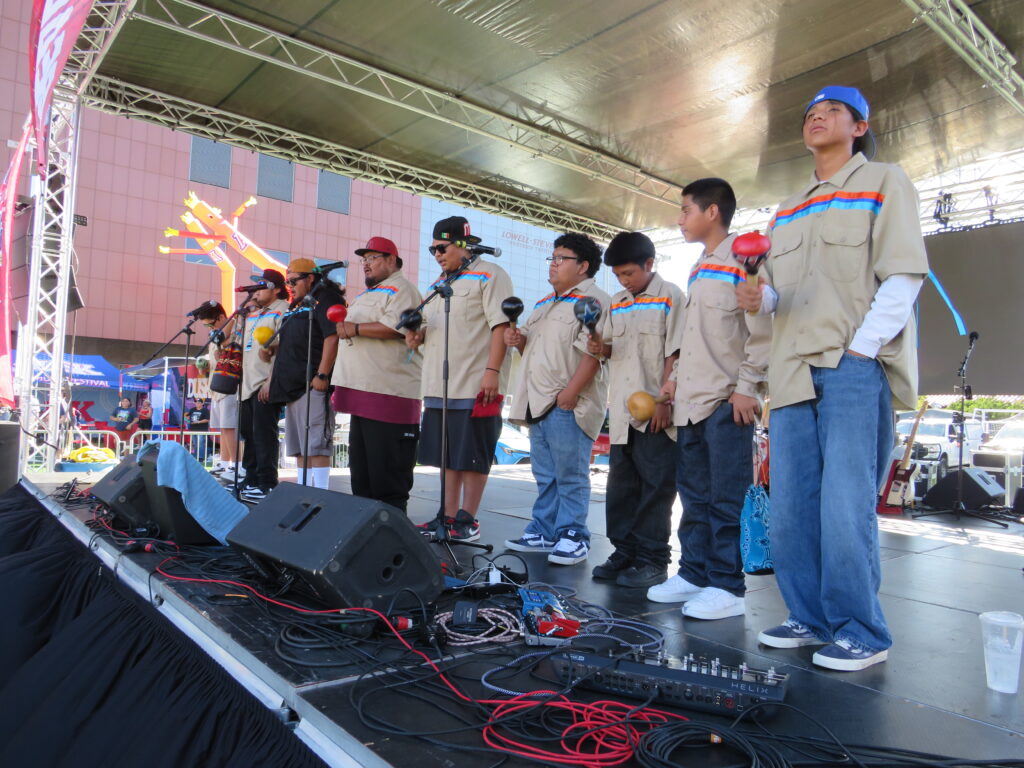
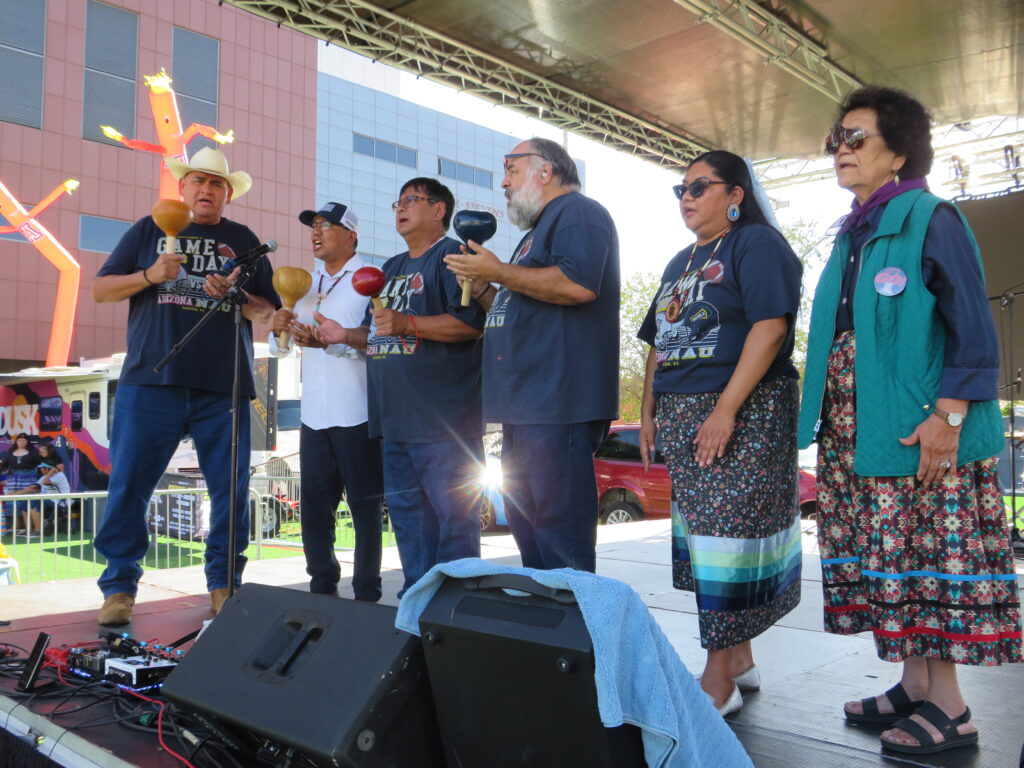

CRIT representatives also participated in the Wildcat Walk, Arizona Football’s traditional pregame arrival. CRIT royalty and tribal leadership were invited to greet the Wildcats’ head coach as part of a gift exchange before the team entered the stadium. (more…)