October 27, 2026 8:18 pm
CRIT Nation, Parker, AZ
October 27, 2026 8:18 pm
CRIT Nation, Parker, AZ

January 26, 2026

ABC15 Arizona
The Central Arizona Project’s general manager warned that deeper Colorado River cuts would have severe impacts across Arizona, affecting municipal supplies, agriculture, and long-term planning. Officials stressed that Arizona is particularly vulnerable because CAP deliveries are among the first reduced during shortages.

Lake Havasu News Herald
Arizona lawmakers are weighing funding for drone-based cloud seeding programs aimed at increasing snowfall in key watersheds. Supporters see it as a potential tool to enhance runoff into the Colorado River system.

Arizona Republic
Mesa is finishing a $210 million water reuse pipeline that will reduce reliance on Colorado River water by recycling treated wastewater for non-drinking uses.

KJZZ
New aircraft equipped with laser technology will measure snow depth and water content across Arizona’s mountains, improving runoff forecasts.

Wyoming is exploring a voluntary program to conserve Colorado River water, potentially paying users to leave water in the river.

ABC15 Arizona
Seven Western governors, including Arizona’s governor, are traveling to Washington, D.C., as negotiations intensify and deadlines approach. States are scrambling to present unified positions ahead of federal meetings.

KUNR
Extraordinary winter warmth continues to suppress snowpack across much of the West. Officials warn that poor snow accumulation could require additional reservoir releases, including from Flaming Gorge, to meet downstream needs.

Colorado Sun
As data centers expand into Colorado, concerns are growing about their large water footprints in already-stressed regions.

(more…)

Federal officials again summoned governors from all seven Colorado River Basin states to Washington, D.C., signaling growing concern that negotiations remain stuck. Reports indicate the federal government is preparing to step in more forcefully if states cannot agree on near-term shortage management and a longer-term framework.

Governor Katie Hobbs is escalating efforts to restrict groundwater pumping tied to Saudi-backed alfalfa farming in La Paz County. The reporting highlights how years of unregulated groundwater use have drawn down aquifers connected to Colorado River–dependent regions.

New analysis outlines what may come next if Basin states fail to reach agreement, including deeper federal control, stricter shortage tiers, and more aggressive conservation.


Sources – January 23, 2026


Arizona Budget Proposal Includes Major Funding for Colorado River Protection

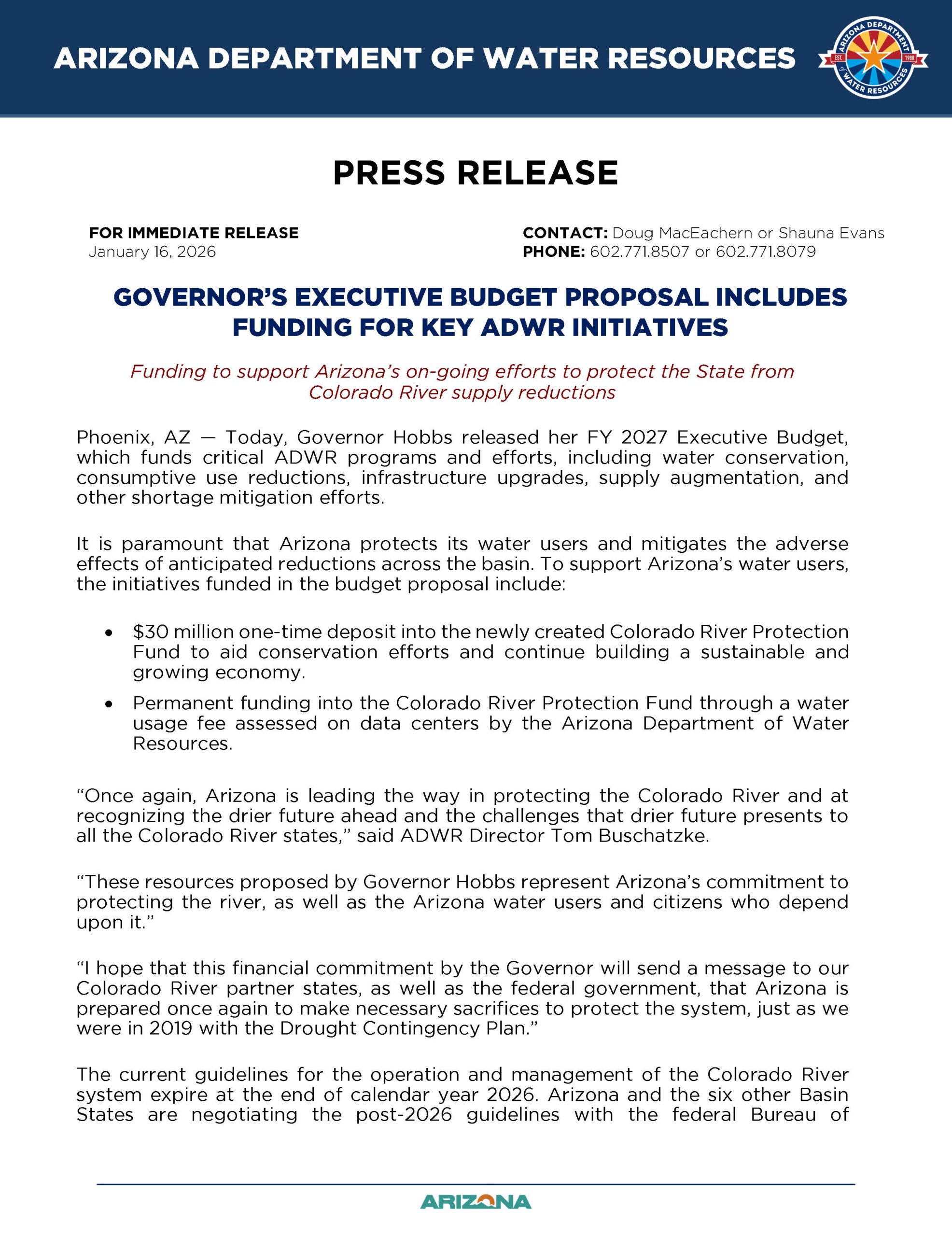
On January 16, 2026, the Arizona Department of Water Resources (ADWR) shared details of Governor Katie Hobbs’ FY 2027 Executive Budget Proposal focused on preparing for long-term challenges facing the Colorado River. The plan includes new and expanded funding aimed at strengthening water security across Arizona in the face of ongoing Colorado River shortages.

Key points from the budget related to water:

  • $30 million one-time deposit into a newly created Colorado River Protection Fund to support conservation efforts and short-term drought response.
  • Permanent funding mechanism for that Protection Fund to be supported by a water usage fee on data centers.
  • Continued investment in water conservation, shortage mitigation, supply augmentation, and water infrastructure upgrades.
  • A recognition that current Colorado River operating rules expire at the end of 2026, with negotiations underway to create a sustainable long-term framework.

Source:
Arizona Water News https://azwaternews.com/2026/01/16/fy2027_execbudgetproposal/
(more…)

Arizona announced new groundwater management rules for parts of La Paz County, expanding oversight in an area long known for unregulated pumping. The move follows increased scrutiny of agricultural water use and reflects a broader push to protect groundwater supplies as Colorado River shortages continue. La Paz County lies within CRIT’s region. Stronger groundwater rules help prevent over-pumping that can undermine surface water systems and threaten tribal water security.

A water policy expert argues that Basin states are unlikely to compromise without clear federal consequences. With post-2026 rules approaching, the federal government’s willingness to step in is seen as a key driver for progress. Federal involvement increases the importance of ensuring tribal water rights and sovereignty are explicitly recognized in any imposed or negotiated plan.

Multiple outlets report on the release of the draft post-2026 Colorado River management alternatives by the U.S. Bureau of Reclamation. The plan outlines several options for operating Lake Powell and Lake Mead, including deeper cuts and greater federal control if states fail to agree. Officials stress that public and stakeholder input is still open but time is limited. These alternatives could directly affect downstream water deliveries. CRIT’s senior water rights, sovereignty, and river stewardship must be included before any plan is finalized.

Arizona municipal water providers stress that collaboration during the legislative session will be essential to address shortages, infrastructure needs, and conservation goals tied to the Colorado River.

Legislation was introduced in Congress to formally codify a tribal water rights settlement, providing legal certainty and recognition of the tribe’s rights. Each tribal settlement strengthens the broader recognition of tribal water rights across the Colorado River Basin and reinforces sovereignty.

Reports highlight emerging technologies, including satellite tools and agricultural innovations, aimed at reducing water use and improving efficiency across the West. Technology can support conservation efforts, but it does not replace enforceable water rights or the need to protect river flows.

(more…)

Several outlets reported on the release of the Draft Environmental Impact Statement (EIS) by the U.S. Bureau of Reclamation, which outlines how the Colorado River could be managed after current rules expire in 2026.

The draft lays out five possible management alternatives for operating Lake Powell and Lake Mead, including options where the federal government steps in if Basin states cannot agree. Federal officials acknowledge that a temporary or stopgap deal may be necessary if negotiations remain stalled. These decisions will directly affect how water is released downstream.

As a senior water rights holder, CRIT’s rights and sovereignty must be protected in any final plan. The draft process is a critical opportunity for tribal input.

Coverage from Nevada and Utah outlets explains that while states continue negotiations, deep disagreements remain over how water cuts should be shared. Federal officials are signaling they are prepared to act if consensus is not reached.Some articles describe this moment as a turning point, where long-standing assumptions about water use are being challenged and previously “untouchable” practices are now on the table.

If states fail to agree, federal decisions could reshape river operations. Tribal nations must be included to ensure historic rights are not overlooked.

California-focused reporting explains how the draft federal plan could require additional water cuts, even during wet years. Officials emphasize that recent storms do not erase long-term shortages caused by overuse and climate change.

California’s use affects overall Basin stability. How cuts are distributed influences downstream reliability for Lower Basin users.

Multiple sources covered Arizona’s continued focus on groundwater protection, including new Active Management Areas and enforcement actions tied to large agricultural water users. These efforts are framed as necessary as Colorado River supplies remain uncertain.

As surface water becomes less reliable, pressure shifts to groundwater. Strong regulation helps prevent over-pumping that could undermine regional water security and tribal resources.

Nonprofit and policy reporting highlights a key admission from federal officials: a full, long-term Colorado River agreement may not be ready by 2026, making interim solutions likely. (more…)

Bureau of Reclamation – The Bureau of Reclamation released its long-awaited Draft Environmental Impact Statement outlining potential strategies for managing Lake Powell and Lake Mead after 2026, when current operating guidelines expire. The draft presents multiple alternatives, including scenarios where the federal government steps in if Basin states fail to reach agreement. No preferred alternative has been selected yet, keeping negotiations open.This document will directly shape how Colorado River water is managed in the future. Tribal water rights, sovereignty, and protections for the river itself must be recognized in any final decision.

Lake Powell Chronicle – This piece outlines which players are involved in current negotiations and what each is seeking, including states, tribes, and federal agencies.Who is “at the table” determines whose rights and values are reflected in the final outcome. Tribal voices remain essential.

Tucson Sentinel – Despite recent storms and heavy rainfall in Phoenix, much of Arizona remains in long-term drought. Experts caution that short-term rain does not replenish groundwater or stabilize Colorado River supplies. Reinforces that reliance on weather alone will not protect tribal water rights or the river.

Arizona Water News – Arizona Department of Water Resources hydrologists are conducting field investigations across multiple basins to better understand groundwater use and conditions. Increased groundwater scrutiny reflects growing pressure as Colorado River supplies tighten, which can affect regional water demand and policy.

KLAS CBS 8 – Forces aligning against healthy snowpack for Colorado River states

Experts warn that warming temperatures, dry spells, and climate trends are working against the development of a healthy snowpack, threatening future river flows. Snowpack is the river’s primary source. Poor conditions upstream affect all downstream users.

Colorado Public Radio / The Hill – House fails to override Trump veto of Colorado water project

Lawmakers failed to override a presidential veto blocking a major Colorado water infrastructure project, leaving future water deliveries uncertain.Delays in infrastructure add pressure to existing Colorado River supplies. (more…)

For a second time CRIT Chairwoman Amelia Flores and members of the Tribal Council provided updates, answered questions, and listened to concerns about issues surrounding Colorado River water.

About 80 people attended a meeting in August  at the Blue Water Resort and Casino. In opening remarks Chairwoman Flores said, “We ae stewards of our river and that’s why we are here tonight.”

CRIT’s water attorney John Bezdek then updated tribal members on the status of potential water leasing made possible by a new federal law as well as enabling documents recently signed between CRIT, the State of Arizona, and the US Department of Interior. Bezdek stressed that CRIT has made no agreements to lease its water off reservation. Bezdek’s presentation stated, “Any potential lease, water storage agreement, or other off-reservation use of water will only occur, as required in the Referendum, after it has been approved by tribal council majority vote only after a public hearing.

The Tribal Council is working diligently to ensure CRIT would get the best possible price in any water leasing agreement. As drought conditions persist, CRIT water becomes more valuable. That’s one of the reasons CRIT’s Tribal Council, its staff, and its legal team are working to protect CRIT’s SENIOR water rights. Recent legislation has greatly helped in that regard, but more can be done. That’s because agreements that manage the operations of the Colorado River expire in 2026.

Bezdek’s presentation states, “Tribal Council is actively engaged in meetings with federal and state officials as guidelines are developed for Colorado River operations post-2026 to ensure the Colorado River remains a living river while protecting the Tribes’ rights.”

CRIT is also looking at all options to make its irrigation systems more efficient and to hold the BIA accountable for failing to do so.

The BIA irrigation project returns between 47% and 50% of the water diverted back to the Colorado River without being used.  Most of the high return flow problems have been identified and solutions have been proposed, however, the BIA is NOT fixing the irrigation project. Leases will provide CRIT with funds to better capture this return-flow and increase project efficiency. This protects CRIT water from being taken in the future.

In response to a question, Tribal Councilmembers Jaymee Moore and Anisa Patch said the Tribal Council has been working to hold the BIA accountable at the local level and are now taking that effort to the next level by going higher up. (more…)

The Colorado River Indian Tribes Tribal Council held its quarterly Elders Luncheon on October 26th for tribal and federally recognized elders.

The event was held at the Blue Water Resort and Casino Showroom. The activities included a chair volleyball match between members of the Tribal Council and the CRIT Mo-Che-Ho-Na Chair Volleyball group.

The Department of Health and Social Services were on site giving out free blood sugar checks, as well as to showcase some of their departments. Staff also gave a presentation on best practices to stay in a healthy mindset as well as healthy eating habits.

Councilwoman Anisa Patch gave closing remarks thanking everyone involved in setting up the event as well as the elders who were able to come and enjoy the day.

Our thanks to everyone who participated in the National Day for Truth and Reconciliation on September 30th

The day honors the children who never returned home as well as survivors of boarding schools, their families and communities. The day is also known as Orange Shirt Day to honor and raise awareness of the thousands of Indigenous children who were sent to residential schools.

Department staff who participated: Executive Offices, Public Defender, Media and Office of the Attorney General.

A quick-thinking CRIT Game Warden likely saved the life of an elderly motorist.

While on routine patrol in late June, Warden Alejandro Lopez III missed the turn off to Agnes Wilson Rd as he was returning from West Boundary patrol. As he turned his vehicle around, he noticed a vehicle facing northbound off the southbound shoulder of the road.  He got out of his truck and walked to the back of the car to run the license plate and found a man lying in the bushes in the desert area.

The man told Warden Lopez he got out of his vehicle for a rest stop, fell over, and could not get back to his feet. He told Lopez that he had been lying there for over three hours in direct sunlight and he was having trouble breathing.

Warden Lopez Immediately requested medical attention for the man identified as 86-year-old Luis Gonzalez.  Warden Lopez provided Mr. Gonzalez with water and improvised shade, keeping him calm as he waited for medical assistance to arrive.

Gonzalez was transported to the La Paz Regional Medical facility. Paramedics told investigators Mr. Gonzalez might not have survived if he had been exposed to the elements for another hour.

Chief Game Warden Woodrow Sharp said Warden Lopez’s attention to detail and patrol procedures led to Mr. Gonzalez being located and rescued from certain death had he not been found.