The Colorado River Indian Tribes Tribal Council has made a historic decision to protect the lifeblood of their Reservation. On November 6, 2025, the Council unanimously approved Resolution No. R-375-25, which proclaims the personhood status of the Colorado River under tribal law.
This resolution acknowledges the Colorado River as a living entity whose health and well-being are intrinsically linked to the well-being of the Colorado River Indian Tribes (CRIT) members. The Tribes’ deep-rooted connection to the river spans centuries, providing cultural identity, spiritual strength, food systems, and economic stability that continue to shape their community life today.
The resolution emphasizes the central role the river has played in defining the identity of the CRIT. It highlights that CRIT’s ancestors have preserved and protected these lands since before the establishment of the Colorado River Indian Reservation in 1865.
The Council underscores the crucial role the river plays in sustaining traditional practices, wildlife, and agriculture, including the federal irrigation systems authorized as early as 1867. Today, the Colorado River Indian Irrigation Project stands as a cornerstone of the tribal economy.
The resolution underscores significant legal milestones that acknowledged CRIT’s water rights. In the landmark 1964 and 2006 Arizona v. California U.S. Supreme Court decisions, the Tribes secured 719,248 acre-feet of water annually, ensuring their access to the river for generations to come.
By granting personhood to the River, the Tribal Council reaffirmed its sovereign duty to honor and protect it. This status mandates that the River’s well-being must be a priority in governance and decision-making moving forward.
As part of the resolution, the Attorney General and their staff will develop legal safeguards and propose updates to the CRIT Water Code and other relevant regulations. These updates may include the potential designation of the river as a protected cultural landscape.
Council members recognized that protecting the river is not merely a legal obligation but a continuation of cultural beliefs passed down through generations.
Through this declaration, CRIT demonstrates its unwavering commitment to stewardship. The resolution concludes with a resolute message: the Colorado River is, and will always remain, a vital entity deserving of respect, care, and protection for all future generations.
Article Written by CRIT Media Reporter Ariana Romero
News Update November 12, 2025
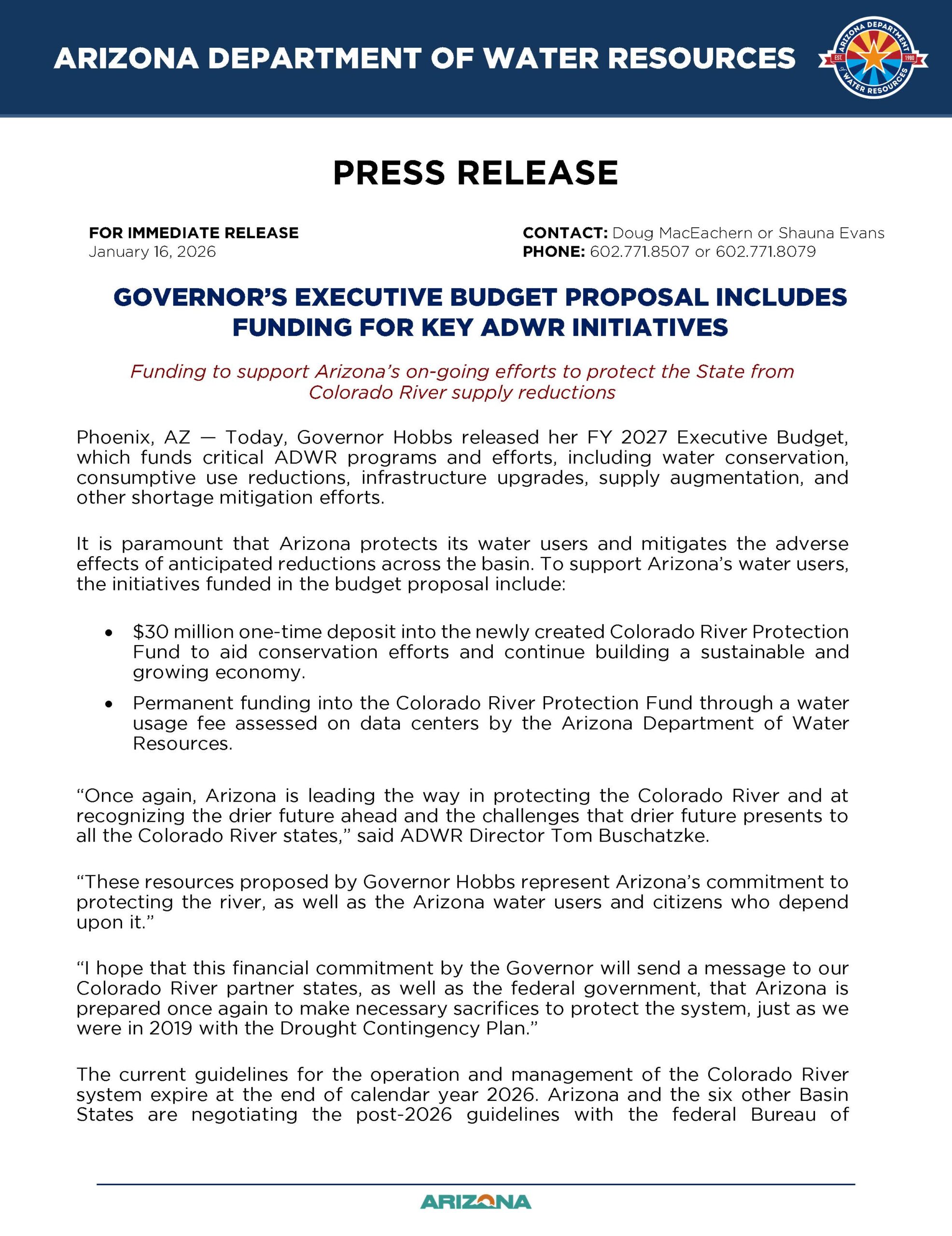
Negotiations over the future of the Colorado River have reached a standstill after all seven basin states failed to meet a key federal deadline. Reports from 12News and 8NewsNow confirm that the states were unable to agree on a new water-sharing plan, leaving the situation unresolved as the river continues to decline.
High Country News explains that the biggest disagreements involve how much each state should give up in the future. The upper Basin states want fewer mandatory reductions, while the Lower Basin states, including Arizona, say they have already taken the deepest cuts and cannot continue to absorb the majority of the impacts.
With no agreement in place, Arizona Governor Katie Hobbs has asked the Trump administration to intervene. She stated that Arizona has made significant sacrifices and cannot carry the weight of the reductions while other states refuse to commit to measurable cuts. If the states cannot reach a plan soon, the federal government may create one for them.
For the Colorado River Indian Tribes, the outcome of these negotiations has major importance. CRIT holds valuable senior water rights and relies on a stable and fair management plan to ensure long-term security for the community and the region.
For more information, you can read the news articles with the links below.
High Country News
https://www.hcn.org/articles/why-colorado-river-negotiations-are-so-difficult/
12 News
/wednesday-is-deadline-for-7-state-including-arizona-to-negotiate-the-colorado-river
Artist Ben Miller spent March 19th at the Colorado River Indian Tribes reservation creating an unusual painting using his signature technique, using thousands of singular casts with a fly rod.
Miller calls this method ‘Fly Cast Painting,’ and the work he created sold for $15,000 at Scottsdale Ferrari Art Week which took place March 20th through the 22nd.

Half the sale price is being sent to CRIT, which was recognized at the art fair for its efforts to conserve Colorado River water. While Miller was painting, he spoke with CRIT Chairwoman Amelia Flores and Tribal members who gave him insight on the river’s cultural and economic significance.
Miller is a Montana-based painter best known for his Endangered Rivers series. Over the last seven years he has painted endangered rivers in Montana, Washington, Colorado and Wyoming, and more recently the rivers of Chicago, New Jersey, New York, and Miami. (more…)
The Bluewater Resort & Casino held a community gathering on the Bluewater Resort Island on March 27th to commemorate the 30 years of gaming and operations.
Blue Water Resort and Casino is celebrating its 30th anniversary offering world-class gaming and luxurious accommodations, and a state-of-the-art casino floor with the latest slots, table games as well as award-winning dining, live entertainment, concerts, and events.
To commemorate this special anniversary, Blue Water has planned for the anniversary year:
Exclusive giveaways and promotions for loyal guests.
Special concerts and performances by legendary artists.
Limited-edition dining experiences curated by master chefs.
Speakers included Chairwoman Amelia Flores, members of the Tribal Council, Blue Water General Manager Michelle Eddy, as well as Blue Water staff and officials from the Tribal Gaming Authority.
Christine Scott started with the Colorado River Indian Tribes on March 13, 1995, as an Inspector for the Tribal Gaming Agency. She was promoted to Chief of Inspectors in 1996. Throughout her career, Christine has continually pursued professional growth, earned numerous certifications and attended specialized trainings to enhance both her skills and the success of her department. She often serves as Acting Executive Director when needed. In 2022, She was made Assistant Executive Director, the position she holds today. Christine Scott has served all of her 30 plus years of service with the Tribal Gaming Agency. The Tribal Council and Human Resources Department thanks Ms. Scott for 30+years of continued service to the Colorado River Indian Tribes.

The San Luis Rey Indian Water Authority (“SLRIWA”) visited the Colorado River Indian Tribes and met with CRIT Chairwoman Amelia Flores and the CRIT Tribal Council to discuss strengthening tribal sovereignty and protecting tribal water rights on March 21st.
The SLRIWA is the oldest Indian water authority in the United States. It was created by the La Jolla Band of Luiseno Indians, Pala Band of Mission Indians, Pauma Band of Luiseno Indians, Rincon Band of Luiseno Indians, and San Pasqual Band of Mission Indians.
Those who visited CRIT include:
– President Bo Mazzetti (Chairman of the Rincon Band)
– Board Member Tuukut Sass (Rincon Band)
– Board Member Band Venessa Brown (Pauma Band)
– Vice President Geneva Lofton (La Jolla Band)
– Board Member Reuben Rodriquez (La Jolla Band)
– Board Member Connor Magee (Pala Band)
– Board Alternate Brandon Johnson (Vice Chairman of the Pala Band)
– La Vonne Peck, SLRIWA Consultant
– Stephanie Zehren, SLRIWA Counsel
– Jerimy Billy, Chief Executive Officer (more…)
TUCSON, Ariz. — The University of Arizona will host a special series of sign unveiling ceremonies on Friday, September 4, 2026, honoring the four languages of the Colorado River Indian Tribes (CRIT): Mohave, Chemehuevi, Hopi, & Navajo. These ceremonies represent an important milestone in an ongoing campus-wide initiative to elevate the visibility, recognition, and continued presence of Indigenous languages and cultural heritage within the campus community.
The events are organized by the University of Arizona’s Office of Native American Advancement & Tribal Engagement (NAATE) in collaboration with individual academic colleges. Students, faculty, staff, tribal community members, and the general public are invited to attend the progression of ceremonies throughout the day.
The schedule for the Friday ceremonies includes:
The celebration of Indigenous culture continues into the weekend with the Native American Heritage Game on Saturday, September 5, 2026. The Arizona Wildcats will face Northern Arizona at Casino Del Sol Stadium, with kick-off scheduled for 6:30 PM MST. Pre-game festivities at Bear Down Field will begin at 3:15 PM with the Bear Down Bash, featuring 18-minute cultural performances from each tribe. A traditional gift presentation will follow during the Wildcat Walk at 4:15 PM, leading up to an on-field tribal recognition ceremony during the second quarter of the football game.
For more operational schedules or to register for the unveiling events, please visit the official University of Arizona Event Page.