The Colorado River Indian Tribes Tribal Council has made a historic decision to protect the lifeblood of their Reservation. On November 6, 2025, the Council unanimously approved Resolution No. R-375-25, which proclaims the personhood status of the Colorado River under tribal law.
This resolution acknowledges the Colorado River as a living entity whose health and well-being are intrinsically linked to the well-being of the Colorado River Indian Tribes (CRIT) members. The Tribes’ deep-rooted connection to the river spans centuries, providing cultural identity, spiritual strength, food systems, and economic stability that continue to shape their community life today.
The resolution emphasizes the central role the river has played in defining the identity of the CRIT. It highlights that CRIT’s ancestors have preserved and protected these lands since before the establishment of the Colorado River Indian Reservation in 1865.
The Council underscores the crucial role the river plays in sustaining traditional practices, wildlife, and agriculture, including the federal irrigation systems authorized as early as 1867. Today, the Colorado River Indian Irrigation Project stands as a cornerstone of the tribal economy.
The resolution underscores significant legal milestones that acknowledged CRIT’s water rights. In the landmark 1964 and 2006 Arizona v. California U.S. Supreme Court decisions, the Tribes secured 719,248 acre-feet of water annually, ensuring their access to the river for generations to come.
By granting personhood to the River, the Tribal Council reaffirmed its sovereign duty to honor and protect it. This status mandates that the River’s well-being must be a priority in governance and decision-making moving forward.
As part of the resolution, the Attorney General and their staff will develop legal safeguards and propose updates to the CRIT Water Code and other relevant regulations. These updates may include the potential designation of the river as a protected cultural landscape.
Council members recognized that protecting the river is not merely a legal obligation but a continuation of cultural beliefs passed down through generations.
Through this declaration, CRIT demonstrates its unwavering commitment to stewardship. The resolution concludes with a resolute message: the Colorado River is, and will always remain, a vital entity deserving of respect, care, and protection for all future generations.
Article Written by CRIT Media Reporter Ariana Romero
News Update November 12, 2025
Negotiations over the future of the Colorado River have reached a standstill after all seven basin states failed to meet a key federal deadline. Reports from 12News and 8NewsNow confirm that the states were unable to agree on a new water-sharing plan, leaving the situation unresolved as the river continues to decline.
High Country News explains that the biggest disagreements involve how much each state should give up in the future. The upper Basin states want fewer mandatory reductions, while the Lower Basin states, including Arizona, say they have already taken the deepest cuts and cannot continue to absorb the majority of the impacts.
With no agreement in place, Arizona Governor Katie Hobbs has asked the Trump administration to intervene. She stated that Arizona has made significant sacrifices and cannot carry the weight of the reductions while other states refuse to commit to measurable cuts. If the states cannot reach a plan soon, the federal government may create one for them.
For the Colorado River Indian Tribes, the outcome of these negotiations has major importance. CRIT holds valuable senior water rights and relies on a stable and fair management plan to ensure long-term security for the community and the region.
For more information, you can read the news articles with the links below.
High Country News
https://www.hcn.org/articles/why-colorado-river-negotiations-are-so-difficult/
12 News
/wednesday-is-deadline-for-7-state-including-arizona-to-negotiate-the-colorado-river
On May 24, 2025, the Parker High School Gymnasium was bursting with excitement, cheers, and proud smiles as some very young scholars reached a big milestone—their official promotion from Head Start to kindergarten.
The gym was filled with families, friends, and loved ones, all gathered to celebrate the Class of 2025. Dressed in bright red caps and gowns, our adorable graduates lit up the stage with joy and confidence, ready to take their first big step into the world of elementary school.
Director Caroline Alcaida gave a warm welcome to kick off the festivities, setting the tone for a celebration full of heart and hope. With Monica C. Rosnagle as the lively emcee, the program flowed beautifully—from sweet songs like “We’re Off to Kindergarten!” performed by the students, to the beaming moment they each received their diplomas from their dedicated teachers and assistants.
Drought conditions, climate change, and concerns about CRIT’s water rights bring into focus the importance of recognizing Earth Day. CRIT’s 15th annual Earth Day celebration takes place May 31st from 8am to 11am at the Ahakhav Preserve.
The event will include raffles, music, food, hayrides, prizes, and information booths.
The event comes as CRIT’s Tribal Council considers personhood status for the Colorado River. The Council would like to hear from Membership about this proposal.
Email: Coloradoriverpersonhood@crit-nsn.gov
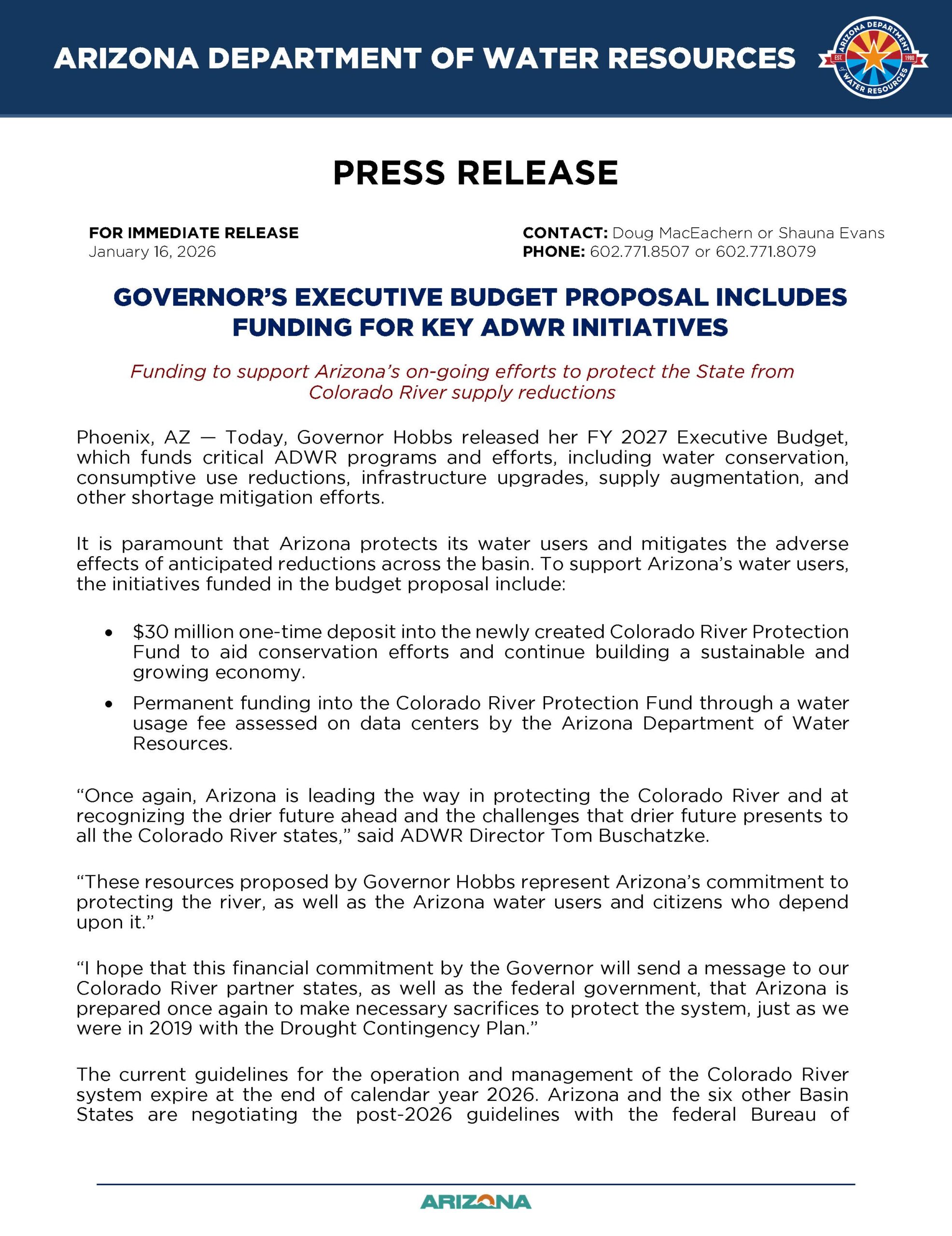
While a small number of Tribal Nations have conferred personhood status on their bodies of water and other natural resource features, CRIT would be the first Tribal Nation in the Colorado River Basin to confer personhood status on the Colorado River.
The designation would reaffirm the CRIT Nation’s commitment to protect the sustainability of the river for future generations and reinforcing CRIT’s sovereignty and its responsibility to the River.
If a resolution is passed conferring personhood status on the Colorado River, the Council would direct the Attorney General and its’ team to develop amendments to the water code that will be shared with membership in the coming weeks.
The Tribal Council is seeking input from CRIT Tribal Members.
Email coloradoriverpersonhood@crit-nsn.gov
Arizona Governor Katie Hobbs was joined by Tribal leaders, including CRIT Chairwoman Amelia Flores, the MMIP Task Force, representatives from the Arizona Department of Public Safety, and the family of Emily Pike for a ceremonial bill signing for HB 2281 (“Emily’s Law”).
This law codifies a new Turquoise Alert which helps law enforcement respond more quickly when Indigenous persons are reported missing.
The Law also honors the memory of slain San Carlos Apache teen Emily Pike, whose body was found Feb. 14 more than 100 miles from a group home she left in Mesa, Arizona, in late January.
After the signing ceremony Charwoman Flores said, “It’s very important to Tribal Nations, especially in Arizona. The Governor signing this bill gives law enforcement a quicker response to find missing and murdered individuals.”

The tragedy of Pike’s death was felt by Tribal communities including CRIT.
During CRIT’s Mega Throw event on March 22nd, a candlelight vigil was held on site to honor Emily Pike. On May 3rd CRIT youth including Junior Miss CRIT along with Little Miss CRIT attended an event at the Arizona State Capitol in Phoenix to honor Missing and Murdered Indigenous Women (MMIW). Additionally, CRIT Tribal Member Tonia Stone provided her survivor story at the event.
On this Memorial Day, the solemn notes of tribute echoed once again across the sacred grounds where service members, their families, and the wider community gathered to remember and reflect.
Delivering the keynote address was Herman “T.J.” Laffoon, a former CRIT Council member, veteran, and representative of the American Legion. His words were both reverent and urgent—calling on all citizens not only to remember the fallen but to carry forward their legacy through action.
Among the dignitaries in attendance were CRIT Chairwoman Amelia Flores; U.S. Army veteran Edward Yava Sr., a Native American service member and member of the 73rd Airborne, who stands as a living symbol of service and sacrifice; as well as tribal leaders, local officials, and community members gathered in solidarity to honor those who gave their lives in service.
The ceremony paid special tribute to Pvt. Lori Ann Piestewa, of Hopi descent, who was not only the first woman in the U.S. military to lose her life in the Iraq War, but also the first Native American woman to die in combat while serving in the United States Armed Forces. Her father, Terry Piestewa, a Vietnam veteran, once found these memorials too painful to attend. But with time, they became a source of strength—not just for him, but for her children, and for all who remember her legacy.
(more…)
TUCSON, Ariz. — The University of Arizona will host a special series of sign unveiling ceremonies on Friday, September 4, 2026, honoring the four languages of the Colorado River Indian Tribes (CRIT): Mohave, Chemehuevi, Hopi, & Navajo. These ceremonies represent an important milestone in an ongoing campus-wide initiative to elevate the visibility, recognition, and continued presence of Indigenous languages and cultural heritage within the campus community.
The events are organized by the University of Arizona’s Office of Native American Advancement & Tribal Engagement (NAATE) in collaboration with individual academic colleges. Students, faculty, staff, tribal community members, and the general public are invited to attend the progression of ceremonies throughout the day.
The schedule for the Friday ceremonies includes:
The celebration of Indigenous culture continues into the weekend with the Native American Heritage Game on Saturday, September 5, 2026. The Arizona Wildcats will face Northern Arizona at Casino Del Sol Stadium, with kick-off scheduled for 6:30 PM MST. Pre-game festivities at Bear Down Field will begin at 3:15 PM with the Bear Down Bash, featuring 18-minute cultural performances from each tribe. A traditional gift presentation will follow during the Wildcat Walk at 4:15 PM, leading up to an on-field tribal recognition ceremony during the second quarter of the football game.
For more operational schedules or to register for the unveiling events, please visit the official University of Arizona Event Page.