Click the links below to download a form
Direct Deposit Authorization Form
General Welfare Application_09242024
General Welfare Application Minors_09242024
PLEASE READ CAREFULLY
Dear Tribal Member:
Tribal Council has approved a 2024 General Welfare Assistance payment of $2,000.00 for each CRIT Tribal Member. CRIT Tribal members, both minors and adults, who are enrolled with CRIT as of November 1, 2024 are eligible to receive assistance. Tribal Members MUST submit an application to receive a General Assistance Payment for 2024.
Click the links below to download a form
Direct Deposit Authorization Form
General Welfare Application_09242024
General Welfare Application Minors_09242024
This 2024 General Welfare Assistance payment replaces the annual Tribal Distribution Payment. The benefits to the membership are that the General Welfare Assistance payment is NOT income subject to federal taxes and should not impact eligibility for benefits such as SSI and food stamps. You will not be issued a 1099 for this payment. Please review the General Welfare Plan for more information.
Tribal Members will receive their General Welfare Assistance payment by mail or by direct deposit into a bank account after submitting their application. Parents or legal guardians may request direct deposit for their eligible minor tribal member children into an account owned by the parent or the child. YOU DO NOT HAVE TO SUBMIT A NEW DIRECT DEPOSIT FORM WITH YOUR APPLICATION IF YOU INTEND TO RECEIVE YOUR GENERAL WELFARE ASSISTANCE PAYMENT IN SAME BANK ACCOUNT AS YOU RECEIVED YOUR 2023 GENERAL WELFARE ASSISTANCE PAYMENT.
The General Welfare Assistance payment will be mailed or direct deposited as follows:
Application and Forms Due Date Payment Issued
Must be received by Accounting:
October 18, 2024 November 21, 2024
November 22, 2024 December 19, 2024
December 20, 2024 January 16, 2025
After December 20, 2024 Payments issued monthly on a rolling basis
and before December 31, 2025
If you want to receive your General Welfare Assistance payment by direct deposit, you must submit the attached Direct Deposit Authorization Form along with a voided check to CRIT Accounting. If you do not have a direct deposit authorization form on file from last year, or do not submit one for 2024 with your application, your payment will be mailed to the address on your application. The mailing address you provide on the application will be used to update your address with both enrollment and accounting. You may have already received written notification along with an application and a self-addressed stamped envelope for your use to return the forms or the forms can be dropped off in person at Tribal Administration. Additionally, the application and forms can be emailed to GWA@crit-nsn.gov.
Please note that the checks for eligible minor tribal members will be issued in the name of the child and not the parents. Parents or guardians must submit proof of their right to receive the distribution on behalf of their child by submitting an application with a copy of the birth certificate listing the parent(s), and if applicable, a court order establishing legal custody and placement before checks will be mailed or the payment directly deposited.
Checks will not be issued to the parent(s) if they do not have the care and custody of their children. Guardians and custodians of minors who are not the child’s legal parent shall be required to provide a court order indicating their status. Payments for children in the physical care and custody of CRIT Social Services or other state or tribal agencies shall be held in an account established by CRIT Accounting.
Tribal Members must apply for the 2024 General Welfare Assistance Payments no later than December 31, 2025 after which a 2024 payment will not be available.
Please be advised that if you are in default on a debt you owe to the Colorado River Indian Tribes or its enterprises, you may voluntarily agree to apply your General Welfare Assistance to the loan or other outstanding debt in default. If you have any questions about outstanding debts in default please contact Tracey Quillen at (928) 669-1239.
If you have any questions regarding General Welfare Assistance or you have an agency incorrectly treating this payment as income please contact the Office of the Attorney General at (928) 669-1271.
Click the links below to download a form
Direct Deposit Authorization Form
Follow this link for more information including how to apply.
This position is located with the Bureau of Indian Affairs, Superintendent, Colorado River Agency in Poston, Arizona.
End of January 2026
Axios Phoenix
Governor Katie Hobbs traveled to Washington, D.C. to meet with federal officials and other Basin state governors as the deadline to reach a Colorado River agreement approaches. Arizona is pushing to avoid deeper mandatory cuts that would heavily affect Central Arizona Project deliveries.
Colorado Sun
Colorado Governor Jared Polis and the state’s top water negotiator joined the D.C. meetings, signaling growing urgency among Upper Basin states. Officials acknowledged drought forecasts are “exceedingly grim,” with reservoirs unlikely to recover soon.
Las Vegas Weekly
Nevada and six other Basin states are running out of time to agree on a plan for managing the shrinking Colorado River. If no consensus is reached, the federal government is expected to impose its own operating rules.
Rep. David Schweikert Press Release
Congressman Schweikert introduced the “Equal Access to the Colorado River Act,” claiming it would protect Arizona during future shortages. The proposal focuses on reallocating access during drought conditions.
Prescott eNews
Panels of experts and negotiators warned that despite ongoing talks, major disagreements remain unresolved. Some officials are openly preparing for legal and political fights if negotiations fail.
Post Independent
Colorado officials are signaling readiness to fight for their water allocations if no deal is reached, reflecting hardened positions among states.
Arizona Republic / State Affairs
New legislation would make it easier to move water from rural Arizona to growing cities, including changes affecting irrigation and groundwater use.
NBC Palm Springs / LA Times
California officials are debating how to manage water deliveries as federal Colorado River rules near expiration. Environmental groups warn that ecosystem collapse is possible if large diversions continue.
Nevada Independent
Nevada’s warmer winter may reduce snowpack and hydropower generation, potentially increasing water and energy costs for residents.
KJZZ
Arizona lawmakers advanced legislation to increase the state’s Colorado River litigation fund, signaling preparation for court battles if negotiations collapse. Colorado is doing the same, underscoring how close the basin is to legal confrontation rather than collaboration.
KJZZ
Central Arizona Project leaders warned that deep federal water cuts would severely impact Arizona communities, agriculture, and economies that rely on CAP deliveries.
Arizona Water News (ADWR)
Arizona’s water director told state lawmakers that the Colorado River is entering a “new paradigm” where historic rules no longer match hydrology or climate reality. Long-term shortages are now assumed, not hypothetical.
California Department of Water Resources
California announced increased State Water Project allocations following December storms, improving flexibility for cities and farms. Officials emphasized that this does not end long-term supply risks. (more…)
KAWC Yuma Public Radio
As the federal deadline approaches, Colorado River stewards and water managers are openly debating which options remain viable to stabilize the river. Discussions now center on short-term operational changes, deeper conservation, and the possibility of federal intervention if states cannot agree.
Parker Pioneer
Local officials and residents raised concerns over proposed legislation that would allow groundwater transfers out of the McMullen Valley Basin, fearing it could accelerate depletion in western Arizona.
SignalsAZ
Queen Creek announced steps to secure its long-term water future through a mix of groundwater, imported water, and infrastructure investment.
NBC 9 News Denver / ABC4 Utah
Lawmakers and governors across the Basin are aligning legislative agendas around water security as negotiations intensify. Leaders acknowledge that compromise will be unavoidable.
Eurasia Review
An international analysis examines how climate change, overuse, and governance failures have pushed the Colorado River toward crisis, calling for coordinated action across jurisdictions.
Arizona House Committee on Natural Resources (Video)
Arizona Department of Water Resources Director Tom Buschatzke testified before lawmakers, outlining the seriousness of the Colorado River situation and the potential consequences if Basin states fail to reach agreement. He emphasized that Arizona remains highly vulnerable to deeper cuts under federal plans.
Colorado Sun
State water officials warn that drought forecasts and reservoir levels in Colorado are worse than previously expected, increasing urgency for action.
January 26, 2026
ABC15 Arizona
The Central Arizona Project’s general manager warned that deeper Colorado River cuts would have severe impacts across Arizona, affecting municipal supplies, agriculture, and long-term planning. Officials stressed that Arizona is particularly vulnerable because CAP deliveries are among the first reduced during shortages.
Lake Havasu News Herald
Arizona lawmakers are weighing funding for drone-based cloud seeding programs aimed at increasing snowfall in key watersheds. Supporters see it as a potential tool to enhance runoff into the Colorado River system.
Arizona Republic
Mesa is finishing a $210 million water reuse pipeline that will reduce reliance on Colorado River water by recycling treated wastewater for non-drinking uses.
KJZZ
New aircraft equipped with laser technology will measure snow depth and water content across Arizona’s mountains, improving runoff forecasts.
Wyoming is exploring a voluntary program to conserve Colorado River water, potentially paying users to leave water in the river.
ABC15 Arizona
Seven Western governors, including Arizona’s governor, are traveling to Washington, D.C., as negotiations intensify and deadlines approach. States are scrambling to present unified positions ahead of federal meetings.
KUNR
Extraordinary winter warmth continues to suppress snowpack across much of the West. Officials warn that poor snow accumulation could require additional reservoir releases, including from Flaming Gorge, to meet downstream needs.
Colorado Sun
As data centers expand into Colorado, concerns are growing about their large water footprints in already-stressed regions.
Federal officials again summoned governors from all seven Colorado River Basin states to Washington, D.C., signaling growing concern that negotiations remain stuck. Reports indicate the federal government is preparing to step in more forcefully if states cannot agree on near-term shortage management and a longer-term framework.
Governor Katie Hobbs is escalating efforts to restrict groundwater pumping tied to Saudi-backed alfalfa farming in La Paz County. The reporting highlights how years of unregulated groundwater use have drawn down aquifers connected to Colorado River–dependent regions.
New analysis outlines what may come next if Basin states fail to reach agreement, including deeper federal control, stricter shortage tiers, and more aggressive conservation.
Sources – January 23, 2026
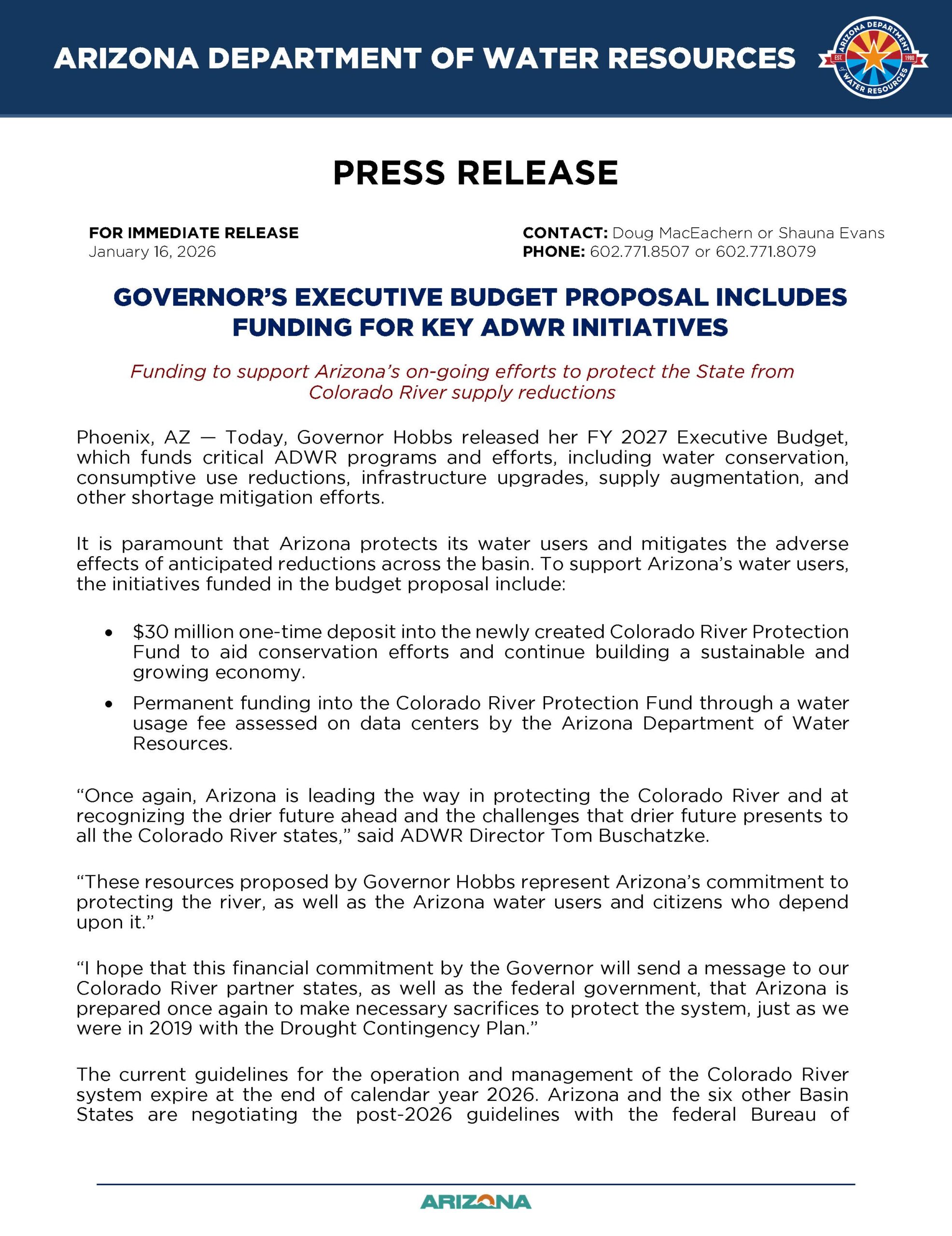
Arizona Budget Proposal Includes Major Funding for Colorado River Protection
On January 16, 2026, the Arizona Department of Water Resources (ADWR) shared details of Governor Katie Hobbs’ FY 2027 Executive Budget Proposal focused on preparing for long-term challenges facing the Colorado River. The plan includes new and expanded funding aimed at strengthening water security across Arizona in the face of ongoing Colorado River shortages.
Key points from the budget related to water:
Source:
Arizona Water News https://azwaternews.com/2026/01/16/fy2027_execbudgetproposal/
Arizona announced new groundwater management rules for parts of La Paz County, expanding oversight in an area long known for unregulated pumping. The move follows increased scrutiny of agricultural water use and reflects a broader push to protect groundwater supplies as Colorado River shortages continue. La Paz County lies within CRIT’s region. Stronger groundwater rules help prevent over-pumping that can undermine surface water systems and threaten tribal water security.
A water policy expert argues that Basin states are unlikely to compromise without clear federal consequences. With post-2026 rules approaching, the federal government’s willingness to step in is seen as a key driver for progress. Federal involvement increases the importance of ensuring tribal water rights and sovereignty are explicitly recognized in any imposed or negotiated plan.
Multiple outlets report on the release of the draft post-2026 Colorado River management alternatives by the U.S. Bureau of Reclamation. The plan outlines several options for operating Lake Powell and Lake Mead, including deeper cuts and greater federal control if states fail to agree. Officials stress that public and stakeholder input is still open but time is limited. These alternatives could directly affect downstream water deliveries. CRIT’s senior water rights, sovereignty, and river stewardship must be included before any plan is finalized.
Arizona municipal water providers stress that collaboration during the legislative session will be essential to address shortages, infrastructure needs, and conservation goals tied to the Colorado River.
Legislation was introduced in Congress to formally codify a tribal water rights settlement, providing legal certainty and recognition of the tribe’s rights. Each tribal settlement strengthens the broader recognition of tribal water rights across the Colorado River Basin and reinforces sovereignty.
Reports highlight emerging technologies, including satellite tools and agricultural innovations, aimed at reducing water use and improving efficiency across the West. Technology can support conservation efforts, but it does not replace enforceable water rights or the need to protect river flows.
On May 24, 2025, the Parker High School Gymnasium was bursting with excitement, cheers, and proud smiles as some very young scholars reached a big milestone—their official promotion from Head Start to kindergarten.
The gym was filled with families, friends, and loved ones, all gathered to celebrate the Class of 2025. Dressed in bright red caps and gowns, our adorable graduates lit up the stage with joy and confidence, ready to take their first big step into the world of elementary school.
Director Caroline Alcaida gave a warm welcome to kick off the festivities, setting the tone for a celebration full of heart and hope. With Monica C. Rosnagle as the lively emcee, the program flowed beautifully—from sweet songs like “We’re Off to Kindergarten!” performed by the students, to the beaming moment they each received their diplomas from their dedicated teachers and assistants.
Drought conditions, climate change, and concerns about CRIT’s water rights bring into focus the importance of recognizing Earth Day. CRIT’s 15th annual Earth Day celebration takes place May 31st from 8am to 11am at the Ahakhav Preserve.
The event will include raffles, music, food, hayrides, prizes, and information booths.
The event comes as CRIT’s Tribal Council considers personhood status for the Colorado River. The Council would like to hear from Membership about this proposal.
Email: Coloradoriverpersonhood@crit-nsn.gov
While a small number of Tribal Nations have conferred personhood status on their bodies of water and other natural resource features, CRIT would be the first Tribal Nation in the Colorado River Basin to confer personhood status on the Colorado River.
The designation would reaffirm the CRIT Nation’s commitment to protect the sustainability of the river for future generations and reinforcing CRIT’s sovereignty and its responsibility to the River.
If a resolution is passed conferring personhood status on the Colorado River, the Council would direct the Attorney General and its’ team to develop amendments to the water code that will be shared with membership in the coming weeks.
The Tribal Council is seeking input from CRIT Tribal Members.
Email coloradoriverpersonhood@crit-nsn.gov
Arizona Governor Katie Hobbs was joined by Tribal leaders, including CRIT Chairwoman Amelia Flores, the MMIP Task Force, representatives from the Arizona Department of Public Safety, and the family of Emily Pike for a ceremonial bill signing for HB 2281 (“Emily’s Law”).
This law codifies a new Turquoise Alert which helps law enforcement respond more quickly when Indigenous persons are reported missing.
The Law also honors the memory of slain San Carlos Apache teen Emily Pike, whose body was found Feb. 14 more than 100 miles from a group home she left in Mesa, Arizona, in late January.
After the signing ceremony Charwoman Flores said, “It’s very important to Tribal Nations, especially in Arizona. The Governor signing this bill gives law enforcement a quicker response to find missing and murdered individuals.”

The tragedy of Pike’s death was felt by Tribal communities including CRIT.
During CRIT’s Mega Throw event on March 22nd, a candlelight vigil was held on site to honor Emily Pike. On May 3rd CRIT youth including Junior Miss CRIT along with Little Miss CRIT attended an event at the Arizona State Capitol in Phoenix to honor Missing and Murdered Indigenous Women (MMIW). Additionally, CRIT Tribal Member Tonia Stone provided her survivor story at the event.
On this Memorial Day, the solemn notes of tribute echoed once again across the sacred grounds where service members, their families, and the wider community gathered to remember and reflect.
Delivering the keynote address was Herman “T.J.” Laffoon, a former CRIT Council member, veteran, and representative of the American Legion. His words were both reverent and urgent—calling on all citizens not only to remember the fallen but to carry forward their legacy through action.
Among the dignitaries in attendance were CRIT Chairwoman Amelia Flores; U.S. Army veteran Edward Yava Sr., a Native American service member and member of the 73rd Airborne, who stands as a living symbol of service and sacrifice; as well as tribal leaders, local officials, and community members gathered in solidarity to honor those who gave their lives in service.
The ceremony paid special tribute to Pvt. Lori Ann Piestewa, of Hopi descent, who was not only the first woman in the U.S. military to lose her life in the Iraq War, but also the first Native American woman to die in combat while serving in the United States Armed Forces. Her father, Terry Piestewa, a Vietnam veteran, once found these memorials too painful to attend. But with time, they became a source of strength—not just for him, but for her children, and for all who remember her legacy.
(more…)
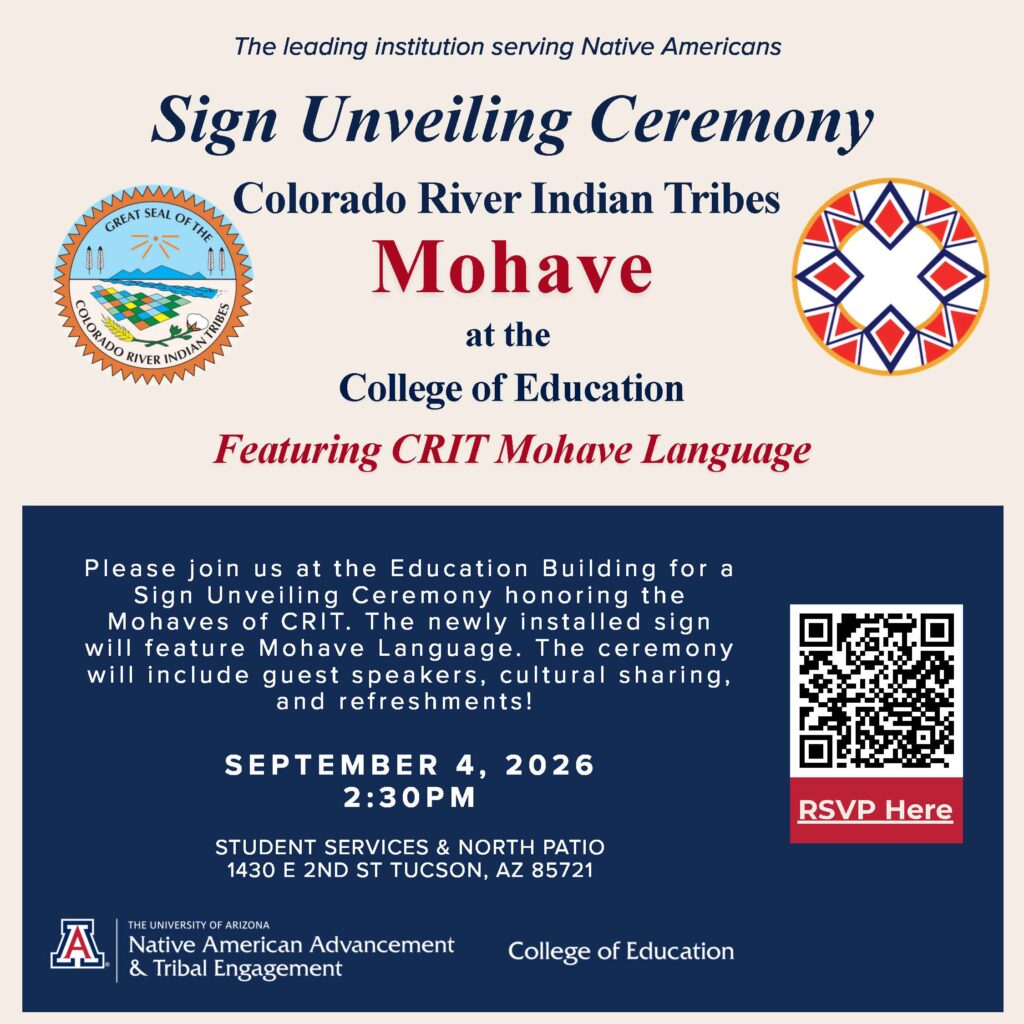
TUCSON, Ariz. — The University of Arizona will host a special series of sign unveiling ceremonies on Friday, September 4, 2026, honoring the four languages of the Colorado River Indian Tribes (CRIT): Mohave, Chemehuevi, Hopi, & Navajo. These ceremonies represent an important milestone in an ongoing campus-wide initiative to elevate the visibility, recognition, and continued presence of Indigenous languages and cultural heritage within the campus community.
The events are organized by the University of Arizona’s Office of Native American Advancement & Tribal Engagement (NAATE) in collaboration with individual academic colleges. Students, faculty, staff, tribal community members, and the general public are invited to attend the progression of ceremonies throughout the day.
The schedule for the Friday ceremonies includes:
The celebration of Indigenous culture continues into the weekend with the Native American Heritage Game on Saturday, September 5, 2026. The Arizona Wildcats will face Northern Arizona at Casino Del Sol Stadium, with kick-off scheduled for 6:30 PM MST. Pre-game festivities at Bear Down Field will begin at 3:15 PM with the Bear Down Bash, featuring 18-minute cultural performances from each tribe. A traditional gift presentation will follow during the Wildcat Walk at 4:15 PM, leading up to an on-field tribal recognition ceremony during the second quarter of the football game.
For more operational schedules or to register for the unveiling events, please visit the official University of Arizona Event Page.