Per the notice attached below, official comments must be made in writing to CRRMC, therefore comments made on Facebook will not be considered official.
Any individual, group, or agency may submit written comments on the ERR (Environmental Review Record) to the Colorado River Residential Management Corporation, Morris P. Sevada III, Executive Director. All comments received by September 24, 2024, will be considered by the Colorado River Indian Tribes prior to authorizing submission of a request for release of funds. Comments should specify which Notice they are addressing.
Please mail any comments to:
Colorado River Residential Management Corporation
PO Box 3427
Parker, Arizona 85344


To safeguard you and your family, here are a few tips and a fact sheet on West Nile Virus.


February 14, 2026
According to the U.S. Department of the Interior, federal officials are moving forward with new operating guidelines for the Colorado River even though the seven basin states have not yet reached full agreement. The updated rules, expected by October 2026, are meant to provide stability for water deliveries, power generation, and long-term management as drought conditions and declining inflows continue to strain the river system. Interior Secretary Doug Burgum said discussions with states, Tribal Nations, and Mexico are ongoing, but federal action is needed to ensure future reliability of the river.
The Colorado River supplies water to about 40 million people, supports millions of acres of farmland, generates hydropower, and serves 30 Tribal Nations, making it one of the most important water sources in the West. Federal officials are currently accepting public comments on the draft environmental review that will guide future reservoir operations.
For CRIT, these federal guidelines are important because Colorado River management decisions directly affect how tribal water rights are protected, how water is allocated in the Lower Basin, and how long-term planning supports the Tribe’s water security, economy, and future generations.
Source: U.S. Department of the Interior / Bureau of Reclamation press release
According to Arizona Mirror, Colorado River negotiations hit a setback as Lower Basin states, including Arizona, criticized Upper Basin states for resisting deeper water conservation commitments. Officials say ongoing drought conditions and declining reservoir levels are increasing pressure to finalize new operating rules before current guidelines expire. The disagreement highlights continuing tension over how water reductions should be shared across the basin. For CRIT, these negotiations are important because interstate agreements and federal management decisions directly influence how tribal water rights are protected and incorporated into long-term river planning.
Source: Arizona Mirror — https://azmirror.com/2026/02/13/arizona-blasts-upper-basin-states-for-refusing-cuts-as-colorado-river-talks-fail/
According to the Arizona Department of Water Resources, state officials say they will continue protecting Arizona’s Colorado River resources even after basin states failed to reach a consensus ahead of the federal deadline. Leaders emphasized ongoing drought challenges and the need for continued negotiations to maintain stability for water users across the region. State agencies say collaboration with federal partners and neighboring states remains essential moving forward. For CRIT, continued state and federal coordination is significant because long-term Colorado River policies directly affect how tribal water rights are recognized and sustained.
Source: ADWR Statement — https://azwaternews.com/2026/02/13/021326_statement/
According to USA Today, Colorado River negotiations approached a critical deadline without a final agreement, reflecting ongoing disputes over how to manage shrinking water supplies across the Southwest. Experts say declining snowpack, persistent drought, and competing demands are making consensus more difficult as states prepare for new post-2026 operating guidelines. Federal involvement may increase if states cannot reach agreement. For CRIT, these developments matter because federal river management decisions play a key role in protecting tribal water rights and ensuring long-term water security.
Source: USA Today — https://www.usatoday.com/story/news/nation/2026/02/13/colorado-river-deal-deadline/88658491007/
According to Arizona Water News, Arizona water leaders recently received a briefing from the governor’s office, the Arizona Department of Water Resources, and the Central Arizona Project on ongoing Colorado River negotiations as a federal deadline approaches. Officials discussed current drought conditions, possible future cutbacks, and the importance of coordinated state and federal planning to stabilize river supplies. The briefing highlights continued uncertainty as states work toward new post-2026 operating guidelines for the river. For CRIT, these negotiations are important because federal and interstate decisions on Colorado River management directly influence how tribal water rights are protected and incorporated into long-term planning.
Source: Arizona Water News — https://www.azwater.gov/news/articles/2026-02-11
According to KJZZ News, Colorado River basin states are facing a federal deadline to reach an agreement on future water management rules, with uncertainty remaining about whether consensus can be reached in time. Experts say possible outcomes range from short-term agreements to federal intervention if negotiations stall, reflecting ongoing tension between Upper Basin and Lower Basin states. Continued drought and competing water demands have made long-term planning increasingly complex. For CRIT, these negotiations matter because federal decisions about river operations directly affect how tribal water rights are recognized and sustained within the broader basin framework.
Source: KJZZ News — https://www.kjzz.org/the-show/2026-02-12/colorado-river-states-are-staring-down-a-feb-14-deadline-heres-what-might-happen-next
According to the Lake Powell Chronicle, federal officials have outlined a post-2026 framework aimed at preventing further decline of the Colorado River system as drought pressures continue. The proposed blueprint focuses on conservation strategies, operational adjustments, and coordinated planning among basin states to stabilize reservoir levels and long-term water supplies. These discussions reflect ongoing efforts to balance environmental conditions, population growth, and water demand across the Southwest. For CRIT, long-term federal planning for the Colorado River is significant because these policies help shape how tribal water rights are protected and managed for future generations.
Source: Lake Powell Chronicle — https://lakepowellchronicle.com/stories/feds-unveil-post-2026-blueprint-to-avert-colorado-river-collapse,99303
According to ABC 15 Arizona, researchers at Arizona State University are developing technology that converts industrial wastewater into ultra-pure water, potentially expanding future water reuse options in the Southwest. Scientists say advanced treatment methods could help supplement limited freshwater supplies while supporting growing populations and industries. Water recycling and reuse are increasingly discussed as part of long-term drought resilience strategies. For CRIT, emerging water reuse technologies may play a role in future regional water planning as tribes, states, and federal agencies work to protect limited Colorado River resources.
Source: ABC 15 Arizona — https://www.abc15.com/news/local-news/asu-turns-industrial-wastewater-into-ultra-pure-water
According to KJZZ News, potential Colorado River cutbacks could increase operating costs for Arizona water utilities and even affect their credit ratings, which utilities rely on to fund infrastructure projects. Analysts say uncertainty around long-term river supplies makes financial planning more difficult and could raise costs tied to water treatment, delivery, and conservation investments. These financial ripple effects show how water shortages extend beyond environmental concerns into economic stability across the region. For CRIT, shifts in regional water costs and infrastructure planning can influence broader river management decisions that ultimately affect how tribal water rights are maintained and utilized.
Source: KJZZ News — https://www.kjzz.org/the-show/2026-02-11/colorado-river-cuts-could-increase-arizona-utilities-costs-and-affect-their-credit-ratings
According to the Sierra Vista Herald Review, basin states are facing an approaching deadline to agree on new Colorado River management guidelines before current rules expire. Ongoing disagreements between Upper Basin and Lower Basin states, combined with continued drought pressures, have slowed negotiations and raised concerns about potential legal disputes if a consensus is not reached. Federal oversight remains a key factor in shaping how future allocations will be determined. For CRIT, these negotiations are important because federal river management decisions directly affect how tribal water rights are recognized, protected, and incorporated into long-term basin planning.
Source: Sierra Vista Herald Review — https://www.myheraldreview.com/news/state/deadline-approaches-for-colorado-river-negotiations/article_5dd6fa1d-eed1-4d98-82f2-4a754853da3c.html
According to KTNV Channel 13 News in Las Vegas, low snowpack levels across the Mountain West are raising concerns about water supplies for Southern Nevada and the broader Colorado River Basin. Snowpack acts as a natural reservoir that feeds rivers and storage lakes during spring runoff, so below-average levels can reduce future water availability and increase pressure on already stressed reservoirs. Experts say continued dry conditions could complicate long-term water planning across the Southwest. For CRIT, declining snowpack is significant because reduced river flows can influence future allocation decisions and federal management strategies affecting tribal water resources.
Source: KTNV News — https://www.ktnv.com/news/why-low-snowpack-levels-raising-alarms-for-southern-nevada-water-supply
According to Newsweek, new data showing concerning water levels at Lake Powell is adding to ongoing worries about the long-term stability of the Colorado River system. Reservoir levels play a critical role in determining water deliveries, hydropower production, and shortage declarations throughout the Southwest. Continued drought conditions combined with sustained demand have kept pressure on the basin’s major storage systems. For CRIT, reservoir conditions remain important because federal water management decisions tied to storage levels directly affect how tribal water allocations are managed and protected.
Source: Newsweek — https://www.newsweek.com/lake-powell-water-levels-as-concerning-data-revealed-11500468
According to the Center for Colorado River Studies at Utah State University, Lake Powell and Lake Mead have recently shown differing storage trends, reflecting the complexity of managing water across the Colorado River system. Researchers say reservoir operations, inflows, releases, and ongoing drought conditions all contribute to shifting water levels that can affect supply planning throughout the basin. Understanding how these reservoirs interact is key to long-term river management decisions. For CRIT, these reservoir dynamics matter because federal operational decisions tied to storage levels directly influence how Colorado River water is allocated and protected for tribal communities.
Source: Center for Colorado River Studies — https://qanr.usu.edu/coloradoriver/news/blog-2026-2-9
According to KJZZ News, the Colorado River Basin is experiencing one of its driest winters in decades, with snowpack levels far below average in key areas that supply water to Lake Powell and Lake Mead. Scientists warn that reduced snowpack could lead to lower river flows this year, increasing pressure on already strained reservoirs and complicating ongoing negotiations over long-term water management. Because snowpack acts as the primary natural storage system for the river, weaker winters often translate into tighter water supplies downstream. For CRIT, these conditions matter because reduced river flows can influence future allocation decisions, federal management strategies, and long-term planning for tribal water resources.
Source: KJZZ News — https://www.kjzz.org/science/2026-02-09/the-colorado-river-is-having-its-driest-winter-in-decades
According to ABC News, record-low snowpack across much of the western United States is raising concerns about potential water shortages, wildfire risks, and continued stress on major river systems including the Colorado River. Experts say warmer temperatures and shifting precipitation patterns are reducing snow accumulation that normally feeds reservoirs during spring runoff. These trends could influence future water allocation planning as states and federal agencies work toward updated river management strategies. For CRIT, changes in snowpack levels matter because they directly affect Colorado River flows that shape long-term water availability and policy decisions impacting tribal communities.
Source: ABC News — https://abcnews.com/US/wireStory/record-snow-drought-western-us-raises-concern-spring-130016613
According to the San Mateo Daily Journal, a key deadline is approaching for Colorado River basin states to reach an agreement on new water management rules before current guidelines expire. Ongoing disagreements between upper and lower basin states, combined with persistent drought conditions, have slowed progress and increased concerns about potential legal disputes if consensus is not reached. Federal oversight plays a major role in shaping these negotiations, particularly for the Lower Basin where water allocations are closely regulated. For CRIT, these negotiations are significant because future federal river management decisions directly affect how tribal water rights are recognized, protected, and incorporated into basin planning.
Source: San Mateo Daily Journal — https://www.djournal.com/news/national/deadline-approaches-for-colorado-river-negotiations/article_5a129b32-06cb-50c0-8945-5186943db1db.html
According to KJZZ News, a new groundwater monitoring tool developed in Nevada is helping scientists better understand how groundwater pumping affects habitats, water availability, and long-term sustainability across the Mountain West. Researchers say improved data can support more informed water management decisions as communities balance development, agriculture, and environmental needs. Groundwater use is increasingly important as surface water supplies face ongoing pressure from drought and climate variability. For CRIT, regional groundwater management discussions matter because they influence broader basin water planning and long-term strategies for protecting tribal water resources.
Source: KJZZ News — https://www.kjzz.org/science/2026-02-08/a-nevada-groundwater-tool-highlights-strained-habitats-with-lessons-for-the-mountain-west
According to Reuters, the Colorado River has been identified as the most endangered river in the United States due to ongoing drought, rising demand, and increasing pressure on its limited water supplies. Experts say declining reservoir levels, climate impacts, and competing state interests continue to challenge long-term sustainability across the basin. The designation highlights growing national attention on the need for cooperative water management and conservation efforts. For CRIT, this recognition underscores the importance of protecting tribal water rights as regional policies evolve to address long-term river stability.
According to KJZZ News, Colorado River negotiators may be leaning toward a short-term agreement as states remain divided on a long-term plan for managing the river before current operating rules expire. Ongoing drought, climate pressures, and disagreements between Upper Basin and Lower Basin states have stalled progress, and some officials believe a temporary deal could help avoid a major court battle while allowing more time for negotiations. Is a five-year deal better than no deal? As Nevada water negotiator John Entsminger noted, “If the alternative is litigation… then a five-year deal starts pretty good,” reflecting concerns that legal disputes could complicate future water management even further. For CRIT, these discussions remain important because federal river management decisions, compact negotiations, and potential legal outcomes directly affect how tribal water rights are protected, recognized, and sustained for future generations.
According to AZ Free News, the Arizona House has approved an additional $1 million for the state’s Colorado River litigation fund, signaling growing concern that water allocation disputes could end up in court as negotiations over future river management continue. State leaders say the funding is meant to ensure Arizona is prepared to defend its interests if talks between basin states break down, reflecting increasing tension as drought, population growth, and competing demands strain the river system. Legal disputes have historically shaped water distribution in the Lower Basin, including the Arizona v. California Supreme Court decision that affirmed tribal water rights. For CRIT, continued legal developments around Colorado River allocations are significant because court decisions often influence how tribal water rights are protected, enforced, and recognized in future negotiations.
According to the Las Vegas Review-Journal, ongoing drought conditions and limited snowpack are increasing pressure on Colorado River water supplies, raising concerns that the basin may face even tighter shortages in the near future. Experts note that declining reservoir levels and continued demand across the Southwest make it harder to stabilize the system, especially as negotiations continue over future operating rules. Some officials warn that without significant conservation or improved conditions, legal disputes between basin states could become more likely. For CRIT, ongoing shortage risks matter because long-term river stability and federal allocation decisions directly influence how tribal water rights are protected and exercised.
According to Arizona Capitol Times, a judge is reviewing whether agricultural groundwater pumping by Fondomonte in western Arizona constitutes a public nuisance, a case that could shape future groundwater regulation statewide. The lawsuit argues that heavy pumping may be affecting nearby wells and water sustainability, highlighting ongoing tensions between agriculture, development, and long-term water conservation. Outcomes from cases like this can influence how groundwater use is monitored and regulated across Arizona. For CRIT, groundwater policy discussions are important because regional water management decisions can affect broader basin planning and long-term protection of tribal water resources.
According to Nevada Current, growing data center development across the Southwest is increasing demand for both water and power, raising concerns among regulators and rural communities about sustainability. Large technology facilities often require significant cooling resources, prompting discussions about infrastructure planning, water efficiency, and future resource allocation. As population growth and technology expansion continue, water demand from emerging industries is becoming part of broader basin conversations. For CRIT, rising industrial water demand across the region highlights the importance of protecting tribal water rights and ensuring long-term sustainability of Colorado River resources.
Article written by CRIT Media Reporter Ariana Romero
CRIT Library recently hosted a read along for the students of CRIT Head-Start with Smokey Bear. The day started off with a short story, “It’s Fall” by Rene Kurilla. Smokey Bear read “Smokey’s story time”. The book touches on camping safety and fire safety and prevention. CRIT Fire was on site to give the kids a tour of their fire engine and other equipment used to help put out fires and save lives.

CRIT’s Revenue and Finance Department recently held a Business License & Tax Workshop at the Blue Water Resort and Casino to give current and potential business owners a look at how tribal businesses ae licensed and regulated. The workshop outlined three primary steps for obtaining a business license.
The workshop also explained the different types of business licenses.
Type one license
A temporary license which consists of 4-day consecutive selling and no further days.
Type two license
A seasonal license which consists of selling for more than four consecutive days and less than three months.
Type three license
An annual business license which consists of selling for more than three consecutive months during the calendar year. Annual business licenses expire on December 31st of the year of issuance.
Type four business license
Peddlers(non-food) license. This license is “retail sales” (non-food sales) for a person or persons who are selling tangible personal property (non-food) at retail.
Type five business license
Peddler (food) license applies to a person or persons selling prepared food items at retail. (more…)
CRIT Head Start hosted its Trunk or Treat event October 31st as a number of departments handed out candy and other goodies to the Head Start students who attended. Head Start Director Caroline Alcadia thanked everyone who attended and helped put the event together. Council members in attendance were Councilwoman Jaymee Moore, Councilwoman Vanessa Welch, Councilman Bobby Page, and Councilman J.D. Fisher.

Robert Esquerra started his career with the Colorado River Indian Tribes on October 18, 1999 as a EMT with CRIT Fire Department. In March of 2002 he went to Head Start as their maintenance worker. He then transferred to CRIT’s Department of Health and Social Services as a driver.
In 2004, Esquerra returned to the CRIT Fire Department as an EMT/Firefighter. In 2006 he was promoted to Captain for the Fire Department and in 2012 Esquerra was promoted to Assistant Fire Chief, the position he still holds today.
The Tribal Council and Human Resources Department thank Robert Esquerra for 25 years of continued service to the Colorado River Indian Tribes.

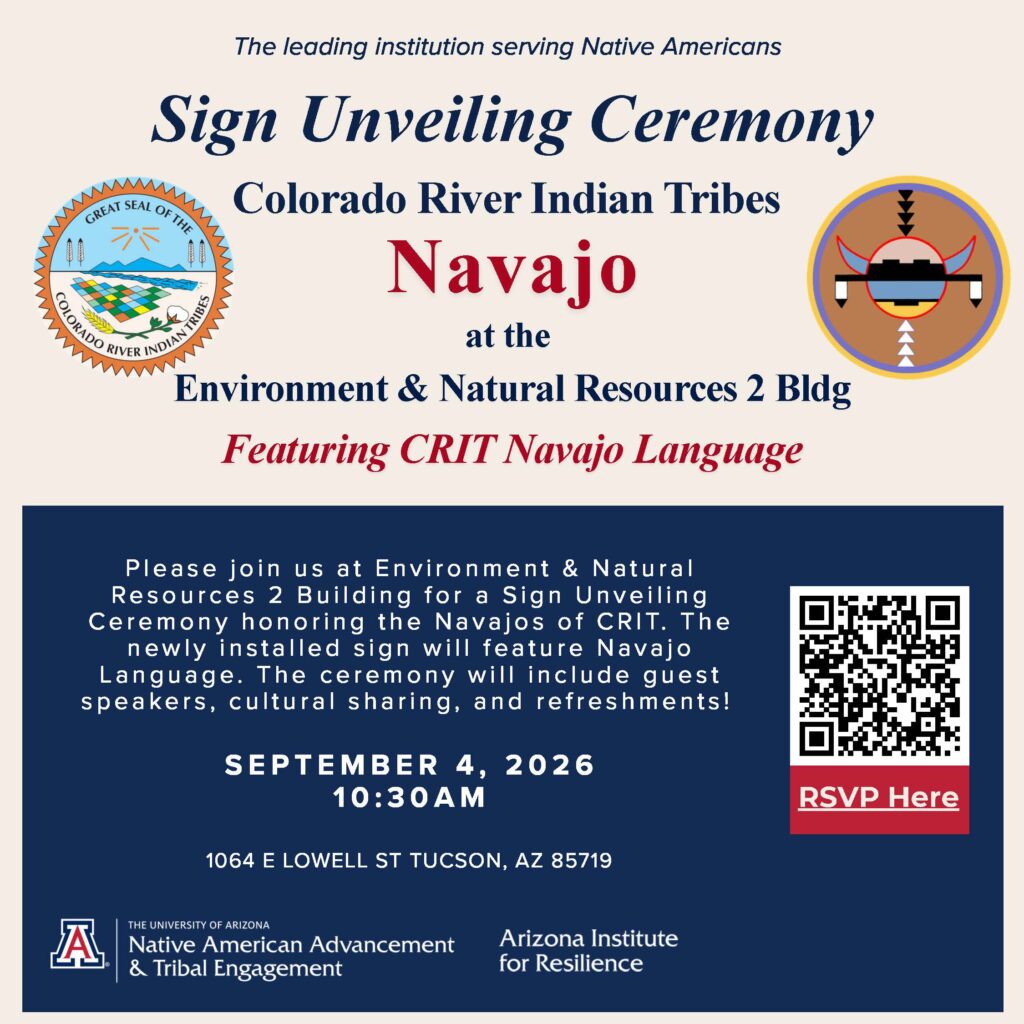
TUCSON, Ariz. — The University of Arizona will host a special series of sign unveiling ceremonies on Friday, September 4, 2026, honoring the four languages of the Colorado River Indian Tribes (CRIT): Mohave, Chemehuevi, Hopi, & Navajo. These ceremonies represent an important milestone in an ongoing campus-wide initiative to elevate the visibility, recognition, and continued presence of Indigenous languages and cultural heritage within the campus community.
The events are organized by the University of Arizona’s Office of Native American Advancement & Tribal Engagement (NAATE) in collaboration with individual academic colleges. Students, faculty, staff, tribal community members, and the general public are invited to attend the progression of ceremonies throughout the day.
The schedule for the Friday ceremonies includes:
The celebration of Indigenous culture continues into the weekend with the Native American Heritage Game on Saturday, September 5, 2026. The Arizona Wildcats will face Northern Arizona at Casino Del Sol Stadium, with kick-off scheduled for 6:30 PM MST. Pre-game festivities at Bear Down Field will begin at 3:15 PM with the Bear Down Bash, featuring 18-minute cultural performances from each tribe. A traditional gift presentation will follow during the Wildcat Walk at 4:15 PM, leading up to an on-field tribal recognition ceremony during the second quarter of the football game.
For more operational schedules or to register for the unveiling events, please visit the official University of Arizona Event Page.