Following a series of historic ceremonies on Friday, September 4, 2026, the University of Arizona has permanently integrated the four native languages of the Colorado River Indian Tribes (CRIT) into its campus landscape. Organized by the university’s Office of Native American Advancement & Tribal Engagement (NAATE) in partnership with individual academic colleges, the Native Languages Campus Sign Initiative unveiled a progression of permanent building signs throughout the day to celebrate the Mohave, Chemehuevi, Hopi, and Navajo languages.
Members of the CRIT Tribal Council attended the sign ceremonies, including Treasurer Anisa Patch, Secretary Josephine Tahbo, Councilmember Vanessa Welch, and Councilmember Raeanne Patch.
The continuous initiative aims to elevate the visibility, recognition, and enduring presence of Indigenous communities within academic spaces. Levi Esquerra, Special Advisor for NAATE, explained that the permanent structural markers grew out of a linguistics department tradition where temporary language signs were posted for just one day each February to observe International Mother Language Day. “They used to put up tarps of native languages throughout campus at six o’clock in the morning, take them down by six, and they wanted permanent signage,” Esquerra said. “We started an initiative of reaching out to tribes and having them add language to our buildings… What makes CRIT so unique is, you know, CRIT is made up of four distinct tribes. And so we felt it was only correct to honor each of those tribes that make up the CRIT nation.”
The day-long celebration began at 9:00 AM at the Emil W. Haury Anthropology Building, home to the School of Anthropology. The Chemehuevi language inscription “Puha” was added to the building’s sign, translating to the “Power of learning about the people.” School of Anthropology Director Rob Schon noted that the naming honors and renews structural ties established in 1954 when Emil Haury preserved Chemehuevi baskets for the Arizona State Museum. Reflecting on the word chosen for the sign, Schon remarked, “Phua is a sacred term… As interpreted here, Puha means power of learning about the people. There is no greater calling for an anthropologist to aspire to.” CRIT Chairwoman Amelia Flores highlighted the deep perseverance required to bring the project to fruition, stating, “When I first heard of the university asking the tribes in Arizona to name buildings, I approached him and I said, ‘Why not CRIT? Why not CRIT?’ … It’s taken this long. So thank you, my dear friend, for making this happen… Most tribes have only one, but CRIT, you have four.”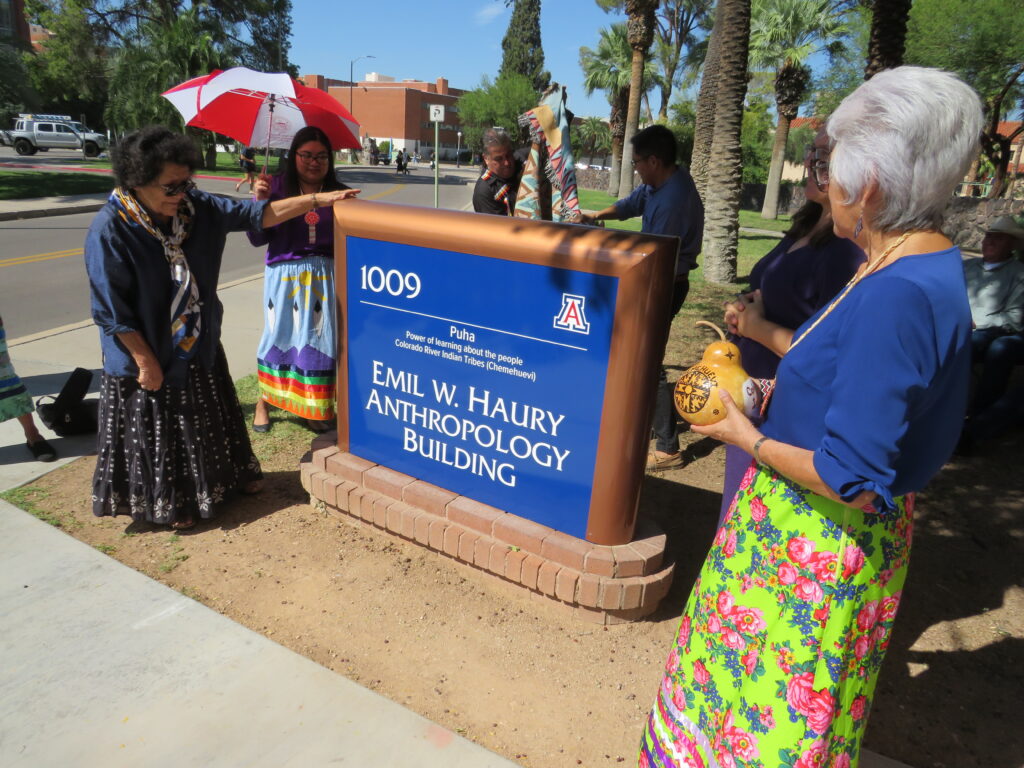
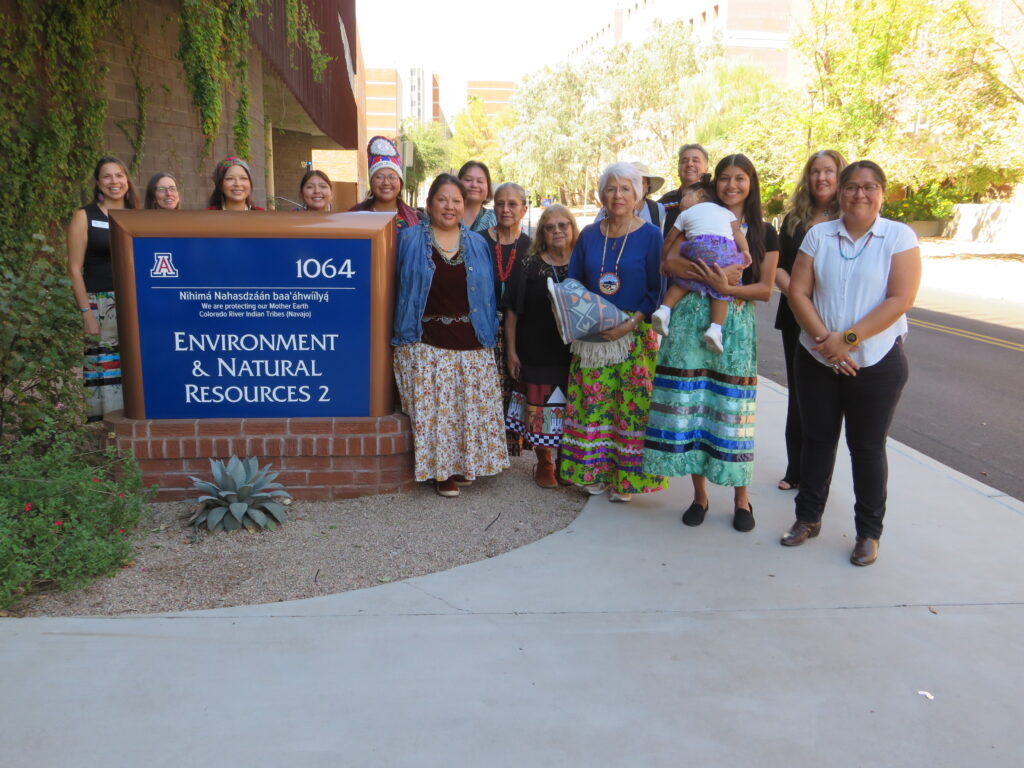
At 10:30 AM, the procession moved to the Environment and Natural Resources 2 (ENR2) Building to honor the CRIT Navajo language with the phrase “Nihimá Nahasdzáán baa’áhwíílyą́,” meaning “We are protecting Mother Earth.” During the ceremony, CRIT Navajo representative Harlietta Mitchell shared her family’s history of post-World War II relocation to the western Arizona desert, emphasizing that true ecological resilience requires a marriage of academic science and ancestral wisdom. “I hope this building will be more than a place where people study environmental science,” Mitchell said. “May it be a place where indigenous knowledge and scientific knowledge meet with respect.” Chairwoman Flores added, “This signage marks a permanent and visible commitment to honoring the first people of the land. When you see the words… they are a powerful, powerful declaration that indigenous knowledge and culture belongs in academia.” Navajo artist Nicole Pete also presented the history of the official CRIT Tribal Seal, which was designed by her grandfather, John Scott Sr., in 1966.
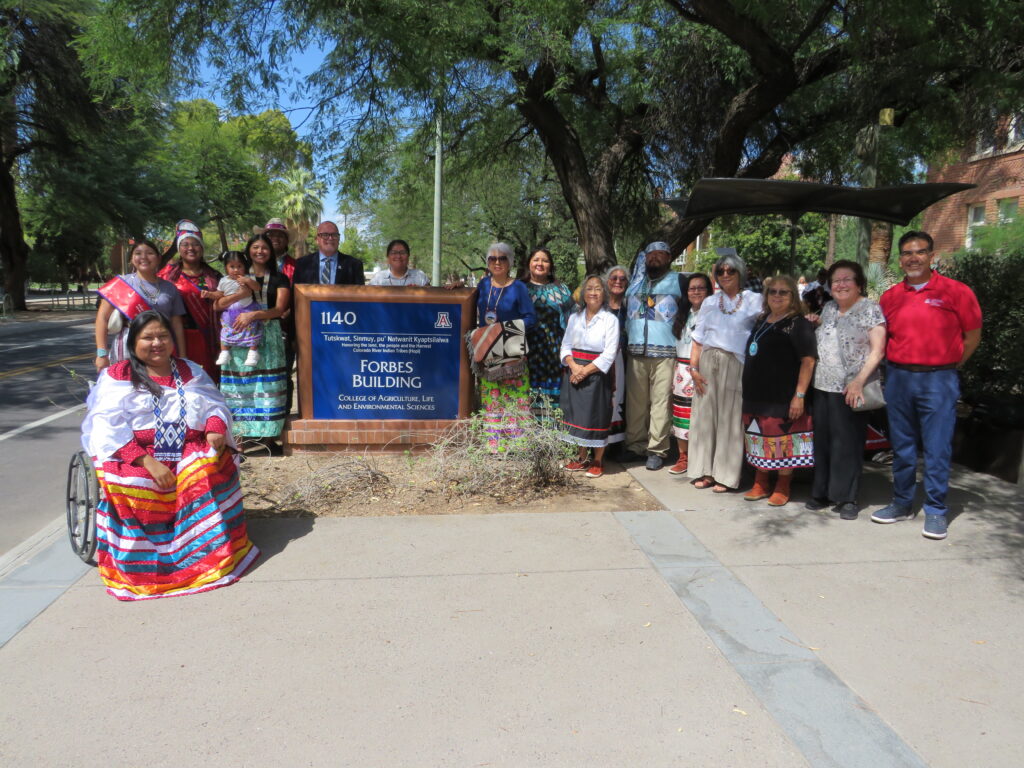
The afternoon continued at 1:00 PM at the Forbes Building, the home of the College of Agriculture, Life, and Environmental Sciences (CALES) and the Cooperative Extension. Honoring the CRIT Hopi language, the building’s new sign reads “Tutskwat, Sinmuy, pu’ Natwanit Kyaptsilalwa,” which translates to “Honoring the land, the people and the Harvest.” Professor Sheilah Nicholas detailed the deep, remote history inherent in the chosen Hopi vocabulary. “Means land, but the nuances of the Hopi perspective of land inherent in the word changes,” Nicholas explained. “…encompasses the understanding of land as place and a specific place where groups of people coalesced and became a distinct people…”
CALES Alumnus and CRIT Amat Kuhwely Farm Manager Joshua Moore also highlighted the personal weight of seeing his culture represented on campus. “Forbes became a home for me,” Moore stated. “…Having these words and my tribe’s symbol out on the sign is just so impactful.” Chairwoman Flores reinforced the necessity of passing these elements down to future generations, stating, “If we don’t share our identities, our languages, our culture, our traditions will die. So thank you for honoring that… May the Hopi naming resonate and bring awareness of learning, respect and shared responsibility for generations to come.”
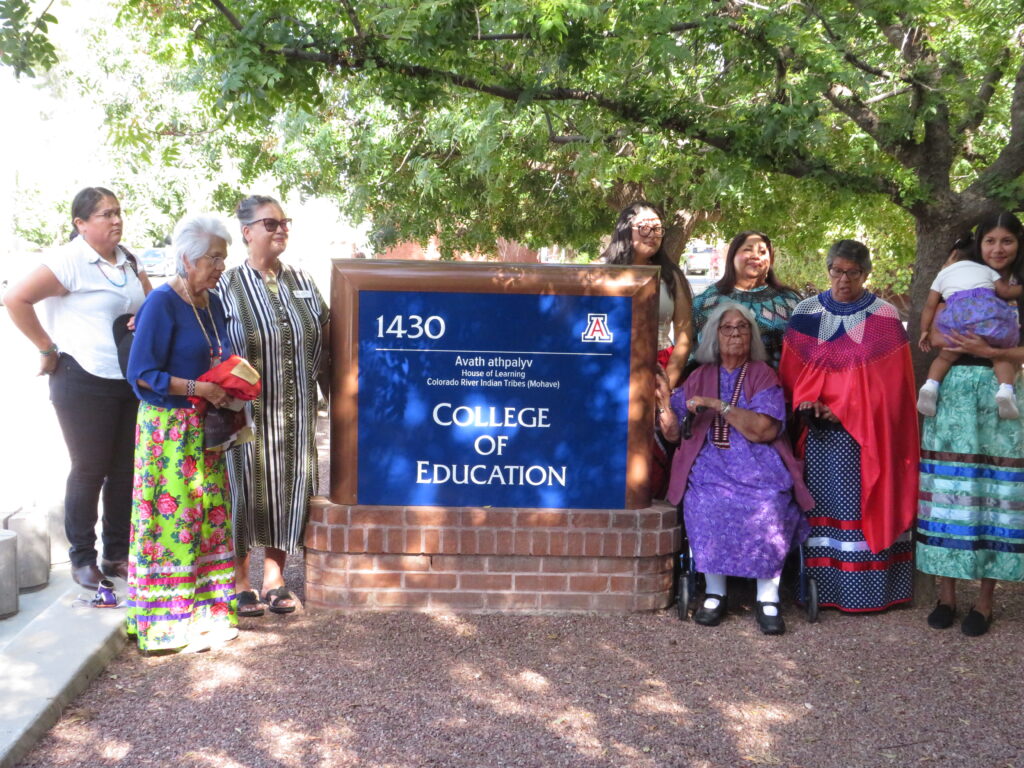
The final sign was unveiled at 2:30 PM at the College of Education Building, honoring the Mohave language with the phrase “Avath athpalyv,” meaning “House of Learning.” For Chairwoman Flores, an alumna of the university’s linguistics department, the day marked a profound personal and historical milestone. Addressing the crowd, Flores calculated that it took 141 years since the university’s founding era for this milestone to arrive. “The unveiling of the College of Education building signage represents a permanent marker of the relationship and collaboration between the University of Arizona and the tribal members of CRIT,” Flores said. “And it has been through the perseverance of leaders and those change makers that this day has become a reality… When students pass by the sign out in front, they will pause and respect the Mohave people and they will honor and respect our language.”