Arizona’s water coverage centered on a practical question: if the Colorado River keeps shrinking, how much backup water is actually available, and who can use it?
KJZZ reported that Phoenix-area cities are asking for clearer answers about Colorado River water stored underground by the Arizona Water Banking Authority. The Water Bank was created in 1996 to store excess Colorado River water underground for use during a shortage. Cities that rely on the Central Arizona Project say they need to know how much of that stored water they can access, when it would be available, and how it would be recovered.
The issue is becoming more urgent as federal officials consider new Colorado River operating rules. Arizona Farm Bureau News reported that Arizona water officials are pushing for the Lower Basin proposal as an alternative to deeper federal cuts. The proposal includes mandatory reductions across Arizona, California, and Nevada, along with additional voluntary savings through 2028.
The Arizona Farm Bureau also reported that the Central Arizona Project is now projecting a 14% shortage in its municipal water pool instead of 20%, partly by using water from Lake Pleasant and wells in Yuma. Even with that smaller projected shortage, cities and farms are still preparing for less water.
Agriculture remains a major part of the discussion. Arizona farmers are watching possible cuts closely because reductions to Colorado River water can affect planting decisions, crop choices, and operating costs. Those changes can also move beyond farms, reaching workers, local economies, and food supply chains.
Arizona is also looking at how to keep more water in the state. KJZZ reported that more than 95% of precipitation that falls in Arizona is lost to evapotranspiration. The reporting was based on the Arizona Tri-University Recharge and Water Reliability Project, which is studying ways to capture more rain, snowmelt, and runoff before it is lost to evaporation or plant use. The project is also looking at how more water can be moved into aquifers through recharge.
That research connects directly to questions about groundwater. As Colorado River supplies become less reliable, cities and rural areas are paying closer attention to underground storage, recharge, and long-term access to stored water.
The Desert Review reported that the Central Arizona Irrigation and Drainage District secured up to 10,000 acre-feet per year of new water supply from the Mojave Groundwater Bank in California. The agreement is another example of Arizona water users looking outside traditional supplies as Colorado River shortages continue.
Lake Powell also remained under pressure. The Guardian reported that the reservoir could fall to unprecedented lows after poor snowpack and limited spring runoff. KUTV and Newsweek reported on a proposal from scientists to move more water from Lake Powell to Lake Mead, arguing that storing more water in Lake Mead could reduce losses and protect downstream supplies. The idea is part of a larger debate over how the two major reservoirs should be managed as both remain low. (more…)
Lake Powell remained one of the biggest concerns. The Colorado Sun reported that low water levels are creating new pressure at Glen Canyon Dam, where federal officials are working to protect dam infrastructure as the reservoir drops. The report focused on cavitation, a problem caused when fast-moving water creates vapor bubbles that can damage dam equipment and concrete surfaces.
The issue shows how falling reservoir levels affect more than water storage. Lake Powell also supports hydropower generation, downstream releases, and dam operations. When the reservoir drops too low, federal managers have fewer options to move water through the system safely and efficiently.
Arizona water users are also watching federal planning closely. The Arizona Daily Star reported that a Colorado River water savings plan could reduce the effect of future cuts on Arizona users. The plan is part of ongoing Lower Basin negotiations as Arizona, California, and Nevada look for ways to conserve water and avoid deeper mandatory reductions.
Those negotiations remain unsettled. Fox 13 Salt Lake City reported that Colorado River governors said they are not at a stalemate, even as the deadline for new river rules gets closer. The current operating guidelines are set to expire after 2026, and the seven Basin states still need agreement on how future shortages will be shared.
For Arizona, Central Arizona Project water remains a major concern. The CAP canal moves Colorado River water to central and southern Arizona, including cities, farms, and tribal users. If future cuts fall heavily on CAP water, impacts would vary depending on each user’s legal priority, water portfolio, and access to stored supplies.
AMWUA reported on the importance of municipal access to stored water credits. Cities have stored water underground for years to prepare for shortages, but access to those credits becomes more important as Colorado River supplies become less reliable. Stored credits can help cities manage short-term gaps, but they are not a permanent replacement for long-term river reductions.
The idea of moving new water into Arizona also received attention. Some proposals have looked at whether abandoned energy pipelines could be used to bring water west. These ideas reflect the search for new supplies, but large importation projects often involve high costs, legal questions, energy demands, and environmental review. (more…)
Recent developments across the Colorado River Basin show how changes in water supply are beginning to affect recreation, agriculture, and future water planning. While the seven Basin states remain divided over how to manage the river, communities are already dealing with the effects of lower flows and looking at new ways to protect their water.
Colorado River negotiators recently made a rare public appearance together, but there was little indication that the states are closer to an agreement. Representatives from the Upper and Lower basins continue to disagree over how future water reductions should be shared and whether the next plan should offer long-term certainty or act as a temporary bridge.
Nevada negotiator John Entsminger said the latest Lower Basin proposal could provide a workable plan for the next few years and help keep the states out of court while discussions continue. Colorado negotiator Becky Mitchell questioned whether returning to negotiations every two years would build stability or simply create another series of temporary fixes.
The negotiators also discussed mediation as a possible next step. One idea would involve choosing three mediators: one selected by the Upper Basin, another by the Lower Basin, and a third selected by the first two. The ongoing disagreement is also making it difficult for Mexico, which receives Colorado River water under international agreements, to prepare for future shortages.
While those larger negotiations continue, uncertainty is reaching businesses that depend directly on the river. KNAU reported that Grand Canyon rafting companies are watching lower water levels near Lees Ferry following a historically dry winter and reduced releases from Lake Powell.
Rafting trips are still operating, and visitors may not notice a major difference today. However, business owners and river guides are concerned about what lower and less predictable flows could mean in the future. One company reported that bookings were down about 25% this year, although it was unclear whether water conditions were the main reason.
The concern shows how Colorado River operations support more than drinking water, agriculture, and hydropower. Releases from Glen Canyon Dam also affect rafting companies, guides, tourism, and communities connected to Grand Canyon recreation.
Arizona is also looking at less traditional ways to increase its water supply. Voice of San Diego reported that a private utility proposed using Arizona funding to help treat wastewater from the Tijuana River. The water would be treated and returned to Mexico, while Arizona could seek part of Mexico’s Colorado River allocation in exchange.
The proposal could initially produce more than 14,000 acre-feet of water each year, with the possibility of increasing that amount through future development. However, the project is still being studied and would involve complicated questions involving water quality, cost, environmental review, and agreements between the United States and Mexico.
Colorado, meanwhile, has taken action to reduce the damage left behind when agricultural water is sold and transferred to cities. A new state law will require farmland in the Arkansas River Basin to be revegetated before irrigation water can be moved to another use. (more…)
As Colorado River negotiations remain stalled, water leaders across the West are looking beyond temporary reservoir protections and considering broader changes to how water is managed. Recent reports show growing interest in mediation, permanent groundwater conservation, less water-intensive agriculture, and stronger tribal participation in state water decisions.
Representatives from the seven Colorado River Basin states recently addressed criticism over their failure to reach an agreement for managing the river after the current operating rules expire. KJZZ reported that negotiators remain divided over how future reductions should be shared between the Upper and Lower basins, despite more than a year of talks and worsening conditions across the watershed.
The negotiators acknowledged the frustration surrounding the process but maintained that the disagreements involve difficult legal, economic, and hydrological questions. Some state representatives have suggested bringing in a mediator to help narrow the divide. Mediation could provide another path toward compromise, but it would not remove the central dispute over who should reduce water use and by how much.
While the states continue debating Colorado River operations, groundwater is becoming another area of concern. KJZZ examined whether Arizona could establish a program to voluntarily purchase and permanently retire groundwater rights, similar to a program being developed in Nevada. Nevada’s approach would pay willing water-right holders to stop pumping permanently in areas experiencing declining aquifers, threats to groundwater-dependent ecosystems, or conflicts between existing users. An assessment of more than 6,000 Nevada wells found that nearly 40% showed significant declines over several decades.
A similar program could offer Arizona another tool for addressing groundwater depletion, especially in rural basins where pumping can exceed natural recharge. However, the cost of purchasing water rights would vary by location, and a voluntary program would require stable funding and clear priorities. Buying back rights would not restore an aquifer immediately, but it could prevent additional pumping and reduce long-term pressure.
Agriculture is also being asked to adapt to shrinking supplies. The Colorado Sun reported that researchers and farmers are testing crops that require less water, including black-eyed peas and drought-tolerant grains. Black-eyed peas can reach strong production with considerably less water than some traditional crops and can withstand heat without showing the same level of stress.
The challenge is not only whether farmers can grow less-thirsty crops, but whether there is a reliable market for them. Farmers must consider processing, transportation, buyers, and prices before replacing established crops. Water conservation will be difficult to sustain if producers are asked to take on the financial risk alone. Researchers say successful transitions will require partnerships among farmers, universities, buyers, and public agencies.
New reporting also provides a clearer picture of agriculture on California tribal lands. The Public Policy Institute of California found that about 15,800 acres are irrigated annually on tribal reservations in the state, representing roughly 0.2% of California’s irrigated acreage and agricultural water use. Most irrigated tribal acreage is located within the Colorado River Basin.
The report found that tribal agriculture generally has a more balanced mix of crops than agriculture statewide, with fewer permanent orchards and vineyards and a greater share of annual crops, pasture, and vegetables. Because annual crops can be changed more easily from year to year, tribal agricultural operations may have more flexibility during drought. However, tribal producers still face challenges involving infrastructure, financing, water access, and unquantified rights.
California lawmakers are also considering a measure that would strengthen the role of tribes in water policymaking. Assembly Bill 2218 passed the State Assembly and would require certain state agencies to consult affected tribes when reviewing water rights and policies. The bill would also recognize historical inequities caused by state actions that excluded tribes from access to and control over water.
Supporters say existing tribal consultation policies are not always legally secure and can depend on executive decisions. The proposed law would provide a stronger requirement for agencies to consider tribal water uses, Indigenous knowledge, and ecosystem restoration when making water decisions. (more…)
While much of the latest Basin Brief coverage has been focused on the new interstate water-exchange agreement between Arizona, California, and Nevada, other reports show the growing consequences of the Basin’s worsening drought. Declining reservoirs are affecting wildlife, hydropower, recreation, and local economies, while new industrial development continues to raise questions about how limited water supplies should be used.
The environmental effects of the Colorado River crisis extend far beyond the millions of people who depend on the river for drinking water, agriculture, and power. ABC15 reported that at least 150 threatened species of mammals, reptiles, fish, and plants depend on the Colorado River. As federal officials work toward new rules for dividing the river, conservation experts say the future of the Basin must also account for the ecosystems that rely on healthy river flows.
The river’s decline can change water temperatures, damage habitat, and place additional pressure on native species. These environmental concerns show that decisions about shortages and reservoir operations are not only about how much water reaches cities and farms. They also determine whether the river can continue supporting the plants, animals, and landscapes that make up the Colorado River ecosystem.
The effects of emergency river operations are already being felt in the Upper Basin. WyoFile reported that additional releases from Flaming Gorge Reservoir are causing serious problems for recreation businesses and communities along the Wyoming-Utah border. Federal water managers plan to release about 1 million additional acre-feet from Flaming Gorge between April 2026 and April 2027 to support Lake Powell.
The releases are expected to lower Flaming Gorge by approximately 35 feet, bringing the reservoir to about 59% of capacity. Falling water levels have already damaged boat ramps and marina structures, caused cancellations, and raised concerns about access to drinking water, fishing, and the future of the local recreation economy.
Flaming Gorge serves as an emergency water bank for the broader Colorado River system, but drawing it down to protect Lake Powell shifts some of the consequences of drought upstream. Communities that depend on the reservoir for tourism and local business are being asked to absorb losses so the larger system can continue operating. Water managers have also warned that using Flaming Gorge now reduces its ability to provide the same emergency support during future dry years.
Colorado may also be moving toward a statewide drought emergency declaration as poor snowpack and dry conditions affect agriculture, waterways, and communities. The Upper Basin provides much of the Colorado River’s flow through mountain snowpack, meaning worsening drought in Colorado has consequences throughout the entire river system. When less water reaches the river’s headwaters, less water is available to refill Lake Powell and serve downstream users.
At the same time, growing industrial demand continues to raise concerns in the Lower Basin. Reports about proposed data centers near Lake Mead have led to questions about whether water-intensive development should continue in areas facing long-term shortages. Data centers require large amounts of electricity and, depending on their cooling systems, can also consume significant amounts of water.
Lake Mead remains at approximately 30% of capacity, yet Southern Nevada and other parts of the Southwest continue to attract new technology and industrial projects. The tension between economic development and water security is becoming harder to ignore. Communities must now consider whether new projects can be supported without placing additional pressure on residents, existing businesses, and the Colorado River. (more…)
Water leaders across the Southwest are looking at new ways to manage limited Colorado River supplies as the Basin continues to face drought, low reservoir levels, and uncertainty over future rules. Recent reports show that agencies are no longer only talking about emergency cuts. They are also exploring interstate exchanges, desalination, recycled water, local conservation, rate increases, and new federal leadership as the Colorado River system moves closer to a critical point.
Arizona Water News reported that the Bureau of Reclamation and water agencies from Arizona, California, and Nevada signed a Memorandum of Understanding at the Claude “Bud” Lewis Carlsbad Desalination Plant in California. The agreement is meant to explore a framework for future interstate water exchanges, allowing agencies to discuss partnerships around desalination, recycled water, and other supply projects that could benefit more than one state.
The MOU was signed by the Bureau of Reclamation, San Diego County Water Authority, Metropolitan Water District of Southern California, Southern Nevada Water Authority, Arizona Department of Water Resources, Central Arizona Project, and Salt River Project. According to the release, future exchanges would use existing infrastructure and would not change or reallocate existing water rights. Instead, the goal is to create more flexibility so agencies can share the benefits of new water supplies when and where they are needed most.
That kind of flexibility is becoming more important as long-term drought has reduced Colorado River system storage to about 36% of capacity. Arizona Water News reported that record-low snowpack and record-breaking heat have added more pressure to the river system, increasing risks to the water and power infrastructure that millions of people depend on.
NPR reported that San Diego, once one of the cities most dependent on the Colorado River, now has excess water it may be able to sell or exchange. The city has invested in water recycling, conservation, and the Carlsbad Desalination Plant, which produces about 50 million gallons of drinking water each day. The plant supplies about 7% to 10% of the region’s water.
The idea would not involve physically sending desalinated water to Arizona or Nevada. Instead, San Diego could use more desalinated water locally and leave some of its Colorado River supplies in Lake Mead for others to use. This kind of exchange could help the larger system by keeping more water in the reservoir while allowing participating agencies to benefit from new local supplies.
At the federal level, the Bureau of Reclamation may soon see new leadership. KJZZ reported that water leader Aubrey Bettencourt is likely to be nominated to run Reclamation, the top federal agency involved in Colorado River operations. Scott Cameron currently serves as the acting leader of Reclamation and oversees the agency at a time when decisions about Lake Mead, Lake Powell, and post-2026 river rules are especially important. Cameron has previously visited the CRIT Reservation, and hopefully CRIT will get the opportunity to meet and build a working relationship with the next Reclamation leader.
Local communities are also preparing for a future with less reliable Colorado River supplies. KJZZ reported that Scottsdale approved a 4.5% water rate increase, with part of the funding going toward additional water sources. Scottsdale receives about 70% of its water from the Colorado River, and Arizona is expected to face more reductions in its river allocation. The city is considering several options, including advanced water purification, groundwater from Harquahala Valley, and expanding Bartlett Dam on the Verde River.
Utah Public Radio reported that Lake Powell may be in worse condition than its surface elevation suggests. A new report from Colorado River experts warns that the Basin’s major reservoirs are sliding toward “devastating consequences” if water levels continue to drop. The report said another dry year could push Lake Powell and Lake Mead toward “run-of-the-river” conditions, meaning the reservoirs would lose much of their ability to store water for the future and would mainly pass water downstream.
The Colorado River’s future will depend on whether states, tribes, federal agencies, cities, and water users can agree on rules that reduce demand while protecting the river itself. New supply projects and flexible exchanges may help, but they cannot replace the need for serious conservation, fair long-term management, and meaningful tribal involvement.
What does this mean for CRIT? (more…)
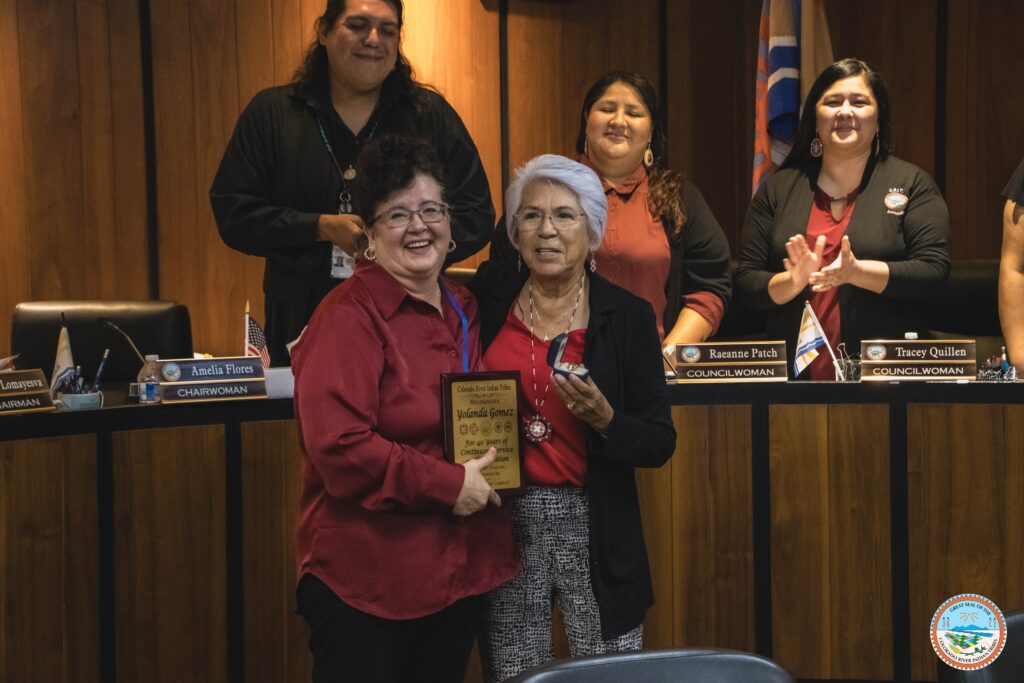
On behalf of CRIT we would like to congratulate Yolanda Gomez for 40 years of service and dedication.
Yolanda started her career with the Colorado River Indian Tribes on August 19, 1985 as Secretary with CRIT Farms.
In May of 1991, Yolanda transferred to Accounting as Enterprise Bookkeeper, and in 2008, she received a promotion to Senior Staff Accountant. Because of her expertise and dedication, “Yoli” as she is affectionately called, has also been appointed Acting Controller during times of need.
The Tribal Council and Human Resources Department thanks you for 40+ years of continued service to the Colorado River Indian Tribes.
COLORADO RIVER INDIAN TRIBES
DEPARTMENT OF HEALTH AND SOCIAL SERVICES
12302 KENNEDY DRIVE
PARKER, ARIZONA 85344
TELEPHONE (928) 669-6577
FAX (928) 669-8881
August 22, 2025
Notice to the Public:
The Colorado River Indian Tribes Department of Health and Social Services (DHSS) has received information that Mosquito Arbovirus Surveillance was conducted on the Colorado River Indian Reservation on August 19“’ & 20“’, 2025. This surveillance was conducted by the Parker Indian Health Service Office of Environment Health and Engineering (IHS;OEH&E) in partnership with the CRIT Environmental Protection Office (EPO).
There were mosquito pools that were tested for the presence of the West Nile Virus. One sample tested Positive for the presence of the West Nile virus collected at the Poston, Arizona – 50 Homes site. The best way to prevent infection is to avoid mosquito bites by taking precautionary measures to protect you and your family from dusk to dawn.
● Use an insect repellent and reapply as directed.
● Wear long-sleeved shirts and pants, covering arms and legs.
● Treat clothing and gear with repellant.
● Take steps to control mosquitoes indoors and outdoors, drain standing water
in flower pots, bird baths, or old tires.
● Keep doors and windows shut.
Eighty percent (80%) of people infected with WNV will not show any symptoms but we are asking the public to report any symptoms that you may be experiencing after a mosquito bite that you feel could be due to the West Nile virus. Symptoms can be flu-like and can include: a fever, a headache, body aches, diarrhea, a rash, nausea and vomiting and can be mild or severe, and may last a few days to a few weeks. However, in rare cases, severe illness can occur; that might include brain infections such as meningitis or encephalitis, paralysis or even death. There is no vaccine for the WNV in the United States, and there are no specific treatments.
The 50 Homes area was treated in the early morning hours of Friday, August 22, 2025, by CRIT EPO, The Parker IHS OEH&E and CRIT EPO will continue to monitor the area as well as the surrounding areas for West Nile virus activity to reduce the mosquito population.
● If you want to report an environmental issue such as standing water, please call the CRIT Environmental Office at 928-662-4336.
For any symptoms that you may be experiencing, please contact your primary care physician or visit the Emergency Department or call the Parker Indian Health Services Public Health Nursing at 928- 669-213
● For more information on the West Nile virus, please visit this link.
You can also contact the Department of Health and Social Services at 928-669-6577, for more information
Ramirez Flores has been serving as a Game Warden for the past four months, bringing a passion for the outdoors and a background in biology that inspired his career with Fish and Game. Growing up, he spent much of his time fishing alongside his father, which gave him an early appreciation for nature. His typical day includes patrolling the reservation, making sure campers and hunters have the proper permits, and helping to keep the reservation safe and clean. One of his most memorable moments on the job was responding to a call about baby falcons in need of care.
Flores and his team transported the birds to a rehabilitation facility, and seeing them survive and thrive was a rewarding experience. For Flores, being a Game Warden is more than working with animals, it’s about protecting the land and ensuring the community can enjoy it responsibly. His advice to anyone interested in joining the field is simple, follow policy. He believes it is the key to keeping both the community and the environment safe. Flores describes the work as exciting and fun, and he is proud to be part of such a strong team. As he heads to the academy alongside his fellow wardens, the community wishes him the best of luck on his journey. Also on the Fish and Game team is Sergeant Christian Handyside, who has been with the department going on one year. (more…)
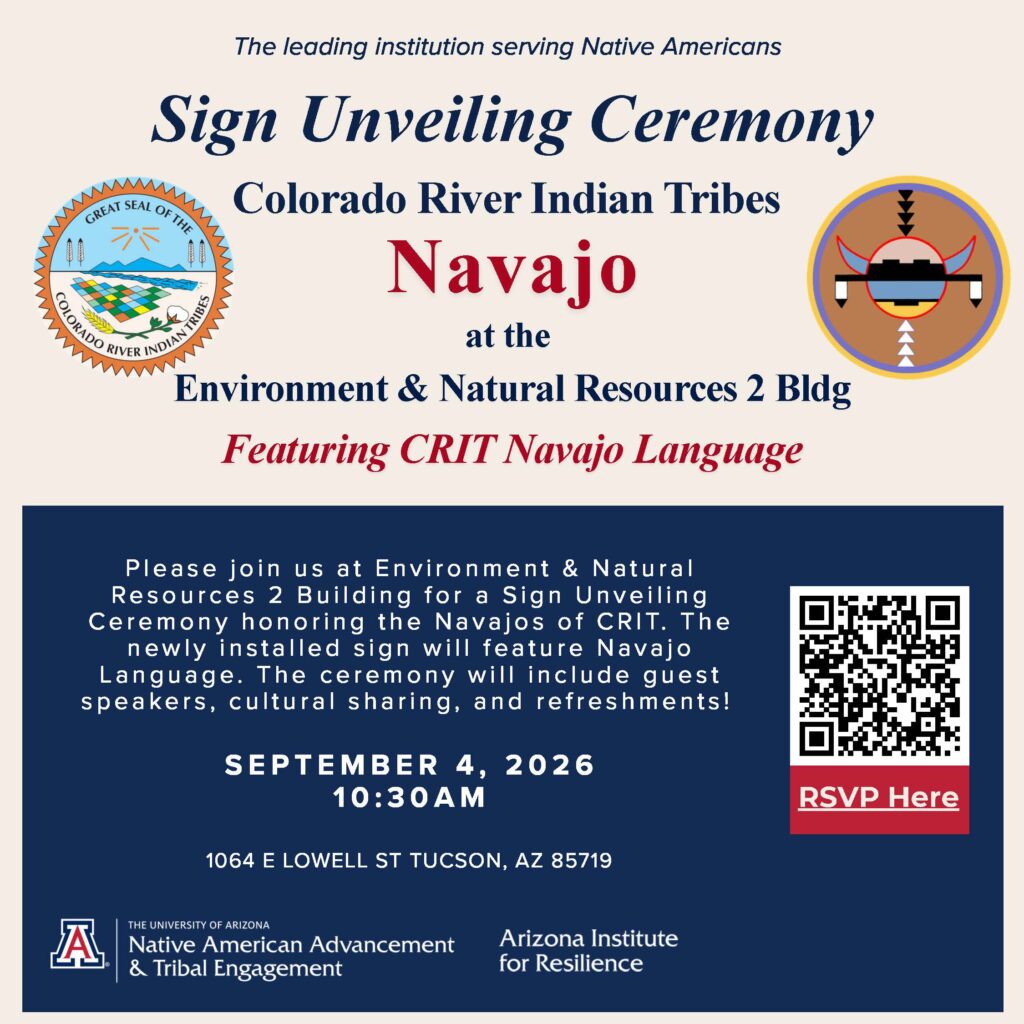
TUCSON, Ariz. — The University of Arizona will host a special series of sign unveiling ceremonies on Friday, September 4, 2026, honoring the four languages of the Colorado River Indian Tribes (CRIT): Mohave, Chemehuevi, Hopi, & Navajo. These ceremonies represent an important milestone in an ongoing campus-wide initiative to elevate the visibility, recognition, and continued presence of Indigenous languages and cultural heritage within the campus community.
The events are organized by the University of Arizona’s Office of Native American Advancement & Tribal Engagement (NAATE) in collaboration with individual academic colleges. Students, faculty, staff, tribal community members, and the general public are invited to attend the progression of ceremonies throughout the day.
The schedule for the Friday ceremonies includes:
The celebration of Indigenous culture continues into the weekend with the Native American Heritage Game on Saturday, September 5, 2026. The Arizona Wildcats will face Northern Arizona at Casino Del Sol Stadium, with kick-off scheduled for 6:30 PM MST. Pre-game festivities at Bear Down Field will begin at 3:15 PM with the Bear Down Bash, featuring 18-minute cultural performances from each tribe. A traditional gift presentation will follow during the Wildcat Walk at 4:15 PM, leading up to an on-field tribal recognition ceremony during the second quarter of the football game.
For more operational schedules or to register for the unveiling events, please visit the official University of Arizona Event Page.