By Ariana Romero
Reporter, CRIT Media
As 2025 comes to a close, new reporting shows Colorado River negotiations narrowing toward what many leaders describe as a final window for agreement, while local water solutions and long-term risks continue to take shape across the Southwest.
ABC15 Arizona reports that Colorado River states may only have one last realistic chance to reach a deal before federal intervention becomes unavoidable. With existing guidelines set to expire and reservoir conditions still fragile, officials warn that failure to compromise soon could lead to decisions being imposed rather than negotiated.
CBS 5 Arizona’s Family highlights what is at stake specifically for Arizona as talks drag on. The report notes that unresolved negotiations could affect everything from water deliveries to long-term planning for cities, tribes, agriculture, and industry, reinforcing why Arizona leaders are under pressure to help move talks forward.
Several opinion pieces stress the need for compromise in the Upper Basin. Phys.org and the Imperial Valley Press argue that without meaningful concessions, negotiations risk collapse, deepening divisions among states and prolonging uncertainty across the Basin.
At the local level, attention turned to Rio Verde Foothills, a community that famously ran out of water. The Arizona Republic, CBS 5, and AZ Big Media report that a permanent water solution has now been secured, ending years of uncertainty. However, the Arizona Republic notes that questions remain about the long-term cost of that solution, underscoring the financial realities of securing water in unregulated areas.
Water policy and development pressures remain closely linked. The Daily Independent reports that Valley water officials are urging legislators to invest more heavily in water resources, while opinion pieces from Nevada question whether the continued expansion of data centers is compatible with long-term water sustainability.
Conditions on the river itself remain mixed. Newsweek reports on how Lake Mead’s water levels changed throughout 2025, showing modest gains at times but continued overall vulnerability. Meanwhile, CBS News warns that Colorado is facing its worst snowpack on record for this point in the season, a troubling signal for future Colorado River flows, though experts say late-season storms could still offer some relief.
Despite tensions, collaboration remains a recurring theme. An opinion from the University of Colorado Boulder notes that Colorado River discussions continue to bring together unlikely partners through forums like the Colorado River Water Users Association, even as disagreements persist. Another Colorado Sun opinion stresses that public access to rivers and responsible stewardship must remain part of broader water policy discussions.
Together, these reports show a Basin approaching a crossroads. With negotiations nearing a critical moment, local water fixes highlighting real costs, and climate signals raising alarm, decisions made in the months ahead will play a major role in shaping the future of the Colorado River.
Sources
As the year comes to a close, new reporting underscores how unresolved negotiations, worsening climate impacts, and continued growth are colliding across the Colorado River Basin.
The Lake Havasu News-Herald reports that federal officials are demanding compromise from Basin states as water shortages deepen. Despite repeated warnings, states remain divided, prompting stronger signals that the federal government may intervene if agreements are not reached soon.
Several opinion pieces question long-held assumptions about water security. The Sun City Independent argues that Arizona’s promise of “assured” water is increasingly disconnected from reality, while national commentary emphasizes that decades of overuse and delayed action have left little room for error.
Weather extremes continued to dominate headlines. The Los Angeles Times reports that Southern California experienced its wettest Christmas holiday on record, highlighting the growing drought-to-deluge cycle driven by climate change. Despite heavy rain in some areas, drought conditions persist elsewhere, according to California and national drought summaries. In Colorado, the Denver Gazette reports snowpack levels are at the lowest ever recorded for this point in the season, raising serious concerns for future Colorado River flows.
Local and regional responses remain mixed. The Payson Roundup reports progress on water system improvements in Star Valley and a brief return to normal rainfall in Payson, though officials caution that short-term relief does not change long-term conditions. In Nevada, the Las Vegas Review-Journal reports that rapid growth in Las Vegas is continuing despite the Colorado River crisis, intensifying concerns about sustainability.
Across the Basin, journalists and experts reflected on the year’s biggest water stories. Aspen Journalism and Aspen Public Radio highlight how climate change is worsening drought conditions and pushing leaders toward difficult decisions in 2026. National Parks Traveler reports that declining Colorado River flows are already affecting national park sites along the river, signaling broader environmental consequences.
Some coverage points toward potential paths forward. Fox 13 in Utah explores ideas aimed at easing water conflicts, while opinion pieces emphasize the need for compromise among Upper Basin states. The Sierra Club highlights how Indigenous knowledge and stewardship can play a key role in adapting to climate change and managing water more sustainably.
The Colorado River Indian Tribes Tribal Council has made a historic decision to protect the lifeblood of their Reservation. On November 6, 2025, the Council unanimously approved Resolution No. R-375-25, which proclaims the personhood status of the Colorado River under tribal law.
This resolution acknowledges the Colorado River as a living entity whose health and well-being are intrinsically linked to the well-being of the Colorado River Indian Tribes (CRIT) members. The Tribes’ deep-rooted connection to the river spans centuries, providing cultural identity, spiritual strength, food systems, and economic stability that continue to shape their community life today.
The resolution emphasizes the central role the river has played in defining the identity of the CRIT. It highlights that CRIT’s ancestors have preserved and protected these lands since before the establishment of the Colorado River Indian Reservation in 1865.
The Council underscores the crucial role the river plays in sustaining traditional practices, wildlife, and agriculture, including the federal irrigation systems authorized as early as 1867. Today, the Colorado River Indian Irrigation Project stands as a cornerstone of the tribal economy.
The resolution underscores significant legal milestones that acknowledged CRIT’s water rights. In the landmark 1964 and 2006 Arizona v. California U.S. Supreme Court decisions, the Tribes secured 719,248 acre-feet of water annually, ensuring their access to the river for generations to come.
By granting personhood to the River, the Tribal Council reaffirmed its sovereign duty to honor and protect it. This status mandates that the River’s well-being must be a priority in governance and decision-making moving forward.
As part of the resolution, the Attorney General and their staff will develop legal safeguards and propose updates to the CRIT Water Code and other relevant regulations. These updates may include the potential designation of the river as a protected cultural landscape.
Council members recognized that protecting the river is not merely a legal obligation but a continuation of cultural beliefs passed down through generations.
Through this declaration, CRIT demonstrates its unwavering commitment to stewardship. The resolution concludes with a resolute message: the Colorado River is, and will always remain, a vital entity deserving of respect, care, and protection for all future generations.
Article Written by CRIT Media Reporter Ariana Romero
News Update November 12, 2025
Negotiations over the future of the Colorado River have reached a standstill after all seven basin states failed to meet a key federal deadline. Reports from 12News and 8NewsNow confirm that the states were unable to agree on a new water-sharing plan, leaving the situation unresolved as the river continues to decline.
High Country News explains that the biggest disagreements involve how much each state should give up in the future. The upper Basin states want fewer mandatory reductions, while the Lower Basin states, including Arizona, say they have already taken the deepest cuts and cannot continue to absorb the majority of the impacts.
With no agreement in place, Arizona Governor Katie Hobbs has asked the Trump administration to intervene. She stated that Arizona has made significant sacrifices and cannot carry the weight of the reductions while other states refuse to commit to measurable cuts. If the states cannot reach a plan soon, the federal government may create one for them.
For the Colorado River Indian Tribes, the outcome of these negotiations has major importance. CRIT holds valuable senior water rights and relies on a stable and fair management plan to ensure long-term security for the community and the region.
For more information, you can read the news articles with the links below.
High Country News
https://www.hcn.org/articles/why-colorado-river-negotiations-are-so-difficult/
12 News
/wednesday-is-deadline-for-7-state-including-arizona-to-negotiate-the-colorado-river
In the quiet valley of the Colorado River Indian Tribes (CRIT), once stood one of the largest Japanese American incarceration camps of World War II, the Poston War Relocation Center. Between 1942 and 1945, nearly 18,000 men, women, and children of Japanese ancestry were forced to live there.
This past weekend, the annual Poston Pilgrimage returned to the CRIT Reservation, drawing in the largest gathering to date. More than 100 visitors met at the CRIT Museum to honor those who have lost their lives while imprisoned at Poston. Starting the weekend off at Blue Water Casino was an introduction of the event with descendants of former incarceratees, Chairwoman Amelia Flores, Debbie Pettigrew, and Karen Harjo. Many of the adults who once lived in the camps have since passed on, leaving their children to share stories of life inside, memories that continue to move and teach new generations.
This year’s pilgrimage carries special meaning with the arrival of the Ireichō, also known as The Book of Names.
The Ireichō is part of the Irei: National Monument for the WWII Japanese American Incarceration, a national project dedicated to honoring more than 125,000 people of the Japanese ancestry who were unjustly imprisoned during the war.
For the first time, every individual’s name has been compiled into one permanent record. The Ireichō follows the Japanese Buddhist tradition of kakochō, “The Book of the Past,” in which the names of those who have passed are written to be remembered and respected.
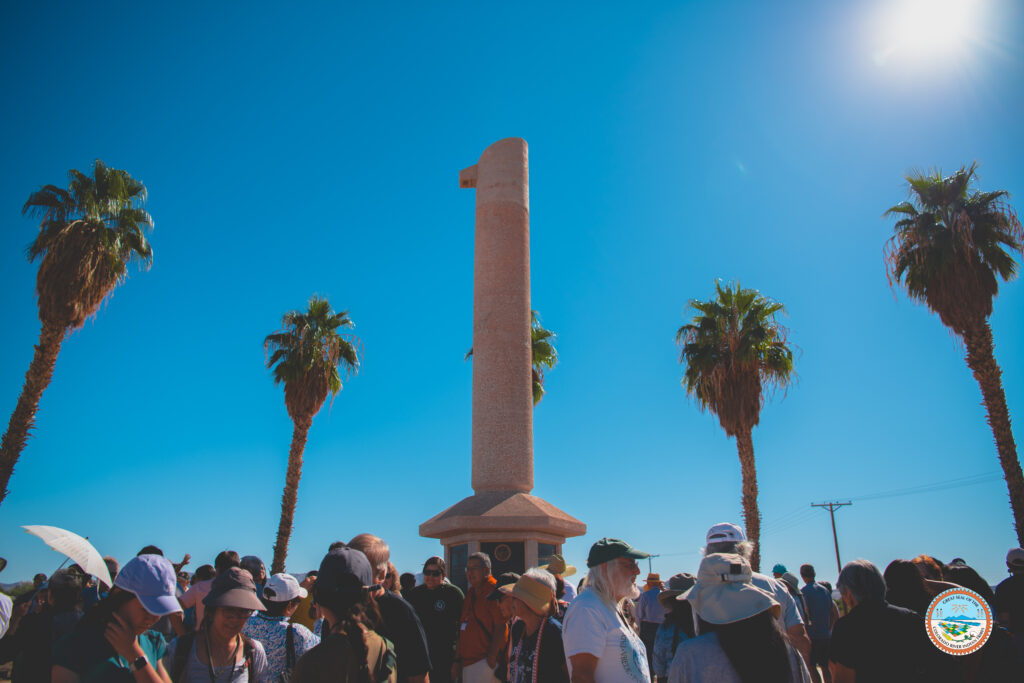
Unveiled at the Japanese American National Museum, the Ireichō invites visitors to place a red hank (stamp) beneath each name as an act of remembrance. The book has since traveled to historic incarceration sites across the country, allowing families, descendants, and visitors to honor those who lived through that time in history.
The day began with a blessing from Duncan Ryūken Williams, the Ireichō’s co-founder and Soto Zen Buddhist priest.
The Ase S’maav Parker Boys and the River Tribes United Dance Group shared songs and danced for the descendants of Poston’s former residents. The ceremony closed with a memorable moment as children and families were invited to stamp the Book of Names.
Each year, the Poston Pilgrimage brings together descendants, historians, and community members returning to the monument to honor those who lived behind the barbed wire and ensures their stories continue to be told. What makes Poston unique is its shared history between the Japanese American community and the tribal nations whose land was used for the camp. Built on CRIT lands under federal direction, the camp became a symbol of resilience and reflection, a reminder of the injustices endured and strength that followed. (more…)
On Friday, October 3, 2025, the Colorado River Indian Tribes kicked off Native American Days with a lively celebration at Manataba Park under the tin shed, bringing together community members, families, and visitors for a day full of culture, food, games, and laughter.
The event opened with Tribal Council presentations, led by Councilwoman Raeanne Patch, Councilman Billy Beeson, Councilman Tommy Drennan, and Treasurer Anisa Patch. Their presence set the tone for a meaningful day of honoring culture and community. Following a blessing by Carol Claw Hammond, the crowd gathered for a hearty lunch of pitted meat, tortillas, macaroni salad, and beans. A feast that kept everyone smiling and full throughout the day.
Vendors brought extra flavor to the celebration with NDN Joe, who kept the crowd refreshed with his famous beverages, while Carrie Burns offered custom cups, popcorn, and sweet treats. Terri Lynn’s snow cones and piccadillys were a big hit, especially under the warm afternoon sun. Visitors also enjoyed the Hopi booth, which raffled off beautiful jewelry, and the Chemehuevi booth, which shared crafts to enjoy and make. The Regional Center for Border Health joined in, connecting with the community and offering helpful resources.
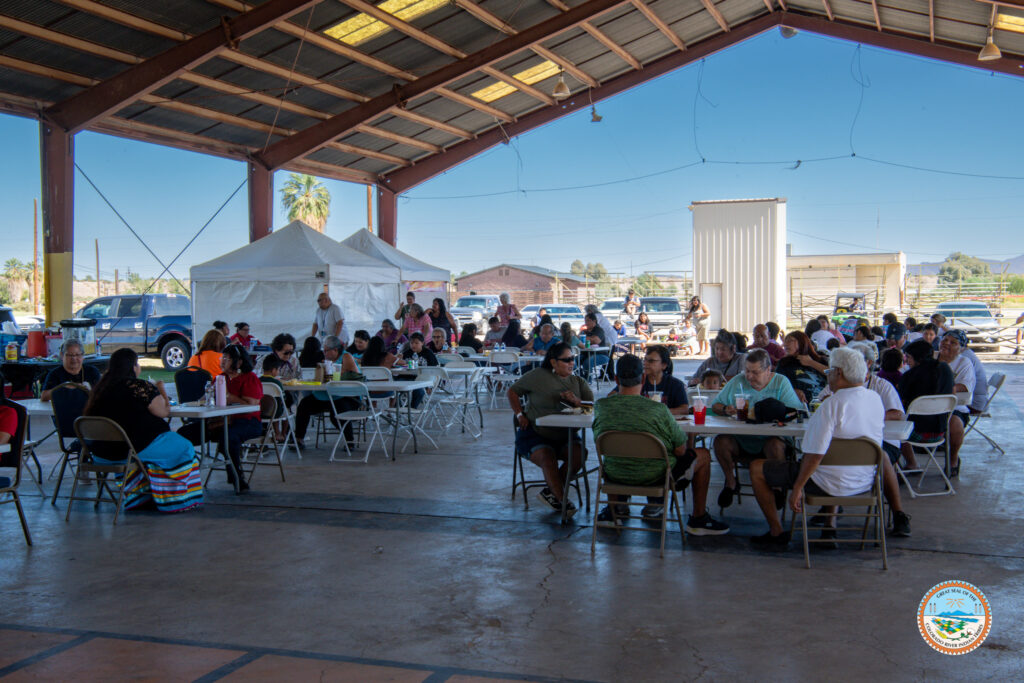
Throughout the day, families enjoyed a wide variety of activities. Native language bingo quickly became a favorite, teaching words from the four tribal languages—Mohave, Chemehuevi, Hopi, and Navajo—in a fun and interactive way. Smiles and laughter filled the air as people competed for prizes while learning more about their heritage.
The regalia presentations were a true highlight of the afternoon. Toddlers charmed the crowd in their tiny regalia while older youth and adults showcased beautifully crafted dresses and traditional wear. The pride and joy that radiated from each participant created a powerful reminder of the beauty and strength of tradition. (more…)