March 7, 2026 4:08 pm
CRIT Nation, Parker, AZ
March 7, 2026 4:08 pm
CRIT Nation, Parker, AZ
bg-spacer

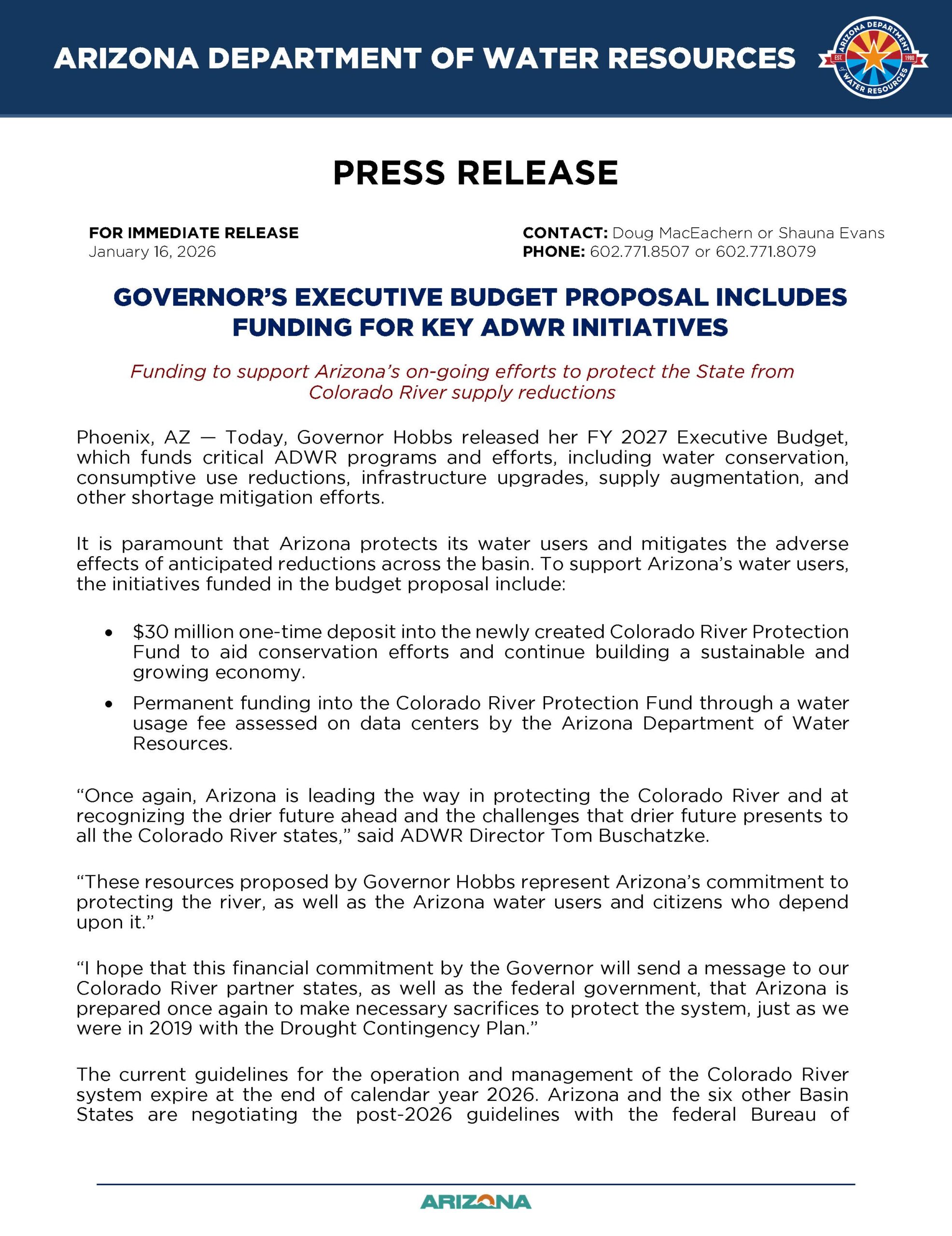
Arizona Budget Proposal Includes Major Funding for Colorado River Protection

On January 16, 2026, the Arizona Department of Water Resources (ADWR) shared details of Governor Katie Hobbs’ FY 2027 Executive Budget Proposal focused on preparing for long-term challenges facing the Colorado River. The plan includes new and expanded funding aimed at strengthening water security across Arizona in the face of ongoing Colorado River shortages.

Key points from the budget related to water:

  • $30 million one-time deposit into a newly created Colorado River Protection Fund to support conservation efforts and short-term drought response.
  • Permanent funding mechanism for that Protection Fund to be supported by a water usage fee on data centers.
  • Continued investment in water conservation, shortage mitigation, supply augmentation, and water infrastructure upgrades.
  • A recognition that current Colorado River operating rules expire at the end of 2026, with negotiations underway to create a sustainable long-term framework.

Source:
Arizona Water News https://azwaternews.com/2026/01/16/fy2027_execbudgetproposal/
(more…)

Arizona announced new groundwater management rules for parts of La Paz County, expanding oversight in an area long known for unregulated pumping. The move follows increased scrutiny of agricultural water use and reflects a broader push to protect groundwater supplies as Colorado River shortages continue. La Paz County lies within CRIT’s region. Stronger groundwater rules help prevent over-pumping that can undermine surface water systems and threaten tribal water security.

A water policy expert argues that Basin states are unlikely to compromise without clear federal consequences. With post-2026 rules approaching, the federal government’s willingness to step in is seen as a key driver for progress. Federal involvement increases the importance of ensuring tribal water rights and sovereignty are explicitly recognized in any imposed or negotiated plan.

Multiple outlets report on the release of the draft post-2026 Colorado River management alternatives by the U.S. Bureau of Reclamation. The plan outlines several options for operating Lake Powell and Lake Mead, including deeper cuts and greater federal control if states fail to agree. Officials stress that public and stakeholder input is still open but time is limited. These alternatives could directly affect downstream water deliveries. CRIT’s senior water rights, sovereignty, and river stewardship must be included before any plan is finalized.

Arizona municipal water providers stress that collaboration during the legislative session will be essential to address shortages, infrastructure needs, and conservation goals tied to the Colorado River.

Legislation was introduced in Congress to formally codify a tribal water rights settlement, providing legal certainty and recognition of the tribe’s rights. Each tribal settlement strengthens the broader recognition of tribal water rights across the Colorado River Basin and reinforces sovereignty.

Reports highlight emerging technologies, including satellite tools and agricultural innovations, aimed at reducing water use and improving efficiency across the West. Technology can support conservation efforts, but it does not replace enforceable water rights or the need to protect river flows.

(more…)

Several outlets reported on the release of the Draft Environmental Impact Statement (EIS) by the U.S. Bureau of Reclamation, which outlines how the Colorado River could be managed after current rules expire in 2026.

The draft lays out five possible management alternatives for operating Lake Powell and Lake Mead, including options where the federal government steps in if Basin states cannot agree. Federal officials acknowledge that a temporary or stopgap deal may be necessary if negotiations remain stalled. These decisions will directly affect how water is released downstream.

As a senior water rights holder, CRIT’s rights and sovereignty must be protected in any final plan. The draft process is a critical opportunity for tribal input.

Coverage from Nevada and Utah outlets explains that while states continue negotiations, deep disagreements remain over how water cuts should be shared. Federal officials are signaling they are prepared to act if consensus is not reached.Some articles describe this moment as a turning point, where long-standing assumptions about water use are being challenged and previously “untouchable” practices are now on the table.

If states fail to agree, federal decisions could reshape river operations. Tribal nations must be included to ensure historic rights are not overlooked.

California-focused reporting explains how the draft federal plan could require additional water cuts, even during wet years. Officials emphasize that recent storms do not erase long-term shortages caused by overuse and climate change.

California’s use affects overall Basin stability. How cuts are distributed influences downstream reliability for Lower Basin users.

Multiple sources covered Arizona’s continued focus on groundwater protection, including new Active Management Areas and enforcement actions tied to large agricultural water users. These efforts are framed as necessary as Colorado River supplies remain uncertain.

As surface water becomes less reliable, pressure shifts to groundwater. Strong regulation helps prevent over-pumping that could undermine regional water security and tribal resources.

Nonprofit and policy reporting highlights a key admission from federal officials: a full, long-term Colorado River agreement may not be ready by 2026, making interim solutions likely. (more…)

Bureau of Reclamation – The Bureau of Reclamation released its long-awaited Draft Environmental Impact Statement outlining potential strategies for managing Lake Powell and Lake Mead after 2026, when current operating guidelines expire. The draft presents multiple alternatives, including scenarios where the federal government steps in if Basin states fail to reach agreement. No preferred alternative has been selected yet, keeping negotiations open.This document will directly shape how Colorado River water is managed in the future. Tribal water rights, sovereignty, and protections for the river itself must be recognized in any final decision.

Lake Powell Chronicle – This piece outlines which players are involved in current negotiations and what each is seeking, including states, tribes, and federal agencies.Who is “at the table” determines whose rights and values are reflected in the final outcome. Tribal voices remain essential.

Tucson Sentinel – Despite recent storms and heavy rainfall in Phoenix, much of Arizona remains in long-term drought. Experts caution that short-term rain does not replenish groundwater or stabilize Colorado River supplies. Reinforces that reliance on weather alone will not protect tribal water rights or the river.

Arizona Water News – Arizona Department of Water Resources hydrologists are conducting field investigations across multiple basins to better understand groundwater use and conditions. Increased groundwater scrutiny reflects growing pressure as Colorado River supplies tighten, which can affect regional water demand and policy.

KLAS CBS 8 – Forces aligning against healthy snowpack for Colorado River states

Experts warn that warming temperatures, dry spells, and climate trends are working against the development of a healthy snowpack, threatening future river flows. Snowpack is the river’s primary source. Poor conditions upstream affect all downstream users.

Colorado Public Radio / The Hill – House fails to override Trump veto of Colorado water project

Lawmakers failed to override a presidential veto blocking a major Colorado water infrastructure project, leaving future water deliveries uncertain.Delays in infrastructure add pressure to existing Colorado River supplies. (more…)

KGUN 9 Tucson – Group urges Sahuarita to review Hudbay groundwater agreement

Community advocates are calling for closer review of groundwater agreements tied to mining operations, citing long-term water security concerns.

Cave Creek/Carefree Independent – Water at the forefront of Tuesday meetings

Local leaders are increasingly focused on water planning as development and supply concerns grow.

Santa Rosa Press Democrat – California’s largest reservoir rises 36 feet as rains boost water supply statewide. Storms have boosted reservoir levels in California, but officials caution that snowpack remains below what is needed for long-term security.

GV Wire – Winter storms wipe out drought in California, for now

California officials stress that recent rains offer short-term relief but do not end the drought.

CBS News – Colorado’s snowpack woes continue into 2026

Colorado snowpack remains well below average, heightening concern for river flows later this year.

Salt Lake Tribune – The Great Salt Lake enters 2026 uncomfortably close to record lows.

Low water levels highlight the broader regional water crisis tied to climate change and overuse.

Engineering News-Record – At Lake Powell, engineering is outpacing Colorado River policy.

Engineers are adapting dam operations to keep the system functioning, even as policymakers lag behind on long-term solutions.

(more…)

KJZZ – Arizona water chiefs report movement in Colorado River talks, potential Lake Powell protections

Arizona water leaders say there is some movement in long-stalled Colorado River negotiations, including discussions around protecting critical elevations at Lake Powell. While no agreement has been reached, officials describe cautious progress as pressure mounts ahead of post-2026 management decisions.

Mohave Valley Daily News – Arizona bill would add $1 million to Colorado River legal fund

Arizona lawmakers are considering adding $1 million to the state’s legal fund to prepare for potential litigation if Colorado River negotiations fail. The proposal reflects how seriously states are preparing for court battles over water rights.

Nevada Current – Tribes stake their claim on the Colorado River, and help conserve it

This article highlights how tribes across the Basin are asserting their legal rights while also leading conservation efforts. It emphasizes tribes as both senior water rights holders and active stewards of the river.

Circle of Blue – Tribal Water Rights Settlement in Arizona Reintroduced in Congress

A long-standing tribal water rights settlement in Arizona has been reintroduced in Congress, aiming to resolve unresolved claims and provide certainty for tribes and non-tribal users alike.

KLAS CBS 8 Las Vegas – Water shortage in 2026: Pressure builds on Colorado River, Lake Mead

Officials warn that 2026 could bring increased pressure on Lake Mead and the Colorado River if snowpack and runoff do not improve. Water managers stress that short-term storms do not erase long-term shortages.

SFGate – America’s largest reservoir remains in peril

Despite recent storms, Lake Mead remains far below healthy levels. Experts caution against assuming drought is over, noting long-term structural shortages.

Newsweek – Where Lake Mead water levels stand amid heavy California rain

Lake Mead has seen limited gains, but experts stress that precipitation alone cannot resolve decades of overuse.

KUNC – Colorado ends 2025 with extremely low snowpack (more…)

bg-spacer